
Opinion
Maximising TESL resources: Gaining speech skills natural way


Prof. W. A. J. M. De Costa’s article on the “Need for rethink on Sri Lankan education” which appeared in The Island of April 12 is insightful and all-encompassing. Although it hasn’t made references to Teaching English as a Second Language (TESL), its content urges one to rethink the way English is taught, specially, in schools.
All these decades, English teaching has been pretty much a classroom affair with more focus on reading and writing. Among the numerous reasons which, both wittingly and unwittingly, have contributed to this anomaly are inadequate proficiency of teachers of English, overemphasis on writing at the cost of spoken fluency, focus on grammar from early grades, lack of resources in schools to implement more productive and efficient methods, tendency to treat English as just another subject in terms of methodology, time constraints, popular and convenient method of translation used by private tutors, lack of motivation, etc. More than any of the foregoing is the students’ lack of exposure to a language-acquisitive environment in the school, and all the above-mentioned factors have been contributing to it.
Exposing Grade1 students to English language will be taking a significant step towards improving their overall proficiency in English. The step taken by the Ministry of Education, in collaboration with the NIE, to train Grade 1 class teachers and those assigned to teach English for Grade1 in using English in their classes is sure to have a far-reaching significance in TESL in Sri Lanka. Although some may look at it pessimistically as too idealistic, specially, considering the lack of exposure of primary grade teachers in remote areas to English, the initiative will surely gather steam in the succeeding years.
This is surely the first instance of employing the primary level class teachers to improve the English language skills of the first graders, which shows an attitudinal shift in our approach to the teaching of English as a Second Language (L2). Firstly, it shows a more mature view with regard to teaching as an L2 in that the method presumes the need to providing a language acquisitive environment as early as possible. Secondly, it engages the class teachers, with whom the students spend most of their time, to play the leading role in the project. All these years, class teachers have not been considered as potential resource persons in making the students feel that English is more a medium of communication and not just another subject to be learned in the traditional way, only with the “English Teacher” presiding over the class. Thirdly, perhaps most importantly, it will create a healthy environment at the school conducive for obviating any resentment felt by the teaching staff towards the ‘teachers of English’ who may speak to their students in English outside the classroom. In other words, brief exchanges in English between teachers and students as well as among students will naturally be accepted as the order of the day by all leaving little room for undue animosity towards English becoming normalized.
Of course, there will be the usual teething problems. The principal can play a big role in promoting a positive attitude towards such a change. It would prove to be a turbo boost to the programme if the principals, specially those who lack fluency in English, are also made to participate in the subsequent training sessions or, alternatively, in a separate programme where they would be motivated to promote the use of English within the school. Surely, the principals with such a training and orientation, will be able to significantly boost the level of enthusiasm of both teachers and students. Conversely, only a lukewarm interest on the part of a principal would tend to have a disenchanting influence on the whole programme in a school. In fact, extending the programme to all the primary grade teachers starting from Grade 2 teachers, specially, to those who have no fluency in English will certainly give an impetus to the programme and the results will be quite exciting in the years to come. It is only through such a holistic approach that the government schools will be able to produce students who may be on par with those of the international schools with respect to their English language proficiency.
Such steps as the above will have a crucial influence on building a healthy environment in the school towards improving the English education of the whole school community. It will create a feeling among the teachers and the principal that enhancing English competency of the students is not only a responsibility of the English Teachers, so to speak, who are resource-strapped, but a collective effort and also a national responsibility.
What has to be done is to make the student feel at home with English without relegating it to the ‘English’ classroom. When the primary grade teachers start using English to give simple instructions and commands such as, for example- stand up, close/open your books, look at the board, who can answer the question etc. the students will naturally be at home with listening to instructions in English. This is especially effective since it is the class teacher of primary level students that constantly interact with her students most of the time and get them to do various outdoor activities. It will immensely help the task of the English teacher who has only 40 minutes with the students.
In other words, the new approach will connect all the primary teachers in a network of facilitators for teaching communication skills of the student. What’s more it will motivate all those teachers who have been cut off from learning English due to various reasons to take heart and increase their own proficiency. In other words, the new approach will be far-reaching and have multiple benefits on the TESL in Sri Lanka. One can only hope that the programme will continue despite potential resistance from various groups who would feel unduly pessimistic.
Susantha Hewa


Here is what you can do!
Comedy and the ability to have a good laugh are what keep us sane. The good news to announce is that there are many British and American comedy shows posted up and available on the internet.
They will bring a few hours of welcome relief from our present doldrums.
Firstly, and in a class of its own, are the many Benny Hill shows. Benny is a British comedian who comes from a circus family, and was brought up in an atmosphere of circus clowning. Each show is carefully polished and rehearsed to get the comedy across and understood successfully. These clips have the most beautiful stage props and settings with suitable, amusing costumes. This is really good comedy for the mature, older viewer.
Benny Hill has produced shows that are “Master-Class” in quality adult entertainment. All his shows are good.
Then comes the “Not the Nine o’clock news” with Rowan Atkinson and his comedy team producing good entertainment suitable for all.
And then comes the “Two Ronnies” – Ronnie Barker and Ronnie Corbett, with their dry sense of humour and wit. Search and you will find other uplifting shows such as Dave Allen, with his monologues and humour.
All these shows have been broadcast in Britain over the last 50 years and are well worth viewing on the Internet.
Similarly, in The USA of America. There are some really great entertainment shows. And never forget Fats Waller in the film “Stormy Weather,” where he was the pianist in the unforgettable, epic, comedy song “Ain’t Misbehavin”. And then there is “Bewitched” with young and glamorous Samantha Stevens and her mother, Endora who can perform magic. It is amazing entertainment! This show, although from the 1970s was a milestone in US light entertainment, along with many more.
And do not overlook Charlie Chaplin and Laurel and Hardy, and all the Disney films. Donald Duck gives us a great wealth of simple comedy.
The US offers you a mountain of comedy and good humour on Youtube. All these shows await you, just by accessing the Internet! The internet channel, ‘You tube’ itself, comes from America! The Americans reach out to you with good, happy things right into your own living room!
Those few people with the ability to understand English have the key to a great- great storehouse of uplifting humour and entertainment. They are rich indeed!
Priyantha Hettige

After the recent disaster, a great deal of information has been circulating on WhatsApp and YouTube regarding our reservoirs, highways, etc.
In many of these discussions, people have analysed what went wrong and how the damage could have been prevented. My question is this: why do all these knowledgeable voices emerge only after disaster strikes? One simple reason may be that our self-proclaimed, all-knowing governing messiahs refuse to listen to anyone outside their circles. It is never too late to learn, but has any government decision-maker read or listened to these suggestions?
When the whole world is offering help to overcome this tragedy, has the government even considered seeking modern forecasting equipment and the essential resources currently not available to our armed forces, police, and disaster-management centres?
B Perera
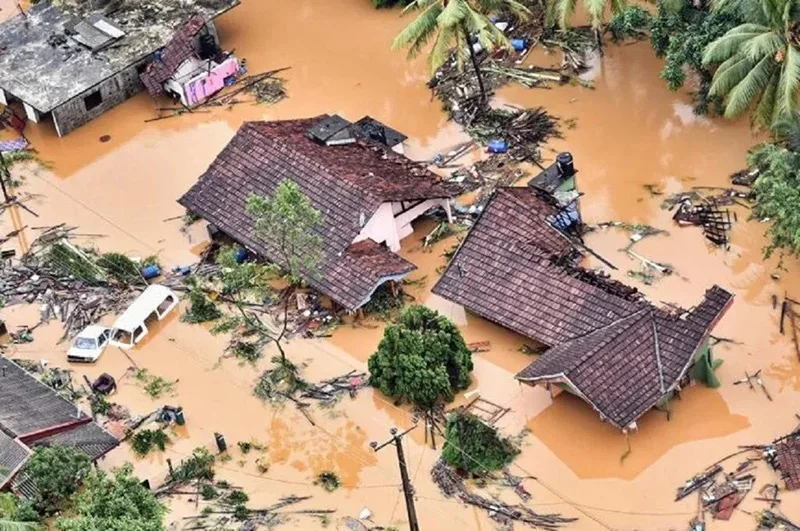
A great deal has been said about Cyclone Ditwah and its impact. To my mind one important aspect of it has not been addressed.
During the 1,400 odd landslides, it washed off a vast volume of soil which entered the various water bodies like tanks, lakes, rivers and streams etc. This process has raised their water levels reducing the water holding capacities (water holding capacity has a different meaning in soil science). What it means is that they cannot hold the same amount of water as before without spilling. Therefore, a precipitation which would not have been significant then can cause spilling of tanks leading to floods now. Hence there is a possibility of experiencing more floods in the future. Due to silting the tanks will carry less water than before, thus reducing the irrigable areas under their command. They will not be able to irrigate the same extents of paddy, thus affecting production.
How do we rectify this situation? It is desilting which can be very expensive.
It is good if these are considered in future planning.
Gamini Peiris
Panadura
Experienced agriculturist

Trump files $5bn defamation lawsuit against BBC over Panorama speech edit

UK and South Korea strike trade deal

Rob Reiner’s son Nick arrested for murder after director and wife found dead

70,297 persons still in safety centers

Showers will occur at times in the Northern, North-Central, Eastern, Uva and Central provinces

MEPA to crack down on marine polluters

‘Dates have the highest sugar content to fight Coronavirus’

Sunday Island 27 December – Headlines

#SundayIsland 17th December – Headlines

Sunday Island – 28th March

Sunday Island Headlines – 21 March

Sunday Island – 21st February – Headlines
-

 Features6 days ago
Finally, Mahinda Yapa sets the record straight
-
 Features6 days ago
Handunnetti and Colonial Shackles of English in Sri Lanka
-

 Business5 days ago
Cabinet approves establishment of two 50 MW wind power stations in Mullikulum, Mannar region
-

 News5 days ago
Gota ordered to give court evidence of life threats
-

 Features5 days ago
Cliff and Hank recreate golden era of ‘The Young Ones’
-
 Opinion6 days ago
A national post-cyclone reflection period?
-
 Features5 days ago
Sri Lanka and Global Climate Emergency: Lessons of Cyclone Ditwah
-

 Latest News6 days ago
Sri Lanka squad named for ACC Men’s U19 Asia Cup