
News
Massive increase in deaths in human-elephant conflict since 1969; things to get worse due to donor dictates

By Rathindra Kuruwita
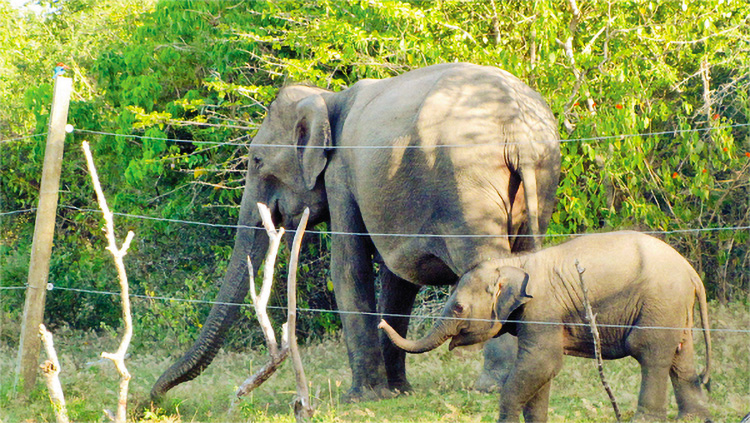
Annual elephant deaths have increased fourfold by this year, compared to 1969, according to official data, environmentalists say.
Sajeewa Chamikara of the Movement for Land and Agricultural Reform (MONLAR) has said the number of elephants killed in the 19 years from 1951 to 1969 was 1,163. This works out to about 61 elephant deaths a year.
“However, 5,010 elephants have been killed in the 19 year period from 2004 to April 2023.
Last year saw the highest number of elephant deaths recorded since Independence; 433 elephants were killed. The highest number of human deaths also occurred due to elephant attacks, in the same year. The number of human casualties were 145, Chamikara said.
“In the 34 years from 1990 to April 2023, a total of 6,642 elephants have died. About 70% of them were killed by humans as a result of the human-elephant conflict. Meanwhile, 2,032 people were killed in elephant attacks in the 26 years from 1998 to April 2023,” he said.
Many believed that an increase in elephant population had contributed to the human-elephant conflict. However, there was no evidence to suggest that the elephant population was on the rise, Chamikara said.
“The last elephant census in Sri Lanka was conducted in 2011. According to the census, 5,879 elephants were reported. However, during the period of over 12 years since the last census, 3,685 elephants have died. The belief that the elephant population has grown stems from an increasing number of elephant attacks on villages. However, these elephants have been compelled to maraud villages because their natural habitats have been destroyed. The elephant population is also dissipating due to the change in the ratio between females and males due to the elimination of males. Tuskers are males and most of the elephants that come into villages are strong male elephants. It is often these animals that are killed,” he said.
According to a report published by the Department of Forest Conservation, following a survey of forests in 2010, the extent of forest cover in the country is 1,951,473 hectares, accounting for 29.7 percent of the total area of the country. Elephants lived mainly in tropical dry mixed evergreen forests belonging to the intermediate, dry and arid zones, tropical moist evergreen forests, savanna grasslands and tropical thorn scrubs, Chamikara said.
“Since 2010, things have taken a turn for the worse. Large-scale investment projects, especially commercial plantations, have been implemented under successive National Physical Plans and on policy decisions taken as per the conditions laid out by the World Bank and the International Monetary Fund (IMF). These have led to deforestation. As a result, many of the natural habitats of elephants have been destroyed and forests have been fragmented, making elephants move from one forest to the other through human settlements. These moves have been identified as the main reasons that have aggravated the human-elephant conflict today,” he said.
“When giving loans to Sri Lanka, the World Bank and the International Monetary Fund highlight that state revenue must be increased to repay the loan installments and interest, the environmentalist said, adding that in doing so, the governments might make decisions that adversely affect natural resources of Sri Lanka.
“In a report, titled “Sri Lanka Non-plantation Crop Sector Policy Alternatives” the World Bank in 1996, to develop Sri Lanka’s agricultural sector, has said that the small-scale agriculture carried out by the small-scale farmers in Sri Lanka is not profitable. Therefore, the report suggests that these extents of land be utilised for large-scale commercial plantations,” Chamikara said.
The report titled ‘Sri Lanka Ending Poverty and promoting shared prosperity: A systematic country diagnostic’ published by the World Bank in 2015 focused on the strategies that the government should take to alleviate poverty in Sri Lanka. The report said that complicated local land laws and the restrictions on foreigners when acquiring lands have adversely affected investment opportunities. As a result, it said that lands should be subjected to the free market mechanism, he said.
The provision of trade and investment facilities included in the loan conditions of the IMF in 2016 and taking measures to increase the State revenue included in the loan conditions of 2023 requires the government-owned land to be exposed to the market mechanism, Chamikara said. All the governments in the recent past have taken steps to fulfil these requirements by reforming policies and ordinances and the main step towards that was the withdrawal of the Circular No. 05/2001 under the Gotabaya Rajapaksa administration, he said.
Accordingly, the Environment and Wildlife Resources Ministry Secretary issued the Circular MWFC/01/2020 on 04 November 2020 based on a Cabinet paper submitted by the Minister of Environment and Wildlife Resources which was approved by the Cabinet on 01 July 2020. The Circular MWFC/01/2020 said that State-owned lands should be kept under the purview of Divisional Secretaries and District Secretaries except for the lands gazetted as wildlife areas by the Director General of Forest Conservation and the Director General of Wildlife Conservation in a Gazette by cancelling the previously published Circulars No. 05/98 dated 01.07.1998, No. 5/2001 dated 10.08.2001 and No. 02/2006 dated 17.05.2006, he said.
Lands Ministry Secretary R.A.A.K. Ranawaka issued the circular No. 02/2021 on 6 August, 2021 for the purpose of “Demarcation of State-owned Lands” to all district secretaries and divisional secretaries. Since the divisional secretaries can measure and de-mark State-owned lands for various purposes based on Article 8 of the Land Development Ordinance and subject to general and special provisions of the Commissioner General of Lands, this circular emphasised on taking measures to identify lands and demark them in order to preserve for various future development activities and village expansion projects. This circular was issued by the Lands Ministry Secretary in accordance with the Cabinet Paper jointly submitted by the Minister of Wildlife and Forest Conservation, the Minister of Environment and the Minister of Lands which was approved by the Cabinet on October 26, 2020.
“Both these circulars have been issued in violation of Article 20 of the Forest Conservation Ordinance. According to the 2014 statistics of the Forest Conservation Department, there are 103 forests designated under Article 20 of the Forest Conservation Ordinance which are known as Proposed Reserves and Other State-owned Forests to be declared as reserves. The total area of these lands is 224,564 hectares or about 579,608 acres. All these forest lands, which is 11.5 percent of total forest cover in Sri Lanka, are to be acquired for development purposes through these circulars. This is significant since about 60% of these forests are home to elephants,” Chamikara said.
Minister of Wildlife and Forest Resources Conservation Pavithradevi Wanniarachchi told The Island that addressing the human-elephant conflict was a top priority of hers and that steps had already been taken to develop a new policy on resolving the issue.
She said that several initiatives had been taken by previous governments to address the problem and that there is a need to build elephant fences according to a master plan. “We have already conducted several workshops on this where lessons could be learnt from the past. Unfortunately, building high quality fences is expensive and given the economic situation in the country, this will take some time,” she said.



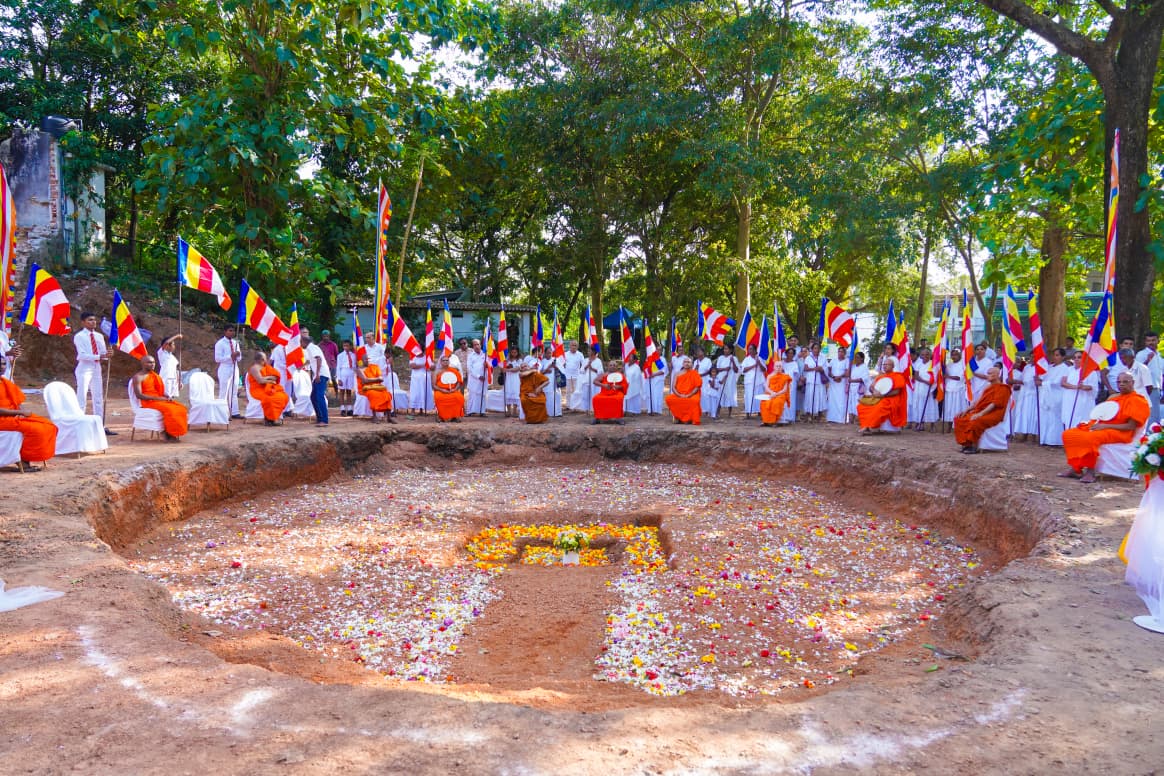
The foundation stone laying ceremony for the proposed seven-storey Sadaham Mandiraya at the historic Sri Jayewardenepura Kotte Rajamaha Viharaya was held on 03rd of January with the participation of Prime Minister Dr. Harini Amarasuriya.
The religious programme, organised to coincide with the Duruthu Full Moon Poya Day, commenced with the chanting of Seth Pirith by the Maha Sangha.
Subsequently, the Prime Minister participated in laying of the foundation stone, formally marking the commencement of construction of the seven-storey Sadaham Mandiraya.
The Sadaham Mandiraya will be constructed as a centre dedicated to the preservation of Buddhist heritage while providing Dhamma education and spiritual guidance for future generations.
The event was graced by the presence of Chief Incumbent of the Kotte Rajamaha Viharaya, Venerable Aluth Nuwara Anuruddha Thero, together with members of the Maha Sangha; and attended by the Deputy Minister of Industry and Entrepreneurship Development, Chathuranga Abeysinghe, local political representatives, state officials, and a large gathering of devotees.

(Prime Minister’s Media Division)


The Public Utilities Commission of Sri Lanka (PUCSL) and the Treasury are facing heightened scrutiny as the Ceylon Electricity Board (CEB) presses for an 11.5 percent electricity tariff increase, a move closely tied to IMF-driven state-owned enterprise (SOE) reforms aimed at curbing losses and easing fiscal pressure on the State.
The proposed hike comes as the Treasury intensifies efforts to reduce the budgetary burden of loss-making SOEs under Sri Lanka’s IMF programme, which places strong emphasis on cost-reflective pricing, improved governance and the elimination of quasi-fiscal deficits.
Power sector sources said the PUCSL has completed its technical evaluation of the CEB proposal and is expected to announce its determination shortly.
The decision is being closely watched not only as a test of regulatory independence, but also as an indicator of how Treasury-backed fiscal discipline is being enforced through independent regulators.Under the IMF agreement, Sri Lanka has committed to restructuring key SOEs, such as, the CEB to prevent recurring losses from spilling over into public finances.
Treasury officials have repeatedly warned that continued operational losses at the utility could ultimately require state intervention, undermining fiscal consolidation targets agreed with the IMF.
The CEB has justified the proposed 11.5 percent hike by citing high generation costs, foreign currency loan repayments and accumulated legacy losses, arguing that further tariff adjustments are necessary to stabilise finances and avoid a return to Treasury support.
However, critics argue that IMF-aligned reforms should not translate into routine tariff hikes without meaningful improvements in efficiency, cost controls and governance within the utility.
Trade unions and consumer groups have urged the PUCSL to resist pressure from both the CEB and fiscal authorities to simply pass costs on to consumers.
They also note that improved hydropower availability should reduce dependence on expensive thermal generation, easing cost pressures and giving the regulator room to moderate any tariff increase.
Energy analysts say the PUCSL’s ruling will reflect how effectively the Treasury’s fiscal objectives are being balanced against the regulator’s statutory duty to protect consumers, warning that over-reliance on tariff increases could erode public support for IMF-backed reforms.
Business chambers have cautioned that another electricity price hike could weaken industrial competitiveness and slow economic recovery, particularly in export-oriented and energy-intensive sectors already grappling with elevated costs.
Electricity tariffs remain one of the most politically sensitive aspects of IMF-linked restructuring, with previous hikes triggering widespread public discontent and raising concerns over social impact.
The PUCSL is expected to outline the basis of its decision, including whether the proposed 11.5 percent increase will be approved in full, scaled down, or restructured through slab-based mechanisms to cushion low-income households.
An energy expert stressed that Sri Lanka navigates IMF-mandated fiscal and SOE reforms, the forthcoming ruling is widely seen as a defining moment—testing not only the independence of the regulator, but also the Treasury’s ability to pursue reform without deepening the burden on consumers.
By Ifham Nizam ✍️

Massive waste, corruption, irregularities and mismanagement at laboratories of the country’s premier hospital, revealed by the National Audit Office (NAO), couldn’t be suppressed by sacking or accusing him of issuing death threats to Health Secretary Dr. Anil Jasinghe, recently sacked Director of the National Hospital of Sri Lanka (NHSL) Dr. Rukshan Bellana told The Island.
Dr. Bellana said so responding to Dr. Jasinghe’s request for police protection claiming that he (Bellana) was directly responsible for threatening him.
The NPP government owed an explanation without further delay as the queries raised by NAO pertained to Rs 900 mn fraud/loss caused as a result of procurement of chemical reagents for the 2022 to 2024 period remained unanswered, Dr. Bellana said, pointing out that NAO raised the issue in June last year.
Having accused all other political parties of corruption at all levels, the NPP couldn’t under any circumstances remain mum on NAO’s audit query, DR. Bellana said, claiming that he heard of attempts by certain interested parties to settle the matter outside legal procedures.
The former GMOA official said that the NPP’s reputation was at stake. Perhaps President Anura Kumara Dissanayake should look into this matter and ensure proper investigation. Dr. Bellana alleged that those who had been implicated in the NAO inquiry were making an attempt to depict procurement of shelf time expired chemical reagents as a minor matter.
By Shamindra Ferdinando ✍️

PM lays foundation stone for seven-storey Sadaham Mandiraya

Showers will occur at times in the Eastern and Uva provinces and in Nuwara-Eliya, Matale, Polonnaruwa, and Mullaittivu districts

Curran, bowlers lead Desert Vipers to maiden ILT20 title

PUCSL and Treasury under IMF spotlight as CEB seeks 11.5% power tariff hike

Bellana says Rs 900 mn fraud at NHSL cannot be suppressed by moving CID against him

First harvest of rice offered to Dalada Maligawa

‘Dates have the highest sugar content to fight Coronavirus’

Sunday Island 27 December – Headlines

#SundayIsland 17th December – Headlines

Sunday Island – 28th March

Sunday Island Headlines – 21 March

Sunday Island – 21st February – Headlines
-

 News2 days ago
Health Minister sends letter of demand for one billion rupees in damages
-

 Features6 days ago
It’s all over for Maxi Rozairo
-
 News5 days ago
Leading the Nation’s Connectivity Recovery Amid Unprecedented Challenges
-

 Opinion4 days ago
Remembering Douglas Devananda on New Year’s Day 2026
-

 News6 days ago
Dr. Bellana: “I was removed as NHSL Deputy Director for exposing Rs. 900 mn fraud”
-

 News8 hours ago
Private airline crew member nabbed with contraband gold
-

 News5 days ago
Dons on warpath over alleged undue interference in university governance
-

 Features6 days ago
Rebuilding Sri Lanka Through Inclusive Governance