
News
Lankans living in Cooma, NSW celebrate Sinhala and Tamil New Year


The Sri Lankan community in and around the townships of Cooma, New South Wales, celebrated the Sinhala and Tamil New Year for the third consecutive year on Saturday April 13.
The community of about 80 families numbering about 120 people brought a riot of colour in their Sarees, Sarongs,`Redda and hatte’ to a park which had leaves of some of its trees turning into vibrant shades of red, orange and yellow in the mid- autumn weather.
The majority of Sri Lankan families in Cooma have its head working for an ambitious hydro-electricity project known as the Snowy 2.0. The project follows up on the success of the world famous post-world war two Snowy Scheme in the Australian Alps which harnesses the melting snow to provide electricity to the States of New South Wales and Victoria.
Sri Lankan surveyors, engineers, quantity surveyors and geologists work shoulder to shoulder with professionals of other fields in the vast project spread across the snowy mountains.
While their husbands work in the mountains and offices, the mothers have their work cut out looking after their children’s needs, cooking and engaging in social activities in a foreign land.
Amidst the tall evergreen cypress trees standing silent sentinel, reminding them of the cool climes of Nuwara Eliya. All families, except for a few dads on duty, were able to relax and enjoy a day reminiscent of times back home.
A mist covering the park heralding winter slowly lifted with the rising sun adding to the warmth brought about by the gathering of families and friends keen to rekindle fading traditions and strengthen friendships.
The lighting of the traditional oil lamp by invitees and the boiling of a pot of milk preceded the partaking of `kiributh’, kavum, kokis, aasmi and other sweetmeats. They competed with bananas and fruits and mouth-watering cakes, cutlets and savouries which replicated many Sri Lankan ‘Aluth Avurudhu’ tables of bygone times.
Tucked away amidst the trays of sweetmeats were neatly cut ‘Kalu Dodol speckled with chopped cashew nuts’: a much sought after delicacy expertly prepared by about 15 young men who had spent the previous Friday night toiling away in a garage battered by cold winds heralding winter.
Expertly cooked Sri Lanka cuisine prepared by the moms were also served at lunchtime.
Traditional games were engaged in with much gusto with all participants including invitees, with the highlight being the ‘tug of war’.


The government, under heavy Opposition fire over inclusion of a sex website in the Grade 6 English module, as well as overall education reforms, has decided to put on hold reforms in respect of Grade 6.
Cabinet Spokesman and Media and Health Minister Dr. Nalinda Jayatissa announced the government decision yesterday (13) at the post-Cabinet media briefing at the Information Department.
According to him, the decision had been taken at the previous day’s Cabinet meeting, chaired by President Anura Kumara Dissanayake. Dr. Jayatissa said that education reforms pertaining to Garde 6 had been put on hold until 2027.
The Minister said that other proposed education reforms would be implemented as planned. The Minister said that action would be taken against those responsible for the inclusion of a link to a sex website following investigations conducted by the Criminal Investigation Department and the National Education Institute.
The SJB and several other political parties, as well as civil society groups, have accused the government of promoting an LGBTQ agenda, through the proposed education reforms.
The Opposition grouping Mahajana Handa, on Monday, made representations to the Mahanayake Thera of the Malwatta Chapter regarding the controversial reforms, while urging their intervention to halt the project.
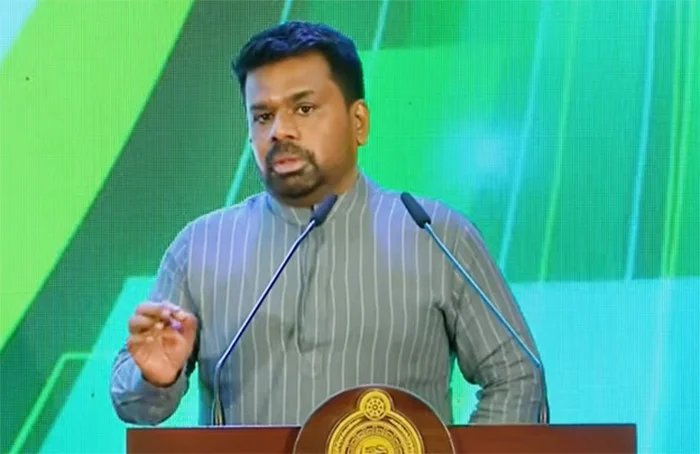
President Anura Kumara Dissanayake yesterday (13) vowed to go ahead with his government’s agenda, regardless of the destruction caused by Cyclone Ditwah.
Emphasising the responsibility on the part of all to contribute to the post-Ditwah recovery efforts, President Dissanayake said that he would have complete faith in the public service.
The President said so at the launch of the re-building Sri Lanka project at the BMICH yesterday.
The JVP and NPP leader said that he wouldn’t take advantage of the death and destruction caused by the cyclone or use the situation as an excuse to reverse their agenda or weaken it.
President Dissanayake said that in spite of many calling for amending the then Budget, in view of the cyclone, the government presented the proposals that were agreed before the disaster struck.

The United States has announced that it will provide the Sri Lanka Air Force with 10 US Navy TH-57 helicopters free of charge.
The announcement was made by outgoing US Ambassador Julie Chung, who stated, on social media, that the helicopters would be transferred under the United States’ Excess Defence Articles programme. The aircraft are Bell 206 Sea Ranger helicopters previously operated by the US Navy.
US sources said that the transfer was intended to strengthen Sri Lanka’s disaster response capabilities, following the devastating cyclone that struck the island at the end of 2025 and killed more than 600 people. US officials have framed the move as a humanitarian measure aimed at improving aerial rescue and relief operations.

Showery condition over the island is expected to reduce from tomorrow (15th)

USA’s Ali Khan claims having been ‘denied’ India visa ahead of T20 World Cup

At least 28 dead as crane collapses onto train in Thailand

Fair weather will prevail except for a few showers in the Uva, Eastern, Western and Central provinces and in Galle, Matara and Rathnapura districts

Trump cancels US-Iran meetings, urges protesters to take over institutions

Govt. bows to pressure, shelves Grade 6 reforms

‘Dates have the highest sugar content to fight Coronavirus’

Sunday Island 27 December – Headlines

#SundayIsland 17th December – Headlines

Sunday Island – 28th March

Sunday Island Headlines – 21 March

Sunday Island – 21st February – Headlines
-

 Business4 days ago
Dialog and UnionPay International Join Forces to Elevate Sri Lanka’s Digital Payment Landscape
-
 News4 days ago
Sajith: Ashoka Chakra replaces Dharmachakra in Buddhism textbook
-

 Features4 days ago
The Paradox of Trump Power: Contested Authoritarian at Home, Uncontested Bully Abroad
-

 Features4 days ago
Subject:Whatever happened to (my) three million dollars?
-

 News4 days ago
Level I landslide early warnings issued to the Districts of Badulla, Kandy, Matale and Nuwara-Eliya extended
-

 Business22 hours ago
New policy framework for stock market deposits seen as a boon for companies
-

 Opinion6 days ago
The minstrel monk and Rafiki, the old mandrill in The Lion King – II
-

 News4 days ago
65 withdrawn cases re-filed by Govt, PM tells Parliament