
News
Labour Minister explains difficulties in bringing back Lankan migrant workers

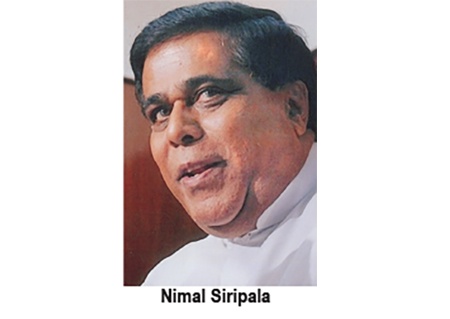
By Saman Indrajith
The government could not dispatch 10 or more aircraft and bring home Lankan migrant workers stranded overseas though it was desirous of doing so because it had to follow international procedures, Labour Minister Nimal Siripala De Silva told Parliament yesterday.
The Minister said that flights and their crew members were required to abide by various laws, regulations and quarantine processes each airport had put in place in view of the prevailing pandemic.
“You just cannot send the required number of planes and bring them home as you wish. There are different regulations as per the different airspaces of different countries. We cannot violate those rules. In addition, there are issues pertaining to the cost of tickets and finding space for quarantine too should be taken into consideration though they are not big issues. The Lankan migrant workers would be brought home gradually as decided by the National Operations Centre for Prevention of COVID-19 Outbreak (NOPCO).”
Answering a question raised by Badulla District SJB MP Chaminda Wijesiri, the Minister said that the decisions pertaining to bringing back migrant workers home were taken by the NOPCO.
Minister De Silva said that as at Nov 13, there had been 816,433 Lankan migrant workers, and they were provided with dry rations, face masks and sanitisers and temporary shelter with the help of Lankan Embassies and High Commissions.
Minister De Silva said that 102 Lankan migrant workers had sought the assistance of the Foreign Employment Bureau (FEB) to obtain tickets and medical assistance because of COVID-19 infections and the Insurance Corporation had so far approved 49 cheques amounting to Rs 2,388,228 for them.
The Minister said that if a Lankan worker registered at the FEB died of COVID-19, the bureau would intervene to get compensation to the family members of the victim migrant worker. So far, 68 such registered Lankan workers had died abroad due to COVID-19 and they had been cremated in the countries where they died. In addition, six Sri Lankan migrant workers whose registration with FEB had expired had died abroad due to the pandemic and their dependents had applied for compensation. Family members of one of those six had been paid Rs 300,000 by the Employees Provident Fund.
The Labour Minister said that as at 13 Nov. 13,181 Lankan migrant workers had returned home because of the pandemic and the FEB had computerised the records of 6,667 of them so far. Out of them 2,163 were planning to return to their work places while 1,617 intended to work in Sri Lanka; 654 would opt for self-employment, 64 had decided to undergo further training and 2,159 had decided to do various other things.


Bus fares have been increased by 12.19% with effect from midnight today [23rd March 2026].
The minimum fare will be increased from Rs 27 to Rs 30 while the maximum fare of Rs2159/- will be increased to 2422/-
Latest News
Public will not be served as Computer system failure at Department of Registration of Persons

The Acting Commissioner General of Registration of Persons has announced that due to an unexpected failure of the computer system of the Department of Registration of Persons, all services, including the one day service will not be held on Tuesday (24th March) at the Head Office and all Provincial offices.

Latest News
Heat Index at Caution Level in the Western, Sabaragamuwa, Southern and North-western provinces and in Anuradhapura, Mannar and Vavuniya districts
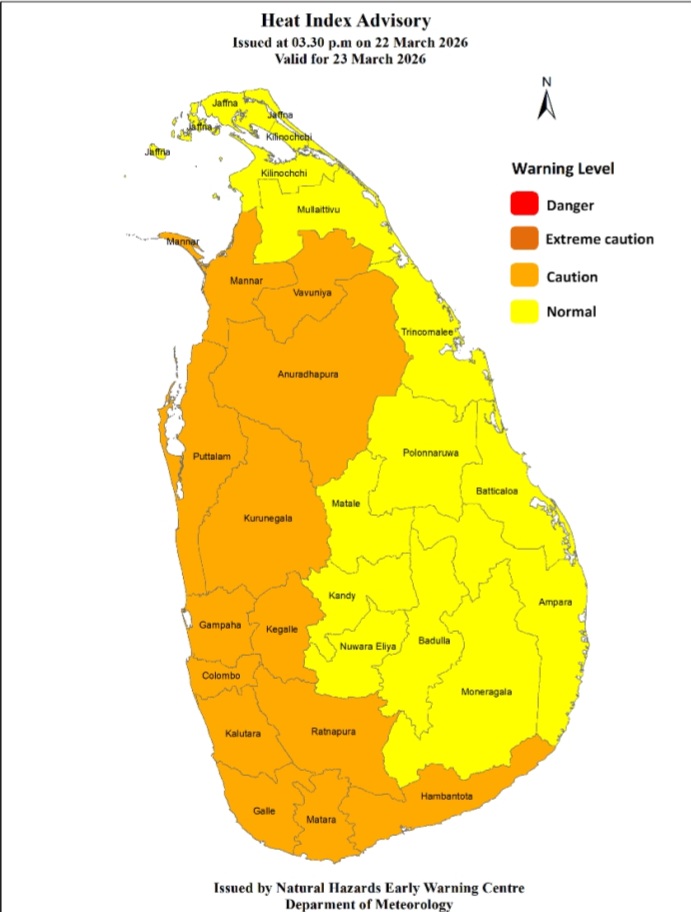
Warm Weather Advisory
Issued by the Natural Hazards Early Warning Centre of the Department of Meteorology
at 3.30 p.m. on 22 March 2026, valid for 23 March 2026.
The Heat index, the temperature felt on human body is likely to increase up to ‘Caution level’ at some places in the Western, Sabaragamuwa, Southern and North-western provinces and in
Anuradhapura, Mannar and Vavuniya districts.
The Heat Index Forecast is calculated by using relative humidity and maximum temperature and this is the condition that is felt on your body. This is not the forecast of maximum temperature. It is generated by the Department of Meteorology for the next day period and prepared by using global numerical weather prediction model data.

Effect of the heat index on human body is mentioned in the above table and it is prepared on the advice of the Ministry of Health and Indigenous Medical Services.
ACTION REQUIRED
Job sites: Stay hydrated and takes breaks in the shade as often as possible.
Indoors: Check up on the elderly and the sick.
Vehicles: Never leave children unattended.
Outdoors: Limit strenuous outdoor activities, find shade and stay hydrated.
Dress: Wear lightweight and white or light-colored clothing.
Note:
In addition, please refer to advisories issued by the Disaster Preparedness & Response Division, Ministry of Health in this regard as well. For further clarifications please contact 011-7446491.

Bus fares increased by 12.19% from midnight today [23]
Public will not be served as Computer system failure at Department of Registration of Persons

Trump says he is postponing strikes on Iran power plants after ‘productive’ talks on ending war

Asia stocks slide as US and Iran threaten to escalate war

Heat Index at Caution Level in the Western, Sabaragamuwa, Southern and North-western provinces and in Anuradhapura, Mannar and Vavuniya districts

Showers may occur at several places in the Western and Sabaragamuwa provinces and in Galle, Matara and Nuwara-Eliya districts after 2.00 pm.

‘Dates have the highest sugar content to fight Coronavirus’

Sunday Island 27 December – Headlines

#SundayIsland 17th December – Headlines

Sunday Island – 28th March

Sunday Island Headlines – 21 March

Sunday Island – 21st February – Headlines
-

 News6 days ago
CIABOC questions Ex-President GR on house for CJ’s maid
-

 News7 days ago
Sri Lankan marine scientist Asha de Vos honoured at UNGA opening
-

 News7 days ago
Australian HC debunks misleading travel risk claims for Sri Lanka
-
 News5 days ago
Bailey Bridge inaugurated at Chilaw
-
 Latest News7 days ago
Wednesdays declared a government holiday with effect from 18th March
-

 News5 days ago
Pay hike demand: CEB workers climb down from 40 % to 15–20%
-
 News4 days ago
CIABOC tells court Kapila gave Rs 60 mn to MR and Rs. 20 mn to Priyankara
-

 Editorial6 days ago
Couple QR-based quota with odd-even rationing