
News
Karu demands immediate repeal of 20-A to win confidence of all political parties


Proposed roundtable discussion
Former Speaker and Chairman of the National Movement for Social Justice (NMSJ) Karu Jayasuriya said yesterday his organisation was glad that the government had decided to hold an all-party conference. As an initial step to win the confidence of all the political parties, the government could repeal the 20th amendment to the Constitution, he said.
Speaking at the Anuradhapura District Conference on “A New Constitution for a Better Country” co-organised by the NMSJ, Jayasuriya said the responsibility for the success of this process lay with the present government.
“First of all, these matters should be discussed in a friendly manner. But trust can never be built as long as the 20th Amendment is in force. Therefore, as an initial step, the government can repeal it as an attempt to show their sincerity,” he said.
Jayasuriya said that everyone should now unite to strengthen the depleted foreign reserves and ensure the economic stability of the country.
“Political parties must set aside narrow political agendas and commit themselves sincerely for the betterment of the country. During the all party conference, the agreement that must be arrived at is not on the forthcoming local government, provincial council, presidential or parliamentary elections. We must now unite to restore the lives of all Sri Lankans, strengthen the depleted foreign reserves and ensure the economic stability of the country”.
Given below are the excerpts of the speech he made in Anuradhapura. “We are honoured to be able to visit the ancient and sacred city of Anuradhapura and meet the most revered Maha Sangha as well as Catholic, Christian, Hindu, Muslim and other religious leaders in the area. It is also a great sense of strength to us to be able to converse and exchange ideas with scholars, intellectuals, professionals, farmers, workers, youth and those representing various sections of society from the area who have joined us today. The National Movement for Social Justice initiated through the leadership of the late Most Venerable Maduluwawe Sobitha Thera and the Collective for Ethnic and Religious Harmony which was formed to create a united society free of racial and religious differences in the country are together carrying out a great national responsibility.
“To that end, along with the blessings of the people, we are making a great effort to awaken the country by visiting various parts of Sri Lanka. There is no need for a lengthy explanation of the current situation in the country. The people are facing many immense pressures today. This unfortunate situation has arisen due to the shortage of foreign reserves, the depreciation of the rupee and the failure of the government to come up with a proper plan to come out of this abyss.
“Currently there is an acute shortage of essential food items and their prices have seen a sharp increase as never before. People are being forced to spend days in queues to obtain necessities such as milk powder, LPG gas, cement, and fuel. There is also a shortage of medicines and ordinary citizens are paying high prices to obtain necessary drugs. Neither is there any formalin to carry out the process of embalming when a death occurs. There is no gas to operate the country’s crematoriums. These are the issues we commonly hear and see.
“For how long can a country carry on this way? That is the question on the lips of many people today. But what is the possible solution? We are not attempting to either embarrass or overthrow the government or to incite the people. Instead, we endeavour to bring the country together to arrive at a practical solution.
“We are very pleased that the government has accepted the proposal put forward by eleven parties in parliament to build the country and will as a result hold a roundtable discussion soon. We sincerely hope for its success.
“All political parties must set aside narrow political agendas and sincerely commit themselves for the betterment of the country. The agreement that must be arrived at is not on the forthcoming local government, provincial council, presidential or parliamentary elections. We must now unite to restore the lives of all Sri Lankans, strengthen the depleted foreign reserves and ensure the economic stability of the country.
“The main responsibility in this process lies with the present government. First of all, these matters should be discussed in a friendly manner in a democratic context. But trust can never be built until the 20th Amendment continues to be in force. Therefore, as an initial step, the government can repeal it as an attempt to show their sincerity.
“The political witch hunt against those who oppose the government through the Upali Abeyratne Commission must also be halted. Independent Commissions must be depoliticised. At present, these institutions have been subjected to complete politicisation.
“A constitutional amendment or a new constitution must be introduced immediately so that all citizens can live with dignity and respect. The promise made by the President relating to this is long overdue. Therefore, the government must present their proposals to the public without delay and also bring them to the attention of the country and parliament.
“Internationally we have made more enemies than friends. In a day and age where people are facing many difficulties like today, we need to earn the respect and trust of the international community.
“This is essential for the future well-being of the country. We point out the issues that are important to the country with nothing but utmost sincerity and good intentions.
“The opposition may also have to make some political sacrifices for the country. But they can only be motivated to do so if the government too is honest. Can the support and coexistence of the people be sought if the government continues to seek revenge from leaders of the opposition while causing the destruction of democratic principles even as they hold on to the powers of the 20th Amendment and the two-thirds majority thereby impeding upon the rights of the people.
“Our message to our leaders and all citizens of Anuradhapura today is to consider this as the final opportunity to save the country and therefore reconcile for the good of the country. If not, our future generations will curse us. Therefore, we will continue to keenly observe the actions of the government.
As I stand on this sacred ground today, I pledge to the people that we will commit and put our full strength behind all efforts to save our motherland.”

Latest News
Heat Index at Caution level’ in the Northern, North-central, North-western, Western and Southern provinces and in Trincomalee district.


Warm Weather Advisory
Issued by the Natural Hazards Early Warning Centre
Issued at 3.30 p.m. on 12 April 2026, valid for 13 April 2026.
Heat index, the temperature felt on human body is likely to increase up to ‘Caution level’ at some places in the Northern, North-central, North-western, Western and Southern provinces and in Trincomalee district.
The Heat Index Forecast is calculated by using relative humidity and maximum temperature and this is the condition that is felt on your body. This is not the forecast of maximum temperature. It is generated by the Department of Meteorology for the next day period and prepared by using global numerical weather prediction model data.

Effect of the heat index on human body is mentioned in the above table and it is prepared on the advice of the Ministry of Health and Indigenous Medical Services.
ACTION REQUIRED
Job sites: Stay hydrated and takes breaks in the shade as often as possible.
Indoors: Check up on the elderly and the sick.
Vehicles: Never leave children unattended.
Outdoors: Limit strenuous outdoor activities, find shade and stay hydrated.
Dress: Wear lightweight and white or light-colored clothing.
Note:
In addition, please refer to advisories issued by the Disaster Preparedness & Response Division, Ministry of Health in this regard as well. For further clarifications please contact 011-7446491.

On the apparent northward relative motion of the sun, it is going to be directly over the latitudes of Sri Lanka from 05th to 15th of April in this year.
The nearest areas of Sri Lanka over which the sun is overhead today (13th) are Pesalai, Mankulam and Nedunkerny about 12:11 noon.
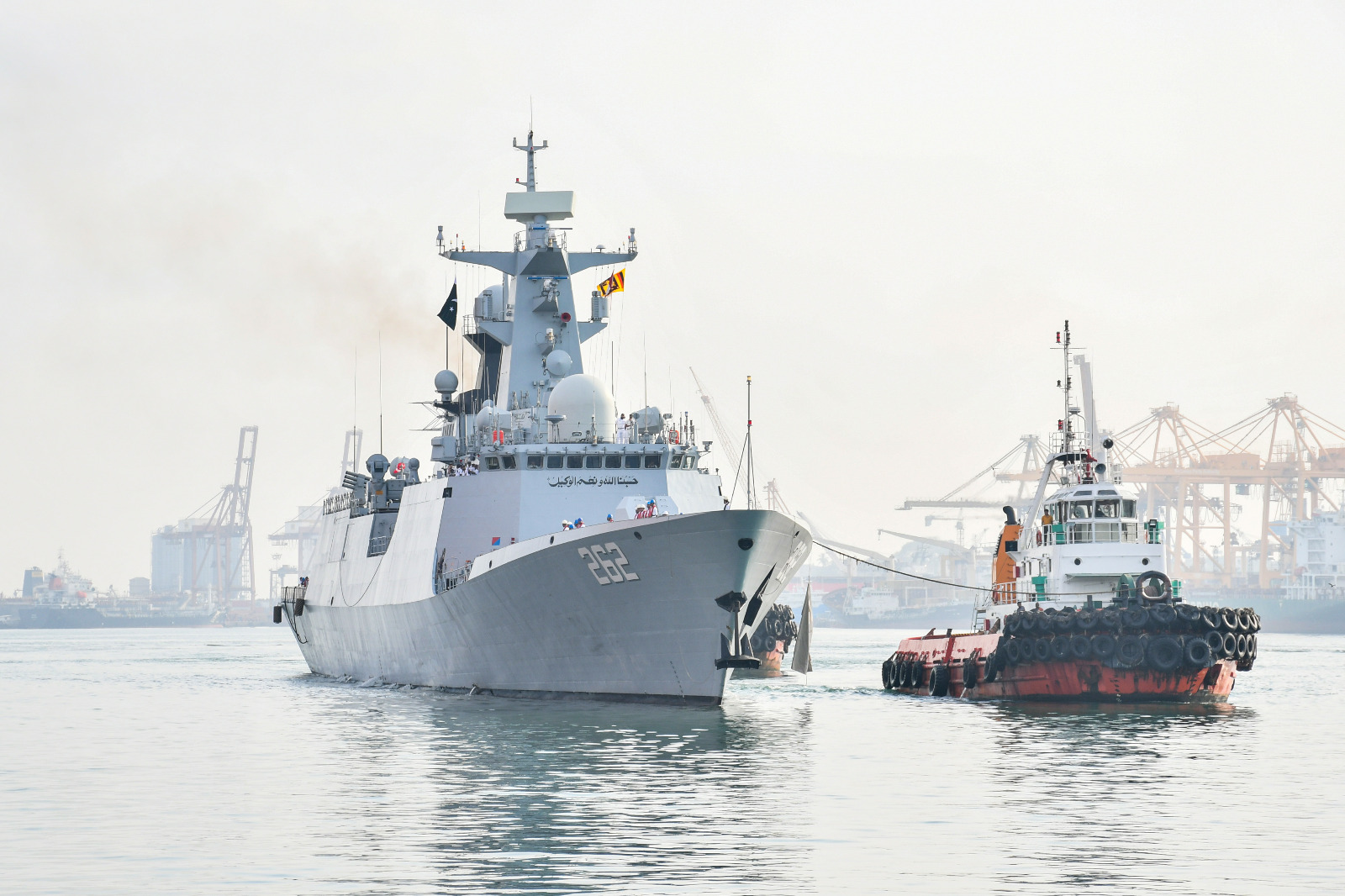
The Pakistan Navy Ship (PNS) TAIMUR and ASLAT arrived at the Port of Colombo on a goodwill visit on 12 Apr 26.
The visiting ships were welcomed by the Sri Lanka Navy in
compliance with naval traditions.
The duo of ships is commanded by Captain NIAMAT SAEED KHAN (PNS TAIMUR) and Captain NADIR MATEEN AFRIDI (PNS ASLAT).
Meanwhile, the ships are expected to conduct a Bilateral Naval Exercise LION STAR V with the Sri Lanka Navy in Colombo seas.

Salt and Patidar power RCB past Mumbai Indians

Prasidh, Buttler set up comfortable win for Gujarat Titans

Heat Index at Caution level’ in the Northern, North-central, North-western, Western and Southern provinces and in Trincomalee district.

Showers above 75 mm are likely at some places in the Western, Sabaragamuwa, Central, Southern and North-western provinces.

Sun directly overhead Pesalai, Mankulam and Nedunkerny about 12:11 noon

PNS TAIMUR & ASLAT arrive in Colombo

‘Dates have the highest sugar content to fight Coronavirus’

Sunday Island 27 December – Headlines

#SundayIsland 17th December – Headlines

Sunday Island – 28th March

Sunday Island Headlines – 21 March

Sunday Island – 21st February – Headlines
-

 News6 days ago
Lankan-origin actress Subashini found dead in India
-

 News1 day ago
CEB orders temporary shutdown of large rooftop solar systems
-

 News4 days ago
AG: Coal procurement full of irregularities
-

 Business3 days ago
Israeli attack on Lebanon triggers local stock market volatility
-

 Business4 days ago
Hayleys Mobility introduces Premium OMODA C9 PHEV
-

 Business3 days ago
HNB Assurance marks 25 years with strategic transformation to ‘HNB Life’
-

 News6 days ago
UN Regional Director launches SL’s first Country Gender Equality Profile during official visit
-

 News6 days ago
Dialog Launches ‘GanuDenu QR’, Making Cashless Transfers Free for All with eZ Cash and Dialog Finance