
Business
Kahawatte Plantations redefines future of Lanka’s plantation industry


In an era of transformation for Sri Lanka’s plantation sector, Kahawatte Plantations PLC (KWPL) has emerged as a formidable force, redefining the parameters of agricultural excellence, sustainability and inclusive growth. As a Regional Plantation Company operating across the landscapes of Nawalapitiya and Sabaragamuwa, KWPL manages 16 estates spread across 12,356 hectares. The company’s diverse crop mix includes tea, rubber, cinnamon, coffee, coconut, pepper, durian, macadamia and commercial forestry which highlights its commitment to diversification and resilience.
Operating under the stewardship of the MJF Group of Companies, globally recognized for the Dilmah Tea brand, KWPL is nurturing innovation, integrity, and long-term impact. Since its acquisition by the MJF Group in 2002, KWPL has undergone a strategic transformation. Moving away from traditional plantation practices, the company has adopted cutting-edge agri-innovation and sustainable business models. With an ambitious focus on reversing profit erosion and boosting margins, KWPL has implemented lean cost structures, rigorous KPI monitoring, mechanization, and high-efficiency operations across its estates. These strategies have delivered tangible results. The company’s investment in solar and hydro energy systems now saves over Rs. 4 million each month, while the Rs. 120 million solar project at Imboolpittia Estate is expected to generate consistent income for the next two decades. Notably, 70% of this project is funded through grants from the MJF Charitable Foundation.

The tea factory of Houpe Estate
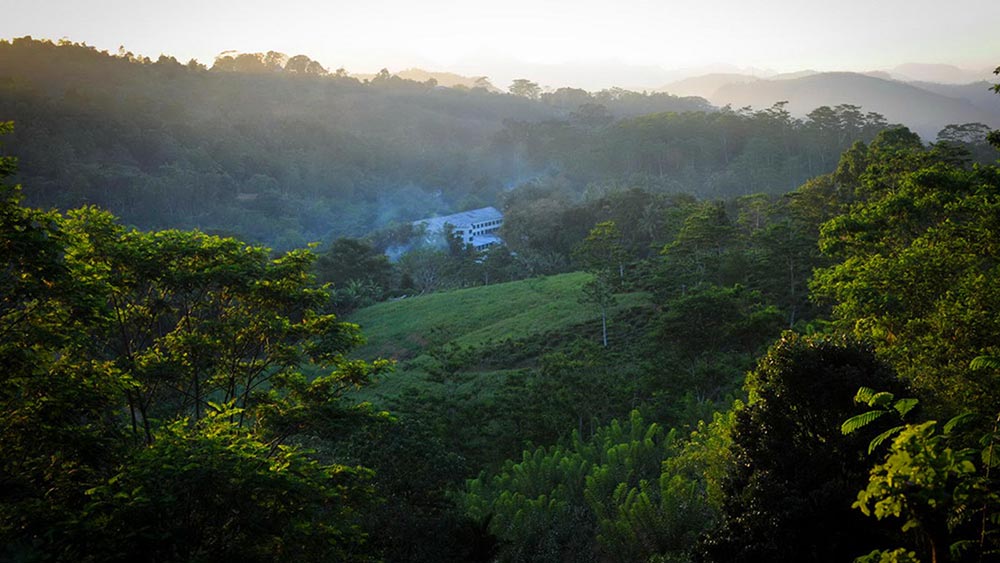
Houpe Estate of Kahawatte located at the foothills of the historic Balangoda hills
Quality, Certification and Market Leadership of Kahawatte
KWPL’s transformation also includes a bold push towards product excellence and diversification. With over 336 hectares under cinnamon cultivation, it became Sri Lanka’s first plantation company to achieve Global GAP certification for cinnamon. The company is also officially registered under the Ceylon Cinnamon Geographical Indication, marking a significant milestone in elevating the credibility of Sri Lankan produce on the global stage. This focus on quality and innovation has paid off handsomely. In 2023 and 2024 alone, KWPL secured over 550 top prices at weekly tea auctions, with estates like Craighead, Queensberry and Kataboola regularly leading in the mid-grown category. Specialty teas such as “Rilagala Curls (Westhall)” and “Silver Green Needles” set records at charity auctions, fetching prices of up to Rs. 1.6 million per lot. KWPL is also breaking new ground through its partnership with the Industrial Technology Institute to commercialize Pentadesma Butter (Kpangnan Butter), derived from a previously underutilized fruit. This venture positions the company at the cutting edge of natural product innovation in the plantation industry.
Environmental Leadership Beyond Compliance
Environmental stewardship is embedded into KWPL’s operations which certainly is not treated as a peripheral responsibility. The company has developed a tea-based agroforestry model in collaboration with the Global Green Growth Institute, Rajarata University and the University of Peradeniya, which integrates biodiversity conservation with productive land use. KWPL’s commitment to sustainability is further evidenced by its management of over 2,000 hectares of timber plantations and 1,600 hectares of conservation forest. One of its standout environmental achievements is the creation of a 3-kilometre biodiversity corridor near the Sinharaja rainforest, developed in partnership with Dilmah Conservation. This project was recognized with the Best Sustainability Project Award at the 2023 Best Corporate Citizen Awards. Adding to its environmental credentials, KWPL also established the One Earth Climate Research Centre at Queensberry Estate which is the first private-sector climate adaptation research station in Sri Lanka, highlighting the company’s leadership in environmental science and policy engagement.

Pentadesma flowers grown in Hunuwella Estate
People-Centered Progress
At the heart of KWPL’s mission is its unwavering commitment to community empowerment. Reflecting the values of the MJF Group, the company’s comprehensive CSR programme supports more than 6,000 plantation workers and their families. Its initiatives encompass early childhood education, elder care, women’s health and scholarships, building a cohesive framework for social upliftment. KWPL has distributed over 2,000 ergonomically designed tea plucking baskets to improve worker wellbeing and safety. It provides scholarships for over 130 students each year, demonstrating a long-standing belief that prosperity must be shared. During the economic hardships brought on by the COVID-19 pandemic, KWPL responded with compassion, distributing Rs. 25 million worth of dry rations to help workers and their families weather the crisis. The company also runs innovative community programmes such as the “Ray of Hope” initiative for children and promotes livelihood diversification through beekeeping enterprises. Further, the “Savings Passbook Programme” for newborns encourages financial literacy from birth, offering families a tangible stake in their children’s future.
Visioning the Future of Plantations
Kahawatte Plantations is investing in a transformative roadmap that seeks to redefine what a modern, responsible plantation company can be. Plans are underway for end-to-end digitization through the implementation of a new ERP system, yield forecasting via drone and multispectral imaging, and the production of biochar from tea waste as a sustainable alternative to inorganic fertilizers. The company also envisions turning its estates into tourism gateways, with initiatives already in motion at Denawaka and Imboolpittia. Expanding its renewable energy footprint and exploring direct-to-consumer channels are further steps in a future oriented strategy that aligns with Environmental, Social and Governance (ESG) principles, carbon neutrality goals and consumer-centric innovation.
As one of the largest landholders in Sri Lanka’s plantation sector, Kahawatte Plantations PLC is leading the industry into a new era. At a time when the sector faces scrutiny around sustainability, profitability and ethical practices, KWPL offers a compelling and transparent model rooted in innovation, inclusivity, and long-term vision.



The government’s new policy framework to allocate a maximum interest rate for stock market deposits would pave the way for companies and investors to plan their future business activities, a senior stockbroker said.
‘Accordingly, the Colombo Stock Exchange (CSE) has entered a period of strong revival, supported by economic stabilization and rising investor confidence while significant market reforms would support the new policy framework on interest, Assistant Vice President Softlogic Stockbrokers, Eardly Kern, told The Island Financial Review.
He said that the imposition of maximum interest rates for stock market deposits would prevent the interest rates from moving upwards, thus paving the way for investors to invest in stocks with a lot of confidence.
Kern added: ‘The CSE outlook would provide expanding opportunities for investors as Sri Lanka positions itself for market-led investor platforms.
‘Improving macro fundamentals, such as lower interest rates, rising corporate earnings and historically attractive valuations, have been key catalysts in driving investment into the equities market.
‘These tailwinds, together with ongoing economic reforms, have helped re-establish confidence among both local and foreign investors.
‘Over the past two years, the number of CDS accounts has surpassed 949,000, with digital on-boarding through the CSE mobile app driving the latest surge.
‘Further, foreign inflows for 2024 amounted to USD 66.5 million, while Rs 175 billion was raised through capital market activity, including 16 new listings. With a target of 20 IPOs on the horizon, the CSE anticipates several new companies entering the market by early 2026.
‘The All Share Price Index (ASPI) delivered an impressive 49.7 percent return in 2024, ranking the CSE as the second-best performing market in Asia for the year. By November 2025, the index had risen a further 45.65 percent amounting to an extraordinary two-year return of approximately 95 percent.
‘The S&P SL20 Index recorded a parallel recovery, gaining 58.5 percent in 2024 and 31.84 percent so far in 2025.
‘ Despite the rally, the CSE continues to trade below its 10-year average PER and valuations remain significantly more attractive than in regional markets, such as, India, Malaysia, Vietnam, and China.
‘ Turnover has surged to Rs 1.06 trillion in 2025 (as of mid-November), nearly doubling the figure recorded in 2024. Market capitalization grew 34 percent n 2024, despite only around 40,000 active investors capturing most of the gains—highlighting the potential for broader participation.
‘ Corporate earnings have also strengthened markedly. After generating Rs 686 billion in earnings during 2024—a 50% year-on-year increase—listed entities are projected to deliver between Rs 775–800 billion in 2025. Earnings for the first half of 2025 have already grown 57 percent year-on-year.’
By Hiran H Senewiratne

Dialog Axiata PLC, Sri Lanka’s #1 connectivity provider, has reinforced its enduring commitment to preserving national culture by sponsoring the Kelaniya Duruthu Festival, aligning long standing patronage with purposeful community engagement to honour religious heritage, support cultural continuity, and strengthen shared values.
The annual Kelaniya Duruthu Festival, one of Sri Lanka’s most significant religious and cultural observances, was held on 8th, 9th and 11th January 2026, marking a congregation of thousands of devotees and visitors at the historic Kelaniya Raja Maha Vihara. As a long-term patron, Dialog continues to provide sponsorship support, enabling the seamless organisation of the festival while uplifting traditions deeply rooted in the nation’s cultural identity.
Through its continued support of the Kelaniya Duruthu Festival, Dialog underscores its role as a responsible corporate citizen dedicated to safeguarding Sri Lanka’s cultural and religious heritage for future generations. This commitment is further reflected in Dialog’s long-term patronage of national events such as the Kandy Esala Perahara, Nawam Maha Perahara at Gangaramaya, Katharagama Esala Perahara and Gatabaru Esala Perahara. Complementing these efforts, Dialog has also undertaken heritage preservation initiatives including the construction of the vestibule at Dimbulagala Aranya Senasanaya, the launch of a website and directory of Amarapura Maha Nikaya Temples, and the restoration of the Anuradhapura Maha Vihara Sannipatha Shalawa.

A National Breakthrough in Public Transport Digitalization Powered by Ceylon Business Appliances with Nimbus Ventures.
Sri Lanka has taken a historic step forward with the launch of its first Smart Bus Ticketing System, enabling passengers to pay fares using contactless cards, digital wallets, and QR payments. This advancement places the country among global leaders in smart mobility.
The initiative was made possible through collaboration with the Government of Sri Lanka, leading banking partners, and the technology leadership of Ceylon Business Appliances (CBA) and Nimbus Ventures, who serve as the Technology, Software, Hardware, and Operational Partners behind the nation’s first Open Loop Transit Payment System.
For decades, CBA has been at the forefront of Sri Lanka’s digital transformation efforts—bringing modern, global-standard technologies that have strengthened the nation’s digital infrastructure.
Speaking to the media at the launch, Sardha Fernando, Managing Director of CBA, stated:
“This is not just a ticketing upgrade—it is a complete digital evolution of public transport in Sri Lanka. For years, CBA has been committed to introducing advanced technologies to the country, and today, we are proud to bring a globally recognized, secure, and seamless smart transit solution to our people. With every tap, we are enabling convenience, transparency, and a more connected future for all Sri Lankans.”
He added:
“This milestone reflects our ongoing mission: to help build a digitally empowered Sri Lanka that is ready to embrace the technologies shaping the world.”
‘Ruwath Fernando, CEO/Director of CBA, highlighted:
“This project demonstrates that Sri Lanka is ready to adopt and operate on par with global smart mobility technologies. Our commitment has always been to bring the world’s best software systems and innovations into Sri Lanka—solutions that are secure, scalable, and built to international standards.”
He continued:
“By introducing a state-of-the-art open-loop transit payment platform, we are proving that Sri Lanka can not only embrace but also successfully operate advanced digital ecosystems. This is a defining moment in positioning the country as a technology-proof nation prepared to trial and adopt global digital advancements.”
CBA extends heartfelt congratulations to the banking partners who trusted this vision—
Sampath Bank, Commercial Bank, Bank of Ceylon, People’s Bank, and DFCC Bank— on the successful launch of their new ticketing application.
This application integrates seamlessly with the PAX A910S ticketing device, powered by a robust CBA– Nimbus ventures software solution, engineered for scale, reliability, and national deployment..

Fair weather will prevail except for a few showers in the Uva, Eastern, Western and Central provinces and in Galle, Matara and Rathnapura districts

Trump cancels US-Iran meetings, urges protesters to take over institutions

Govt. bows to pressure, shelves Grade 6 reforms

AKD: Govt. agenda on track despite Ditwah disaster

SL to receive 10 helicopters from US

Foreign couple held over alleged biopiracy at Horton Plains

‘Dates have the highest sugar content to fight Coronavirus’

Sunday Island 27 December – Headlines

#SundayIsland 17th December – Headlines

Sunday Island – 28th March

Sunday Island Headlines – 21 March

Sunday Island – 21st February – Headlines
-

 News3 days ago
Sajith: Ashoka Chakra replaces Dharmachakra in Buddhism textbook
-

 Business3 days ago
Dialog and UnionPay International Join Forces to Elevate Sri Lanka’s Digital Payment Landscape
-

 Features3 days ago
The Paradox of Trump Power: Contested Authoritarian at Home, Uncontested Bully Abroad
-

 Features3 days ago
Subject:Whatever happened to (my) three million dollars?
-

 News3 days ago
Level I landslide early warnings issued to the Districts of Badulla, Kandy, Matale and Nuwara-Eliya extended
-

 News3 days ago
National Communication Programme for Child Health Promotion (SBCC) has been launched. – PM
-

 News3 days ago
65 withdrawn cases re-filed by Govt, PM tells Parliament
-

 Opinion5 days ago
The minstrel monk and Rafiki, the old mandrill in The Lion King – II