
Foreign News
Iran hangs man convicted of spying for Israel’s Mossad

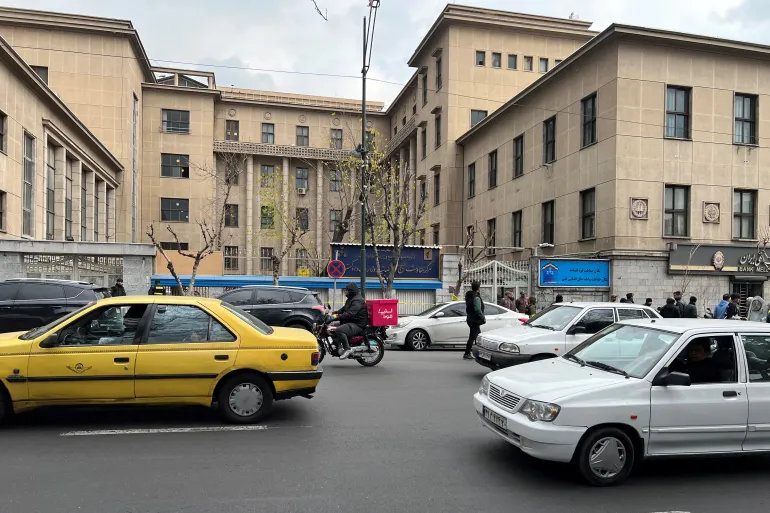
Iran has executed a “senior spy” on charges of cooperating with Israel’s Mossad intelligence agency, its judiciary says.
Mohsen Langarneshin, who was hanged on Wednesday morning, provided Mossad with extensive “logistical, technical and operational support” for two years, starting in 2020, the judiciary said via its official news agency, Mizan.
One of the key accusations against Langarneshin was his involvement in the May 2022 killing of an Islamic Revolutionary Guard Corps (IRGC) colonel, Sayyad Khodai, who was shot dead by two motorcyclists on his way home in Tehran. According to The New York Times, Israel informed the United States that it was responsible for the killing.
Mizan reported that Langarneshin bought a motorcycle to track Khodai’s movements, relayed the information to Mossad and was present during the killing. Additionally, he was accused of supporting an attack on an industrial site in Isfahan, affiliated with Iran’s Ministry of Defence and Armed Forces Logistics.
Iran cited “extensive intelligence and technical evidence” linking Langarneshin to these operations, and said he “fully confessed” to his involvement.
However, Mahmood Amiry-Moghaddam, the head of the Norway-based Iran Human Rights (IHR) monitor, said Langarneshin was sentenced after an unfair trial and a confession was obtained by torture.
“The Iranian authorities’ execution machine is accelerating every day, taking the lives of more people,” he told the AFP news agency, describing the executions as “extrajudicial killings”.
The US-based Abdorrahman Boroumand Center, which had campaigned over his case, said Langarneshin had been convicted after his July 2023 arrest at a Revolutionary Court presided over by judge Abolghasem Salavati, sanctioned by the US and EU and notorious for his handing out of death sentences.
“He denied all charges, stating that his confessions were extracted under torture,” the group said.
The Iran-born British actor and activist Nazanin Boniadi wrote on X: “The bloodthirsty Islamic Republic has executed yet another innocent.”
Caught in a decades-long shadow war with Israel, Iran has executed numerous individuals over their alleged links to Mossad, particularly those accused of sabotage and assassination efforts aimed at undermining its nuclear programme.
In December 2023, three men and a woman were executed for their alleged links to Mossad.
Langarneshin’s execution comes amid renewed US-Iran nuclear talks, which Foreign Minister Abbas Araghchi has accused Israel of attempting to derail. A fourth round of Oman-mediated negotiations between Washington and Tehran is scheduled for Saturday in Rome, according to Tehran.
Araghchi described the last round of indirect talks, held on April 26 in Muscat, as “extremely serious”, but he remained extremely cautious about their potential success.
[Aljazeera]

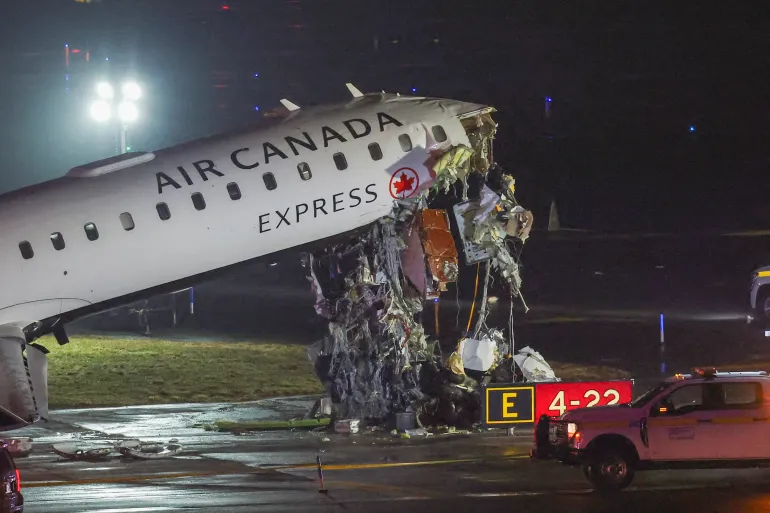
At least two people have been killed when an Air Canada Express flight from Montreal struck a ground vehicle while landing at New York’s LaGuardia Airport, according to several United States media outlets. The airport has been closed and flights diverted.
Kathryn Garcia, the executive director of the Port Authority of New York and New Jersey, said 32 of the 41 people who were injured had been released on Monday while nine remained in hospital with “serious injuries”. Those injured included passengers, crew members and the two officers on the fire truck. Both officers remained hospitalised with non-life-threatening injuries.
The aircraft, operated by Jazz Aviation, a regional partner of Air Canada, struck a firefighting truck on Runway 4 about 11:40pm on Sunday (03:40 GMT on Monday) as the vehicle drove to a separate incident, the Port Authority said.
A preliminary passenger list showed 76 people on board Flight AC8646, including four crew members, Jazz Aviation said in a statement.
The CRJ-900 aircraft struck the vehicle at a speed of 39 kilometres per hour (24 miles per hour), the flight tracking website Flightradar24 said.
“The airport is currently closed to facilitate the response and allow for a thorough investigation,” the Port Authority said in a statement to the AFP news agency.
Emergency response protocols were “immediately activated”, it said.

The US Federal Aviation Administration (FAA) issued a ground stop for all departures to LaGuardia due to the aircraft emergency with the airport closure in effect until 05:30 GMT. The probability of an extension was listed as high.
[Aljazeera]

Along Beirut’s downtown waterfront, Alaa is looking for somewhere to rest his head.
The Syrian refugee, originally from the occupied Golan Heights, is now homeless. He explained that he had already spent the day wandering around the Lebanese capital trying to find shelter.
He used to live in Dahiyeh – the southern suburbs of Beirut that have been pummelled by Israeli attacks, which have now killed MORE THAN 1,000 across Lebanon.
Now, he’s just looking for somewhere he can be safe. And in that context, Eid al-Fitr, the Muslim festival that began on Friday, is far from his mind.
When asked if he had any plans for Eid, he replied in the negative. Instead, his focus was on getting a tent.
“I got rejected from staying in a school, then I went to sleep on the corniche,” Alaa said. “Then people from the municipality told me to come here to downtown Beirut’s waterfront.”
Alaa wasn’t able to find a tent and is sleeping in the open air for now. But others in the area have, transforming a downtown more famous for its expensive restaurants and bars into a tent city for those displaced by the fighting. Across Lebanon, more than a million people have been displaced.
Lebanese are uncertain when this war will end, particularly as they have barely recovered from the conflict with Israel that ran between October 2023 and November 2024.
It makes celebrations difficult – a common theme across the countries affected by the current conflict.
In Iran, now in its third week of US-Israeli attacks – with no sign of an immediate end and an economic crisis that preceded the conflict, people are struggling to afford any of the items typically bought during the holiday season.
And it is potentially dangerous for people to shop at places like Tehran’s grand bazaar, which has been damaged by the bombing.
The religious element of Eid adds an extra sensitivity for antigovernment Iranians, some of whom now see any sign of religiosity as support for the Islamic Republic. The fact that Nowruz – the Persian New Year – falls on Friday this year means that some in the antigovernment camp will be focused on that celebration instead, and eschewing any events to mark Eid.
[Aljazeera]

King Charles has hosted a spectacular state banquet for the president and first lady of Nigeria, praising the strengths of Nigeria’s partnership with the UK.
After greeting the 160 guests in the Yoruba language, the King spoke of the “living bridge” of the Nigerian community in the UK, in a speech in St George’s Hall at Windsor Castle.
Famous figures at the banquet included England rugby union captain, Maro Itoje, Olympic athlete Christine Ohuruogu and poet Sir Ben Okri, alongside senior royals including Queen Camilla and the Prince and Princess of Wales.
There were special adaptations for Muslims, with the banquet taking place in the fasting month of Ramadan.
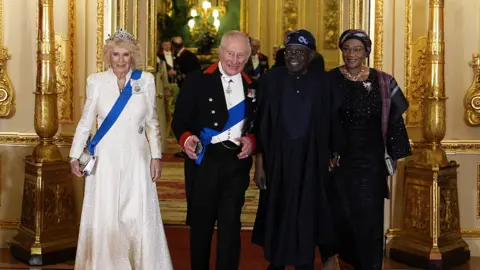
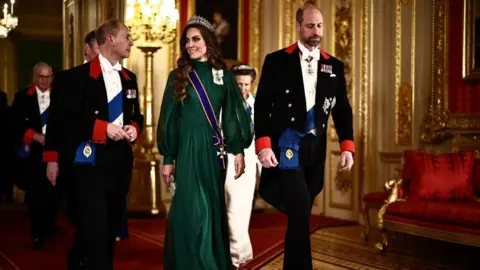
A prayer room was set aside in Windsor Castle and the usual lunch hosted by the King on such state visits did not take place.
It’s become a tradition to invent a cocktail for state visits – and in this case the “crimson bloom” was made from non-alcoholic ingredients, combining the Nigerian drink Zobo with English rose soda and hibiscus and ginger syrup.
There were also alcoholic drinks available for guests in St George’s Hall, including fine red and white wines, port and whisky.
The King’s speech reflected on the importance of religious tolerance, in which “people of different faiths can, do, and must live alongside one another in peace”.
He also told President Bola Ahmed Tinubu and First Lady Oluremi Tinubu of the importance of partners such as Nigeria and the UK standing together in difficult times “when rain clouds gather”.
As well as diplomatic ties, King Charles spoke of “Afrobeats filling our concert halls and Nollywood captivating our screens”.
There was also a reflection by the King on the “painful marks” of a shared history, in a reference to colonialism.
“I do not seek to offer words that dissolve the past, for no words can,” said the King, but he hoped for a more optimistic future “worthy of those who bore the pains of the past”.
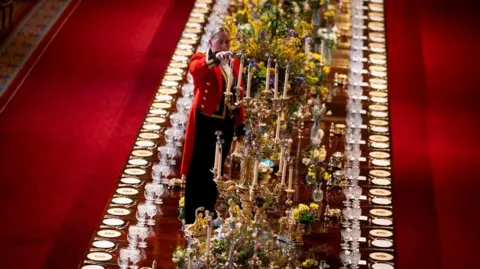
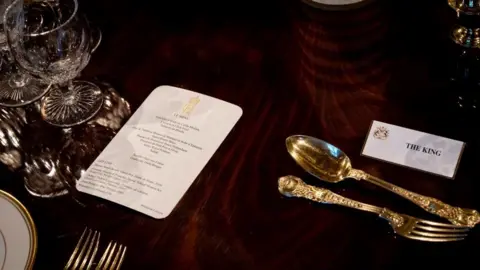
The banquet, on an elaborately decorated table filled with spring flowers, saw a meat-free menu.
It included:
- Soft boiled quail egg tartlet with watercress and kale and a basil sabayon
- Fillet of turbot, lobster mousse wrapped in spinach, beurre blanc sauce, sprouting broccoli with hollandaise sauce, fricassee of peas and broad beans, Jersey Royal potatoes
- Iced blackcurrant souffle with red fruit coulis
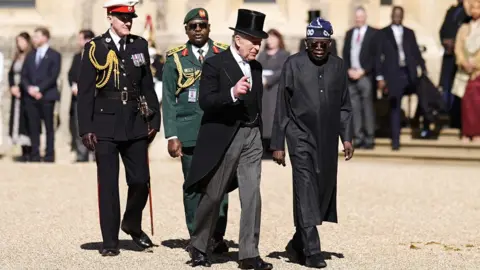
The two-day state visit began on Wednesday morning with a ceremonial welcome at Windsor.
In warm spring sunshine, the president and first lady – wearing traditional robes – were given the ceremonial grandeur of a royal welcome.
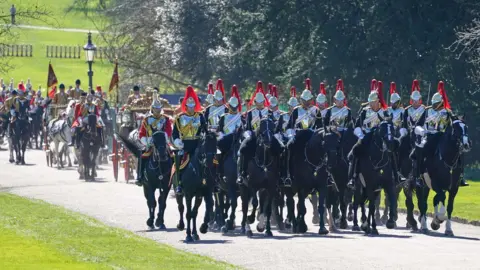
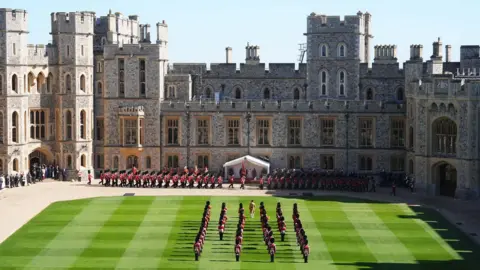
There was a carriage procession, bringing the Nigerian visitors into the quadrangle inside Windsor Castle, where a military band, with careful symmetry, paraded on the chequerboard lawn.
There was a gun salute, national anthems were played, guards were inspected and the Household Cavalry kicked up dust as they paraded inside the castle, in front of a viewing stand for the King and Queen and their visitors.
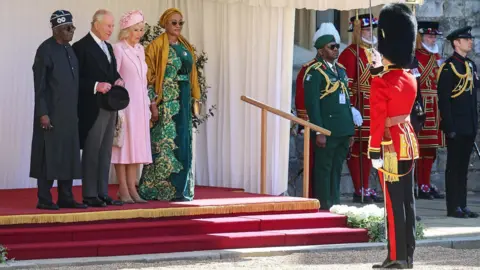
Official gifts were exchanged. The president and Mrs Tinubu were given hand-crafted pottery, a silver photo frame containing a picture of the King and Queen and a silver and enamel bowl.
In return, the King and Queen were given a traditional Yoruba statuette and a jewellery box featuring the faces of important Nigerian women.
President Tinubu is a Muslim and his wife is a Christian and the couple attended an interfaith event at Windsor Castle, designed to build bridges between religions.
It’s at a time of tensions within Nigeria, with a series of suspected suicide bombings this week in the north-eastern state of Borno, in which at least 23 people were killed and 108 injured in attacks blamed on hard-line Islamist militants from the Boko Haram group.
This is Nigeria’s first state visit to the UK for 37 years and such visits are a way of building relationships with international partners.
The Nigeria visit will see a strengthening of business links, including financial services. And there are personal and family connections, with more than 270,000 Nigerian-born people living in the UK.
“This state visit is about turning a historic relationship into a modern economic partnership – transforming trust into opportunity,” said Nigeria’s government spokesman Mohammed Idris.
“Nigeria’s economic reforms are unlocking the potential of Africa’s largest consumer market. The United Kingdom is a natural partner in what comes next.”

‘Dates have the highest sugar content to fight Coronavirus’

Sunday Island 27 December – Headlines

#SundayIsland 17th December – Headlines

Sunday Island – 28th March

Sunday Island Headlines – 21 March

Sunday Island – 21st February – Headlines
-

 News7 days ago
CIABOC questions Ex-President GR on house for CJ’s maid
-
 News6 days ago
Bailey Bridge inaugurated at Chilaw
-

 Features2 days ago
Trincomalee oil tank farm: An engineering marvel
-
 News5 days ago
CIABOC tells court Kapila gave Rs 60 mn to MR and Rs. 20 mn to Priyankara
-

 News6 days ago
Pay hike demand: CEB workers climb down from 40 % to 15–20%
-

 Editorial7 days ago
Couple QR-based quota with odd-even rationing
-
 Features5 days ago
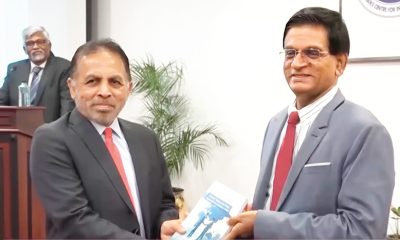
Science and diplomacy in a changing world
-

 News4 days ago
Colombo, Oslo steps up efforts to strengthen bilateral cooperation in key environmental priority areas