
Business
Havelock City Mall built at a cost of USD 130 million opens for business

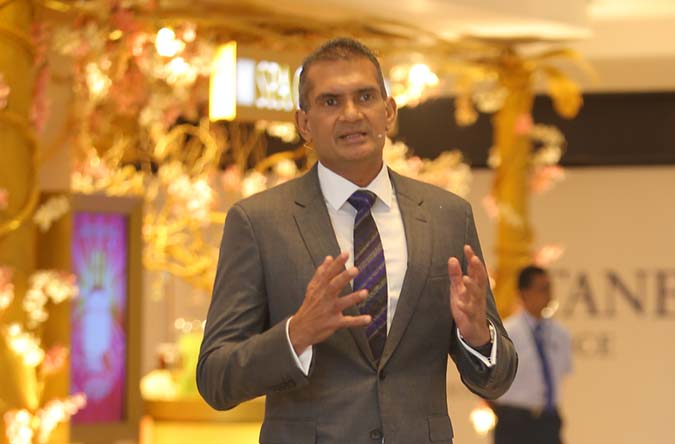
99% of the space has already been leased out
Stands out as a property with a good tenant mix
by Sanath Nanayakkare
The highly anticipated Havelock City Mall built at a cost of US$ 130 million, spanning over 200,000 square feet was officially opened for business yesterday.This international standard shopping mall promises to deliver an unparalleled shopping and entertainment experience, creating an ideal destination for the local community right in the heart of Colombo.
Pravir Samarasinghe, Group CEO/Director of Overseas Realty (Ceylon) PLC speaking to The Island Financial Review said that Overseas Realty was very excited to have opened the Havelock City Mall for business after five years since its groundbreaking ceremony.
“The project got delayed a lot because of the pandemic, the lockdowns and the economic crisis. Eventually things have begun to work out as planned. We are not only hopeful but also are confident in the same vein about the promising success of this project. There are several reasons for that. Number one is; 99% of the space has already been leased out.
We are extremely happy about that. Number two is; those who have taken up the space are great tenants. Number three is; the mall is creating an ideal destination for tourists and the local community right in the heart of Colombo. Another key factor is the mall is located in a place which is a vast catchment area of consumers. It offers accessibility to residents in Colombo 3, 4, 5, and 6, as well as those in Dehiwela, Mount Lavinia, Nugegoda, Maharagama, Kottawa, Homagama, Kirulapone, Narahenpita, Rajagiriya, Nawala, Kotte, and beyond. This makes us very optimistic about the endless positive opportunities. We have invested US$ 130 million in the project,” he said.
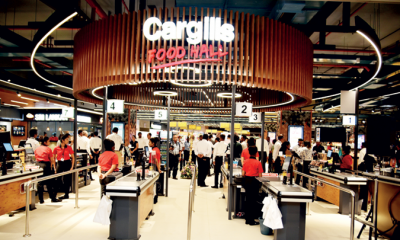
“We have a good mix of international and local brands at the Havelock City Mall making it a retail paradise. It houses six premier anchor tenants that include ODEL, Cargills Food Hall, Scope Cinemas, Food Studio, Cool Planet, and Abans. Moreover, there are 132 other retail outlets, offering an unparalleled selection of fashion and accessories, entertainment options, tantalizing food and beverages, convenient services, electronics, homeware, and gifts and novelties,” he said.
For food enthusiasts, the options at Havelock City Mall are nothing short of a culinary odyssey. Havelock City Mall will also unveil its astonishing entertainment line-up.
Opening early next year is the Havelock City Mall’s 1,000-seat, six-screen multiplex, along with the first and only premium, large format IMAX cinema in Sri Lanka.
“We are delighted to welcome everyone to the Havelock City Mall. We look forward to providing a diverse and exciting retail environment, entertainment options and dining experiences for all our shoppers. Havelock City Mall is poised to become the ultimate modern lifestyle suburban mall, catering to the entire family – a happy place for all.” Pravir said.
Havelock City Mall is developed by Overseas Realty (Ceylon) PLC; the owner, manager, and developer of the iconic World Trade Center, Colombo.








Business
Sri Lanka Customs exceeds revenue targets to enters 2026 with a surplus of Rs. 300 billion – Director General


The year 2025 has been recorded as the highest revenue-earning year in the history of Sri Lanka Customs, stated Director General of Sri Lanka Customs, Mr. S.P. Arukgoda, noting that the Department had surpassed its expected revenue target of Rs. 2,115 billion, enabling it to enter 2026 with an additional surplus of approximately Rs. 300 billion.
The Director General made these remarks at a discussion held on Tuesday (30) morning at the Sri Lanka Customs Auditorium, chaired by President Anura Kumara Dissanayake.
The President visited the Sri Lanka Customs Department this to review the performance achieved in 2025 and to scrutinize the new plans proposed for 2026. During the visit, the President engaged in extensive discussions with the Director General, Directors and senior officials of the Department.
Commending the vital role played by Sri Lanka Customs in generating much-needed state revenue and contributing to economic and social stability, the President expressed his appreciation to the entire Customs employees for their commitment and service.
Emphasizing that Sri Lanka Customs is one of the country’s key revenue-generating institutions, the President highlighted the importance of maintaining operations in an efficient, transparent and accountable manner. The President also called upon all officers to work collectively, with renewed plans and strategies, to lead the country towards economic success in 2026.
The President further stressed that the economic collapse in 2022 was largely due to the government’s inability at the time to generate sufficient rupee revenue and secure adequate foreign exchange. He pointed out that the government has successfully restored economic stability by achieving revenue targets, a capability that has also been vital in addressing recent disaster situations.
A comprehensive discussion was also held on the overall performance and progress of Sri Lanka Customs in 2025, as well as the new strategic plans for 2026, with several new ideas and proposals being presented.
Sri Lanka Customs currently operates under four main pillars, revenue collection, trade facilitation, social protection and institutional development. The President inquired into the progress achieved under each of these areas.
It was revealed that the Internal Affairs Unit, established to prevent corruption and promote an ethical institutional culture, is functioning effectively.
The President also sought updates on measures taken to address long-standing allegations related to congestion, delays and corruption in Customs operations, as well as on plans to modernize cargo inspection systems.
The discussion further covered Sri Lanka Customs’ digitalization programme planned for 2026, along with issues related to recruitment, promotions, training and salaries and allowances of the staff.
Highlighting the strategic importance of airports in preventing attempts to create instability within the country, the President underscored the necessity for Sri Lanka Customs to operate with a comprehensive awareness of its duty to uphold the stability of the State, while also being ready to face upcoming challenges.
The discussion was attended by Minister of Labour and Deputy Minister of Finance and Planning, Dr. Anil Jayanta Fernando, Deputy Minister of Economic Development, Nishantha Jayaweera, Secretary to the President, Dr. Nandika Sanath Kumanayake, Deputy Secretary to the Treasury, A.N.Hapugala, Director General of Sri Lanka Customs, S.P.Arukgoda, members of the Board of Directors and senior officials of the Department.

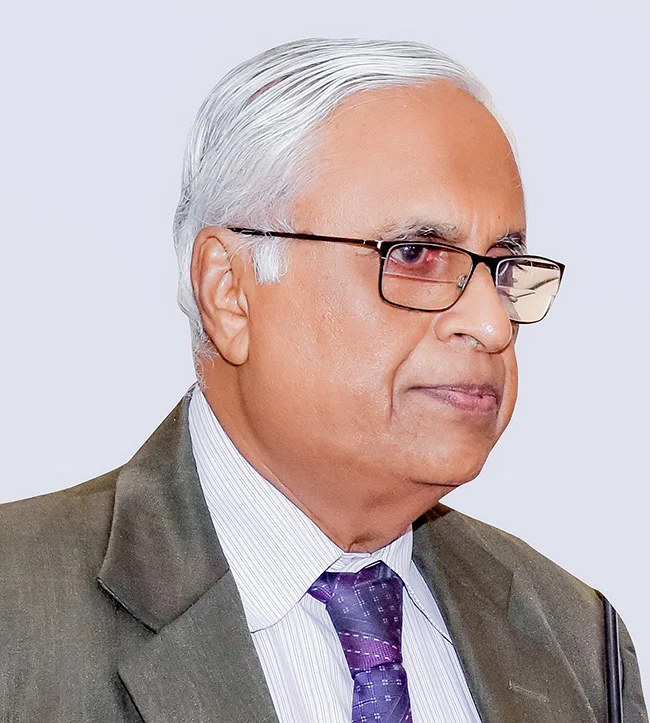
The dawn of 2026 represents a time for critical recalibration, not just ceremony, for the nation’s vital construction sector, says Eng Nissanka N Wijeratne, Secretary General/CEO of the Chamber of Construction Industry (CCI).
In a New Year message, Wijeratne reframes the annual greeting as a strategic call to action. “For Sri Lanka’s construction industry – the true backbone of our economy – the turning of the calendar is an ideal moment for a realistic and forward-looking assessment,” he states.
His vision sketches a practical blueprint where the unprecedented challenges of the recent past become the foundation for a smarter, more sustainable future.
The industry, long considered a barometer of national prosperity, has weathered severe headwinds: economic volatility and spiraling material costs. “These were not mere business cycles, but unprecedented tests,” Wijeratne notes, acknowledging the severe strain on firms and professionals. Yet, the sector’s response, he observes, has been “nothing short of remarkable,” showcasing a deeply ingrained resilience.
The Chamber’s chosen theme for the year, “Resilience through Innovation,” signals a pivotal shift from enduring hardship to actively engineering progress.
The pathway forward, Wijeratne outlines, is built on three interdependent pillars.
First is the revitalization of Infrastructure. “This is not a simple call for new projects,” he clarifies, “but a strategic push to reactivate stalled ventures and initiate sustainable developments in concert with the government and international agencies.” He emphasises that construction activity is intrinsically linked to the broader economy’s pulse, where resuming projects catalyses employment, energises supply chains, and restores public confidence.
The second pillar, technological Integration, addresses the urgent need to modernise the sector’s core. Advocacy for Building Information Modeling (BIM), green building practices, and digital project management is a direct answer to past inefficiencies. “It is a commitment to ensuring Sri Lankan construction is not just rebuilt, but upgraded becoming more competitive, cost-effective, and environmentally responsible,” Wijeratne says. ” Innovation must move from slogan to practice, transforming how the nation conceives, builds, and maintains its infrastructure,” he notes.
The third pillar, consistent policy advocacy, underpins all efforts. The Chamber positions itself as a vital intermediary, fighting for fair pricing mechanisms, streamlined regulations, and a protective framework for local contractors. Wijeratne stresses that the best-laid plans of engineers can falter without a conducive policy environment, calling for a strengthened partnership with the state to create a level playing field where skill and enterprise determine success.
Ultimately, Wijeratne’s message is a powerful reminder of the industry’s profound legacy. “When we build, the nation grows,” he states, elevating construction from a commercial activity to a national mission. The structures that rise from the ground are more than concrete and steel; they are the schools, hospitals, roads, and homes that shape the nation’s future.
As Sri Lanka steps into 2026, the construction industry’s message is clear: it is ready to transform resilience from a trait of survival into a dynamic force for innovation.
The past challenges, according to Wijeratne, have been met with grit. Now, the future must be built with vision.
By Sanath Nanayakkare
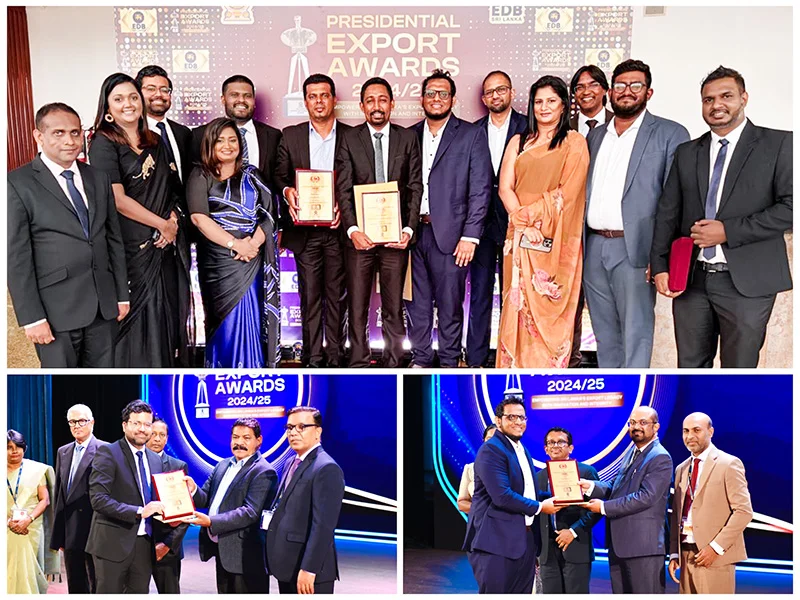
Expo Commodities (Pvt) Ltd, together with its member company STAY Naturals (Pvt) Ltd, has been recognized with Merit Awards at the Sri Lanka Export Development Board (EDB) Presidential Export Awards 2024/25, one of the country’s most prestigious platforms celebrating export excellence.
The awards were presented under the categories of Spices and Allied Products and Essential Oils, Oleoresins & Condiments, recognizing the companies’ consistent performance, product quality, and contribution to strengthening Sri Lanka’s presence in global markets.
The recognition reflects Expo Commodities’ continued focus on delivering high-quality, value-added Sri Lankan products while upholding international standards across innovation, sustainability, and responsible sourcing. Through STAY Naturals, the group has expanded its reach in key export markets, promoting Sri Lanka’s essential oils, oleoresins, and condiments derived from its rich agricultural heritage to customers worldwide.
The achievement also reflects the collective effort, technical expertise, and commitment of the teams behind the operations, alongside the continued trust of global partners and customers. Expo Commodities (Pvt) Ltd, part of Expo Commodities Global, is strategically focused on driving sustainable export growth and strengthening Sri Lanka’s global positioning as a reliable supplier of high-quality natural products.
Expo Commodities Global is a globally active Agri-commodity enterprise with operations spanning multiple origins including Sri Lanka, Vietnam, Indonesia, Madagascar, Comoros, Egypt, the UAE, India, Germany, and the Netherlands. The company specializes in the production, processing, and export of premium organic and conventional spices, coconut products, essential oils, oleoresins, and value-added agricultural products, delivering consistent quality through integrated and sustainable operations.
Expo Commodities Global and STAY Naturals (Pvt) Ltd are part of Aberdeen Holdings, a diversified Sri Lankan conglomerate with interests across pharmaceuticals, packaging, commodities, transport and logistics, power generation, and digital innovation, supporting long-term growth through strong governance, sustainability, and global market engagement.

Showers or thundershowers will occur at times in the Northern, Eastern, Central, North-central, North-western and Uva provinces

Israel to bar 37 aid groups from Gaza

Protests spread across Iran for third day after currency hits record low

Sri Lanka Customs exceeds revenue targets to enters 2026 with a surplus of Rs. 300 billion – Director General

Harmanpreet Kaur leads the way as India complete 5-0 sweep over Sri Lanka

Educators slam govt. for ‘unprepared’ education reforms

‘Dates have the highest sugar content to fight Coronavirus’

Sunday Island 27 December – Headlines

#SundayIsland 17th December – Headlines

Sunday Island – 28th March

Sunday Island Headlines – 21 March

Sunday Island – 21st February – Headlines
-

 News6 days ago
British MP calls on Foreign Secretary to expand sanction package against ‘Sri Lankan war criminals’
-
 News5 days ago
Street vendors banned from Kandy City
-

 Sports6 days ago
Chief selector’s remarks disappointing says Mickey Arthur
-

 Opinion6 days ago
Disasters do not destroy nations; the refusal to change does
-

 News5 days ago
Lankan aircrew fly daring UN Medevac in hostile conditions in Africa
-

 Sports2 days ago
Gurusinha’s Boxing Day hundred celebrated in Melbourne
-

 Sports3 days ago
Time to close the Dickwella chapter
-

 Sports6 days ago
Royal record crushing innings win against Nalanda