
Foreign News
Hamas returns remains of two more hostages but says more time needed to reach others

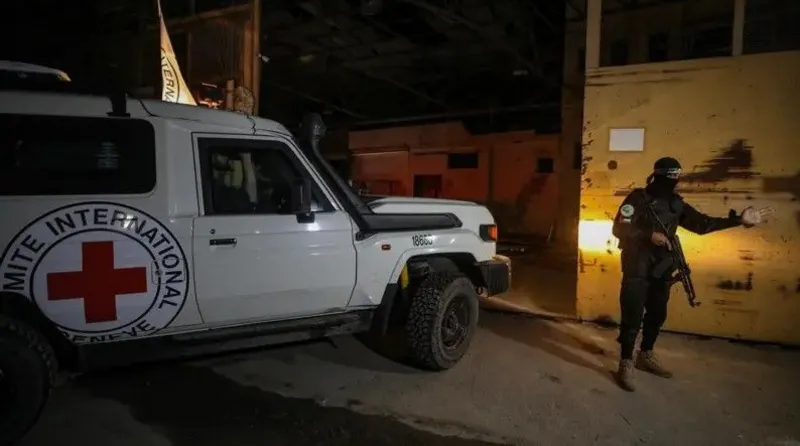
Hamas says it has handed over the bodies of two more Israeli hostages under the terms of the US-brokered ceasefire deal, but says it needs time and specialised equipment to recover the rest of the deceased from the ruins of Gaza.
The group’s armed wing said in a statement it was committed to the deal but had returned all the bodies of hostages it was able to reach.
US President Donald Trump has said Israeli forces could resume fighting in Gaza if Hamas does not uphold the agreement.
In a statement, the Israeli PM’s office said Israel had received – through the Red Cross – coffins containing the bodies of hostages which were now awaiting official identification.
“The IDF urges the public to act with sensitivity and wait for official identification, which will first be communicated to the families of the deceased hostages,” the statement said.
Senior US advisors providing an update on the implementation of the 20-point peace plan said that the US government did not so far believe Hamas had broken the agreement by not retrieving the remains of remaining deceased hostages.
The advisors argued that Hamas had acted in good faith by returning the live hostages and was working with various interlocutors to find and return the remains of hostages.
If the two bodies returned on Wednesday night are confirmed to be hostages, that would mean 19 are still unaccounted for in Gaza. Hamas is required to return all 28 dead hostages as part of the first phase of the Gaza peace plan.
But Hamas’s armed wing said in a statement “the remaining bodies require significant efforts and specialised equipment to search for and retrieve, and we are making a great effort to close this file”.
Earlier, Israel said it would “not compromise” on hostage returns, saying “the mission is not complete”.
Israel’s defence minister said he had instructed the IDF to prepare a “comprehensive plan” to defeat Hamas in Gaza in the event of a renewal of the war.
After meeting senior generals on Wednesday, Israel Katz said the military must be prepared to act if Hamas refuses to implement the peace plan.
The latest repatriations came after Israel said one of four bodies returned by Hamas on Tuesday was not one of the missing hostages.
The other three deceased were identified as Tamir Nimrodi, 20, Eitan Levy, 53, and Uriel Baruch, 35, the Hostages Families Forum said.
Earlier on Wednesday UN humanitarian chief Tom Fletcher urged Israel to immediately open all crossings into Gaza for humanitarian aid, as called for in the ceasefire plan.
In a post on X, Fletcher said Hamas must “make strenuous efforts to return all the bodies of the deceased hostages”.
He added: “As Israel has agreed, they must allow the massive surge of humanitarian aid – thousands of trucks a week – on which so many lives depend, and on which the world has insisted.”
He called for “more crossings open and a genuine, practical, problem-solving approach to removing remaining obstacles” and said “withholding aid from civilians is not a bargaining chip”.
Trump’s ceasefire plan, which both Israel and Hamas accepted, envisaged the handover of all 48 hostages would be completed by noon on Monday. Hamas returned all the 20 living hostages on Monday.
But the US-brokered ceasefire agreement appears to acknowledge that Hamas and other Palestinian factions may not have been able to find all hostage remains before the initial deadline on Monday.
Under the agreement, Israel also agreed to hand over the bodies of 15 Palestinians in return for every deceased Israeli hostage.
Israel has returned the bodies of a further 45 Palestinians, the Hamas-run health ministry confirmed on Wednesday, bringing the total number of bodies released by Israel to 90.
Meanwhile in Gaza, residents report growing concern about the durability of the ceasefire – and food prices have surged as Palestinians stockpile food.
Traders and suppliers in the enclave have been hoarding food items to create shortages and drive up profits, fearing that the war could resume, local residents told the BBC.
“Every time we start to feel safe, new threats appear, and we fear the war will start all over again,” says mother-of-six Neven Al-Mughrabi, a displaced resident from Gaza who lives in Khan Younis.
“I lost my house in Gaza City, I decided to stay here with my family because I don’t trust the ceasefire and we’re sick of displacement.”
She added that a trader in Khan Younis’s main market said demand for flour, oil and sugar had surged within hours. “Despite the sudden rise of prices by about 30%, people are buying as if they don’t trust the calm will last long, everyone is afraid aid will stop,” Neven says.
The US advisors also said the US was working with Israel to create “safe spaces” behind the yellow-line for people to flee if they feel under threat from Hamas.
In the longer-term, the advisors said they did not see a future for Hamas to govern parts of Gaza.
The current focus, according to the advisors, is on “de-confliction” that would allow aid to flow into Gaza and reconstruction to begin, with an international security force still in its early stages.
[BBC]

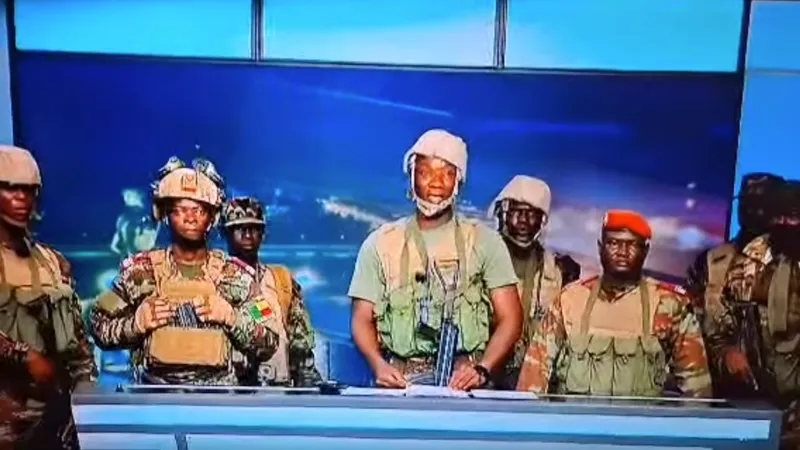
Benin’s president has appeared on television to reassure citizens of the West African nation that the situation was now “totally under control” following an attempted coup earlier in the day.
“I would like to commend the sense of duty demonstrated by our army and its leaders, who have remained… loyal to the nation,” Patrice Talon said, looking calm during the live evening broadcast.
The government said it had thwarted the mutiny hours after a group of soldiers declared a takeover on national television.
Later in the afternoon, huge explosions were heard in Cotonou, Benin’s largest city and seat of government. They were thought to have been the result of an air strike.
Prior to the explosions, flight-tracking data showed that three aircraft had entered Benin’s airspace from neighbouring Nigeria before returning home.
A spokesman for Nigeria’s president later confirmed that its fighter jets had gone in to “take over the airspace to help dislodge the coup plotters from the national TV and a military camp where they had regrouped”.
There have been a series of coups in West Africa before Sunday’s thwarted attempt in Benin, heightening fears that the security of the region could worsen.
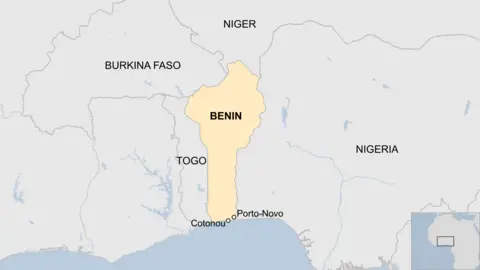
Benin, a former French colony, has been regarded as one of Africa’s more stable democracies. But Talon has faced accusations of suppressing criticism of his policies.
The nation is one of the continent’s largest cotton producers, but ranks among the world’s poorest countries.
Nigeria, Benin’s large neighbour to the east, has described the coup attempt as a “direct assault on democracy”.
“This commitment and mobilisation enabled us to defeat these opportunists and avert disaster for our country. This treachery will not go unpunished,” he added.
“I would like to reassure you that the situation is completely under control and therefore invite you to go about your business peacefully this evening.”
It is not clear if there have been casualties, but the president expressed his condolences “to the victims of this senseless adventure, as well as to those still being held by fleeing mutineers”.
Earlier, government spokesperson Wilfried Leandre Houngbedji told news agency Reuters that 14 people had been arrested in connection with the attempted coup.
A journalist in Benin told the BBC that, of those reportedly arrested, 12 are believed to have stormed the offices of the national TV station – including a soldier who had previously been sacked.
Eyewitnesses told the BBC gunfire was heard near the presidential residence early on Sunday morning, as a group of soldiers announced on national TV that they were suspending the constitution.
They also said some journalists working for the state broadcaster had been held hostage for a few hours.
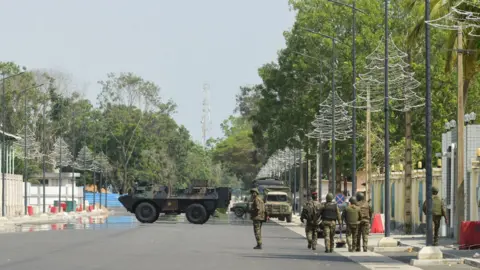
The French and Russian embassies urged their citizens to remain indoors, while the US embassy’s advice was to stay away from Cotonou, especially the area around the presidential compound.
The rebel soldiers, led by Lt Col Pascal Tigri, justified their actions by criticising Talon’s management of the country, complaining first about his handling of the “continuing deterioration of the security situation in northern Benin”.
Benin’s army has suffered losses near its northern border with insurgency-hit Niger and Burkina Faso in recent years, as jihadist militants linked to Islamic State and al-Qaeda spread southwards.
The soldier’s statement cited “the ignorance and neglect of the situation of our brothers in arms who have fallen at the front and, above all, that of their families, abandoned to their sad fate by Mr Patrice Talon’s policies”.
The rebels also hit out at cuts in health care, including the cancellation of state-funded kidney dialysis, and taxes rises, as well as curbs on political activities.
Talon, who is regarded as a close ally of the West, is due to step down next year after completing his second term in office, with elections scheduled for April.
A businessman known as the “king of cotton”, he first came to power in 2016. He promised not to seek a third term, despite Benin’s current two-term limit for presidencies, and has endorsed Finance Minister Romuald Wadagni as his successor.
Talon has been praised by his supporters for overseeing economic development, but his government has also been criticised for suppressing dissenting voices.
In October, Benin’s electoral commission barred the main opposition candidate from standing on the grounds that he did not have enough sponsors.
Last month, constitutional amendments were passed by MPs, including the creation of a second parliamentary chamber, the Senate.
Terms for elected officials were extended from five to seven years, but the presidential two-term limit remained in place.
Sunday’s attempted coup comes just over a week after Guinea-Bissau’s President Umaro Sissoco Embaló was overthrown – though some regional figures have questioned whether this was staged.
In recent years, West Africa has also seen coups in Burkina Faso, Guinea, Mali and Niger, prompting concerns about the region’s stability.
Russia has strengthened its ties with these Sahel countries over recent years – and Burkina Faso, Mali and Niger have left the West African regional bloc Ecowas to form their own group, the Alliance of Sahel States.
News of the attempted takeover in Benin was hailed by several pro-Russian social media accounts, according to BBC Monitoring.
Ecowas and the African Union (AU) have both condemned the coup attempt.
A contingent from Ecowas’s standby force is to be deployed to preserve the “constitutional order and the territorial integrity of the Republic of Benin”, the regional bloc has said in a statement.
AU Commission chair Mahmoud Ali Yousouf reiterated the pan-African organisation’s “zero tolerance stance toward any unconstitutional change of government, regardless of context or justification”.
[BBC]

A drone attack on the town of Kalogi, in Sudan’s South Kordofan region, is said to have hit a kindergarten and killed at least 50 people, including 33 children.
The Rapid Support Forces (RSF), the paramilitary group battling the army in Sudan’s civil war, was accused of Thursday’s attack by a medical organisation, the Sudan Doctors’ Network, and the army.
There was no immediate comment from the RSF.
The RSF in turn accused the army of hitting a market on Friday in a drone attack in the Darfur region, on a fuel depot at the Adre border crossing with Chad.
Sudan has been ravaged by war since April 2023 when a power struggle broke out between the RSF and the army, who were formerly allies.
The reports could not be verified independently.
According to the army-aligned foreign ministry, the kindergarten was struck twice with missiles from drones.
Civilians and medics who rushed to the school were also attacked, it added.
Responding to reports of the attack in Kalogi, a spokesman for the UN children’s agency Unicef said: “Killing children in their school is a horrific violation of children’s rights.”
“Children should never pay the price of conflict,” Sheldon Yett added.
The agency, he said, urged “all parties to stop these attacks immediately and allow safe, unhindered access for humanitarian assistance to reach those in desperate need”.
The RSF accused the army of attacking the Adre crossing because it was used for the “delivery of aid and commercial supplies”.
According to the Sudan War Monitor, a group of researchers tracking the conflict, the attack caused civilian casualties and significant damage to a market.
The military did not immediately comment on the reports from Darfur.
Wedged between Sudan’s capital Khartoum and Darfur, the region made up of North Kordofan, South Kordofan and West Kordofan has been a frontline in the civil war.
The battle for the Kordofans – which have a population of almost eight million – has intensified as the army pushes towards Darfur.
[BBC]
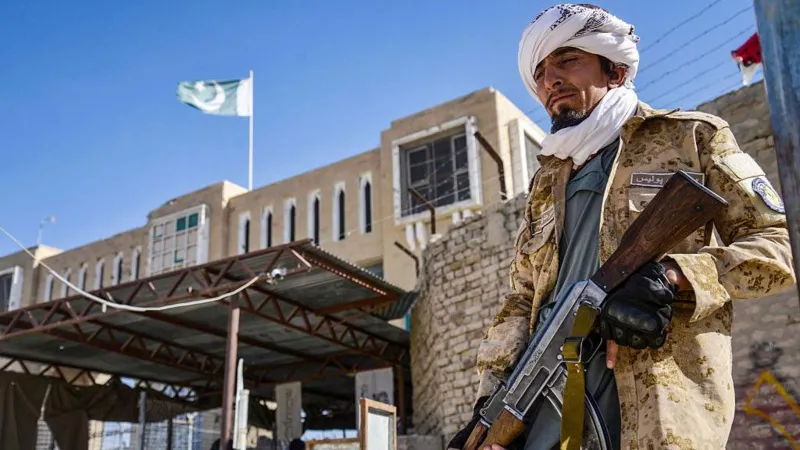
Border clashes have erupted again between Pakistan and Afghanistan’s Taliban forces, with each sides accusing the other of breaking a fragile ceasefire.
Residents fled the Afghan city of Spin Boldak overnight, which lies along the 1,600-mile (2,600 km) border between the two countries.
A medical worker in the nearby city of Kandahar told BBC Pashto that four bodies had been brought to a local hospital. Four other people were wounded. Three were reportedly wounded in Pakistan.
There has been sporadic fighting between the two countries in recent months, while Afghanistan’s Taliban government has also accused Pakistan of carrying out air strikes inside the country.
Both sides have confirmed they exchanged fire overnight but each blamed the other for initiating the four hours of fighting.
Mosharraf Zaidi, a spokesperson for Pakistan’s Prime Minister Shehbaz Sharif, accused the Taliban of “unprovoked firing”.
The statement continued: “An immediate, befitting & intense response has been given by our armed forces. Pakistan remains fully alert & committed to ensuring its territorial integrity & the safety our citizens.”
Meanwhile, a Taliban spokesperson said Pakistan had “once again initiated attacks” and said it was “forced to respond”.
Residents on the Afghan side of the border said the exchange of fire started at around 22:30 (18:00 GMT) on Friday.
Footage from the area showed a large number of Afghans fleeing on foot and in vehicles.
Ali Mohammed Haqmal, head of Kandahar’s information department, said Pakistan’s forces had attacked with “light and heavy artillery” and civilian homes had been hit by mortar fire.
The latest clashes came less than two months after both sides agreed to a ceasefire mediated by Qatar and Turkey.
It ended more than a week of fighting in which dozens were killed – the worst clashes between Pakistan and the Taliban since the group returned to power in 2021 – though tensions have remained high.
The government in Islamabad has long accused Afghanistan’s ruling Taliban of giving shelter to armed groups which carry out attacks in Pakistan.
The Taliban government denies the accusation and has accused Pakistan of blaming others for their “own security failures”.
The Pakistan Taliban have carried out at least 600 attacks on Pakistani forces over the past year, according to the Armed Conflict Location & Event Data Project.
Last week delegations from both sides met in Saudi Arabia for a fourth round of negotiations on a wider peace settlement, but did not reach an agreement.
Sources familiar with the talks told BBC News that both sides had agreed to continue with the ceasefire.
[BBC]

Jetstar to launch Australia’s only low-cost direct flights to Sri Lanka, with fares from just $315^

Starmer to host Zelensky for Ukraine talks in London

Benin coup thwarted by loyalist troops, president tells nation

Laws to curb unauthorised constructions to be strengthened

Van Niekerk cameo, Tunnicliffe fifty give South Africa series win

627 confirmed dead, 190 persons missing as at 6:00 a.m. today [08]

‘Dates have the highest sugar content to fight Coronavirus’

Sunday Island 27 December – Headlines

#SundayIsland 17th December – Headlines

Sunday Island – 28th March

Sunday Island Headlines – 21 March

Sunday Island – 21st February – Headlines
-
News5 days ago
Lunuwila tragedy not caused by those videoing Bell 212: SLAF
-

 News10 hours ago
Over 35,000 drug offenders nabbed in 36 days
-
 News4 days ago
Level III landslide early warning continue to be in force in the districts of Kandy, Kegalle, Kurunegala and Matale
-
 Latest News7 days ago
Level III landslide early warnings issued to the districts of Badulla, Kandy, Kegalle, Kurunegala, Matale and Nuwara-Eliya
-

 Features6 days ago
Ditwah: An unusual cyclone
-

 Business2 days ago
LOLC Finance Factoring powers business growth
-

 News2 days ago
CPC delegation meets JVP for talks on disaster response
-

 News2 days ago
A 6th Year Accolade: The Eternal Opulence of My Fair Lady