
Foreign News
Greek coastguards charged over 2023 migrant shipwreck


A naval court in Greece has charged 17 coastguards over the deadliest migrant boat disaster in the Mediterranean Sea for a decade.
Up to 650 people were feared to have drowned when the overcrowded Adriana fishing vessel sank near Pylos, off the Greek coast, in the early hours of 14 June 2023.
Survivors later told the BBC that Greek coastguards had caused their boat to capsize in a botched attempt to tow it and then silenced witnesses.
“It has taken us two years just for these charges to come, even though so many people witnessed what happened,” one of the survivors, a Syrian man we called Ahmad, said on Monday.
The Greek authorities have always denied the claims against them.
The Deputy Prosecutor of the Piraeus Naval Court has found that 17 members of the Hellenic Coast Guard should face criminal charges.
Among them is the captain of the coastguard ship, the LS-920, who is charged with “causing a shipwreck”, leading to the deaths of “at least 82 people”.
This corresponds to the number of bodies recovered, although it is thought as many as an additional 500 people drowned, including women and children who were all below deck.
The disaster occurred in international waters – but within Greece’s rescue zone.
The then-Chief of the Coast Guard and the Supervisor of the National Search and Rescue Coordination Centre in Piraeus are among four officials charged with “exposing others to danger”.
The captain of the LS-920 is also charged with “dangerous interference of maritime transport” as well as a “failure to provide assistance” to the migrant boat.
The crew of the ship are charged for “simple complicity” in all the acts allegedly committed by the captain.
A coastguard ship had been monitoring the Adriana for 15 hours before it sank.
It had left Libya for Italy with an estimated 750 people on board. Only 104 of them are known to have survived.
We’ve been investigating since the day of the disaster and our series of findings has cast serious doubt on the official Greek version of events.
Within a week, we obtained shipping data which challenged the claim the migrant boat had not been in trouble and so did not need to be rescued.
A month later, survivors told us the coastguard had caused their boat to sink in a disastrous effort to tow it and then forced witnessed to stay silent.
Last year, a case against nine Egyptians was thrown out, amid claims they had been scapegoated by the Greek authorities.
Earlier this year, audio recordings emerged which further challenged the official Greek version of events.
We first met Syrian refugees, who we called Ahmad and Musaab to protect their identities, a month after the disaster.
They said they each paid $4,500 (£3,480) for a spot on the boat.
Ahmad’s younger brother was also on board and did not survive.
Musaab described to us the moment when – he alleged – the Greek coastguards caused their boat to sink.
“They attached a rope from the left,” he said. “Everyone moved to the right side of our boat to balance it. The Greek vessel moved off quickly causing our boat to flip. They kept dragging it for quite a distance.”
The men claimed that once on land, in the port of Kalamata, the coastguard told survivors to “shut up” when they started to talk about how the Greek authorities had caused the disaster.
“When people replied by saying the Greek coastguard was the cause, the official in charge of the questioning asked the interpreter to tell the interviewee to stop talking,” Ahmad said.
He said officials shouted: “You have survived death. Stop talking about the incident Don’t ask more questions about it.”
Today Ahmad – who is now living in Germany – said he felt vindicated by the charges that had been brought.
“I’m very happy they are eventually being held accountable for all that they have committed, but until I see them in prison nothing has been done yet,” he said.
“To be honest, the Greek legal system is very unreliable.”
The joint legal team representing survivors and victims of the disaster said the decision to pursue a case against the 17 coastguards was a big step forward towards justice being done.
In a statement it said: “Almost two years after the Pylos shipwreck, the prosecution and referral to main investigation for felonies of 17 members of the Coast Guard, including senior officers of its leadership, constitutes a substantial and self-evident development in the course of vindication of the victims and the delivery of justice.”
It is understood the 17 men who have now been charged will be questioned in the coming weeks by the Deputy Prosecutor of the Piraeus Naval Court.
The court will then decide whether to send them to full trial or dismiss the charges.
It is not immediately clear what punishment the coastguards could receive if found guilty.
Greece has previously told the BBC its Coast Guard fully respects human rights and has rescued more than 250,000 people at sea in the past decade.
[BBC]


China has approved a sweeping new law which claims to help promote “ethnic unity” – but critics say it will further erode the rights of minority groups.
On paper, it aims to promote integration among the 56 officially recognised ethnic groups, dominated by the Han Chinese, through education and housing. But critics say it cuts people off from their language and culture.
It mandates that all children should be taught Mandarin before kindergarten and up until the end of high school. Previously students could study most of the curriculum in their native language such as Tibetan, Uyghur or Mongolian.
The law was approved on Thursday as the annual rubber-stamp parliamentary session drew to an end.
“The law is consistent with a dramatic recent policy shift, to suppress the ethnic diversity formally recognised since 1949,” Magnus Fiskesjö, an associate professor of anthropology at Cornell University said in a university report.
“The children of the next generation are now isolated and brutally forced to forget their own language and culture.”
However, Beijing argues that teaching the next generation Mandarin will help their job prospects.
It also says the law for “Promoting Ethnic Unity and Progress” is crucial for promoting “modernisation through greater unity”.
The law was voted and passed on Thursday at the National People’s Congress in Beijing, which has never rejected an item on its agenda.
The law also provides a legal basis to prosecute parents or guardians who may instil what it described as “detrimental” views in children which would affect ethnic harmony and it calls for “mutually embedded community environments” which some analysts believe could result in the break up of minority-heavy neighbourhoods.
The Chinese government started to push for what it describes as the “sinicisation” of minority groups in the late 2000s and create a more unified national identity by assimilating ethnic groups into the dominant Han culture.
Han Chinese make up more than 90% of the country’s 1.4 billion people.
Beijing has long been accused of restricting the rights of minority ethnic groups in regions like Tibet, Xinjiang and Inner Mongolia.
Critics say assimilation has often been forced on people in these places – a state-led policy that has accelerated under Chinese leader Xi Jinping who has taken a harder line on dissent and protests, especially in areas home to minority ethnic groups,
In Tibet, the authorities have arrested monks, and taken control of monasteries to ensure they do not worship the Dalai Lama.
When the BBC visited a monastery that had been at heart of Tibetan resistance in July last year, monks spoke of living under fear and intimidation.
“We Tibetans are denied basic human rights. The Chinese government continues to oppress and persecute us. It is not a government that serves the people,” one of them told us.

In Xinjiang, human rights groups have documented the detention of a million Uyghur Muslims in what the Chinese government calls camps for “re-education”, while the UN has accused Beijing of grave human rights violations.
The BBC’s reporting from 2021 and 2022 found evidence supporting the existence of detention camps, and allegations of sexual abuse and forced sterilisation, which Beijing denies.
In 2020, ethnic Mongolians in northern China staged rare rallies against measures to reduce teaching in the Mongolian language in favour of Mandarin.
Parents even held children back in protest at the policy as some ethnic Mongolians viewed the move as a threat to their cultural identity. Authorities moved quickly to crackdown on what it saw as dissent.
The Communist Party says it embraces different ethnicities. The country’s constitution states that “each ethnicity has the right to use and develop their own language” and “have the right to self-rule”.
But critics believe this new law will cement Xi’s push toward assimilation.
“The law makes it clearer than ever that in Xi Jinping’s PRC non-Han peoples must do more to integrate themselves with the Han majority, and above all else be loyal to Beijing,” Allen Carlson, an associate professor of government at Cornell University said, referencing China by the initials of its official name.
This focus on development and prosperity is “telling”, Professor Ian Chong of the National University of Singapore told the BBC.
“It is easy to read this language as meaning that minority languages and cultures are backward and impediments to advancement.”
Xi’s approach towards minorities is “consistent with his idea of creating a great and strong Chinese nation with a northern Han core… minorities are seen as branching off from that core, and hence in some ways derivative,” he adds.
“In practice, this has prompted concerns about further rounds of increasing control, diminution, and even crackdowns on minority cultures and languages.”
[BBC]

A Chinese national has been arrested in Kenya’s main airport accused of attempting to smuggle more than 2,000 queen garden ants out of the country.
Zhang Kequn was intercepted during a security check at Jomo Kenyatta International Airport (JKIA) in the capital Nairobi after authorities discovered a large consignment of live ants in his luggage bound for China.
He has yet to respond to the accusation but investigators said in court that he was linked to an ant-trafficking network that was broken up in Kenya last year.
The ants are protected by international bio-diversity treaties and their trade is highly regulated.
Last year, the Kenya Wildlife Service (KWS) warned of a growing demand for garden ants – scientifically known as Messor cephalotes – in Europe and Asia, where collectors keep them as pets.
A state prosecutor told the court on Wednesday that Zhang had packed some ants in test tubes, while others were concealed in tissue paper rolls hidden in his luggage.
“Within his personal luggage there was found 1,948 garden ants packed in specialised test tubes,” prosecutor Allen Mulama told the court.
“A further 300 live ants were recovered concealed in three rolls of tissue paper within the luggage,” he added.
The prosecutor asked the court to allow the suspect’s electronic devices – phone and laptop – to be forensically examined.
Duncan Juma, a senior KWS official, told the BBC that more arrests were expected as investigators widen their probe into other Kenyan towns where ant harvesting was suspected to be ongoing.
Last May, a Kenyan court sentenced four men to one year in prison or a fine of $7,700 for trying to smuggle thousands of live queen ants out of the country, in a first-of-its kind case.
The four suspects – two Belgians, a Vietnamese and a Kenyan – had pleaded guilty to the charges after their arrest in what the KWS described as “a co-ordinated, intelligence-led operation”.
The Belgians told the court that they were collecting the highly sought-after ants as a hobby and didn’t think it was illegal.
Investigators now say Zhang was the mastermind behind this trafficking ring but apparently escaped Kenya last year using a different passport.
On Wednesday, the court allowed prosecutors to detain him for five days to enable detectives to conduct further investigations.
The KWS, which is more used to protecting larger creatures, such as lions and elephants, described last year’s ruling as a “landmark case”.
The ants seized last year were giant African harvester ants, which KWS said were ecologically important, noting that their removal from the ecosystem could disrupt soil health and biodiversity.
It is believed that the intended destinations were the exotic pet markets in Europe and Asia.
[BBC]
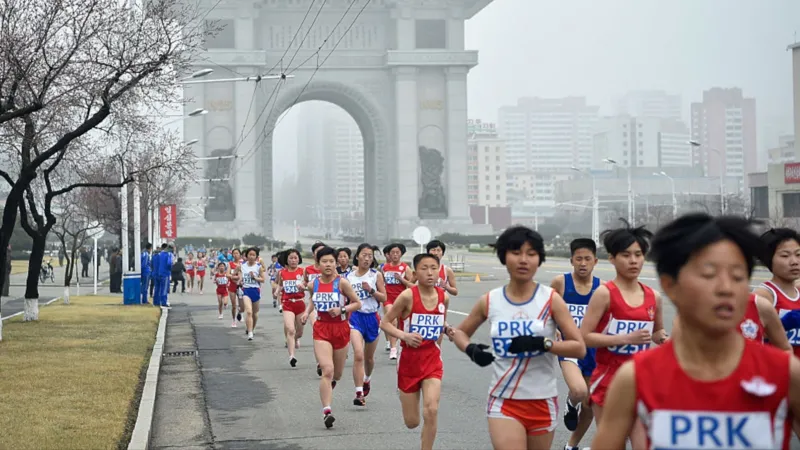
North Korea has cancelled the Pyongyang marathon for unspecified reasons, a tour agency linked to the event has said.
British-owned Koryo Tours, which describes itself as the official partner of the marathon, said on Monday that it had received notice of the cancellation from North Korea’s athletics association.
A message it attributed to the association said the marathon was being cancelled “due to some reasons”.
The annual event was established in 1981 to celebrate the birth of North Korea’s founding leader Kim Il Sung. The 2026 race was set to take place on 5 April.
The message, purportedly from the North Korea athletics association’s general secretary, thanked “all the Elite Marathoners and Amateur Runners of the world who are interested in Pyongyang International Marathon”.
The message gave no further explanation on what the reasons for the cancellation were.
Koryo Tours said it understood the decision was final and had been taken “at a level above the organisers of the event itself”.
It said it would be seeking clarification on the circumstances surrounding the decision.
The tour company added that neither organisers nor event partners were involved in making the decision, and said it recognised “this announcement will be disappointing to many runners who had already registered or were planning to participate”.
Koryo Tours, based in Beijing, China, offers several marathon packages to foreigners, departing from Beijing, Shanghai and Shenyang.
Packages start from €2,190 ($2,529; £1,894) for 2.5 nights in the North Korean capital, Pyongyang, including a marathon place and “highlights” of the capital and tickets were sold out this year, according to the agency’s website.
It said all deposits paid will be returned and runners have the option to retain their deposit for a future event or North Korea tour.
A date for the 2027 marathon has not yet been set.
The event had only returned last year after it was suspended for five consecutive years due to the Covid pandemic.
It is open to both amateur and some professional athletes and offers several race distances – 5km (3.1 miles), 10km (6.2 miles), half marathon (21.1km; 13.1 miles) or full marathon (42.2km; 26.2 miles).
[BBC]

Navy seizes an Indian fishing boat poaching in Mannar seas

Bodies of 84 Iranian sailors killed in US torpedo strike to be repatriated

Four crew members killed after US refuelling plane crashes in Iraq

Safeguarding linguistic heritage is not only a cultural responsibility, but also a shared commitment to preserving the diversity of our world – PM

This is not an ordinary scholarship programme. It defines the future vision of our country – PM

West Indies name unchanged squad for home T20Is against Australia

‘Dates have the highest sugar content to fight Coronavirus’

Sunday Island 27 December – Headlines

#SundayIsland 17th December – Headlines

Sunday Island – 28th March

Sunday Island Headlines – 21 March

Sunday Island – 21st February – Headlines
-

 News7 days ago
Peradeniya Uni issues alert over leopards in its premises
-
 News5 days ago
Repatriation of Iranian naval personnel Sri Lanka’s call: Washington
-

 News7 days ago
Wife raises alarm over Sallay’s detention under PTA
-
 Features5 days ago
Winds of Change:Geopolitics at the crossroads of South and Southeast Asia
-

 News4 days ago
Prof. Dunusinghe warns Lanka at serious risk due to ME war
-

 Sports3 days ago
Royal start favourites in historic Battle of the Blues
-

 Latest News7 days ago
Heat Index at ‘Caution Level’ in the Sabaragamuwa province and, Colombo, Gampaha, Kurunegala, Anuradhapura, Vavuniya, Hambanthota and Monaragala districts
-

 Sports2 days ago
The 147th Royal–Thomian and 175 Years of the School by the Sea