
News
Govt. urged to announce its policy on foreign research vessels soon

By Shamindra Ferdinando
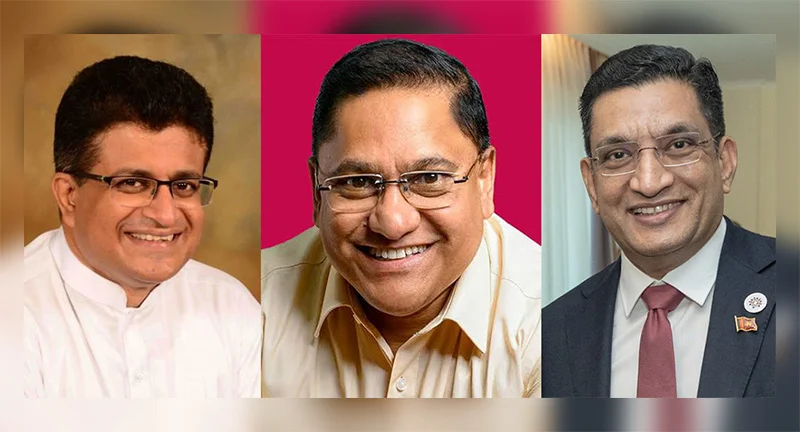
Former Foreign Minister Ali Sabry, PC, yesterday (28) said that the National People’s Power (NPP) government was in a much better position to address concerns over foreign research vessels’ visit to Sri Lankan harbours.
Sabry, who served as Foreign Affairs Minister during Ranil Wickremesinghe’s presidency (July 2022 to Sept. 2024), emphasized the need to act without keeping the issue in abeyance.
The former National List MP said so in response to The Island query how he viewed the NPP’s decision not to lift the moratorium on foreign vessels, an assurance given by him during an official visit to Tokyo mid last year.
The prominent lawyer said that he was misquoted by a section of the foreign media. That sort of misrepresented facts, the ex-parliamentarian said. “Actually, what I really told in Tokyo was that we were planning to review the moratorium towards the end of December, 2024, not lifting it as a section of the media had reported. I clarified the situation subsequently in Singapore, particularly during a programme on Channel News Asia.”
In spite of that, the media continued to quote the erroneous statement that had been attributed to me, he said. President Wickremesinghe announced a moratorium on research ship visits during 2024, following strong Indian protests over Chinese ships visiting Hambantota and Colombo.
Ali Sabry’s successor Vijitha Herath told The Island yesterday that a decision would be taken soon. The JVP and NPP frontliner recently announced the appointment of a committee to make recommendations to the government in this regard.
PC Sabry pointed out that the NPP has received an unprecedented mandate and given the fact that the public always supported a non-aligned foreign policy, the new administration, based on the committee report, should have a clear policy on research outlining the parameters, areas interested, boundaries of research, sharing of data and information gathered, and what is permitted and not, and clearly communicate it to the world and pursue in a transparent manner.
The former Minister emphasized the urgent requirement to reach a consensus on this matter.
“Given the fact that the agreement with the IMF, debt assurances and debt restructuring have been done, the NPP is in a better position to negotiate and articulate its position now, compared to what we were, as our focus was to finalize debt restructuring without creating unnecessary pressure.”
During President Anura Kumara Dissanayake’s maiden state visit to New Delhi, in December last year, after the presidential election in September, India took up the Chinese ship visits. Sources said that India, in no uncertain terms, indicated to the NPP government that their wish was to see the continuation of the ban.
After the conclusion of talks between President Dissanayake and Premier Modi, Indian Foreign Secretary Vikram Misri addressed the media. As regards the berthing of research vessels, etc., Misri was quoted as having said: “Our understanding is that the Sri Lankan Government is looking at this issue. There are several considerations that they need to consider…We pointed to the importance and the sensitivity of our security interests in this area. President Dissanayake was very upfront in saying that he would ensure that nothing was done by using Sri Lankan territory that might impact India’s security. So, we will continue to engage with the Government of Sri Lanka on all these issues, and we are confident that issues of importance, such as these, will continue to be given due care by the Government of Sri Lanka.”
Pivithuru Hela Urumaya (PHU) leader and ex-Minister Udaya Gammanpila said that the government couldn’t side-step this issue.
The government owed the public an explanation, Gammanpila said, pointing out that in the absence of a statement nearly four weeks after the lapse of the moratorium imposed by Wickremesinghe at the behest of India and US, meant Sri Lankan ports were now open for foreign research vessels visit.
Does the appointment of a committee to examine the issue mean the moratorium has been extended, pending the NPP government’s decision, the former Minister asked. Attorney-at-law Gammanpila said that the government had to keep in mind that both India and the US were aggressively pushing for continuation of the moratorium.





Latest News
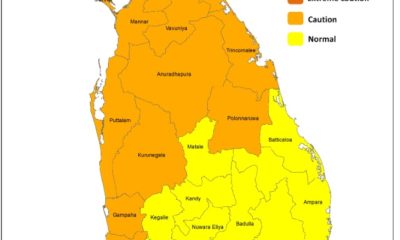
Heat Index at Caution level’ in the Northern, North-central, North-western, Western and Southern provinces and in Trincomalee district.


Warm Weather Advisory
Issued by the Natural Hazards Early Warning Centre
Issued at 3.30 p.m. on 12 April 2026, valid for 13 April 2026.
Heat index, the temperature felt on human body is likely to increase up to ‘Caution level’ at some places in the Northern, North-central, North-western, Western and Southern provinces and in Trincomalee district.
The Heat Index Forecast is calculated by using relative humidity and maximum temperature and this is the condition that is felt on your body. This is not the forecast of maximum temperature. It is generated by the Department of Meteorology for the next day period and prepared by using global numerical weather prediction model data.

Effect of the heat index on human body is mentioned in the above table and it is prepared on the advice of the Ministry of Health and Indigenous Medical Services.
ACTION REQUIRED
Job sites: Stay hydrated and takes breaks in the shade as often as possible.
Indoors: Check up on the elderly and the sick.
Vehicles: Never leave children unattended.
Outdoors: Limit strenuous outdoor activities, find shade and stay hydrated.
Dress: Wear lightweight and white or light-colored clothing.
Note:
In addition, please refer to advisories issued by the Disaster Preparedness & Response Division, Ministry of Health in this regard as well. For further clarifications please contact 011-7446491.

On the apparent northward relative motion of the sun, it is going to be directly over the latitudes of Sri Lanka from 05th to 15th of April in this year.
The nearest areas of Sri Lanka over which the sun is overhead today (13th) are Pesalai, Mankulam and Nedunkerny about 12:11 noon.
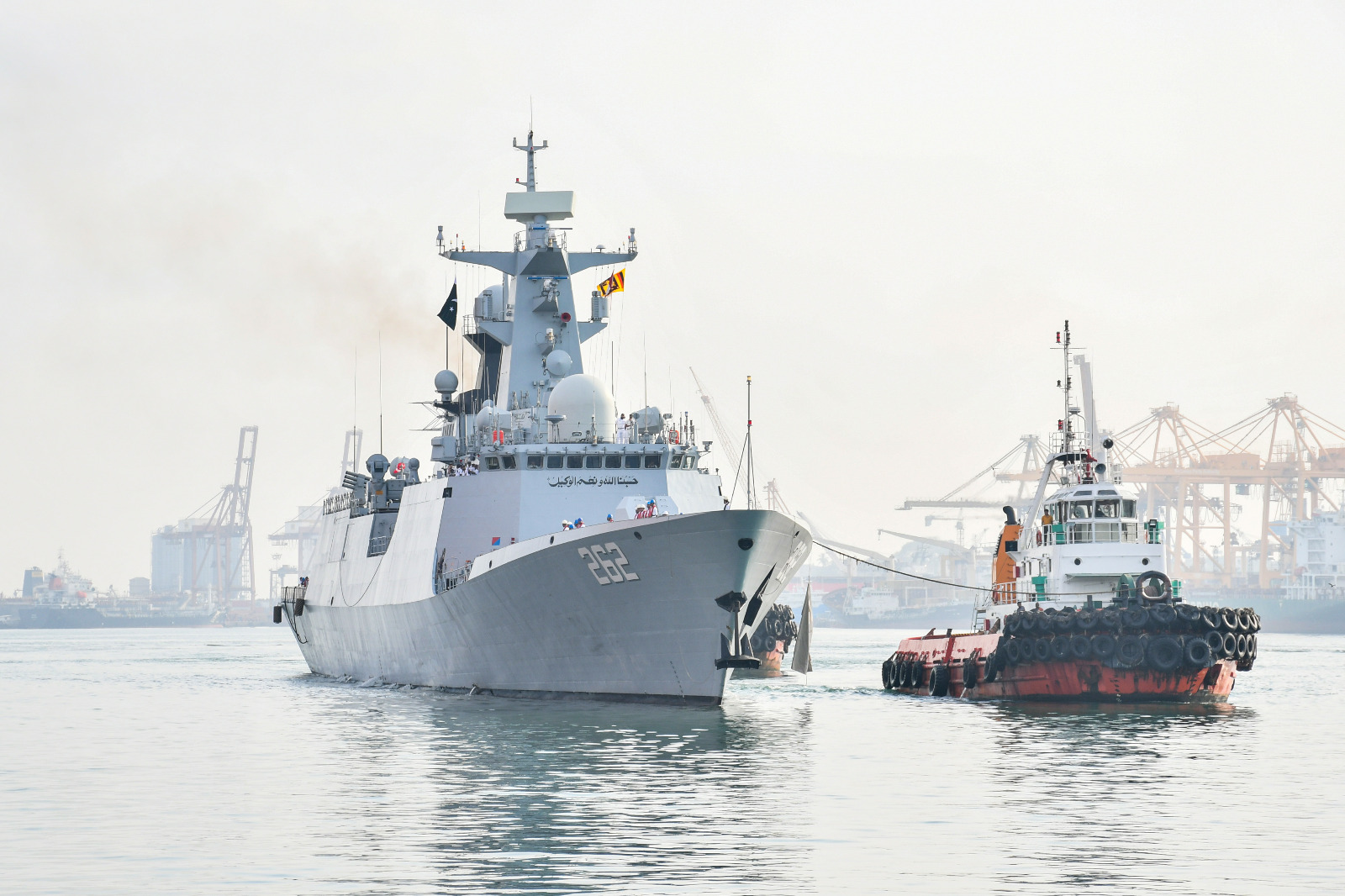
The Pakistan Navy Ship (PNS) TAIMUR and ASLAT arrived at the Port of Colombo on a goodwill visit on 12 Apr 26.
The visiting ships were welcomed by the Sri Lanka Navy in
compliance with naval traditions.
The duo of ships is commanded by Captain NIAMAT SAEED KHAN (PNS TAIMUR) and Captain NADIR MATEEN AFRIDI (PNS ASLAT).
Meanwhile, the ships are expected to conduct a Bilateral Naval Exercise LION STAR V with the Sri Lanka Navy in Colombo seas.

Salt and Patidar power RCB past Mumbai Indians

Prasidh, Buttler set up comfortable win for Gujarat Titans

Heat Index at Caution level’ in the Northern, North-central, North-western, Western and Southern provinces and in Trincomalee district.

Showers above 75 mm are likely at some places in the Western, Sabaragamuwa, Central, Southern and North-western provinces.

Sun directly overhead Pesalai, Mankulam and Nedunkerny about 12:11 noon

PNS TAIMUR & ASLAT arrive in Colombo

‘Dates have the highest sugar content to fight Coronavirus’

Sunday Island 27 December – Headlines

#SundayIsland 17th December – Headlines

Sunday Island – 28th March

Sunday Island Headlines – 21 March

Sunday Island – 21st February – Headlines
-

 News2 days ago
CEB orders temporary shutdown of large rooftop solar systems
-

 News7 days ago
Lankan-origin actress Subashini found dead in India
-

 News5 days ago
AG: Coal procurement full of irregularities
-

 Business4 days ago
Israeli attack on Lebanon triggers local stock market volatility
-

 Business5 days ago
Hayleys Mobility introduces Premium OMODA C9 PHEV
-

 News7 days ago
UN Regional Director launches SL’s first Country Gender Equality Profile during official visit
-

 News7 days ago
Dialog Launches ‘GanuDenu QR’, Making Cashless Transfers Free for All with eZ Cash and Dialog Finance
-

 Business4 days ago
HNB Assurance marks 25 years with strategic transformation to ‘HNB Life’