
News
Govt. decision to give two million farming families freehold land deeds will lead to shanty towns – Udaya


By Saman Indrajith
The government’s decision to give two million farming families freehold land deeds will lead to shanty towns popping up in most major towns in Sri Lanka, Pivithuru Hela Urumaya (PHU) leader Udaya Gammanpila said.
Gammanpila added that President Ranil Wickremesinghe’s Urumaya Freehold Deed Programme could probably mark the end of Sri Lankan smallholder farming.
Gammanpila said that farmers only mad money during crop harvesting periods, i.e., at most three times a year.
“A typical farmer borrows money to cover daily expenses. Then he pays these loans with the money he makes during the harvest. Sometimes, he suffers crop losses due to natural disasters, diseases and insects. Sometimes, the farmers commit suicide, but because they do not have freehold titles, the land remains in the family,” he said.
Gammanpila said that since Independence, successive governments have given farmers deeds that are not transferable or sellable. None of these governments have freehold deeds because it was understood that farmers were in a debt trap.
“These days, farmers are facing greater economic challenges than ever. If we give them freehold land, within two years, a significant number of farming families will sell their lands. We will have so many landless people.”
The PHU leader said that most farmers are indebted to loan sharks. This is mainly the fault of banks, which are hesitant to give loans to farmers. Most bank loan schemes are aimed at monthly wage earners.
“The government recently decided that it will not purchase paddy this year. It will, however, give nine billion rupees to small and medium-scale rice millers so that they can buy paddy from farmers. If the government can come up with new schemes to support millers, it should also do something for farmers.”
About 35 percent of the workforce is in the informal sector, and the government and banks must come up with creative schemes to cater to their needs, too, he said.
“Now, the loan sharks can’t ask the farmers to keep their deeds as collateral. With freehold titles, loan sharks can ask farmers to do so, and the moment something goes wrong, these unscrupulous businessmen will take over farmers’ lands. What will the farmers do? Because of their pride, most people will come into the main towns with their families, instead of becoming a labourer. They will set up a shed, and we will soon have colonies of shanties.”
Gammanpila said that such shanty towns can be seen across South Asia. We escaped that because Presidents Ranasinghe Premadasa and Mahinda Rajapaksa pumped money into rural infrastructure. Despite the many shortcomings of the initiatives of these men, most Sri Lankan villages have schools, a road network and basic infrastructure that prevented an exodus of villagers into towns.
“These shanty towns become dens of inequity. There will be diseases and crime. Unplanned urbanization will lead to a plethora of socio-economic problems. Just look at India, Bangladesh, Nepal, Indonesia, etc.”
Gammanpila said the government needs to introduce farming insurance, and state banks should come up with deposit and lending schemes for farmers. Even if we had such schemes, this is the worst time to expose farmland to market mechanisms, he said.
“The price of locally manufactured goods have doubled in the last 18 months. Price of imports has tripled. Most people are selling their assets to make ends meet. At this point, we are giving farmers another item they can sell or pawn. Why are people taking loans now? It’s to bridge the gap between income and expenses. They are not borrowing to invest. There is no way that people can pay these loans. This is the reality.”
The PHU MP said he has no problem introducing a freehold deed scheme once the economy has recovered and bank loans and insurance schemes for farmers have been established.
“Even now, there is nothing preventing farmers from joining hands with others to start collectives, establish businesses or lease the land to another farmer in the same category. There are people who have established farmer’s cooperatives. We also have other state lands that can be released for large-scale commercial agriculture.”









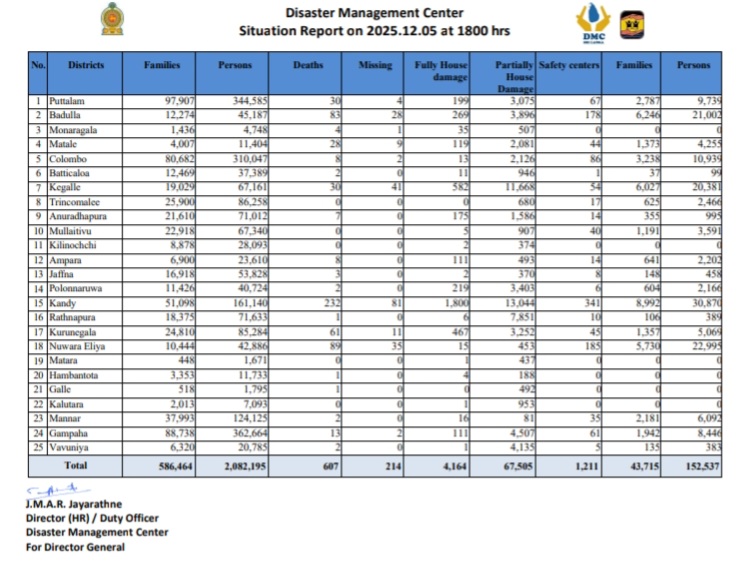
The situation report issued by the Disaster Management Centre at 1800hrs today (5th December) confirms that 607 persons have died due to the adverse weather conditions while the number of missing persons has reduced to 214.
The number of persons affected topped the 2 million mark (2,082,195).

The Sri Lanka Navy (SLN) formally took delivery of the EX- United States Coast Guard Cutter, USCGC DECISIVE, provided by the United States to SLN, at a ceremony held at the United
States Coast Guard Yard in Baltimore on 02 Dec 25. The event was also attended by the Commander of the Navy, Vice Admiral Kanchana Banagoda.
The ship formally joined the SLN fleet on 02 December under the pennant number P 628 and the main mast of the ship will fly the National Flag effective from that date.
Aiming to strengthen and develop partnerships to overcome common challenges in the maritime domain, the U.S. Coast Guard has previously provided 03 ships to SLN and they are currently patrolling island waters under the names of ‘Samudura’ (P 621), ‘Gajabahu’(P 626), and ‘Vijayabahu’ (P 627).
As an extension of partnership ties that bring value to each other’s services, Ex-USCGC DECISIVE was transferred as the fourth ship to be handed to SLN.
Ex-USCGC DECISIVE, a ‘B-Type Reliance Class 210-foot Cutter’, measures 64m in length, and having endurance of 6000 NM at cruising speed. Further, she has been designed for a
crew of 100 and is equipped with weapons and machinery.
The ship which was used by the U.S. Coast Guard has rendered exceptional service during her tenure by curbing illegal activities, including smuggling of narcotics in U.S. waters.
Sri Lanka inherits an Exclusive Economic Zone (EEZ) that is seven times larger than the landmass. In such a backdrop, the Navy is determined to deploy this vessel in wide-ranging
operations that include the conservation of marine resources in the region and the search and rescue of naval and fishing communities in distress. Thereby, the Navy will be able to utilize
this vessel efficiently in the future to achieve the national aspiration, while ensuring safe and secure seas for all economic affairs.
The formal handing over – taking over ceremony was also distinguished by the presence of the Deputy Chief Acquisition Officer and Director of Domain & Integration Services U.S. Coast
Guard, James L. Knight, Deputy Assistant Secretary of War for South and Southeast Asia, Dr. Andrew Byers, the Ambassador of Sri Lanka to the United States, Mahinda Samarasinghe, Commanding Officer designate of P 628, Captain Gayan Wickramasuriya as well as a group of officials from the Embassy of Sri Lanka in United States and the State Department
of the United State
The situation report issued by the Disaster Management Center at 0600hrs today [5th December] confirms that 486 persons have died and another 341 persons are missing after the devastating weather conditions in the past week.
171,778 persons have been displaced and have taken refuge at 1,231 safety centers established by the government.


Death toll rises to 607, missing persons reduce to 214 at 1800hrs today (5)

Sri Lanka Navy takes delivery of Ex-USCGC DECISIVE

Hope holds firm as West Indies drag New Zealand into fifth-day battle

Ireland among countries boycotting Eurovision after Israel allowed to compete

Putin says Russia will take Donbas by force or Ukraine’s troops will withdraw
486 dead, 341 missing, 171,778 displaced as at 0600hrs today [05]

‘Dates have the highest sugar content to fight Coronavirus’

Sunday Island 27 December – Headlines

#SundayIsland 17th December – Headlines

Sunday Island – 28th March

Sunday Island Headlines – 21 March

Sunday Island – 21st February – Headlines
-
 News6 days ago
Weather disasters: Sri Lanka flooded by policy blunders, weak enforcement and environmental crime – Climate Expert
-
 Latest News6 days ago
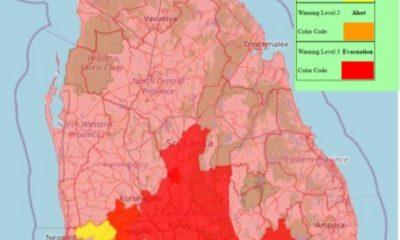
Level I landslide RED warnings issued to the districts of Badulla, Colombo, Gampaha, Kalutara, Kandy, Kegalle, Kurnegala, Natale, Monaragala, Nuwara Eliya and Ratnapura
-

 Latest News6 days ago
INS VIKRANT deploys helicopters for disaster relief operations
-
News3 days ago
Lunuwila tragedy not caused by those videoing Bell 212: SLAF
-

 Latest News7 days ago
Department of Irrigation issues Critical flood warning to the Kelani river basin
-
 Latest News4 days ago
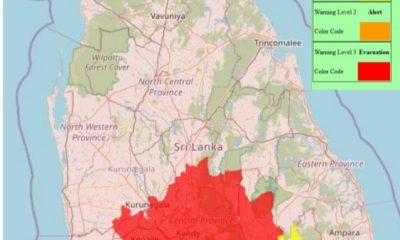
Level III landslide early warnings issued to the districts of Badulla, Kandy, Kegalle, Kurunegala, Matale and Nuwara-Eliya
-
 News2 days ago
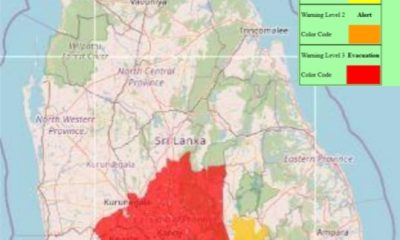
Level III landslide early warning continue to be in force in the districts of Kandy, Kegalle, Kurunegala and Matale
-

 Editorial7 days ago
Needed: Action not rhetoric