
Editorial
Futile gimmicks


Tuesday 10th October, 2023
President Ranil Wickremesinghe has reportedly taken exception to his likeness being used in cutouts, banners, posters, etc., and banned such representations of him. The erection of a cutout of Ozymandian proportions carrying his picture in Batticaloa is said to have irked him beyond measure. He had it removed immediately. That could be considered a wise move in that the use of such propaganda paraphernalia is counterproductive. Propagandists tend to go overboard in their efforts to please their masters. One may recall that a plethora of monstrous cutouts displaying the pictures of Mahinda Rajapaksa would shadow many intersections across the country when he was the President so much so that he looked like Big Brother watching the people to ensure that no one stepped out of line. But such gimmicks did not prevent him suffering a painful pratfall in the 2015 presidential race.
Good wine is said to need no bush, and a political leader therefore can do without cheap promotional stunts to boost his or her image if he or she is confident of winning the hearts and minds of voters by governing the country well. If President Wickremesinghe, or any other leader for that matter, lives up to the expectations of the public, he will need no propaganda gimmicks to win future elections.
It is being claimed in some quarters that President Wickremesinghe has failed to fulfil his promises to the public, and instead heaped unbearable economic burdens on them. This assertion may not be without some merit, but the question is whether it is fair to expect him to sort out a bankrupt economy in double-quick time, much less perform economic miracles. The country is facing its worst-ever economic crisis, the blame for which should be apportioned to all successive governments, albeit to varying degrees. The ailing economy has had to undergo a painful treatment regimen, whose positive effects will take some more time to kick in.
Ranil has been able to make a stunning comeback and overshadow other political leaders because he took time by the forelock last year, after the resignation of Prime Minister Mahinda Rajapaksa; he accepted President Gotabaya Rajapaksa’s invitation and took over as Prime Minister while other political leaders did not take the political gamble, citing various reasons. If Ranil, too, had refused to accept the premiership, the country would have been rudderless when President Rajapaksa fled overseas and sent in his resignation. One shudders to think what would have happened if Ranil had not been there to order the military and the police to disperse the mobs that tried to march on Parliament, last year. But for his decisive action, the country would have been plunged into anarchy and bracketed with Libya, etc.
President Wickremesinghe may be able to shore up his image, provided he continues to perform well on the economic front. But it is doubtful whether he will be able to revitalise the UNP with the same political liabilities occupying its key positions. There are some promising ones, but they are a microscopic minority. It is thanks to those arrogant, incompetent and corrupt characters that the UNP was reduced to a single National List seat at the 2020 general election. The presidential contest is a political steeplechase, wherein the candidates jockeying for the cup must ride thoroughbreds, and not donkeys!
President Wickremesinghe may be able to obviate the need for propaganda cutouts to boost his image by reviving the economy, but he has his work cut out on the political front. The SLPP leaders are notorious for tripping anyone up if they consider him or her a political threat to them. Mahinda has resumed temple visits, and other SLPP seniors are striking discordant notes while trying to dupe the public into believing that they were not responsible for bankrupting the country. Interestingly, the Rajapaksas are even critical of the postponement of elections, which they and President Wickremesinghe will not be able to live down!
Curiously, President Wickremesinghe goes out of his way to kick up political rows and invite trouble while struggling to straighten up the economy, and run unnecessary political risks, as evident from the public outcry against the Online Safety Bill, etc. Old habits are said to die hard!

Wednesday 24th December, 2025
Climate change has upended long-held theories about cyclones in the equatorial regions, and Sri Lanka, which was once considered reasonably safe from such severe weather phenomena, is becoming increasingly vulnerable, as evident from the devastating impact of Cyclone Ditwah. All signs are that the worst is yet to come, and the need for a multi-pronged national strategy to prepare the country to face future natural disasters linked to climate change cannot be overstated.
The government of Sri Lanka has been in overdrive, seeking assistance from the international community for its post-Ditwah rebuilding programmes. The World Bank has estimated the losses caused by the recent disasters at USD 4.1 billion. Foreign assistance is coming, but in dribs and drabs. There have also been loans for rebuilding, but such borrowing is bound to make the country’s efforts to achieve debt sustainability even more uphill. This has caused much concern to international experts.
A group of internationally renowned economists, including Nobel Laureate Joseph Stiglitz, has called for the “immediate suspension of Sri Lanka’s external sovereign debt payments, and a new restructuring that restores debt sustainability under the new circumstances”. Other members of the group of eminent economists urging the international community to help Sri Lanka are Jayati Ghosh, Thomas Piketty, Martín Guzmán and Kate Raworth. They have said: “This environmental emergency is poised to absorb – and potentially exceed – the extremely limited fiscal space created by the current debt restructuring package. Additional external debt is already being obtained from the IMF, and more lending to deal with the impacts of the disaster is likely.” These economists deserve praise for their concern for a disaster-stricken nation mired in debt, but whether international creditors will take a sympathetic view of Sri Lanka’s predicament and agree to another round of debt restructuring is in doubt.
Another debt default is something Sri Lanka needs like a hole in the head. Hence the need to explore other avenues to raise finance for rebuilding.
Leader of the United Republic Front and former Cabinet Minister Patali Champika Ranawaka argued in an interview with Derana TV on Monday night that Sri Lanka should leverage its situation as a victim of climate change to gain access to international climate financing to cover at least part of the cost of post-disaster rebuilding, instead of depending on loans. He said that obtaining such climate relief should be part of Sri Lanka’s recovery strategy, and some debt relief should be sought from the carbon-polluting industrialised nations among its creditors.
There is a growing corpus of literature about the pathways vulnerable states can use to seek climate aid. The countries affected by climate change can gain access to international aid and relief through established climate finance mechanisms, humanitarian channels, and multilateral institutions. A dedicated Loss and Damage Fund is now in place to channel resources to vulnerable nations. There have been instances where some vulnerable nations, especially those of the organisations, such as the Small Island Developing States (SIDS), have successfully accessed international climate change finance, relief and legal avenues for support. Tuvalu became one of the first Pacific island nations to access climate finance from the Green Climate Fund. However, UN reports show that SIDS still receive only a fraction of international climate finance relative to their vulnerability. There’s the rub.
Another method the victim nations can adopt to raise funds is ‘innovate finance’, which has been defined as “creative use of financial markets and partnerships with international finance institutions to support adaptation and resilience in a climate-vulnerable nation”.
What Ranawaka has proposed by way of easing the country’s rebuilding burden to some extent deserves serious consideration. It is hoped that the government will take such views on board at this crucial juncture.
Tuesday 23rd December, 2025
What’s this world coming to when the police cringe and cower before politicians? The JVP has a history of attacking the police. It even murdered the family members of the police personnel who dared defy its illegal orders during its reign of terror in the late 1980s. Old habits are said to die hard. A policeman attached to the Suriyakanda police station has complained that a gang led by a JVP/NPP MP assaulted him following a raid on a cannabis cultivation in Bulutota in the Suriyakanda area. The victim was first admitted to the Kolonna hospital and thereafter transferred to the District General Hospital, Embilipitiya.
NPP MP Shantha Pathmakumara Subasinghe has denied any involvement in the aforesaid assault incident. He has claimed that the policeman confronted him and there was a heated argument; the assault incident was a total fabrication and part of a conspiracy against him, he has alleged. If so, why was the policeman hospitalised and transferred to a District General Hospital? Another police officer has been transferred over the cannabis cultivation issue, according to media reports.
Worse, the policeman receiving treatment was arrested yesterday while his assailants were moving about freely! Thankfully, he was granted bail.
If the land used for cannabis cultivation in Bulutota had belonged to an Opposition politician, IGP Priyantha Weerasooriya himself would have rushed there and held a press conference. Most of all, if the assailants of the policeman had been political rivals of the ruling JVP/NPP, they would have been arrested immediately.
The JVP/NPP politicians have apparently graduated from roughing up their political rivals to assaulting policemen. Such transgressions brought about the collapse of the Mahinda Rajapaksa government, which gave free rein to the likes of Mervyn Silva, who together with his son, reduced the police to a bunch of lackeys. The culture of impunity persists despite last year’s regime change.
The JVP leaders asked for stern action against Mervyn, his son and other goons—and rightly so. They sought a popular mandate to govern the country, break what they called a 76-year curse, eliminate bribery and corruption and political violence and restore the rule of law. But today the ruling party politicians have risen above the law. The police mysteriously ran out of breathalyzers when NPP MP Asoka Ranwala met with an accident. He was subjected to a blood alcohol test more than 12 hours after the crash, and his blood and urine samples were sent to the Government Analyst’s Department. It was a foregone conclusion that those samples would test negative for alcohol. There have been instances where heroin samples sent to the Government Analyst’s Department for testing turned out to be flour! Such is the integrity of that institution.
The police unashamedly sided with a group of JVP cadres who stormed a Frontline Socialist Party office and forcibly occupied it a few months ago. The JVP/NPP members can park their vehicles anywhere on the expressway with impunity. Drunk driving is not a problem for the government MPs, for they can undergo blood alcohol tests leisurely after they become fully sober in case of accidents. When raids happen to expose ruling party politicians’ involvement in drug dealing, police officers who conduct them are transferred or assaulted.
One of the worst things that can happen to a country is for its citizens to lose faith in its legal system. A perquisite for bringing order out of chaos in any society is to restore the rule of law, and this is a task for statespersons and not a bunch of self-righteous politicians posing as messiahs.
Politicians take leave of their senses when power goes to their heads. This may explain why they rough up policemen, subvert the legal process, hold ceremonies to mark the resumption of train services after disasters and dance like clowns at railway stations while the country is mourning hundreds of its citizens who perished in disasters.


Monday 22nd December, 2025
Maan Pharmaceuticals Ltd., the manufacturer of Ondansetron, which has been withdrawn from hospitals here pending a probe, is reported to have asked the Sri Lankan health authorities to have the drug tested by an internationally accredited laboratory. The use of nine other Maan products too has been suspended in Sri Lanka over quality concerns. Maan’s reaction has come as no surprise; all companies ardently defend their products. However, its concerns should be heeded. The National Medicines Regulatory Authority (NMRA) and the Ministry of Health ought to furnish irrefutable evidence in support of their decision to suspend the use of the drugs at issue. The manner in which the NMRA has carried out its duties and functions, especially granting approval for drugs and investigating complaints of their quality, over the years, does not inspire public trust.
The subtext of what has been reported of the Maan’s letter to the Sri Lankan health authorities is worth taking note of. It can be argued that in corporate newspeak, Maan has questioned the competence of the NMRA to test its products. As Maan would have us believe that its products meet international standards, it should be asked to state whether it has gained access to stringent regulatory destinations, such as the US and EU, and, if not, why.
It is being argued in some quarters that the degradation of pharmaceuticals can happen due to improper storage and transport. Maan’s aforesaid letter reportedly has reference to drug storage here. There are allegations that the Sri Lankan health authorities leave imported drugs in freight containers under inappropriate conditions for extended periods. However, the phials of Ondansetron which were tested at the Kandy National Hospital and found to be affected by microbial contamination had been stored properly and their seals were intact, according to media reports, quoting doctors. Thus, the contamination of the drug points to issues in manufacturing and packaging rather than storage and transport.
Meanwhile, a news item in this newspaper today reveals the pivotal importance the pharmaceutical industry has assumed in the Indian economy; India’s pharmaceutical exports have crossed USD 30 billion. Therefore, some critics of the Indian pharmaceutical products are of the view that India will do everything in its power to protect the interests of its drug companies, including Maan. But the fact remains that India itself has cracked down on some of its pharmaceutical companies involved in scandals. It severely dealt with the Indian companies that manufactured contaminated cough syrups which killed 66 children in Gambia in 2022 and 22 children in India in September 2025.
In the greed-driven corporate world, profits take precedence over human life, and there is hardly anything that Big Pharma spares in pursuing profit maximisation. As we pointed out in a previous comment, the World Health Organization has revealed that at least one in 10 medical products in low-and middle-income countries fails to meet quality standards or is falsified. This shows the enormity of the problem of fake and substandard drugs. Hence the need for robust mechanisms to protect patients.
All issues related to substandard and falsified drugs and their adverse effects in this country boil down to the failure of successive governments to address multiple problems pertaining to drug regulation and testing and find long-term solutions. Flaws in regulatory oversight and the absence of proper testing facilities have helped corrupt politicians and bureaucrats enrich themselves by turning this country into a dumping ground for poor-quality and fake medicines. Health Minister Dr. Nalinda Jayatissa himself has said that not all drugs approved by the NMRA undergo rigorous testing, and thorough tests are conducted on drugs only when there are complaints about their quality.
Most of all, the NMRA has to be cleansed, as a national priority. Its history is replete with numerous scandals, including allegations of corrupt drug registrations, data manipulation, issues with substandard and fake medicines leading to patient deaths prompting investigations, suspensions, legal action, and internal turmoil with officials resigning amidst claims of threats and cover-ups.

Navy seizes an Indian fishing trawler poaching in Sri Lankan waters north of Talaimannar

Several spells of showers may occur in Central, Uva and Eastern provinces and in Polonnaruwa and Mullaittivu districts

India’s External Affairs Minister meets Sri Lanka PM

Shafali 69 not out , spinners lead India’s rout of Sri Lanka

Sri Lanka’s coastline faces unfolding catastrophe: Expert

SOC examines proposed amendments to the Microfinance and Credit Regulatory Authority Bill

‘Dates have the highest sugar content to fight Coronavirus’

Sunday Island 27 December – Headlines

#SundayIsland 17th December – Headlines

Sunday Island – 28th March

Sunday Island Headlines – 21 March

Sunday Island – 21st February – Headlines
-

 News2 days ago
Members of Lankan Community in Washington D.C. donates to ‘Rebuilding Sri Lanka’ Flood Relief Fund
-
 News7 days ago
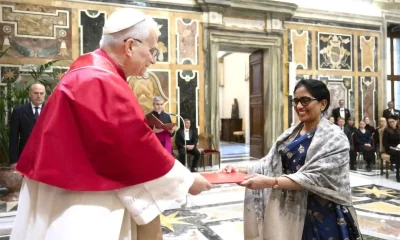
Pope fires broadside: ‘The Holy See won’t be a silent bystander to the grave disparities, injustices, and fundamental human rights violations’
-

 News7 days ago
Pakistan hands over 200 tonnes of humanitarian aid to Lanka
-

 Business6 days ago
Unlocking Sri Lanka’s hidden wealth: A $2 billion mineral opportunity awaits
-

 News6 days ago
Army engineers set up new Nayaru emergency bridge
-

 News7 days ago
Officials of NMRA, SPC, and Health Minister under pressure to resign as drug safety concerns mount
-

 News7 days ago
Expert: Lanka destroying its own food security by depending on imported seeds, chemical-intensive agriculture
-

 Editorial7 days ago
Flawed drug regulation endangers lives