
News
FSP cries foul over allowing India to have stranglehold over SL power sector

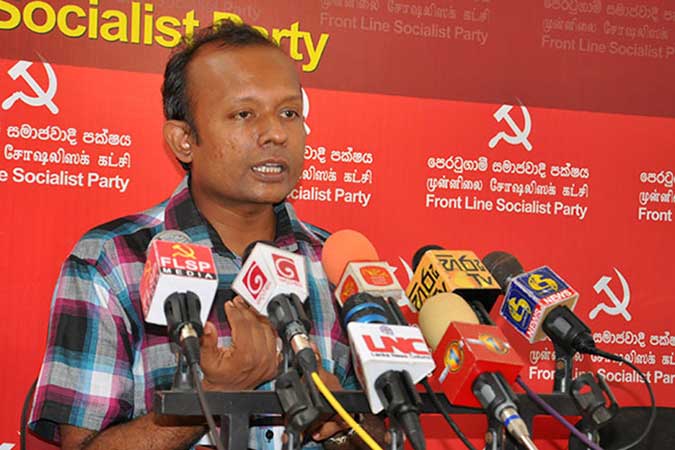
… condemns haste in tying up deals on eve of important national poll
By Rathindra Kuruwita
The government continues to enter into secretive agreements with India, compromising the nation’s economic and political sovereignty, says Pubudu Jayagoda, Education Secretary of the Frontline Socialist Party (FSP).
Jayagoda told The Island yesterday that the Memorandum of Understanding (MOU) signed on Tuesday (20) between LTL Holdings Ltd., Sri Lanka, and Petronet LNG Ltd., India, for developing infrastructure related to the storage, regasification, and supply of Liquefied Natural Gas (LNG) to the ‘Sobadhanavi’ Combined Cycle Power Plant at Kerawalapitiya was detrimental to the country’s energy security.
“People’s attention is now on elections and the government is busy signing vital international agreements, despite the widespread belief that President Ranil Wickremesinghe will not win the election on 21 September. The agreement signed on Tuesday will have devastating consequences for the country’s energy security,” Jayagoda stated.
Jayagoda claimed that the agreement between LTL Holdings and Petronet had stemmed from an unsolicited proposal, with the details not disclosed to the public. Wickremesinghe in his 2023 visit to India had agreed to integrate the energy sectors of the two countries and the agreement at issue was a part of that understanding, he said.
“India has been allowed to control the LNG supply to Sri Lanka without competitive bidding. Now, India has a monopoly. The procurement procedure has been bypassed. It is highly likely that the government has agreed to purchase LNG at prices higher than the market rate, placing an additional burden on the people of this country. It is evident that this agreement was signed under Indian pressure,” the FSP Education Secretary told The Island.
Jayagoda also noted that Sri Lanka was planning to generate 1,000 megawatts of electricity from LNG in the short term, at the Yugadhanavi and Sobadhanavi power plants, as well as some sections of the Kelanitissa power plant, set to operate on LNG.
“India will be the sole supplier for these plants. You can imagine the control this gives India—it’s akin to having the main switch, trip switch, and fuse board of your house installed in the neighbour’s house,” he said.
A number of countries in the region had entered into similar agreements with India and those nations had learnt that when India gained access to those vital sectors, its control over them was used to push for political and economic agendas favourable to India.FSP Education Secretary said that if a future Sri Lankan government antagonised India in any manner, the Indian company could deliberately delay LNG supplies, crippling the Sri Lankan economy.






The National Water Supply and Drainage Board (NWSDB) on Friday said the largest groundwater source discovered in Sri Lanka so far had been identified during tube-well drilling near the Pitabeddara Police Station.
Indrajith Gamage, geologist in charge of the Southern Province, said the source recorded a continuous flow of about 10,000 litres (10 cubic metres) per minute, marking the first instance in the country where a groundwater source of that magnitude had been found.
He noted that the previous largest groundwater source was discovered in the Madhu area, which recorded a flow of about 7,000 litres per minute.
According to the NWSDB, the tube well was drilled following geological studies of rock layers and the identification of underground water through fractures in rock strata using specialised technical instruments.
The Board said steps would be taken to distribute water from the newly discovered source to residents facing shortages in Pitabeddara, Morawaka and surrounding areas.

The Ceylon Chamber of Commerce has formally handed over its historical records to the National Archives Department, entrusting over a century of the nation’s commercial history to the country’s official custodians of heritage.
The archive, spanning from the CCC’s founding in 1839 to 1973, includes correspondence, meeting minutes, reports, ledgers, and publications that chronicle the development of trade, enterprise, and industry in Sri Lanka. Together, the records provide a rare and detailed account of the island’s economic evolution and the role of its business community in shaping national progress.

The Ministry of Defence said on Friday (13) that arrangements had been made to repatriate to Iran the bodies of 84 sailors who died aboard the IRIS Dena, which sank in the southern seas off Sri Lanka.
A special aircraft carrying the bodies departed from Mattala Rajapaksa International Airport on Friday, the Ministry said, adding that the repatriation was carried out in coordination with the Embassy of Iran in Sri Lanka.
The remains had been kept in two mobile cold-storage units at the Galle National Hospital before being transported to Mattala by lorry following a court order. Forty-five bodies were moved in the morning, while the remaining 39 were transported later in the day.
Earlier this month, the Iranian naval vessel suffered an incident about 40 nautical miles off Port of Galle while carrying around 180 personnel. Thirty-five rescued sailors were admitted to the Karapitiya Teaching Hospital, while 84 bodies were subsequently recovered.
Following the incident, Pete Hegseth confirmed that the Iranian vessel had been sunk in international waters by a torpedo fired from a submarine of the United States Navy.
Showers will occur at several places in the Western, Sabaragamuwa, Central, North-western and Uva provinces and in Galle, Matara, Mannar and Anuradhapura districts after 2.00 pm.

Lanka discovers largest groundwater source

Lanka’s commercial legacy preserved in National Archives

Bodies of 84 Iranian sailors flown home

Kirsten brings pedigree, but Sri Lanka must fix the system

Barrels vs bombs

‘Dates have the highest sugar content to fight Coronavirus’

Sunday Island 27 December – Headlines

#SundayIsland 17th December – Headlines

Sunday Island – 28th March

Sunday Island Headlines – 21 March

Sunday Island – 21st February – Headlines
-

 News6 days ago
Repatriation of Iranian naval personnel Sri Lanka’s call: Washington
-
 Features6 days ago
Winds of Change:Geopolitics at the crossroads of South and Southeast Asia
-

 News5 days ago
Prof. Dunusinghe warns Lanka at serious risk due to ME war
-

 Sports4 days ago
Royal start favourites in historic Battle of the Blues
-

 Sports3 days ago
The 147th Royal–Thomian and 175 Years of the School by the Sea
-

 News3 days ago
Historic address by BASL President at the Supreme Court of India
-

 News4 days ago
CEBEU warns of operational disruptions amid uncertainty over CEB restructuring
-

 Business4 days ago
BOI launches ‘Invest in Sri Lanka’ forum