
Opinion
Four generations


Surasena was a scraggy boy with a runny nose, most of the time. He came to school sometimes, when he was well enough. Coughs and colds were a part of him. The entire school had an enrolment of less than 100; attendance varied from about 80 to about 100. Enrolment fell as students dropped out as they grew older: in grade V, there were usually 6 or 7 students, mostly boys. Most students were in Kindergarten, the Lower and the Upper. There were six teachers, one female, who was the principal’s wife, and both came from about 75 km away. They lived in the principal’s quarters with no other suitable house they could rent in the village. There was one English teacher, a man who cycled daily from a considerable distance. He was remarkably regular. He was the class teacher for Grade III and taught English in grades III, IV and V. He had had no special training in teaching English, or any other language and his final year students could hardly write the English alphabet without error. The parents of the children were mostly illiterate and hardly came to school after they had brought their child for admission. Surasena’s illiterate parents saw no function they could serve in the school. Teachers did the teaching.
Although Surasena was irregular in attendance, he picked up what was taught in class without any effort. When the end-of-term tests came, if he were present, he always came first in class. One teacher noticed this and spoke to the principal. The teacher thought that the boy was bright enough to win a scholarship if the gaps in his knowledge of arithmetic could be filled. Because the boy had come to school only when he was well, there were large gaps in his competence, especially in arithmetic. The young teacher took up the challenge, and when the results came, the boy had done well. So began a venture, which few had set out on then. One scholarship after another carried him to the highest centre of learning in his discipline, where he earned the highest degree any university could award.
Then a career: compromising among several objectives and laying aside many objections, Surasena decided to work for the world’s primary intergovernmental organisation. In doing so, he chose to live in the richest city in the world. Rich cities offer citizens many and varied services unavailable in less sophisticated habitats: theatres, concert halls, public libraries, high quality schools, universities, good sanitation and sophisticated architecture. Surasena chose to send their children to a unique school where both students and teachers came from many parts of the world. When the children prepared to go to university, each of them found her/himself in the first percentile of intellectual ability. Each chose to attend the highest quality colleges and universities. Their first jobs were with the Securities and Exchange Commission and the Federal Reserve System, both the highest-level regulatory agencies in that country. They eventually changed their careers and residences. One took up to law in New York City and the other a professorship in a state university.
Two young men in the fourth generation have completed secondary school and are in universities studying engineering.
An illiterate family goes to university. A family that lived in a coconut leaf thatched hut in a remote village lives in good housing in choice parts of cities, large and small. A boy who had only rice ration books in his home dispersed his collection of nearly one thousand books to several universities. A man who had never seen a play on a stage goes to Broadway and Carnegie Hall regularly. A young man in the fourth generation plays the saxophone at the Lincoln Centre. A family in the first generation that had not ventured beyond its native district, in the second generation, travels the world over. With different destinations and varied byways, these paths have been traversed by thousands of individuals and families in our society. A different and much larger cohort of our labour force, young, healthy and literate, has been pushed out of our economy.
I have used a fictional name to avoid embarrassing individuals. The rest of the narrative is factual. These sequences are repeated many thousands of times in this country, a highly mobile society. Neither poverty nor social position or habitat in town nor country bars children of ability from going where they wish. (One last habitat is systematically denied access to the high roads. One expects these roads to open literally and metaphorically, in short order.) We have had several employees in our household who used their earnings to pay for their children’s education at university. A few weeks back, one of those children graduated from a prestigious medical faculty in the country. A child in another family is in university studying mathematics. I reckon that is not an uncommon or infrequent occurrence.
It is one thing to move up the education ladder and another to find mobility within the economy. The space at the top is created in the economy and not in schools. It is an easy and common confusion to think that young men and women cannot find employment because they studied the wrong subjects at school or university. No matter what they learnt at school and university, they will be unemployed so long as there is no demand for labour. And the demand for labour is a function of the structure and the level of activity in the economy, not of the education system. Well into the second half of the 19th century, the founders of Dartmouth College declared, ‘though our great objective was to erect a seminary for educating ministers of the gospel, yet we hope that it will be a means of raising up men that will be useful in other learned professions- ornaments of the state as well as the church.’ And the United States was rushing to be the largest economy in the world. From 1929 to about 1936, there was high unemployment in most capitalist economies because economic activity fell disastrously and not because there was something suddenly wrong with education in those countries. Millions of rural folk in China and India, with no special education or training, marched to factories, when entrepreneurs opened workplaces for them. In both instances, the cause of unemployment is a lack of demand for labour. In China and India, demand arose when enterprises, both national and international, were created to produce goods and services. For markets in rich countries. Workers from Lanka took planes to workplaces overseas, where there was demand for them. Others remain unemployed in this country, because there are no enterprises that can pay competitive wages.
That brings us to the woeful inadequacy of interpleural activity in this country. The provision of health and sanitation and education in this country has been primarily the government’s responsibility. They have been resounding successes. Their success has had expected consequences on population changes. Our governments have systematically invested in peasant agriculture, placing populations from crowded areas in less densely populated areas. During the last 20 years or so, governments have invested, at exorbitant cost, in infrastructure development. The main visible enterprises in the private sector are in finance, construction and the manufacture of garments. Garment manufacturing is a low productivity activity (shoved out of high productivity economies), and there is severe competition for market shares. China (+Taiwan), Malaysia and India have employed millions of people in manufacturing high-wage products for markets in growing markets. To make matters worse, ground conditions in Lanka over a long period have been inimical to foreign enterprises. In the early 1960s, whatever foreign enterprises were inherited from colonial times were nationalized. Since then, the fate of attempts to establish foreign enterprises has not been bright. Every successive government, during the last few decades, has declared itself welcoming foreign investment. There were no takers. Foreign capital that came created disabling debt. In a society notoriously lacking entrepreneurial talent and overrun with corruption, debt inflows will create problems. We must grow enterprises (not wayside kade, which is a common sign of underemployment) and decide to create conditions that truly welcome foreign investment to provide full-time time well-paying jobs.
An education system by itself can do little to create employment, except in teaching.
by An Observer


Here is what you can do!
Comedy and the ability to have a good laugh are what keep us sane. The good news to announce is that there are many British and American comedy shows posted up and available on the internet.
They will bring a few hours of welcome relief from our present doldrums.
Firstly, and in a class of its own, are the many Benny Hill shows. Benny is a British comedian who comes from a circus family, and was brought up in an atmosphere of circus clowning. Each show is carefully polished and rehearsed to get the comedy across and understood successfully. These clips have the most beautiful stage props and settings with suitable, amusing costumes. This is really good comedy for the mature, older viewer.
Benny Hill has produced shows that are “Master-Class” in quality adult entertainment. All his shows are good.
Then comes the “Not the Nine o’clock news” with Rowan Atkinson and his comedy team producing good entertainment suitable for all.
And then comes the “Two Ronnies” – Ronnie Barker and Ronnie Corbett, with their dry sense of humour and wit. Search and you will find other uplifting shows such as Dave Allen, with his monologues and humour.
All these shows have been broadcast in Britain over the last 50 years and are well worth viewing on the Internet.
Similarly, in The USA of America. There are some really great entertainment shows. And never forget Fats Waller in the film “Stormy Weather,” where he was the pianist in the unforgettable, epic, comedy song “Ain’t Misbehavin”. And then there is “Bewitched” with young and glamorous Samantha Stevens and her mother, Endora who can perform magic. It is amazing entertainment! This show, although from the 1970s was a milestone in US light entertainment, along with many more.
And do not overlook Charlie Chaplin and Laurel and Hardy, and all the Disney films. Donald Duck gives us a great wealth of simple comedy.
The US offers you a mountain of comedy and good humour on Youtube. All these shows await you, just by accessing the Internet! The internet channel, ‘You tube’ itself, comes from America! The Americans reach out to you with good, happy things right into your own living room!
Those few people with the ability to understand English have the key to a great- great storehouse of uplifting humour and entertainment. They are rich indeed!
Priyantha Hettige

After the recent disaster, a great deal of information has been circulating on WhatsApp and YouTube regarding our reservoirs, highways, etc.
In many of these discussions, people have analysed what went wrong and how the damage could have been prevented. My question is this: why do all these knowledgeable voices emerge only after disaster strikes? One simple reason may be that our self-proclaimed, all-knowing governing messiahs refuse to listen to anyone outside their circles. It is never too late to learn, but has any government decision-maker read or listened to these suggestions?
When the whole world is offering help to overcome this tragedy, has the government even considered seeking modern forecasting equipment and the essential resources currently not available to our armed forces, police, and disaster-management centres?
B Perera
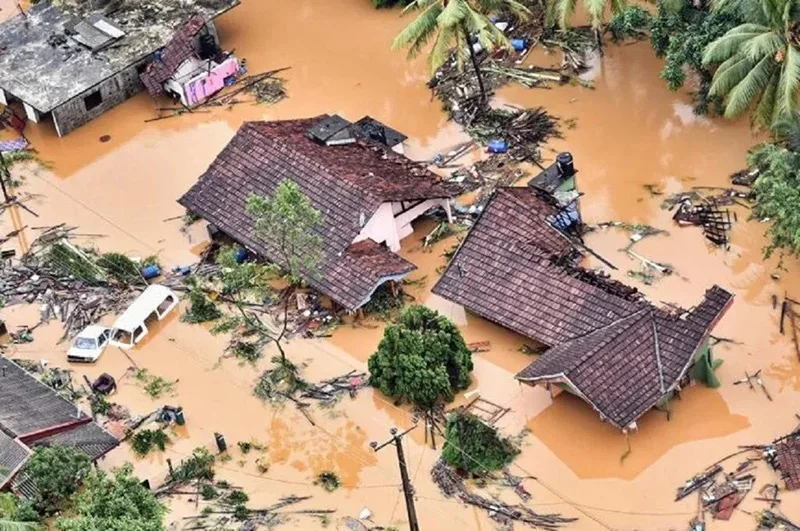
A great deal has been said about Cyclone Ditwah and its impact. To my mind one important aspect of it has not been addressed.
During the 1,400 odd landslides, it washed off a vast volume of soil which entered the various water bodies like tanks, lakes, rivers and streams etc. This process has raised their water levels reducing the water holding capacities (water holding capacity has a different meaning in soil science). What it means is that they cannot hold the same amount of water as before without spilling. Therefore, a precipitation which would not have been significant then can cause spilling of tanks leading to floods now. Hence there is a possibility of experiencing more floods in the future. Due to silting the tanks will carry less water than before, thus reducing the irrigable areas under their command. They will not be able to irrigate the same extents of paddy, thus affecting production.
How do we rectify this situation? It is desilting which can be very expensive.
It is good if these are considered in future planning.
Gamini Peiris
Panadura
Experienced agriculturist

Trump files $5bn defamation lawsuit against BBC over Panorama speech edit

UK and South Korea strike trade deal

Rob Reiner’s son Nick arrested for murder after director and wife found dead

70,297 persons still in safety centers

Showers will occur at times in the Northern, North-Central, Eastern, Uva and Central provinces

MEPA to crack down on marine polluters

‘Dates have the highest sugar content to fight Coronavirus’

Sunday Island 27 December – Headlines

#SundayIsland 17th December – Headlines

Sunday Island – 28th March

Sunday Island Headlines – 21 March

Sunday Island – 21st February – Headlines
-
 Features7 days ago
Finally, Mahinda Yapa sets the record straight
-
 Features7 days ago
Handunnetti and Colonial Shackles of English in Sri Lanka
-

 Business5 days ago
Cabinet approves establishment of two 50 MW wind power stations in Mullikulum, Mannar region
-
 News6 days ago
Gota ordered to give court evidence of life threats
-

 Features6 days ago
Cliff and Hank recreate golden era of ‘The Young Ones’
-
 Features6 days ago
Sri Lanka and Global Climate Emergency: Lessons of Cyclone Ditwah
-
 Opinion7 days ago
A national post-cyclone reflection period?
-

 Latest News6 days ago
Sri Lanka squad named for ACC Men’s U19 Asia Cup