
Life style
Forgotten exotic yellow mandarin calls for renewed interest

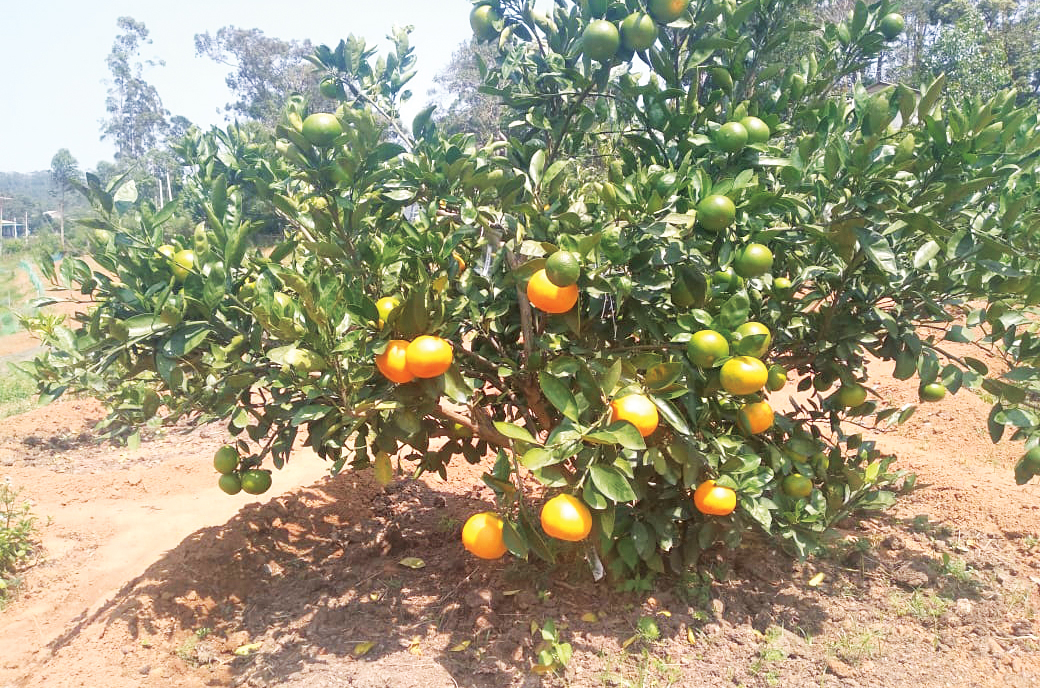
- The exotic yellow mandarin introduced from Japan thrives in the agro-climatic conditions of Bandarawela and Rahangala
- The abandoned tea estates in the area are ideal for the commercial cultivation of the crop
BY RANDIMA ATTYGALLE
Sri Lanka’s orange and mandarin imports alone recorded 8,135 mt. in 2022, according to Department of Agriculture’s (DOA) statistics. This corresponded to Rs 1.158 Million. The sizable annual expenditure incurred for mandarin imports could be significantly reduced if locally cultivable varieties could be promoted among farmers and potential large scale fruit exporters, Former Director of the Fruit Research and Development Institute, (FRDI) W.D. Lesly tells the Sunday Island. The scientist who had done extensive research on Sri Lanka’s potential for the yellow mandarin, encourages cultivators from areas such as Bandarawela and Rahangala where the crop thrives, to take a renewed interest in it.
Mandarin botanically known as Citrus reticulata is considered to be a distinct species of Citrus genus. The mandarin is smaller and oblate and is sweeter and stronger in taste than the common orange. Mandarins are usually easier to peel and to split into segments than the common orange.
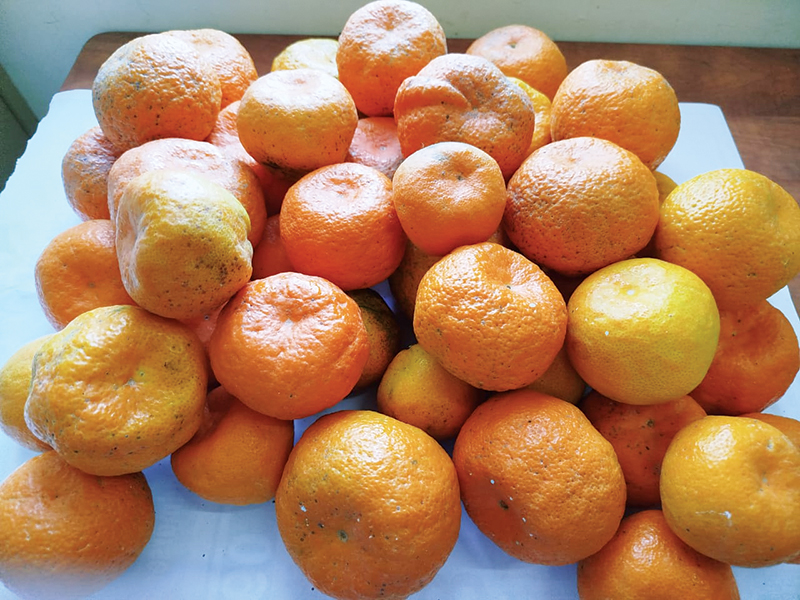
Local exotic yellow mandarin
China is the top mandarin producing country today. Spain, Turkey, Morocco and Japan are also among the other leading mandarin producing countries.
Premium Japanese varieties
In 2006 Lesly who was then a fruit scientist at the FRDI, was sent to Japan for a one-year training in mandarin research. “FRDI had a collaboration with Japan’s Ehime Prefectural International Center (EPIC) and Ehime Fruit Tree Research Station. And as part of this programme, I had the good fortune of getting hands-on-experience in Ehime which the Japanese call the ‘Citrus Kingdom.’ Ehime is Japan’s largest citrus-producing region.”
After completing his training in Japan, Lesly introduced eight premium Japanese varieties of mandarin to Sri Lanka which he trialed in eight different agro-climatic conditions across the island. The varieties were trailed in Horana (where FRDI is located), Angunukolapelessa, Gannoruwa, Seetha Eliya, Bandarawela, Rahangala, Girandurukotte and Monaragala.
-
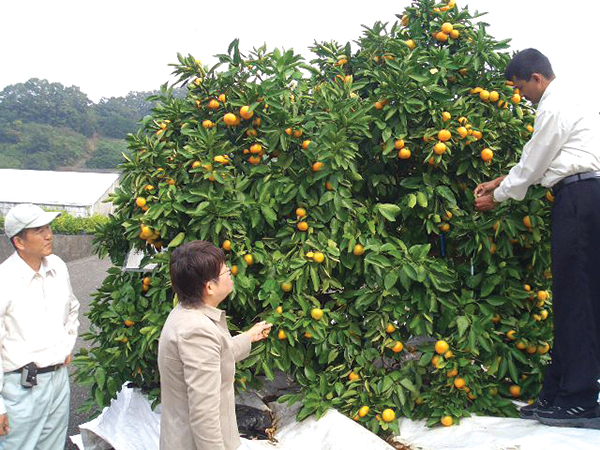
- Mandarin of Ehime in Japan
-
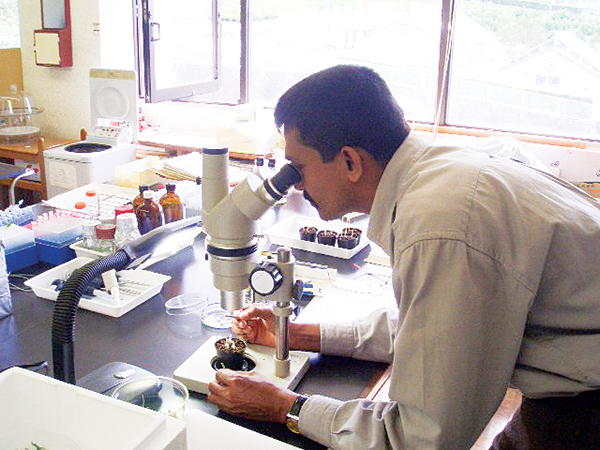
- Lesly immersed in research
After seven years of extensive research which tested the crop’s yield, fruit quality and adaptability, in 2013 three out of the eight varieties were identified as the best to suit the climatic conditions of up country intermediate highlands. “This region is the one that is closest to Japan’s Ehime’s agro-climate in which mandarin thrives. Today Bandarawela and Rahangala which have a cool-dry climate and lie 3,800 ft above sea level, are considered to be the best mandarin-growing regions here at home. This particular environmental condition is essential for turning the fruit peel colour to yellow when ripened and to develop the deep yellow colour and sweetness of the pulp.”
The three exotic varieties which were recommended and released for cultivation by the Varietal Release Committee of the Department of Agriculture are known as Horana-Ehime 1, 2 and 3 in recognition of the FRDI-Ehime collaboration. “In terms of the quality and taste, these three varieties are on par with the yellow mandarins which are imported. We largely import the fruit from Pakistan and India incurring a significant expenditure. In 2022 alone, we have imported 8,135 Mt. of orange and mandarin worth of Rs. 1,158 million.”
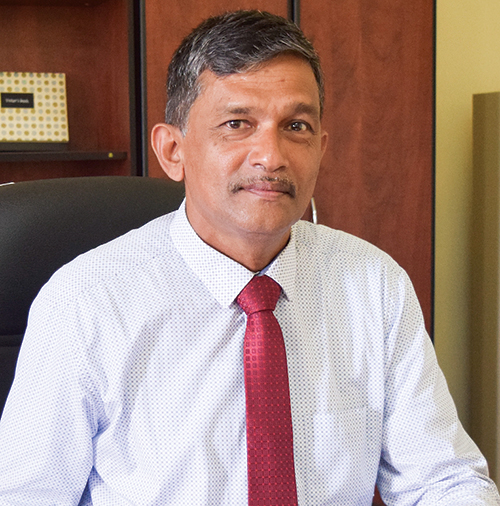
W.D Lesly
High yielding crop
Since the release of the three promising high-yielding varieties more than 10 years ago, the interest taken in them by local farmers is still minimal, laments Lesly who calls for renewed interest in this high-yielding crop. Lesly who succeeded in securing funds for the expansion of the crop under Council for Agriculture Research Policy (CARP) and Korea Plant Industries Association (KOPIA) distributed nearly 30,000 plants among farmers under the two schemes. The sales center of seed and planting material development center in Kahagolla and Agriculture Research Station in Rahangala provides planting materials of these mandarin varieties to farmers today.
The crop’s harvesting seasons are from March to April and August to September. “The demand for these varieties are high and the local produce is bought predominantly by supermarkets in the area. The fruit is also seedless and contains a higher quantity of beta-carotene than common mandarins” says Lesly.
Utilizing abandoned tea lands
Although ideally promoted as a monocrop, the yellow mandarin can also be grown along the land borders of large vegetable plots, points out the scientist. “The fruit yields a bumper harvest in prime vegetable-growing areas of the country. Since the farmers prioritize vegetable cultivation in the area, not much importance is still given to this promising crop,” says Lesly who goes onto note that abandoned tea lands of up country intermediate zone are ideal for commercial cultivation of the crop and calls upon fruit growers to come forward to invest in it.


In a country where creative pursuits are often treated as indulgences rather than vocations, Saman Halloluwa’s journey stands apart — carved patiently through brushstrokes, framed through a camera lens, and articulated through the written word. Painter, wildlife and nature photographer, and independent environmental journalist, Halloluwa inhabits a rare space where art, ecology and social responsibility converge.
His relationship with art began not in galleries or exhibitions, but in a classroom. From his school days, drawing was not simply a subject but an instinct — a language through which he learned to observe, interpret and respond to the world around him. Under the guidance of two dedicated mentors, Ariyaratne Guru Mahathaya and Gunathilaka Guru Mahathaya, he honed both skill and discipline. Those early lessons laid the foundation for a lifelong engagement with visual storytelling.

“His work navigates between traditional Sinhala artistic sensibilities, abstract compositions and expansive landscapes.”
 That commitment eventually materialised in two solo art exhibitions. The first, held in 2012, marked his formal entry into Sri Lanka’s art scene. The second, staged in Colombo in 2024, was a more mature statement — both in content and confidence. Featuring nearly fifty paintings, the exhibition drew an encouraging public response and reaffirmed his place as an artist with a distinct visual voice.
His work navigates between traditional Sinhala artistic sensibilities, abstract compositions and expansive landscapes. There is restraint in his use of form and colour, and an underlying dialogue between memory and space. Yet, despite positive reception, Halloluwa speaks candidly about the structural challenges faced by artists in Sri Lanka. Recognition remains limited; fair valuation even rarer.
“This is not merely an artistic issue,” he observes. “It is a social and economic problem.”
In Sri Lanka, art is often viewed through the lens of affordability rather than artistic merit. Many approach a painting by first calculating the contents of their wallet, not the value of the idea or labour behind it. In contrast, he notes, art in Europe and many other regions is treated as cultural capital — an investment in identity, history and thought. Until this mindset shifts, local artists will continue to struggle for sustainability.
The decisive push toward wildlife photography came from Professor Pujitha Wickramasinghe, a close friend who recognised both Halloluwa’s observational skills and his affinity with nature. From there, the journey deepened under the mentorship of senior wildlife photographer Ravindra Siriwardena.
Both mentors, he insists, deserve acknowledgment not merely as teachers but as ethical compasses. In a field increasingly driven by competition and spectacle, such grounding is invaluable.
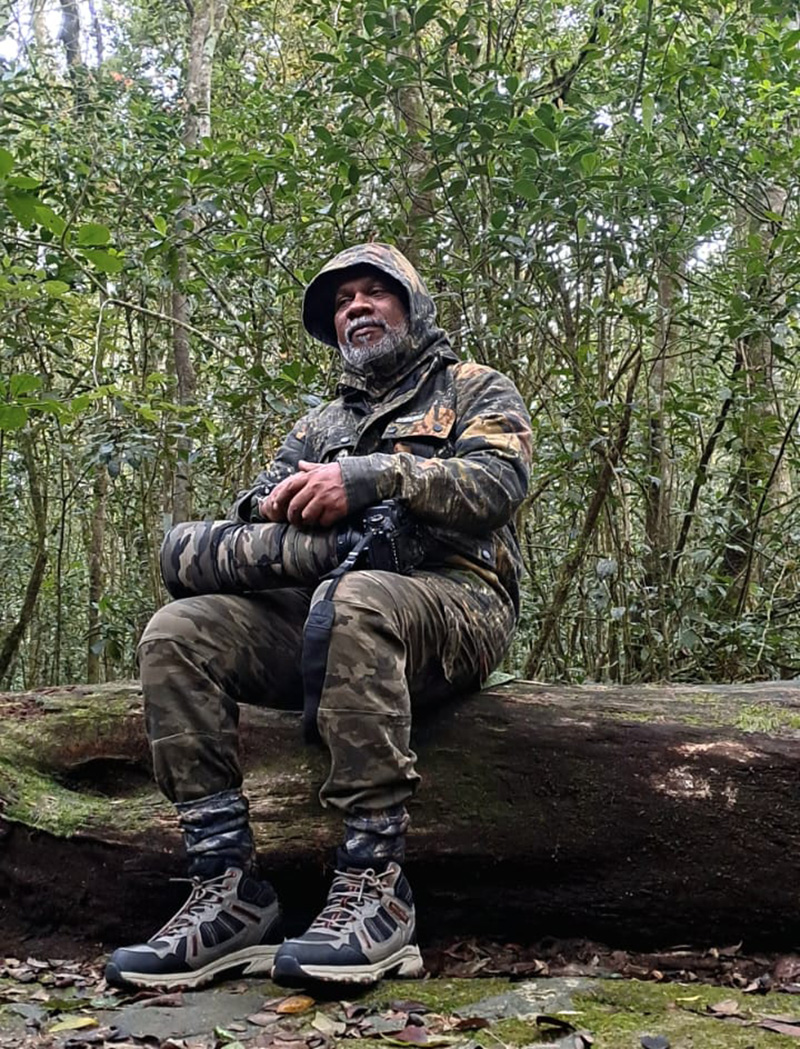
Saman Halloluwa
Wildlife photography, Halloluwa argues, is among the most demanding visual disciplines. It cannot be improvised or rushed. “This is an art that demands restraint,” he says.
Among all subjects, elephants hold a special place in his work. Photographing elephants is not merely about proximity or scale, but about understanding behaviour. Observing social patterns, movement, mood and interaction transforms elephant photography into a constantly evolving challenge. It is precisely this complexity that draws him repeatedly to them.
Halloluwa is cautiously optimistic about the current surge of interest in wildlife photography among Sri Lankan youth. Opportunities have expanded, with local and international competitions, exhibitions and platforms becoming more accessible. However, he issues a clear warning: passion alone is not enough
Sri Lanka, he believes, is uniquely positioned in the global nature photography landscape. Few countries offer such concentrated biodiversity within a compact geographical area. This privilege, however, carries responsibility. Nature photography should not merely aestheticise wildlife, but foster respect, aware ness and conservation.
Parallel to his visual work runs another equally significant pursuit — environmental journalism. For the past seven to eight years, Halloluwa has worked as an independent environmental journalist, giving voice to ecological issues often sidelined in mainstream discourse. His entry into the field was guided by Thusara Gunaratne, whose encouragement he acknowledges with gratitude.
An old boy of D.S. Senanayake College, Colombo, Halloluwa holds a Diploma in Writing and Journalism from the University of Sri Jayewardenepura and has completed journalism studies at the Sri Lanka Press Institute. He is currently pursuing an Advanced Certificate in Wildlife Management and Conservation at the Open University of Sri Lanka — a testament to his belief that learning must remain continuous, especially in a rapidly changing ecological landscape.
Outside his professional life, he enjoys cricket, rugby and badminton. Yet even leisure intersects with responsibility. He is a founding member and former president of the D.S. Senanayake College Old Boys’ Wildlife Forum, an active member of Wild Tuskers Sri Lanka, and a contributor to several independent environmental and wildlife volunteer organisations. In an era dominated by speed, spectacle and short attention spans, Saman Halloluwa’s journey unfolds differently. It is deliberate, reflective and rooted in values. Through art, he captures memory and form. Through photography, he frames life beyond human control. Through journalism, he asks uncomfortable but necessary questions.
“What I do, what I love” is not fashion here.
It is conviction — patiently lived, quietly asserted, and urgently needed in a country still learning how to value its artists, its environment and its truth.
By Ifham Nizam ✍️

Ramani Fernando Sunsilk Hair and Beauty Academy
Ramani Fernando Sunsilk Hair and Beauty Academy marked their graduation of their latest cohort of aspiring hair professionals in a ceremony held at Kingsbury Hotel.

Senaka de Silva, creative force behind Ramani’s shows
For over two decades, the Ramani Fernando Sunsilk Hair and Beauty Academy has stood as a beacon of excellence in beauty education in Sri Lanka. Founded by industry icon Ramani Fernando, the Academy has built a reputation for producing highly skilled professionals who go on to make their mark in salons, both locally and internationally. As the newly minted graduates step out into the world, they carry forward not just certificates, but also the promise of creative authority and personal empowerment.
The chief guest for the occasion was Rosy Senanayake, a long-standing supporter of the Academy’s mission. Addressing the graduates her message echoed her enduring belief that the beauty industry is not merely about aesthetic but about. confidence, self-worth and future leaders.
Over months of rigorous training, these young professionals honed their skills in cutting colouring, styling and contemporary artistry readying themselves to set trends rather than follow them.
Each graduate walked the stage with confidence, their dedication signalling a promising future for Sri Lanka’s beauty and fashion industry! With this new generation of stylists preparing to raise the standard of professional hairstyling.
Ramani Fernando, addressing the audience reflected on the academy’s mission to cultivate not only skills but vision and confidence in every student.
She urged the graduates to embrace continuous learning to take risks with creativity .The world of beauty is ever evolving, stay curious, stay bold and never underestimate the power of your talent, she added emphasising the importance of confidence, discipline and passion in carving a successful career in shaping the future of style.
These graduates are stepping into a world of endless possibilities. They are future of the country, who will carry a forward legacy of creativity. Behind every successful graduate at Sun silk Hair Academy stands a team dedicated to excellence. While Ramani Fernando serves as a visionary Principal and it is Lucky Lenagala, her trusted person who ensures that the academy runs seemingly.
From overseeing training sessions to guiding students, through hands on practice, Lucky plays a pivotal role in shaping the next generation of hairstylists.
Kumara de Silva, who has been the official compere Ramani’s, Hair graduation ceremony, from inception has brought energy, poise and professionalism. The Sunsilk Hair Academy is a celebration of talent and mentor ship for the graduates stepping confidentially into the next chapter of their careers, ready to make their mark on Sri Lanka beauty landscape

A moment of pride Ramani with chief guest Rosy Senanayake


Statement in style

Gliding in romance and sophistication
Pix by Thushara Attapathu
By Zanita Careem ✍️

During this season, Romesh Atapattu’s Capello Salon buzzes with a unique energy – a blend of festive excitement and elegance. Clients arrive with visions of holiday parties, office soirees, seeking looks that capture both glamour and individuality. The salon itself mirrors this celebrity mood. Warm lights, tasteful festive décor create an atmosphere where beauty and confidence flourish.
Romesh Atapattu himself curates the festive décor, infusing the space with his signature sense of style. His personal eye ensures that the décor complements the salon’s modern interiors.
As Colombo slips effortlessly into its most glamorous time of year, the Christmas season brings with it more than twinkling lights and celebrity soirees – it signals a transformation season at salons across the city. Capello salons are no exception.
At the heart of this festive beauty movement is Romesh Atapattu of Capello salons, a name synonymous with refined hair artistry, modern elegance and personalised style.
Christmas is about confidence and celebration. Romesh believes ‘People want to look their best without losing who they are”. Our role is to enhance, not overpower. This philosophy is evident in the salon’s seasonal approach.
Beyond trends, what sets Atapattu apart is the attention to individuality. Each consultation is treated as a creative collaboration – face shape, lifestyle, hair texture and personal style all play a role in creating the best for Romesh.
Stepping into Romesh’s salon during the Christmas season is an experience in itself. The space hums with festive energy while maintaining an atmosphere of calm sophistication.
The décor embraces the Christmas spirit with understated elegance. Tastefully adorned décor, beautiful Xmas tree, soft gold and ivory tones, and gentle hints of red are woven seamlessly into the salon’s contemporary design.
His staff, known for their warmth and professionalism also plays a key role in shaping the salon’s atmosphere—friendly, stylish and always welcoming. The Capello staff combine skill and creativity to deliver results that have a lasting impression.
Beyond trends, what sets Romesh Atapattu apart is the attention to individuality. Each consultation is treated as a creative collaboration – face shape, lifestyle, hair texture and personal style all play a role.
He is a professional who blends technical mastery with a deeply personal approach to style. His dedicated team of skilled professionals, operate with quiet confidence ensuring styles that create an atmosphere of trust, turning every appointment into a personalised and memorable experience.
(ZC) ✍️
Pic by Rohan Herath
-

 News7 days ago
British MP calls on Foreign Secretary to expand sanction package against ‘Sri Lankan war criminals’
-
 News6 days ago
Street vendors banned from Kandy City
-

 Sports7 days ago
Chief selector’s remarks disappointing says Mickey Arthur
-

 Opinion7 days ago
Disasters do not destroy nations; the refusal to change does
-

 Sports3 days ago
Gurusinha’s Boxing Day hundred celebrated in Melbourne
-

 News6 days ago
Lankan aircrew fly daring UN Medevac in hostile conditions in Africa
-

 Sports4 days ago
Time to close the Dickwella chapter
-
 Sports7 days ago
Royal record crushing innings win against Nalanda