
News
Foreign Minister underlines importance of data based research to guide govt. policy

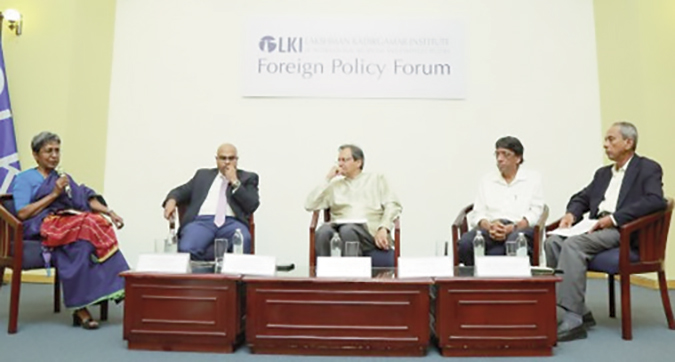
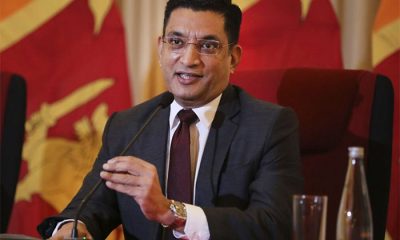
Foreign Minister Ali Sabry, addressing the ‘LKI Foreign Policy Forum’ on Wednesday, said there is a serious need for data-based research to guide government policy-making.The LKI Foreign Policy Forum is a quarterly flagship event of the Lakshman Kadirgamar Institute of International Relations and Strategic Studies (LKI).
Foreign Minister Sabry said if such a practice had been followed, particularly in regard to the economy, Sri Lanka would have averted the crisis which it faced. The Minister said it is important to conduct research, present papers, debate openly and within closed doors, in order to make the right decisions.
The LKI Foreign Policy Forum coincided with the 18th death anniversary of the Late Lakshman Kadirgamar which falls on 12 August 2023. The event was attended by the State Minister of Foreign Affairs Tharaka Balasuriya, the Acting Foreign Secretary U.L.M. Jauhar, and a representative gathering, comprising heads of diplomatic missions and international organizations, government officials, academics, business leaders, civil society, media practitioners, as well as students.
Noting that the LKI was initiated in 2000 as the Sri Lanka Institute of Strategic Studies by the late Foreign Minister Lakshman Kadirgamar, Minister Ali Sabry said following the late Minister’s assassination the institute was renamed in 2006, to honour the services he had rendered to the country. He said the legacy of Lakshman Kadirgamar lives through the Institute, and that in remembering him, it was important to work with the same diligence, enthusiasm and dedication.
The Minister emphasized the importance for LKI to ensure that research produced maintains high standards of accuracy, independence and impartiality, and noted that this prerogative of the LKI to engage in independent research is essential, in order for it to maintain its credibility. He hoped the ‘LKI Foreign Policy Forum’ would provide a platform for discussion, analysis and evaluation, which will strengthen engagement with relevant actors. He added that it was important that the topics chosen are contemporary and relevant, and that the ensuing discussions help provide recommendations for policy decisions.
Executive Director of LKI Ambassador Ravinatha Aryasinha, who delivered the welcome remarks, noted that in a rapidly changing world the new platform could contribute to build ‘common ground’ and develop a ‘Sri Lankan perspective’ on issues. He said these were goals the late Foreign Minister Kadirgamar was committed to in his lifetime, and trusted an institute of the nature of LKI would fulfil beyond his time. He said, besides several other LKI flagship projects being undertaken on a periodic basis, the Institute has put in place a comprehensive ‘LKI Research Programme’ under four pillars – Global Governance, Global Economy, Global Peace and Security, and Global Relations. He noted that in addition to the institution’s resident research staff, the LKI will draw on relevant academics and issue experts, in order to build a network that could contribute to the development of foreign policy options and enable a public discourse that could evolve strategies to better serve the country and the global community.
The Changing Global Dynamics: Implications for Sri Lanka was discussed by an eminent panel, comprising: Former Foreign Secretary, Ambassador H.M.G.S. Palihakkara, Director/ International Relations and Director/Centre for Strategic Assessment, Kotelawala Defence University (KDU) Dr. Harinda Vidanage, Executive Director, Institute of Policy Studies (IPS) Dr. Dushni Weerakoon, and the Executive Director, National Peace Council of Sri Lanka (NPC) Dr. Jehan Perera. In addressing some of the salient dynamics of the current global order, outlined by Ambassador Aryasinha, who moderated the session, the panel analyzed the implications of these trends to Sri Lanka from foreign policy, strategic security, economic and civil society perspectives, respectively. This was followed by a question and answer session.






… Warns would-be polluters of criminal prosecution, hefty fines and even blacklisting
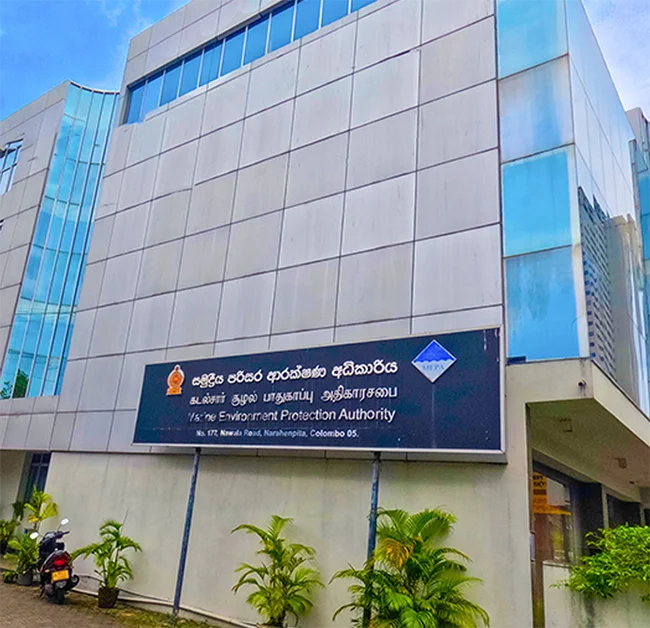
The Marine Environment Protection Authority (MEPA) has warned that ship owners, operators and local entities responsible for marine pollution will face criminal prosecution, heavy financial penalties and possible blacklisting, MEPA Chairman Samantha Gunasekera said yesterday.
Gunasekera told The Island that Sri Lanka would no longer tolerate negligence and regulatory breaches that threaten the country’s marine ecosystems, coastal livelihoods and national economy.
“Any party that pollutes our seas—whether foreign vessels or local operators—should be prepared to face the full force of the law,” Gunasekera said. “There will be no room for excuses, delays or backdoor negotiations when marine pollution is involved.”
He said MEPA has intensified surveillance of major shipping routes, ports and environmentally sensitive zones amid rising maritime traffic through Sri Lankan waters, which remain among the busiest in the Indian Ocean.
by Ifham Nizam
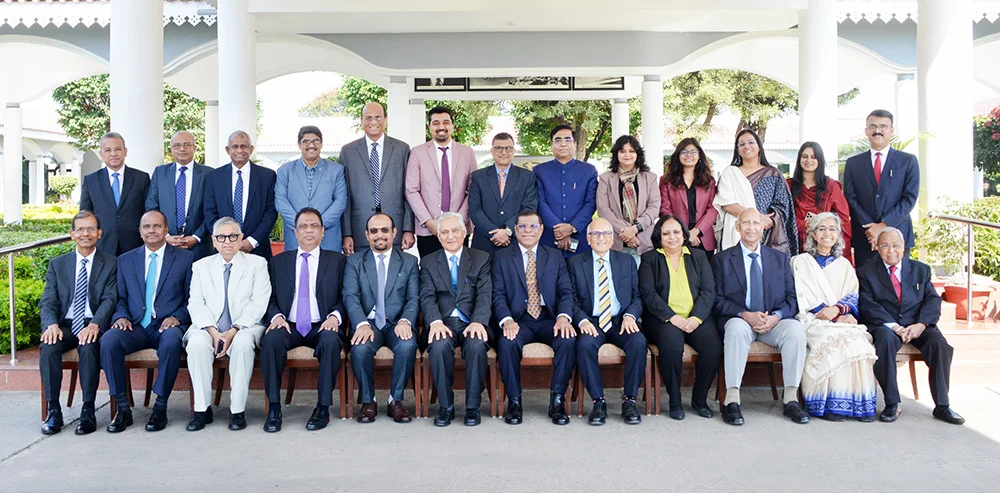
A 10-member delegation from Sri Lanka’s Supreme Court, headed by Chief Justice P. Padman Surasena, departed to New Delhi on the 11th of December, 2025, for an official visit to the Supreme Court of India as part of the ongoing official visit by the delegation to India.
The group was accorded a ceremonial welcome in the Court’s main hall, led by the Chief Justice of India (CJI) Surya Kant. CJI Kant told the assembled Judges that “the Indian judiciary was honoured to host” their Sri Lankan counterparts, expressing hope that the visit would be “meaningful and very constructive” and underscoring the “close emotional bonds” between the two countries.
The focal point of the programme was a special sitting of the Supreme Court. Chief Justice Surasena joined CJI Kant and Justice Joymalya Bagchi on the bench, presiding over the Court as a guest Justice. He was accompanied by nine other Supreme Court justices from Sri Lanka, who took seats in the well of CJI Kant’s courtroom to observe the day’s proceedings.
Supreme Court Bar Association President Vikas Singh formally greeted the delegation and praised Justice Surasena’s reformist efforts. Singh recalled the Sri Lankan Chief Justice’s own maxim, “If you want something you have never had, then you have got to do something you have never done”, highlighting the bold changes Surasena had introduced to modernise Sri Lanka’s Court system. Singh noted that these initiatives, particularly court digitization, were aimed at eradicating “the persisting problems of law delays” and streamlining case backlogs.
The Sri Lankan Judges spent the morning observing live Supreme Court proceedings in CJI Kant’s courtroom. This first-hand exposure to Indian court operations formed a key part of the programme’s judicial engagement. During the hour-long session, the visiting justices witnessed a range of cases on the Supreme Court’s roster, with Justice Surasena and the delegation following arguments from the front. The experience was designed to be immersive and following the hearing the Sri Lankan Judges were briefed on India’s own initiatives towards a digitalised court system, e-filing and case management systems.
The official programme then shifted to capacity-building and information exchange. In the early afternoon, Indian Supreme Court officials gave the Sri Lankan delegation detailed briefings on India’s technological initiatives. Court registrars demonstrated the e-filing system and other e-initiatives implemented by the Supreme Court of India. Additional presentations outlined the Court’s new case management systems and administrative reforms. These sessions highlighted how digital tools and better case-listing procedures have been used in India to increase efficiency. The Sri Lankan judges asked questions about India’s experience with electronic court records and the integration of technology in daily judicial work, reflecting their own interest in similar reforms back home.
The visit underscored the growing collaboration between the Indian and Sri Lankan judiciaries. Throughout the proceedings, both sides emphasised their shared legal traditions and mutual respect. As Chief Justice Surasena noted during the sitting, India is Sri Lanka’s “closest neighbour,” and historic links, even dating back to ancient epics, form the backdrop for today’s judicial dialogue. CJI Kant remarked that having the chief justices of two vibrant democracies together on the bench was a “significant moment” for the rule of law.
The Sri Lankan delegation continued its programme in Delhi on 12 December with a visit to the Delhi High Court and its International Arbitration and Mediation Centres. The exchange visit is expected to deepen judicial cooperation and provide practical insights for both courts. Officials on both sides say the engagement aimed at sharing best practices in court administration, reinforce legal ties and support ongoing reforms aimed at reducing case backlogs and delays.
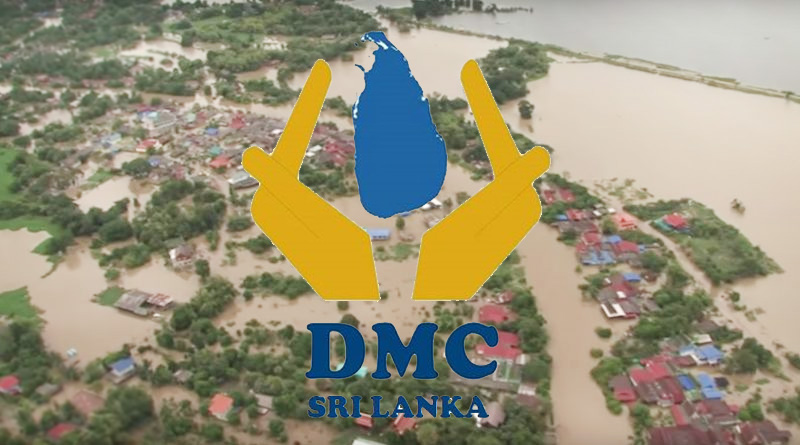
Relentless monsoon rains continued to batter large parts of the country yesterday, triggering floods and landslide warnings and placing disaster response units on high alert, as authorities warned of further deterioration in ground conditions.
The Disaster Management Centre (DMC) said persistent rainfall has inundated roads and houses in low-lying areas while sharply increasing the risk of landslides and slope failures in vulnerable districts.
“District and divisional disaster management committees have been activated and response teams are on standby to assist affected communities,” DMC Director General Maj. Gen. (Retd.) Sampath Kotuwegoda said, urging the public to strictly follow official advisories.
The National Building Research Organisation (NBRO) warned that saturated soil conditions caused by prolonged rainfall have heightened landslide hazards in the hill country and adjoining areas.
“Residents in identified high-risk zones must remain vigilant and evacuate immediately if early warning signs such as ground cracks or leaning trees are observed,” an NBRO official said.
Irrigation authorities said spill gates of several reservoirs have been opened, advising downstream communities to exercise caution. The DMC urged the public to avoid unnecessary travel and to contact hotline 117 for emergency assistance.
By Ifham Nizam

MEPA to crack down on marine polluters

SC delegation, headed by CJ Surasena, observes Indian Supreme Court in action

Heavy rains leave communities at risk; disaster units on high alert

Rebuilding Sri Lanka for the long term

Bulk of disaster displaced centres in Kandy

Feeling sad and blue?

‘Dates have the highest sugar content to fight Coronavirus’

Sunday Island 27 December – Headlines

#SundayIsland 17th December – Headlines

Sunday Island – 28th March

Sunday Island Headlines – 21 March

Sunday Island – 21st February – Headlines
-
 Features6 days ago
Finally, Mahinda Yapa sets the record straight
-
 Features6 days ago
Handunnetti and Colonial Shackles of English in Sri Lanka
-
 Business5 days ago
Cabinet approves establishment of two 50 MW wind power stations in Mullikulum, Mannar region
-
 News5 days ago
Gota ordered to give court evidence of life threats
-

 Features5 days ago
Cliff and Hank recreate golden era of ‘The Young Ones’
-
 Opinion6 days ago
A national post-cyclone reflection period?
-
 Features5 days ago
Sri Lanka and Global Climate Emergency: Lessons of Cyclone Ditwah
-

 Latest News6 days ago
Sri Lanka squad named for ACC Men’s U19 Asia Cup