
News
Foreign investors seek greater legal certainty before investing in Sri Lanka

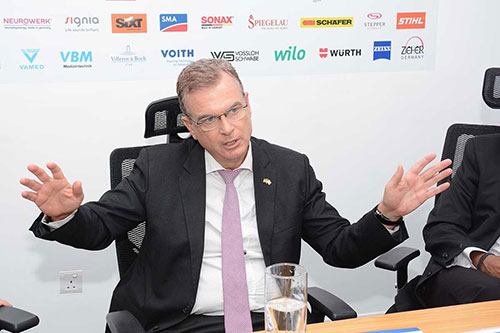
German Industry and Commerce in Sri Lanka Chief Delegate Andreas Hergenrother (Pic by Nishendra Silva)
German companies in discussion regarding potential upcoming investments here
by Sanath Nanayakkare
Legal certainty was a fundamental principle for foreign investment across the world, important even for potential German investors, Andreas Hergenröther, Chief Delegate of German Industry and Commerce (AHK Sri Lanka) told The Island yesterday:
“The reliability of the legal framework in Sri Lanka is essential for foreign investors. We have seen many changes since the beginning of 2020; so many gazette notifications and operating instructions which appear quite confusing for foreign investors and trading partners,” he said.
Elaborating Andreas said: “Of course, we understand that there is a scarcity of foreign currency in the country. On the other hand, it has to be understood that foreign companies operating in Sri Lanka need a clear framework which they can rely on. We hope that when the Covid-19 situation improves, there will be a coherent, transparent investment and trade policy for foreign investors to continue their businesses without uncertainty. They need an operating framework upon which they can plan on their mid-term and long-term prospects. This is very necessary because investors do not want to invest in a scenario that they do not fully understand”.
“For Foreign direct investors including German investors the reliability and predictability of legal frameworks are of very high importance not only with regard to Sri Lanka but worldwide. We fully understand the current situation in the aftermath of Covid-19 where decision makers need to make quick decisions and sometimes the impact of these decisions may not be foreseeable or predictable, but the continuous changing of the business landscape is a major challenge, because what investors mostly need is legal certainty. This fact was further confirmed at a survey we conducted among 160 CEOs and representatives of German companies and their Sri Lankan partners”.
“Of course, Sri Lanka is a sovereign country. Every country has to find its own way to promote foreign direct investment and even during the pandemic, we received some requests for potential investments in Sri Lanka. These requests were much related to certain product groups that are on very high demand and they are also related to free market access to mainly Pakistan and India. Sri Lanka offering free trade access to these two countries is a clear advantage, but it would give much more advantage if Sri Lanka would have free trade agreements (FTAs) with South East Asia (ASEAN), People’s Republic of China and East Asia. Such broad-based market access would definitely increase the potential of Sri Lanka to promote its foreign direct investments”.
“Currently these potential investors are gathering information about Sri Lanka and how they could run their operations from here. Once the airport reopens these investors will be keen to come to Sri Lanka and hold detailed talks with the decision makers here”.
“With regard to these investors’ wish to invest in Sri Lanka, AHK Sri Lanka has initiated talks with Sri Lankan institutions – mainly the Bureau of Investments (BOI). These companies are currently evaluating the situation and will likely visit here to see the ground realities for themselves before making the decision to invest”.
“These companies are from the medical sector, rubber related sector and another one in the field of logistics; namely a Multi-Country Consolidation service. There is another ongoing project in the field of chemicals. These companies are continuously having discussions with the authorities here. In fact, AHK Sri Lanka initiated talks at the time of the lockdown via video links with Sri Lankan decision makers on particular challenges facing German companies in Sri Lanka as well as upcoming projects”.
When asked to name these companies, Andreas said “it should remain confidential as the talks are still at an initial stage”.
“Once the health crisis improves, the decision makers of these companies will visit Sri Lanka to evaluate the legal framework. AHK Sri Lanka and German investors are very satisfied with the talks they have had with Susantha Ratnayake- the Chairman of BOI. He is doing everything he can to support the investors to come here and we have a very close relationship with the BOI. In fact, German companies have been in close contact with the BOI”.
“A level playing field is something very important to build confidence in foreign investment. In this context, we have supported a lot in the initiative of liberalization in the field of freight forwarding and shipping in Sri Lanka. In this regard, we held many conferences as we strongly believe that once foreign ownership will be possible in the field of freight forwarding and shipping, more foreign direct investments will come to Sri Lanka. And with those freight forwarding and logistics companies, their key customers will also follow suit. This convergence would enable Sri Lanka to transform from a transshipment hub into a ‘true logistics and a trading hub’. And then the ideal would be to have companies here that assemble, manufacture and/or make value addition under the scheme of Multi-Country Consolidation.
“The minimum capital requirement for Multi-Country Consolidation in Sri Lanka is US$ 3 million and US$ 5 million for Entrepot Trade. The potential investors are not ready to put three or five million dollars on the table. When it comes to investing, companies in the freight forwarding sector want to have full ownership and not be a minority shareholder of 40%. Currently the law [in Sri Lanka] allows maximum 40% shareholding for freight forwarding and shipping companies”.
When asked why the foreign companies in the freight forwarding sector wanted full ownership, Andreas said, “These companies have reporting obligations and internal compliance rules which have been made more severe in the past years, therefore, it is important for them to determine the processes and operations inside the companies according to their standards. Furthermore, companies compare different Foreign Direct Investment Destinations in the world. Nowadays most of the ‘hub-countries’ offer full ownership to freight forwarders and encourage investments under the scheme of Multi-Country-Consolidation”.
The Delegation of German Industry and Commerce in Sri Lanka (AHK Sri Lanka) was officially inaugurated on 27th March 2018, with the purpose of enhancing the bilateral economic relationship between Germany and Sri Lanka. AHK Sri Lanka is part of the German Chamber Network supported by the Federal Ministry for Economic Affairs and Energy. With 142 locations in 92 countries around the world, the members of the German Chamber Network (AHKs) offer their experience, connections and services to German and foreign companies. AHKs are located in all countries of particular importance to German companies and are closely connected to the Chambers of Industry and Commerce (IHKs) in Germany. Together they support German companies with building up and extending their business relations to foreign countries, representing in total 3.6 million German companies.
During the past years, AHK Sri Lanka) has been a reliable partner for many Sri Lankan institutions such as BOI and EDB. Committed to investment and export promotion, more than 20 business delegations have been organised in both directions. Further, AHK is planning to take four business delegations to promote exports in the sectors of agriculture/food, PPE, rubber, and energy efficient industrial solutions in the fourth quarter of 2020,
On 21st of August AHK Sri Lanka will organize a joint webinar with Deutsche Bank and Allianz on ‘Planning and Risk Mitigation in Times of Economic Uncertainty’.

Latest News
Sun directly overhead Pomparippu, Anuradhapura, Mihinthale, Galenbindunuwewa, Agbopura and Serunuwara about 12:11 noon today (11)


On the apparent northward relative motion of the sun, it is going to be directly over the latitudes of Sri Lanka from 05th to 15th of April in this year.
The nearest areas of Sri Lanka over which the sun is overhead today (11th) are Pomparippu, Anuradhapura, Mihinthale, Galenbindunuwewa, Agbopura and Serunuwara about 12:11 noon.

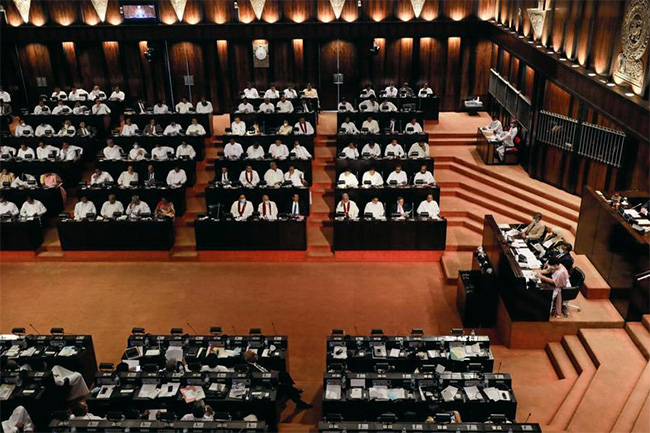
A no-confidence motion brought by the Opposition against Energy Minister Kumara Jayakody was defeated in Parliament yesterday by a majority of 104 votes.At the end of the debate, 49 members voted in favour of the motion, while 153 voted against it.
The motion, submitted to the Speaker on 19 March, was signed by Opposition Leader Sajith Premadasa, SJB MPs, and other Opposition members.
It accused Minister Jayakody of failing to ensure the procurement of adequate and quality coal for the Lakvijaya Coal Power Plant in Norochcholai, alleging that such negligence amounted to a breach of ministerial responsibility over a critical national energy asset.
The motion also cited ongoing legal proceedings against the Minister, noting that he has been indicted by the Commission to Investigate Allegations of Bribery or Corruption and produced before the Colombo High Court under Section 70 of the Bribery Act, in connection with alleged acts of corruption during his tenure as Procurement Manager of the Ceylon Fertiliser Company Limited.
The motion read: Vote of No Confidence against Kumara Jayakody, Minister of Energy,— Whereas the Provision in Section 6 of the Part III of the Code of Conduct for Members of Parliament which states that: “The Members shall on all occasions act in accordance with the public trust entrusted with them and shall always behave with probity and integrity, including the use by them of any public resources.” has been violated; And whereas the following rules of conduct set out in Section 9 of the Part V of the Code of Conduct for Members of Parliament have prima facie been breached, namely:- “(a) to be conscience; (c) to act so as to merit the trust and respect of the people; (e) to hold themselves accountable for the conduct and duties for which they are responsible;” And whereas it is observed that the Minister has failed, in his capacity as a Minister of the Cabinet of Ministers, to discharge the fundamental duties incumbent upon him in accordance with Article 28 of the Constitution;
And whereas it is established that the Minister of Energy has failed to discharge his primary duty of ensuring the procurement of adequate and good quality coal for the Norochcholai Lakvijaya Coal Power Plant;
And whereas such gross negligence in overseeing a critical national energy asset constitutes a fundamental breach of ministerial responsibility;
And whereas the Minister of Energy has failed to carry out the subjects and functions vested in him by the Notification of Gazette Extraordinary No. 2412/08 of 25th November 2024 of the Democratic Socialist Republic of Sri Lanka, including taking necessary steps to reduce the losses at the institutional management level and technical damages that occur to the electricity generation and distribution system and reduction of costs for generating electricity and removal of uncertainties during generation;
And whereas the Commission to Investigate Allegations of Bribery or Corruption has filed formal indictments before the Colombo High Court against the incumbent Minister of Energy under Section 70 of the Bribery Act (Chapter 26) for the offence of “corruption” in connection with acts of corruption allegedly committed while he was serving as the Procurement Manager of the Lanka Fertilizer Company;
And whereas, in light of the foregoing, the Minister of Energy has irretrievably forfeited the confidence of Parliament and the people of Sri Lanka by causing losses to public finances, endangering national energy security, corruptly mishandling the procurement process, being subjected to active judicial proceedings for the offence of “corruption”, and betraying the Government’s own “anti-corruption mandate”, and his continued tenure as the Minister of Energy is contrary to the public interest, the rule of law, and the principles of good governance;
That this Parliament resolves that it has no confidence in the competence of Kumara Jayakody, Minister of Energy to function as a Minister of the Cabinet of Ministers any longer.”
by Saman Indrajith

Chinese Ambassador to Sri Lanka Qi Zhenhong yesterday assured that China would not allow a fuel crisis to arise in Sri Lanka, under any circumstances, reaffirming Beijing’s continued support to the country.
The Ambassador made these remarks addressing the media after attending a dry ration distribution programme for 350 low-income families at Sri Chandananda Buddhist College, at Asgiriya, in Kandy.
Highlighting the longstanding ties between the two countries, Ambassador Qi said China has consistently stood by Sri Lanka and remains ready to extend assistance whenever required.
Amid concerns over global energy disruptions, stemming from the ongoing Middle East conflict, he noted that several countries are already facing difficulties, but stressed that China is prepared to support Sri Lanka at any time.
He said that any potential fuel shortage in Sri Lanka could be managed with the involvement of China’s Sinopec.
Reiterating Beijing’s commitment to Sri Lanka’s economic recovery and development, the Envoy also expressed hope that the current ceasefire in the Middle East would hold, while assuring that China stands ready to respond to any future developments and assist Sri Lanka as needed.
By SK Samaranayake

Sooryavanshi blitz, Jurel 81* help Rajasthan Royals take down Royal Challengers Bengaluru with ease

Sun directly overhead Pomparippu, Anuradhapura, Mihinthale, Galenbindunuwewa, Agbopura and Serunuwara about 12:11 noon today (11)

Showers expected in the Western, Sabaragamuwa, North-western , Southern and Uva provinces and in Anuradhapura, Mannar, Kandy and Nuwara-Eliya districts after 2.00 p.m.

Opposition NCM against Energy Minister defeated

Chinese Ambassador assures Lanka China will not allow a fuel crisis to develop here

Minister Jayatissa blames administrations since 2010 for not following proper procedures when procuring coal

‘Dates have the highest sugar content to fight Coronavirus’

Sunday Island 27 December – Headlines

#SundayIsland 17th December – Headlines

Sunday Island – 28th March

Sunday Island Headlines – 21 March

Sunday Island – 21st February – Headlines
-

 Features6 days ago
Ranjith Siyambalapitiya turns custodian of a rare living collection
-

 News6 days ago
Global ‘Walk for Peace’ to be held in Lanka
-

 News4 days ago
Lankan-origin actress Subashini found dead in India
-

 Business1 day ago
Israeli attack on Lebanon triggers local stock market volatility
-

 News2 days ago
AG: Coal procurement full of irregularities
-

 Features6 days ago
Beyond the Blue Skies: A Tribute to Captain Elmo Jayawardena
-

 Features6 days ago
Aspects of Ceylon/Sri Lanka Foreign Relations – 1948 to 1976
-

 Business2 days ago
Hayleys Mobility introduces Premium OMODA C9 PHEV