
News
Ex- HRC Chairman warns against allowing one man show in governance if country to remain a democracy


No country could be described as democratic if there is no separation of powers that ensures one branch of government does not exceed its powers, former head of the Human Rights Commission of Sri Lanka (HRCSL) Prof. Deepika Udagama said in a televised interview on Tuesday (28.)
“The three branches of government, i.e., the executive, the legislature, and the judiciary, must keep an eye on each other so that there is a balance. The 1978 Constitution centered power on the executive president. The question ever since has been how to put limits on the power of the executive president and to achieve balance between the three branches of government,” she said.
The establishment of the constitutional council in 2001 was an attempt to limit the power of the president, Prof. Udagama said. The Council is to ensure that the president does not make appointments to key positions on his own.
“The idea is that these key positions must be appointed through consensus,” she said.
President Ranil Wickremesinghe recently told parliament that the Council failed to approve his nominee to the Supreme Court and his continuing requests to reappoint the current IGP long after his age of retirement.
The president added that the lack of approval has resulted in the police not functioning and the courts coming to a standstill.
The President also announced his decision to appoint a Parliamentary Select Committee to probe delays by the Council.
“The 20th Amendment made the executive president extremely powerful. 21st was brought to amend this, and President Ranil Wickremesinghe played a role in passing the amendment. Almost everyone who becomes president, depending on his or her view of the executive president, brings an amendment to the constitution. They make the constitution in their image using the two-thirds majority,” she said.
The Constitutional Council was established first under the 17th Amendment under specific political circumstances, Prof. Udagama said. The executive presidency was held by Chandrika Bandaranaike Kumaratunga, who represented the Sri Lanka Freedom Party, while the parliamentary majority was held by the United National Party. Most parties agreed that the powers of the executive needed to be limited. The Mahinda Rajapaksa administration that followed undermined the 17th Amendment and, in 2010, abolished the 17th Amendment by passing the 18th Amendment.
“The 18th Amendment established the parliamentary council, which had no power. The Constitutional Council was brought back under the 19th Amendment during the yahapalana government. President Gotabaya Rajapaksa abolished it again with the 20th Amendment to the Constitution. The 21st Amendment was an acknowledgement that the president must not be given such unlimited powers,” she said.
The Constitution is the supreme law of the land, but successive presidents have remade the Constitution the way they want, she said. This is against the idea of democracy and what a constitution is, Prof. Udagama said.
“Maybe the next president will bring in the 22nd Amendment. This is not good. This is making light of the Constitution,” she said.
(RK)


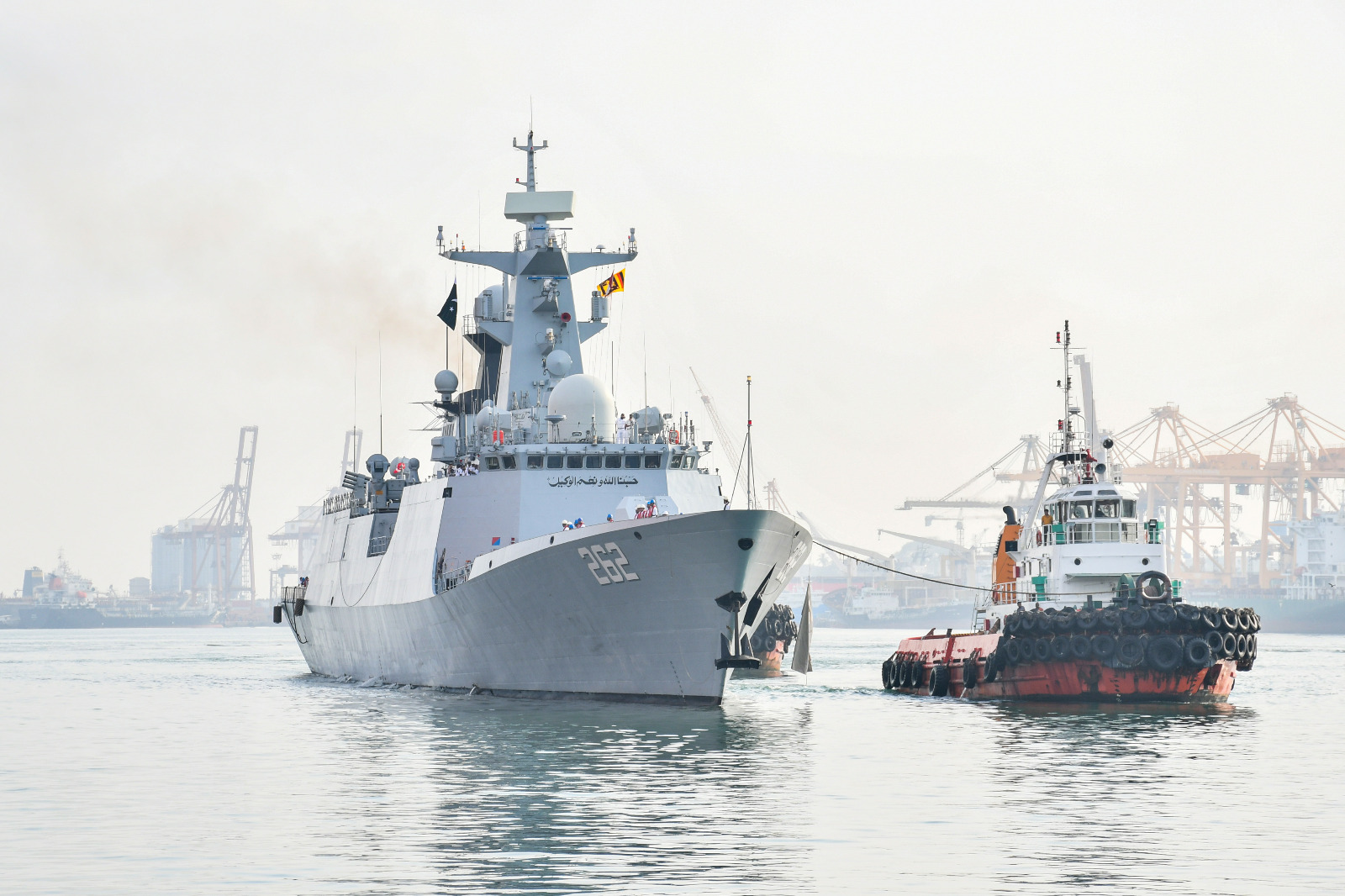
The Pakistan Navy Ship (PNS) TAIMUR and ASLAT arrived at the Port of Colombo on a goodwill visit on 12 Apr 26.
The visiting ships were welcomed by the Sri Lanka Navy in
compliance with naval traditions.
The duo of ships is commanded by Captain NIAMAT SAEED KHAN (PNS TAIMUR) and Captain NADIR MATEEN AFRIDI (PNS ASLAT).
Meanwhile, the ships are expected to conduct a Bilateral Naval Exercise LION STAR V with the Sri Lanka Navy in Colombo seas.
Latest News
Heat index likely to increase up to ‘Caution level’ at some places in the Northern, North-central, North-western, Western, Sabaragamuwa, Southern and Eastern provinces and Monaragala district


Warm Weather Advisory
Issued by the Natural Hazards Early Warning Centre at 3.30 p.m. on 11 April 2026, valid for 12 April 2026
The Heat index, the temperature felt on the human body is likely to increase up to ‘Caution level’ at some places in the Northern, North-central, North-western, Western, Sabaragamuwa, Southern and Eastern provinces and Monaragala district.
The Heat Index Forecast is calculated by using relative humidity and maximum temperature and this is the condition that is felt on your body. This is not the forecast of maximum temperature. It is generated by the Department of Meteorology for the next day period and prepared by using global numerical weather prediction model data.

Effect of the heat index on human body is mentioned in the above table and it is prepared on the advice of the Ministry of Health and Indigenous Medical Services.
ACTION REQUIRED
Job sites: Stay hydrated and takes breaks in the shade as often as possible.
Indoors: Check up on the elderly and the sick.
Vehicles: Never leave children unattended.
Outdoors: Limit strenuous outdoor activities, find shade and stay hydrated.
Dress: Wear lightweight and white or light-colored clothing.
Note: In addition, please refer to advisories issued by the Disaster Preparedness & Response Division, Ministry of Health in this regard as well. For further clarifications please contact 011-7446491.
Latest News
Sun directly overhead Cheddikulam, Kebithigollewa, Gomarankadawala and Nilaveli about 12:11 noon. today [12]

On the apparent northward relative motion of the sun, it is going to be directly over the latitudes of Sri Lanka from 05th to 15th of April in this year.
The nearest areas of Sri Lanka over which the sun is overhead today (12th) are Cheddikulam, Kebithigollewa, Gomarankadawala and Nilaveli about 12:11 noon.

PNS TAIMUR & ASLAT arrive in Colombo

Sanju Samson and Jamie Overton deliver first points for Chennai Super Kings

Arya, Prabhsimran and Shreyas help Punjab Kings ace another 200-plus chase

Beauty of Sri Lanka in focus: Global showcase blends art, diplomacy and conservation

Showers expected in the Western, Sabaragamuwa, Central, Southern, North-western and Uva provinces and in Ampara, Batticaloa and Polonnaruwa districts after 1.00 p.m.

Heat index likely to increase up to ‘Caution level’ at some places in the Northern, North-central, North-western, Western, Sabaragamuwa, Southern and Eastern provinces and Monaragala district

‘Dates have the highest sugar content to fight Coronavirus’

Sunday Island 27 December – Headlines

#SundayIsland 17th December – Headlines

Sunday Island – 28th March

Sunday Island Headlines – 21 March

Sunday Island – 21st February – Headlines
-

 News6 days ago
Lankan-origin actress Subashini found dead in India
-

 News4 days ago
AG: Coal procurement full of irregularities
-

 News1 day ago
CEB orders temporary shutdown of large rooftop solar systems
-

 Business3 days ago
Israeli attack on Lebanon triggers local stock market volatility
-

 Business4 days ago
Hayleys Mobility introduces Premium OMODA C9 PHEV
-

 Business3 days ago
HNB Assurance marks 25 years with strategic transformation to ‘HNB Life’
-

 News6 days ago
UN Regional Director launches SL’s first Country Gender Equality Profile during official visit
-

 Sports4 days ago
DS to face St. Anthony’s in ‘Bridges of Brotherhood’ cricket encounter