
News
Elephant deaths climb to 66 so far, this year

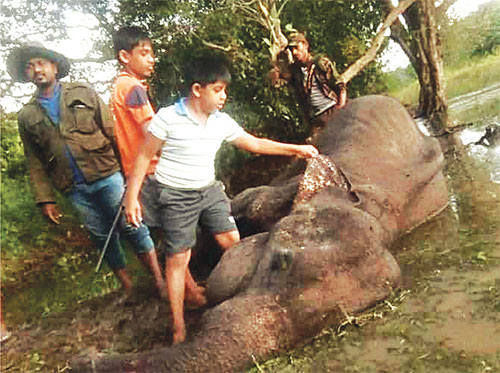
Children and wildlife officers inspecting a she elephant killed by an improvised explosive device, called hakkapatas, at Herathgama, in Kurunegala, on Monday.
by Ifham Nizam
Elephant deaths, so far this year, had shot up to 66, on Monday, when a she elephant succumbed to her injuries received from an improvised explosive device, commonly known as hakkapatas, Rally for Animal Rights and Environment (RARE) said yesterday.
Biodiversity Conservation and Research Circle of Sri Lanka Convener Supun Lahiru Prakash said the human-elephant conflict (HEC) had shown a rapid escalation recently.
“From 2016 to 2020 we have lost at least 1,578 elephants and the majority of them have died due to anthropogenic reasons. When compared with the 1992 – 2001 period, the present annual death rate of elephants shows about 90% rise and it is a 30% increase when compared with the 2005–2010 period. It is the highest annual death rate of elephants in the world.”
A sharp decrease in the elephant home ranges and repeating the failed mitigation measures were among the factors that have led to increased HEC in the county, according to experts.
President Gotabaya Rajapaksa appointed a multi-stakeholder committee chaired by eminent elephant researcher Dr. Prithiviraj Fernando to prepare “National Action Plan for the Mitigation of Human-Elephant Conflict”, which was prepared and handed over to the government last December.

Latest News
Payment of Compensation to the people who have lost their cultivable lands in implementing the Uma Oya Multipurpose Development Project


Approval has been granted at the Cabinet meeting held on 27-06-2012 to provide cultivable agricultural lands from the lower Uma Oya valley to 276 farming families in Hali-Ela, Walimada, and Uva Paranagama Divisional Secretariat Divisions who have lost their cultivable lands due to the acquisition of lands for the
Uma Oya Multipurpose Development Project.
However, the aforementioned proposal could not be implemented due to the encroachment of a large portion of the identified lands by unauthorized persons, heavy forest cover, the threats posed by wild elephants, remoteness from their original settlements, and difficulties in adapting to other environmental conditions and social anomalies.
Accordingly, the Cabinet of Ministers has approved the resolution furnished by the Minister of Agriculture, Livestock, Land, and Irrigation to pay an estimated compensation of Rs. 12 lakhs for each of these 276 farming families, based on the
recommendations submitted by the Cabinet Sub-Committee appointed to provide solutions for the issues arising in the implementation of the Uma Oya Multipurpose Development Project.
Policy approval was granted at the Cabinet meeting held on 07.04.2025 to prepare a draft bill to establish the Chartered Institute of Media Professionals of Sri Lanka in order to accomplish the requirement of a training institution to carry out studies in order to create chartered media professionals and mould intelligent media personalities with skills in order to enhance the quality and standard of the media society.
Clearance of the Attorney General has been received for the final draft prepared by the Legal Draftsman for the purpose.
Accordingly, the Cabinet of Ministers granted approval to the resolution furnished by the Minister of Health and Mass Media to publish the draft bill of Chartered Institute of Media Professionals of Sri Lanka in the Government Gazette Notification and thereafter submit the same for the concurrence of the House.
The Telecommunication Levy Act No. 21 of 2011 has enabled provisions to impose telecommunication levy. The budget 2026 has proposed to introduce amendments for the act including changes imposed from time to time regarding the telecommunication levy.
Accordingly, the Legal Draftsman has formulated a draft bill for
amending the Telecommunication Levy Act No. 21 of 2011 including provisions to extend applicable to envisage all the tax amounts applicable from the year 2015 along with the telecommunication levy existing at present, applicable of taxes on unrecovered revenue (bad debts) and to extend the provisions of that act to cater the telecommunication suppliers.
The Cabinet of Ministers approved the resolution furnished by the President in his capacity as the Minister of Finance, Planning and Economic Development to publish the said draft bill in the Government Gazette Notification and subsequently to submit the same for the concurrence of the House.

Payment of Compensation to the people who have lost their cultivable lands in implementing the Uma Oya Multipurpose Development Project
Draft Bill of the Chartered Institute of Media Professionals of Sri Lanka to be Gazzated
Telecommunication Levy Act No. 21 of 2011 to be amended
Management of State Expenditure during the Energy Crisis
Vesak week from 27 May to 02 June
Free Tourist Visas for Passport Holders of 39 Countries

‘Dates have the highest sugar content to fight Coronavirus’

Sunday Island 27 December – Headlines

#SundayIsland 17th December – Headlines

Sunday Island – 28th March

Sunday Island Headlines – 21 March

Sunday Island – 21st February – Headlines
-

 News7 days ago
Senior citizens above 70 years to receive March allowances on Thursday (26)
-

 Features4 days ago
A World Order in Crisis: War, Power, and Resistance
-

 News5 days ago
Energy Minister indicted on corruption charges ahead of no-faith motion against him
-

 News6 days ago
US dodges question on AKD’s claim SL denied permission for military aircraft to land
-

 Business6 days ago
Dialog Unveils Dialog Play Mini with Netflix and Apple TV
-

 News7 days ago
CEB Engineers warn public to be prepared for power cuts after New Year
-

 Sports5 days ago
SLC to hold EGM in April
-

 Latest News6 days ago
A strong Technical and Vocational Education and Training (TVET) system equips individuals with practical, relevant, and future-oriented skills helping to innovate responsibly towards a greener and sustainable future – PM