
Editorial
Easter Sunday carnage: Vital aspect overlooked


Tuesday 26th March, 2024
Former President Maithripala Sirisena, who declared last Friday that he was aware of the identity of the mastermind behind the Easter Sunday terror attacks, made a statement to the CID yesterday. His political opponents are baying for his blood; among them are those who were in the Yahapalana government at the time of the carnage. Some of them have even called for grisly penalties for Sirisena, such as drawing and quartering!
The ongoing political battle over the Easter Sunday terror mastermind’s identity, conspiracy theories involving local politicians, the vilification of Sirisena, etc., have eclipsed a critical dimension of the carnage—the possibility of an external involvement. Instances of bloody conflicts, uprisings, terror attacks and other forms of shocks being used to make feeble economies scream and jolt the developing countries, caught up in the great power rivalry, out of their strategic alliances and to engineer radical geopolitical shifts are not rare.
As for the Easter Sunday attacks, there are two major schools of thought. One is that they were engineered to catapult national security to the centre stage of politics in favour of wartime Defence Secretary Gotabaya Rajapaksa, who was planning to run for President in 2019. Gotabaya announced his candidature a few days after the carnage. The other school of thought is that there was a foreign hand in the Easter Sunday carnage, and the conspirators sought to destabilise Sri Lanka to compass their geopolitical ends.
The PCoI (Presidential Commission of Inquiry), which probed the Easter Sunday attacks, dealt with the alleged foreign involvement perfunctorily. Only an eight-page chapter in its bulky report has been devoted to the claim of a foreign hand in the attacks. The witnesses who expressly testified that there was ‘an external hand or conspiracy behind the attacks’, according to the PCoI, are Malcolm Cardinal Ranjith, former President Maithripala Sirisena, former Minister Rauf Hakeem, former Minister Rishad Bathiudeen, former Governor Azath Salley, SJB MP Mujibur Rahman, former SIS Director SDIG Nilantha Jayawardena, former STF Commandant M. R. Lateef, former Chief of Defence Staff Ravindra Wijegunaratne, former SDIG CID Ravi Seneviratne and former CID Director Shani Abeysekera. Dismissing their statements as mere ipse dixits (assertions made but not proven), the PCoI has said, in its report, that it did not find any such foreign link. It has, however, recommended that certain identified parties be further investigated. This recommendation has not been implemented.
We argued, prior to the release of the PCoI report, that it was possible that Zahran and his gang had taken orders from a fake ISIS created by a foreign spy agency. The PCoI has quoted SDIG Jayawardena as saying that an Indian named Abu Hind ‘may have triggered the attacks’: “He [Jayawardena] went on to imply that the intelligence agencies that provided him with the intelligence on 4th, 20th and 21st April 2019 may have had a hand in the attack.” According to the PCoI report an ‘international expert on terrorism, who testified in camera, said, “Abu Hind was a character created by a section of a provincial Indian intelligence apparatus, and the intelligence that the Director SIS received on the 4th, 20th and 21st April 2019 was from this operation and the intelligence operative pretending to be one Abu Hind. Operatives of this outfit operate on social media pretending to be Islamic State figures. They are trained to run virtual personas.” The PCoI report says, “The testimony was that Zahran believed Abu Hind was the Islamic State regional representative. Abu Hind was in touch with both Zahran and his brother, Rilwan, and had spoken to Naufer. This part of the evidence is confirmed by the testimony of Hadiya [Zahran’s wife].” It is mentioned on page 220 of the report that according to the aforesaid international expert, ‘the Indian Central Government was not aware of the intelligence obtained by the provincial outfit’.
The allegation that there was a conspiracy behind the Easter Sunday attacks to enable the SLPP to capture state power must be probed. Similarly, there is a pressing need for a thorough investigation to find out whether an external force was behind the carnage.



Friday 6th March, 2026
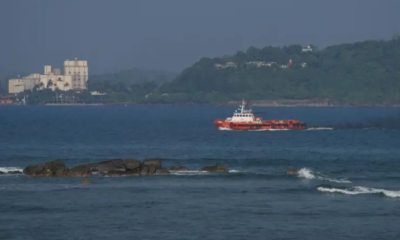
Only about 35 crew members of an Iranian frigate survived a torpedo attack by the US, off Galle, on Wednesday. More than 100 Iranians are believed to be dead. The Sri Lanka Navy and Air Force rescued the survivors and brought ashore about 85 bodies of the victims of the US attack. The sinking of the Iranian naval vessel, the IRIS Dena, which was on a non-combat mission, and the brutal act of killing so many naval personnel, thousands of kilometres away from the conflict zone, must be condemned unreservedly.
The NPP government led by the JVP, which would condemn the US and the western bloc at the drop of a hat during its Opposition days, has not explicitly criticised Wednesday’s incident. The Opposition yesterday asked in Parliament whether the Iranian vessel had come under attack while waiting for permission to reach the Galle harbour. Its question went unanswered. The government resorted to prevarication.
It is believed that the US did not inform India of its move to launch Wednesday’s attack in the Indian Ocean. The sinking of the IRIS Dena, which was Indian Navy’s guest, has become not only a huge embarrassment but also as a strategic concern to New Delhi, for the attack was carried out in an area where India projects its dominance as a regional leader. Has a Quad member got short shrift from the US?
Most of all, the IRIS Dena was returning from India, where it took part in an international fleet review, together with vessels from 40 other nations including the US and Russia. The naval exercise was conducted in Visakhapatnam, where the Indian Navy’s Eastern Naval Command is headquartered. This has made the sinking of the IRIS Dena and the killing of its crew members even more unacceptable. Strangely, India has refrained from explicitly condemning the incident.
If the US thinks Iranian assets anywhere in the world are legitimate targets, can Iran be blamed for adopting a similar approach, in dealing with the US and its interests? The Middle East conflict is not going to end in a few weeks or months with the conclusion of the ongoing US-Israeli bombing spree. Iran has vowed to take revenge.
Much has been spoken about the Indian Ocean as a Zone of Peace during the past five decades or so, but it is fast becoming a conflict zone for all intents and purposes. The peace-zone doctrine is based on several core principles such as demilitarisation, non-aggression, freedom of navigation, removal of foreign bases, regional cooperation, and the promotion of international peace and security. It was intended to prevent smaller states from being dragged into conflicts that are not of their own making and preserve regional stability. Wednesday’s US submarine attack in Sri Lanka’s exclusive economic zone should be viewed against the backdrop of the Indian Ocean peace zone concept.
The expansion by the US of the theatre of its current military operations against Iran beyond the Gulf region and the presence of a US submarine in Sri Lanka’s exclusive economic zone pose a serious threat to international trade routes in this part of the world. This is why India’s position on the issue of offensive US military action in the Indian Ocean matters.
The NPP government also gave evasive answers when the Opposition demanded to know whether another Iranian naval ship in Sri Lanka’s exclusive economic zone was also in danger, and whether it would be given permission to enter Sri Lanka’s territorial waters. The civilised world must help Sri Lanka ensure that another Iranian vessel in imminent danger is not left to its fate and condemn the brutality of the self-righteous unequivocally.
Thursday 5th March, 2026
There was a time when Sri Lanka was known the world over as the Granary of the East. Ancient rulers made selfless sacrifices to enable it to achieve and sustain self-sufficiency in food, especially rice. Alas, it has today become a hunduwa (a small traditional rice-measuring cup), according to its current Head of State himself.
On Tuesday, President Anura Kumara Dissanayake (AKD) caused quite a stir by referring to Sri Lanka as a hunduwa in a bid to drive a point home in Parliament. Opposition politicians let out howls of protests, condemning him for disparaging the country. Their ruling party counterparts, true to form, did their best to obfuscate the issue and defend their leader.
If the Granary of the East has ended up as a mere hunduwa, as President AKD says, then the blame for its retrogression should be apportioned to its leaders, both past and present. All of them secured power by promising to usher in good governance and develop the country, but they conveniently reneged on their promises.
The JVP-led NPP came to power on an anti-corruption platform, claiming that the leaders of all previous governments had institutionalised waste and corruption among other things, and the post-Independence era had been a 76-year curse, which had to be broken. Its campaign slogan struck a responsive chord with the resentful public and helped it obtain a two-thirds majority in Parliament to eliminate the scourge of corruption. One cannot but agree with President AKD that previous governments were notorious for corruption, and the corrupt elements currently in the Opposition, masquerading as good governance campaigners must be brought to justice. Similarly, the incumbent government must make a serious effort to rid itself of corruption, which is eating into its vitals.
US President Donald Trump’s Operation Epic Fury (or Epstein Fury?) against Iran, its economic fallout, and the brouhaha over hunduwa have eclipsed a mega coal scam here. Opposition Leader Sajith Premadasa has told Parliament that the government has resorted to emergency purchases of coal amounting to five shipments to meet a power generation shortfall caused by nine low-grade coal shipments. The country has already lost about Rs. 9 billion due to the coal scam, according to the Opposition. The JVP-NPP government has made a mockery of its commitment to upholding accountability by trying to cover up the coal scandal.
As for the hunduwa debate, a country with a patriotic, visionary leadership can achieve progress, overcoming challenges arising from territorial and resource constraints. This has been the secret behind Singapore’s success. Had Lee Kuan Yew (LKY), leading a city state with limited resources, let an inferiority complex weigh him down, Singapore would still have been lagging behind Sri Lanka. Opinion may be divided on the methods used by LKY to achieve his goals, but the leaders of the developing countries ought to emulate his strong leadership and unwavering commitment to accountability and development.
One is reminded of what LKY said about ministers and officials in this part of the world. In his widely read book, From Third World to First, he has said: “The higher they are, the bigger their homes and more numerous their wives, concubines, or mistresses, all bedecked in jewellery appropriate to the power and position of their men. Singaporeans who do business in these countries have to take care not to bring home such practices.” When one sees Sri Lankan politicians and bureaucrats enriching themselves and living the life of Riley, one remembers LKY’s memorable words.
All Singaporean politicians who did not heed LKY’s aforesaid warning were severely dealt with. The fate that befell Teh Cheang Wan, the Minister for National Development, is a case in point. When the CPIB (Corrupt Practices Investigation Bureau) launched a probe into an allegation of bribery against Wan in the mid-1980s, he sought to meet LKY, who refused to see him until the investigation was over. Wan took his own life. In 2023, LKY’s son, Prime Minister Lee Hsien Loong, allowed the CPIB to arrest his Transport Minister, S. Iswaran, over a top-level corruption probe. Iswaran was imprisoned after he pleaded guilty to accepting gifts worth more than S$403,000 while in office, as well as obstructing the course of justice.
As we pointed out in a previous editorial comment, if the Sri Lankan ministers had received from their leaders the same treatment as Wan and Iswaran, most of them would have been either pushing up the daisies by now or languishing behind bars; the vital sectors such as health, education, finance, agriculture, power and energy, and trade and commerce in this country would have been free from corruption, and most of all, substandard drugs and equipment would not have snuffed out so many lives in the state-run hospitals, and the issue of low-grade coal causing huge losses to the state coffers would not have arisen.
The least AKD can do to transform the hunduwa back into the Granary of East and make good on his thriving-nation-beautiful-life promise is to take a leaf out of LKY’s book on punishing the corrupt regardless of their political affiliations and pursuing development goals vigorously.
Wednesday 4th March, 2026
President Anura Kumara Dissanayake yesterday spoke in Parliament about the worsening Middle East conflict and its impact on Sri Lanka. Sidestepping the hot-button issue of unprovoked US-Israeli attacks that killed Iran’s Supreme Leader Ayatollah Ali Khamenei on Saturday, he called upon all parties concerned to resolve the conflict peacefully. There was a time when the JVP would openly market its anti-American rhetoric, but under President Dissanayake’s leadership, it is wary of criticising the US for attacking a sovereign nation and killing its supreme leader. Interestingly, even UNP leader and former President Ranil Wickremesinghe, widely considered pro-American, has called US-Israeli attacks unacceptable.
President Dissanayake read the economic consequences of the Middle East conflict accurately, reassuring the public. He said the Central Bank and the Finance Ministry had been tasked with assessing the developing situation and its economic consequences and recommending how to navigate issues affecting Sri Lanka. It is said that in facing any conflict, one should expect the best and prepare for the worst.
The first casualty of any conflict in the Middle East region is the global oil supply. Iran has closed the Strait of Hormuz, located in its territorial waters, and threatened to attack all vessels that pass through it. This is bound to affect 20% of the global oil supply. Even before the closure of that vital sea route, Sri Lankans went on a fuel panic buying spree, causing long lines of vehicles outside filling stations. President Dissanayake referred to fuel queues in his speech, and assured the public that there would be no fuel shortage.
It is hoped that the government will be able to formulate a robust strategy to face any eventuality, with the Middle East conflict showing signs of spreading across the region. Sri Lankan economy is likely to receive multiple shocks, such as decreases in remittances and a decline in export earnings. The success of a national strategy to weather a mega crisis hinges on cooperation among political parties, especially in Parliament. Thankfully, the current Opposition has been acting responsibly during the past several days, without trying to aggravate the panic buying of fuel in sharp contrast to the manner in which the JVP instigated protests during the 2022 fuel crisis.
Revealing that sufficient fuel stocks were currently available and more oil shipments were on the way, President Dissanayake lamented the limited fuel storage facilities in Sri Lanka. This situation has come about because successive governments have not cared to develop the Trinco oil tank farm as a national priority. Only a section of the 99-tank complex built during World War II has been developed. According to media reports, 14 tanks have been given to Indian Oil Corporation (IOC); 61 are to be developed as a joint venture between the CPC and the IOC. The CPC owns 24 tanks with a capacity of about 10,000 MT each.
There have been only half-hearted efforts to develop the Trinco tanks owned by the CPC. It is up to the NPP government to expedite the development of these facilities and increase the country’s petroleum storage capacity significantly to face global supply disruptions and price escalations. After all, President Dissanayake, during the 2024 presidential election campaign, rightly flayed previous governments for their failure to make use of the Trinco oil tanks and promised to develop them under an NPP government.
Meanwhile, Sri Lanka is now paying the price for ignoring the wise counsel of renewable energy experts who have been striving to knock some sense into successive governments, but in vain. If their advice had been heeded and steps taken to lessen the country’s fossil fuel dependence, we would have gained tremendously.
One can only hope that the current crisis will strengthen Sri Lanka’s resolve to strategise and invest more in producing renewable energy, especially by expanding solar power generation, to overcome formidable challenges arising from escalating fossil fuel prices and supply disruptions. At the same time, the government should incentivise the use of electric vehicles with higher tax concessions to reduce the country’s reliance on fossil fuel imports and promote a cleaner transport sector.

‘No deal with Iran except unconditional surrender,’ Trump says

Tiny possum and glider thought extinct for 6,000 years found in remote West Papua

Maldives Coast Guard Ship Huravee departs island

Cost to US for war on Iran is $3.7bn in first 100 hours, says think tank

More than 120 killed in Israel’s Lebanon attacks as Beirut, south, east hit

Hungary confirms it is holding seven Ukrainian bank workers and $80m

‘Dates have the highest sugar content to fight Coronavirus’

Sunday Island 27 December – Headlines

#SundayIsland 17th December – Headlines

Sunday Island – 28th March

Sunday Island Headlines – 21 March

Sunday Island – 21st February – Headlines
-

 Features5 days ago
Brilliant Navy officer no more
-

 Opinion5 days ago
Sri Lanka – world’s worst facilities for cricket fans
-

 News2 days ago
Legal experts decry move to demolish STC dining hall
-

 Features5 days ago
A life in colour and song: Rajika Gamage’s new bird guide captures Sri Lanka’s avian soul
-

 Business2 days ago
Cabinet nod for the removal of Cess tax imposed on imported good
-
 Features6 days ago
Overseas visits to drum up foreign assistance for Sri Lanka
-
 Features6 days ago
Sri Lanka to Host First-Ever World Congress on Snakes in Landmark Scientific Milestone
-
 Latest News2 days ago
Around 140 people missing after Iranian navy ship sinks off coast of Sri Lanka