
Business
Departing Japanese ambassador’s advice to guide Sri Lanka towards a better future


Says if bribes culture remains in Sri Lanka, no prospects of Japanese investment coming into Sri Lanka
By Sanath Nanayakkare
Japan, a country that always stood by Sri Lanka, putting its words into action – extending its support to the country by being a genuine partner in many socio-economic spheres in the past few decades – remains ready to carry the torch of its diplomatic legacy into the future, for the wellbeing of Sri Lankan citizens.
The above is a concise summation of the insightful speech made by Mizukoshi Hideaki, the ambassador for Japan in Sri Lanka at the JICA Chair Programme held on October 1, at Galle Face Hotel, Colombo.
The intellectuals in the audience were seen listening to his speech with great ardour as the diplomat is widely known to have done his utmost for Sri Lanka, especially in the past two years to help the country get out of the deep abyss it had fallen into. The fact that the ambassador will be saying adieu to his diplomatic posting in Sri Lanka in just three weeks added to this enthusiasm.
The reproduction below contains a few excerpts from his speech.
“Why recount this tale in Sri Lanka today? Because in the heart of Japan’s historical narrative lie universal lessons of overcoming adversity, embracing change, and fostering growth. Sri Lanka, at this juncture of economic hardship, stands where Japan once stood. Today, as Sri Lanka is trying to overcome the worst economic crisis in its history and turn a new page towards the future, I wish to draw parallels, illuminate paths, and inspire ideas that can potentially guide Sri Lanka toward a future of prosperity and stability.”
“Our journey through history is a testament to resilience, innovation, and foresight. Beginning in the late 19th century, under the pressure to open the country from Western powers, Japan embarked on a path of rapid modernization and industrialization, fundamentally altering its society and economy. This journey was not without its challenges, as the scars of World War II testify. However, the occupation by victors of WWII was the Japan’s 2nd chance of transformation. The post-war era opened the doors to an unprecedented period of economic growth and prosperity, a phase often referred to as the ‘Japanese Economic Miracle.’
“In terms of economic modernization, the government actively promoted industrialization. This included the establishment of a modern banking system, the construction of railroads and telegraph lines, and the adoption of Western technologies. The government fostered high quality silk industry for export and encouraged zaibatsu, or powerful business conglomerates, which played a crucial role in Japan’s industrial growth until World War II.”
“In education, a national system was established, inspired by American and French models, which emphasized universal education and literacy. This was a revolutionary change, as it provided the general population with access to education, fostering a more informed and capable workforce.”
“Thanks to improvements made by the past efforts, Japan now ranks in the 20th position out of 180 countries as least corrupted country according to the Corruption Perception Index by Transparency International in 2023.”
“For Sri Lanka, in the process of rebuilding its economy, there are several lessons to be learned from Japan’s experience, but I would like to highlight three key points.”
Taking advantage of External Pressure:
Firstly, taking advantage of external pressure. Looking back at Japan’s history, most reforms in Japan that were achieved would not have been possible without pressure from the international community. The reformist leaders of Japan, whether during the Meiji restoration period or under occupation after WWII, had made wise decisions for the future of the country decisions under foreign pressure.
Today, Sri Lanka is trying to reform the economic system under the agreement with the IMF. Reforms such as tax reform, electricity reform, or SOE reform may be challenging and not always popular to citizens. However, viewing the utilization of such external pressure for the betterment of the country should not be seen as a weakness but as a testament to the wisdom of leaders. India which went into financial crisis in 1991, went through structured adjustment of the IMF and World Bank. The economic reforms which have achieved at the time transformed India into a fast-growing economy. From an international perspective, agreements with the IMF serve as backing for Sri Lanka’s commitment to pursuing rational and consistent economic policies.
Japan recently announced the resumption of 11 yen loan projects that have been suspended since May 2022 due to the default of Sri Lanka ahead of any other foreign countries. It is important to recognize that this resumption was done on the basis of Sri Lanka’s agreement with IMF and official creditor countries.
2. Building up Competitive Industries:
2nd lesson from Japan’s experience that I can think of is importance of building up a competitive industry for economic growth. Sri Lanka is now at a crossroads. This economic crisis can be utilized as a golden opportunity to transform and grow. Japan’s experience of the economic miracle shows that it is important to formulate its industrial policy to foster a competitive export industry. What can be the strong and competitive industries for Sri Lanka?
Sri Lanka’s economy has stabilized under the IMF programme. The inflation was contained to single digit and the GDP growth turned positive from the 4th quarter of the last year. I commend the immense efforts of the government and the people of Sri Lanka to bring about this economic stability in a very short time. However, once Sri Lanka lifts its import restriction, there is a danger of foreign currency shortage happening again. Therefore, after achieving the stabilization, it is essential to build up a competitive industry that can push sustainable development of the country and earn foreign currencies. In building up industries, Sri Lanka may learn lessons from Japan’s industrial policies. It is important not to protect a loss making industry with government money but to ensure a smooth transition from uncompetitive industry to more competitive industry.
3. Overcoming Corruption:
The third point I would like to raise is overcoming corruption. I would like to touch upon corruption problems because it is important for the development of Sri Lanka. As Sri Lankan people having chosen a new leader, Anura Kumara Dissanayake, so committed to overcoming corruption, there is a unique opportunity to eradicate this malady that has been spoiling this country for a long time. Observing Sri Lankan politics since I came here, I would like to point out two aspects of problems of corruption in Sri Lanka.
“First, corruption is a source of distrust of leaders of the country by the people, and it discourages people from being responsible citizens of the country when leaders are corrupt. It gives convenient excuses to tax payers for tax evasion. Secondly, it is very harmful when Sri Lanka wants to attract foreign investment. A transparent and predictable business environment is essential to gain trust from foreign investors.”
“Japanese companies are nowadays strictly observing the compliance obligation and therefore never offer bribes or kickbacks. If that kind of culture remains in Sri Lanka, there is no prospect for Japanese investment coming into Sri Lanka. I am saying this because I would like to see more Japanese investment in Sri Lanka to support economic growth. Sri Lankan people have chosen a leader who has promised to eradicate corruption as his No.1 agenda. I have mentioned earlier that Japan ranks in 20th place out of 180 as least corrupted countries. Sri Lanka’s ranking is No.101. I hope, Sri Lanka will draw lessons from experiences of various countries, including Japan, to develop effective anti-corruption mechanisms. Last week I met Dr. Nandika Sanath Kumanayake, the new secretary to the President who has studied in the National Graduate Institute for Policy Studies (GRIPS) in Japan and completed MA and PhD, and he is an expert on the corruption issue. I offered him to share the experiences of anti-corruption measures that Japan has been taking to date.”
“There are many other lessons that can be drawn from Japanese experiences and we are ready to provide opportunities for Sri Lankan people to learn from them through JICA programs and other means.”
When The Island asked the departing ambassador what advice he could give Sri Lankan politicians, bureaucrats and business leaders to take this country forward post-crisis, he replied, “Rise above narrow self-interests and act to serve your country in the best way you can.”

Business
Successful completion of consent solicitation, exchange and tender offer related to SriLankan Airlines’ bond restructuring

SriLankan Airlines Limited (the “Company”) and the Government of Sri Lanka (the “Government”) announce the expiration of the Consent Solicitation, Exchange and Tender Offer related to the Company’s U.S.$175,000,000 Guaranteed Bonds due June 2024, guaranteed by the Government (the “Existing Bonds”).
On 20 February 2026, the Company launched an official invitation to holders of the Existing Bonds to tender and exchange their holdings for cash and the U.S.$-denominated 4.00% amortizing PDI bonds due 2028 issued by the Government (the “New Republic Bonds”), pursuant to the agreement in principle reached on 20 November 2025 with the members of the Ad Hoc Group of Bondholders – together holding approximately 55% of the aggregate outstanding amount of the Existing Bonds.
Following the expiration of the offer period, the Company and the Government are delighted to report a very high level of participation of over 99% of the total outstanding amount of the Existing Bonds. Bondholders representing more than 97% of the outstanding amount voted in favour, resulting in all Existing Bonds being tendered and exchanged on the settlement date.
Mr. Sarath Ganegoda, the Company’s Chairman, reacted to the results stating: “We are sincerely appreciative of the bondholders’ strong participation. The overall transaction results in a 16% haircut on the outstanding claim, and its successful completion marks a significant step forward that allows us to focus on the future of the Company with renewed optimism. As the flag carrier of our island nation, this important progress toward financial recovery will further strengthen our ability to support Sri Lanka’s economic prosperity.”
Dr. Harshana Suriyapperuma, Secretary to the Treasury at the Ministry of Finance, issued the following statement: “The successful completion of this transaction paves the way for the full normalization of our relations with our external partners. Having now successfully concluded restructuring agreements covering 99% of our public external debt, we extend our sincere appreciation to all stakeholders who supported Sri Lanka throughout this process. This achievement strengthens our position as we pursue our efforts to improve our credit rating.”
The settlement of the exchange and tender offer is intended to take place on 20 March 2026, subject to the relevant settlement conditions being satisfied.
Any questions related to this transaction can be directed to the Information, Tender, Tabulation and Exchange Agent for this transaction, Sodali & Co Limited
Email: srilankanairlines@investor.sodali.com
Transaction Website: https://projects.sodali.com/srilankanairlines
With over 18% already aged 60 and above—and one in four projected to be 60 or older by 2041—the Sri Lankan population is rapidly ageing. IF harnessed effectively, the elderly population and the related Silver Economy have great potential to contribute to Sri Lanka’s economy. This blog analysis shows the challenges and the possibilities for Sri Lanka to reap demographic dividends by unlocking the potential of the ageing population and the related Silver Economy.
Demographic Dividend and Silver Economy
Although population ageing poses challenges such as slower growth and increased fiscal pressures, healthier ageing trends offer a silver lining by boosting labour force participation, extending working lives, and enhancing productivity. Population ageing becomes a demographic dividend when the older population is considered an economic asset, rather than a social burden, and the potential of the change in the age structure is harnessed to accelerate economic growth. This involves creating employment and other economic opportunities, products, and services required by the elderly.
The Silver Economy refers to the economic opportunities associated with the growing public and consumer expenditure related to population ageing and the specific needs of the 50+ population. It is the system of production, distribution, and consumption of goods and services, targeting older adults, who are recognised as active economic agents with spending power, life experience, and growing demographic significance.
Changing Population Dynamics
To trigger a demographic dividend, this older population requires accumulated savings and investments to finance consumption during their retirement. However, the status quo of the elderly in Sri Lanka is mostly gloomy. In recent years, 49% of 55-64 year old cohorts were economically inactive, while the labour force participation rate for males and females were 36% and 11%, respectively. This suggests limited interest, capacity, and/or employment options. For instance, the retirement age of 60 years restricts formal employment opportunities for the elderly. Hence, a majority of older workers are employed in the informal sector, which underutilises their skills and underemploys them. Similarly, the elderly have limited options for part-time and flexible work, and are dissatisfied with participating in work. With the current average life expectancy of 75.5 years, they face about 15 years of post-retirement life with limited income and employment opportunities.
Additionally, only 31% of those above retirement age received a pension in recent years. Over three-quarters of retired persons were net dependants, and 91.7% did not receive any income from savings. Among those with savings such as the Employees’ Provident Fund (EPF), most spent their EPF without saving or investing for later life. Estimates suggest that by 2030, the economic old-age dependency ratio in Sri Lanka will reach 29.2%. Moreover, the 65+ years population had the highest multidimensional poverty headcount ratio (17.9%) in 2019. The age group of 36-64 years, including those who will be 60+ years in 2037, had a multidimensional poverty headcount ratio of 16%. With the worsening of overall poverty in the post-crisis setting, Sri Lanka’s older population is likely to be more vulnerable now.
Looming Care Crisis
Moreover, there is a growing care deficit – a gap in demand and availability of caregivers, for the ageing population. Around 76% of 65+ years population live with children, which is projected to decline over time with the emerging cultural and social shift from home-based care towards institutional care. Three-generation households are projected to decline from 19% in 2012 to 5% by 2060. The decreased availability of family care due to smaller family sizes and growing female employment will increase demand for commercial care. Yet, as discussed, most elderly people will not have the financial capacity to seek commercial care. At the same time, the elder care sector in Sri Lanka is polarised. On the one hand, there is an excess demand for the limited number of state-run elder care institutions—often of relatively low quality, while fee-based facilities remain unaffordable for the average elderly. Hence, the less-affluent middle-class elderly have virtually no options for institutional care. On the other hand, formal and professional home-based care is costly, while lower-cost options are informal and ad hoc. Moreover, free adult day care centres are limited and often target low-income elders, with almost no paid day-care options for other income groups. Across all care options, there is an acute deficit in both formal and informal care workers. Projections indicate a 149,076 deficit of long-term care workers by 2037.
Silver Economic Strategic Plan
Therefore, without timely strategic action, the ageing population would become a burden to the Sri Lankan society and increase government expenditure on health and other care, pensions, and social protection. The potential demographic dividend would instead become a drag on the economy.
The global approach to reap a demographic dividend includes policies supporting healthy ageing, increasing labour force participation among older individuals, and closing gender gaps in the workforce, to boost growth and rebuild fiscal buffers amid demographic headwinds. In the case of Sri Lanka, targeted strategies are needed urgently to facilitate the elderly to accumulate savings and investments to finance their post-retirement consumption. Similarly, it is important that Sri Lanka creates an ecosystem of affordable products and services for healthy, productive, and dignified lives for this demographic group.
To achieve this, Sri Lanka should focus on two strategic areas:
Prioritise the extension of economic opportunities into later life. This includes employment opportunities, such as phased retirement, flexible working arrangements, part-time work, and work-from-home arrangements targeted at older workers, to engage them in productive economic activities for a longer period. Such activities include adopting an age-friendly certification for businesses and employers to ensure businesses are welcoming, accessible, and responsive to older workers and clients. Another is to increase the minimum retirement age in the formal sector beyond 60 years of age. Moreover, increasing awareness on saving and investing for retirement and expanding related options—such as scaling up coverage of private life insurance and state-led contributory pension schemes—are essential.
Expand care options to not only protect the elderly but also create economic opportunities. This includes scaling up both free and fee-based elder care facilities to cater to all income types across both living-in and day-care options. Another is providing incentives, such as tax breaks or land, for the private sector to invest in care facilities and tie these to subsidised services for low-income elders. Additionally, existing infrastructure and systems, such as Development Officers at the Divisional Secretariats and local government community centres, could be harnessed to provide community-based care. Similarly, establishing and protecting the rights of elder care workers, providing formal Recognition of Prior Learning and certifying their skills would help attract and retain care workers.
By Dr Bilesha Weeraratne,
Research Fellow and Head of Migration and Urbanisation Policy Research at the Institute of Policy Studies of Sri Lanka
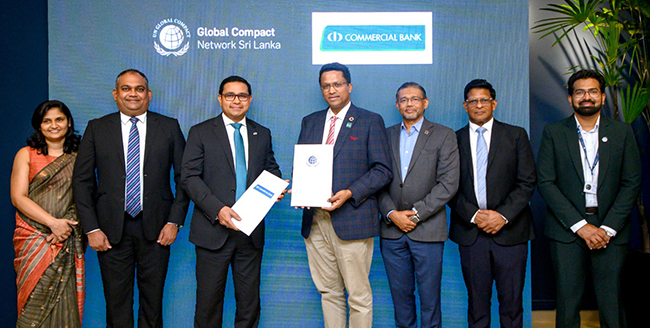
The Commercial Bank of Ceylon has taken a leadership role in advancing key sustainability priorities of the United Nations Global Compact Network Sri Lanka by becoming a Patron of Network Sri Lanka’s ‘Diversity & Inclusion’ and ‘Water & Ocean Stewardship’ Working Groups.
The Bank formalised this landmark commitment through the signing of a two-year Memorandum of Understanding (MoU) between Commercial Bank and UN Global Compact Network Sri Lanka, establishing the Bank’s patronage of the two Working Groups and its role in guiding initiatives that promote sustainable water management and inclusive business practices.
Commercial Bank will provide leadership and advocacy to advance the objectives of the Diversity & Inclusion and Water & Ocean Stewardship Working Groups. The Bank will collaborate with the Network to organise events, facilitate dialogue and partnerships, and encourage greater participation by companies seeking to strengthen their environmental, social and governance (ESG) practices. The engagement will also focus on initiatives that accelerate progress towards the Ten Principles of the UN Global Compact and the UN Sustainable Development Goals (SDGs), particularly in the areas of sustainable water management, ocean stewardship, gender equality and inclusive economic participation.

CEYPETCO Fuel prices increased from midnight today (21)

Advisory for Severe Lightning issued for Galle, Matara, Kaluthara and Rathnapura districts

Sri Lanka says it denied US request to land two aircraft at Mattala airport

Eid celebrations dimmed by war and displacement across Middle East

Showers may occur at several places in the Western, Sabaragamuwa, Northwestern and Uva provinces and in Galle, Matara, Kandy and Nuwara-Eliya districts after 1.00 pm.

Iranian strikes on bases used by US caused $800m in damage, new analysis shows

‘Dates have the highest sugar content to fight Coronavirus’

Sunday Island 27 December – Headlines

#SundayIsland 17th December – Headlines

Sunday Island – 28th March

Sunday Island Headlines – 21 March

Sunday Island – 21st February – Headlines
-

 Business6 days ago
Browns EV launches fast-charging BAW E7 Pro at Rs. 5.8 million
-

 Life style7 days ago
From culture to empowerment: Indonesia’s vision for Sri Lanka
-

 News4 days ago
CIABOC questions Ex-President GR on house for CJ’s maid
-

 Life style7 days ago
Ranjith Fernando celebrates cricketing journey with Hob Nails to Spikes
-

 News5 days ago
Sri Lankan marine scientist Asha de Vos honoured at UNGA opening
-

 Features6 days ago
Achievements of the Hunduwa!
-

 Latest News7 days ago
QR code system will be implemented for fuel with effect from 06.00 a.m. today (15th)
-

 News5 days ago
Australian HC debunks misleading travel risk claims for Sri Lanka