
Business
Creating a culture of creativity: Importance of Intellectual Property Rights

By Dilani Hirimuthugodage
On the 26th of April each year, Intellectual Property (IP) Day is celebrated to draw public attention to the importance of IP rights in fostering creativity and innovation.
It is said that oil was the primary fuel of the 20th century economy while creativity is the fuel of the 21st century. Creative industries encompass a broad range of activities such as arts, craft, music, design and media which have their origin in individual creativity, skill and talent, and have a potential for wealth and job creation through the generation and exploitation of intellectual property. Creative industries are vital to many economies, accounting for 7% of the world’s GDP and growing at an annual rate of 8.7% according to the latest available data.
The World Intellectual Property Rights Organization (WIPO) marks IP Day under specific themes, and this year, it focuses on creativity in Small and Medium Enterprises (SMEs) in bringing novel ideas to the market. Intellectual Property Rights (IPRs) including copyrights, trademarks, Geographical Indications (GI), patents, and sui generis systems are important in protecting and fostering creativity. This blog highlights the importance of IPRs for Sri Lanka’s creative industries and offers strategies to build stronger, more competitive and resilient businesses.
Creative Industries in Sri Lanka
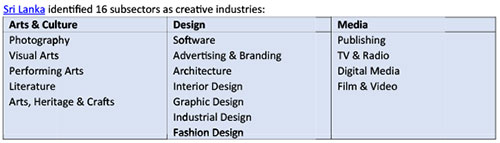
 Sri Lanka’s creative sector can be broadly divided into three categories: arts and culture, design, and media. A study by the Institute of Policy Studies of Sri Lanka (IPS) commissioned by the British Council, Sri Lanka identified 16 subsectors as creative industries:
According to the available data, Sri Lanka’s creative industry has shown a growth of 95% between 2010 to 2014, rising from USD 433.6 million to USD 845.4 million. An approximate estimate of the GDP share of creative goods and services exports in 2014 was nearly 1.1%. The IPS survey, which sought to capture the current size and scale of the creative industry sector in Sri Lanka, found that only 4.6% of respondents were export-oriented and the balance produced for local consumption. Thus, the 1.1% GDP share is an underestimate, as it only accounts for the exports of creative goods and services.
The IPS survey also found that the number of employees in the sector make-up approximately 3% of the country’s total labour force. Approximately 36% of creative workers are female and 67% of workers in the sector are between the ages of 24 and 55 years, while 71% of workers are in the private sector and the rest is in government and semi-government sectors. Self-employment is high in this sector, with 40% of the workforce identifying themselves as ‘self-employed’. As is the case globally, in Sri Lanka too, the sector consisted mostly of SMEs and sole traders with only a few large businesses.
Most importantly, the creative industries depend on the talents of individuals and the generation of intellectual property. Thus, several IPRs are relevant to the sector. For example, copyrights for literature, music, visual arts, digital creative work, trademarks for advertising and branding, GI for location-specific creativities, and patents for gaming and digital designs. Therefore, IPRs play a major role in driving this sector. Further, IP enforcement is important to protect the creator and/or investors to provide them with incentives to invest and further develop the sector.
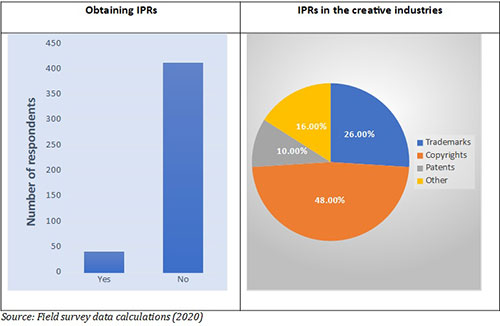
The awareness of IPRs among the survey respondents in the above-mentioned IPS study was poor. Only 8.8% had obtained any form of IP protection, out of which 48% had copyrights, 10% had patents, 26% had trademarks and 16% had others. Copyrights and trademarks were taken up in each sector whereas patents were only adopted in a few subsectors such as visual/performing arts, crafts, advertising, etc. (Figure 1).
IPRs are relevant to the creative industry as it relies on the use of intellectual production to create its goods and services. Following are a few suggestions to enhance the effective utilisation of IPRs for the development of the creative sector: Firstly, it is important to enhance knowledge on access to IPRs in the creative industry sector through awareness programmes at the grassroots levels especially in the craft, music, dance and design sectors. Industry professional associations should take the lead in this regard.
 Secondly, many traditional creative industry sectors such as craft, performing arts, and visual arts are location-specific such as Ambalangoda masks, Dumbara mats, and Weweldeniya cane products. Thus, products can use GI to indicate that the goods have a special quality, character or reputation because they originate from a specific place. This will help to protect their rights, increase product value and better visibility. As such, the National Intellectual Property Office (NIPO) must speed up the process of identifying and obtaining GIs for selected sectors while also expanding links with WIPO to protect traditional creative industries.
Thirdly, at the national level, it is important to adopt a sui generis (a unique system) legal framework for protecting traditional knowledge and cultural expressions, which are ultimately the foundation from which Sri Lanka creates its unique designs. Fourth, laws need to be updated as the existing legal framework does not cater to developments in modern technology. NIPO should also improve its efficiency and capacity to cater to modern creativities especially for IT and design sectors. Finally, Sri Lanka must modernise its IP system, incentivise grassroots innovation and promote homegrown creativity to fuel a culture of creativity.
This blog is based on an IPS study, commissioned by the British Council, Sri Lanka on Creative and Cultural Industries in Sri Lanka (2020).
Dilani Hirimuthugodage is a Research Economist working on Environment, Natural Resources and Agriculture Policy at IPS. Her research interests include agriculture economics, food security, intellectual property rights and innovations. She holds a Masters in Economics (with Distinction) from the University of Colombo. She is part-qualified in Charted Institute of Management (CIMA-UK). (Talk to Dilani: dilani@ips.lk)


The latest earnings report for Sampath Bank PLC (SAMP), analysed by First Capital Research (FCR), firmly supports a positive outlook among investors. The research firm has stuck with its “MAINTAIN BUY” recommendation , setting optimistic targets: a Fair Value of LKR 165.00 for 2025 and LKR 175.00 for 2026. This signals strong belief that the bank is managing the economy’s recovery successfully.
The key reason for this optimism is the bank’s shift towards aggressive, yet smart, growth. Even as interest rates dropped across the market, which usually makes loan income (Net Interest Income) harder to earn, Sampath Bank saw its total loans jump by a huge 30.2% compared to last year. This means the bank lent out a lot more money, increasing its loan book to LKR 1.1 Trillion. This strong lending, which covers trade finance, leasing, and regular term loans, shows the bank is actively helping businesses and people spend and invest as the economy recovers.
In addition to loans, the bank has found a major new source of income from fees and commissions, which surged by 42.6% year-over-year. This money comes from services like card usage, trade activities, and digital banking transactions. This shift makes the bank less reliant on just interest rates, giving it a more stable and higher-profit way to earn money.
Importantly, this growth hasn’t weakened the bank’s foundations. Sampath Bank is managing its funding costs better, partly by improving its low-cost current and savings account (CASA) ratio to 34.5%. Moreover, the quality of its loans is getting better, with bad loans (Stage 3) dropping to 3.77% and the money set aside to cover potential losses rising to a careful 60.25%.
Even with the new, higher capital requirements for systemically important banks, the bank remains very strong, keeping its capital and cash buffers robust and well above the minimum standards.
In short, while the estimated profit for 2025 was adjusted slightly, the bank’s excellent performance and strong strategy overshadow this minor change. Sampath Bank is viewed as a sound stock with high growth potential , offering investors attractive total returns over the next two years.
By Sanath Nanayakkare

The Asian Development Bank (ADB) has approved a $200 million loan to support the ongoing Mahaweli Development Program, Sri Lanka’s largest multiuse water resources development initiative.
The program aims to transfer excess water from the Mahaweli River to the drier northern and northwestern parts of Sri Lanka. The Mahaweli Water Security Investment Program Stage 2 Project will directly benefit more than 35,600 farming households in the North Central Province by strengthening agriculture sector resilience and enhancing food security.
ADB leads the joint cofinancing effort for the project, which is expected to mobilize $60 million from the OPEC Fund for International Development and $42 million from the International Fund for Agricultural Development, in addition to the ADB financing.
“While Sri Lanka has reduced food insecurity, it remains a development challenge for the country,” said ADB Country Director for Sri Lanka Takafumi Kadono. “Higher agricultural productivity and crop diversification are necessary to achieve food security, and adequate water resources and disaster-resilient irrigation systems are key.”
The project will complete the government’s North Central Province Canal (NCPC) irrigation infrastructure, which is expected to irrigate about 14,912 hectares (ha) of paddy fields and provide reliable irrigated water for commercial agriculture development (CAD). It will help complete the construction of tunnels and open and covered canals. The project will also establish a supervisory control and data acquisition system to improve NCPC operations. Once completed, the NCPC will connect the Moragahakanda Reservoir to the reservoirs of Huruluwewa, Manankattiya, Eruwewa, and Mahakanadarawa.
Sri Lanka was hit by Cyclone Ditwah in late November, resulting in the country’s worst flood in two decades and the deadliest natural hazard since the 2004 tsunami. The disaster damaged over 160,000 ha of paddy fields along with nearly 96,000 ha of other crops and 13,500 ha of vegetables.
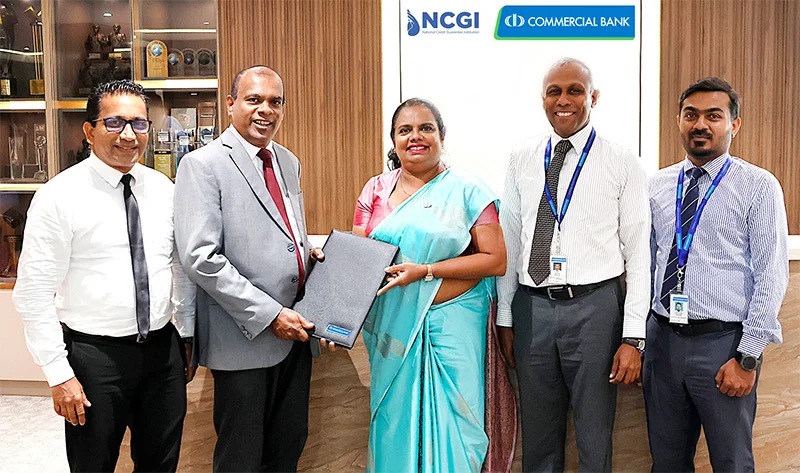
The Commercial Bank of Ceylon has reaffirmed its long-standing commitment to advancing women’s empowerment and financial inclusion, by partnering with the National Credit Guarantee Institution Limited (NCGIL) as a Participating Shareholder Institution (PSI) in the newly introduced ‘Liya Shakthi’ credit guarantee scheme, designed to support women-led enterprises across Sri Lanka.
The operational launch of the scheme was marked by the handover of the first loan registration at Commercial Bank’s Head Office recently, symbolising a key step in broadening access to finance for women entrepreneurs.
Representing Commercial Bank at the event were Mithila Shyamini, Assistant General Manager – Personal Banking, Malika De Silva, Senior Manager – Development Credit Department, and Chathura Dilshan, Executive Officer of the Department. The National Credit Guarantee Institution was represented by Jude Fernando, Chief Executive Officer, and Eranjana Chandradasa, Manager-Guarantee Administration.
‘Liya Shakthi’ is a credit guarantee product introduced by the NCGIL to facilitate greater access to financing for women-led Micro, Small, and Medium Enterprises (MSMEs) that possess viable business models and sound repayment capacity but lack adequate collateral to secure traditional bank loans.

Akbar Brothers crowned MBSA A-Division champions

Several spells of showers will occur in the Northern, North-Central, Eastern, Uva and Central provinces

Bondi Beach gunmen who killed 15 after targeting Jewish celebration were father and son, police say

Govt. urged to take action against deputy minister

India sends stock of life-saving medicines

George Keyt Foundation contributes to national disaster relief efforts

‘Dates have the highest sugar content to fight Coronavirus’

Sunday Island 27 December – Headlines

#SundayIsland 17th December – Headlines

Sunday Island – 28th March

Sunday Island Headlines – 21 March

Sunday Island – 21st February – Headlines
-

 Features6 days ago
Finally, Mahinda Yapa sets the record straight
-

 News7 days ago
Cyclone Ditwah leaves Sri Lanka’s biodiversity in ruins: Top scientist warns of unseen ecological disaster
-
 Features6 days ago
Handunnetti and Colonial Shackles of English in Sri Lanka
-

 Business5 days ago
Cabinet approves establishment of two 50 MW wind power stations in Mullikulum, Mannar region
-

 News5 days ago
Gota ordered to give court evidence of life threats
-

 Features5 days ago
Cliff and Hank recreate golden era of ‘The Young Ones’
-

 Features7 days ago
An awakening: Revisiting education policy after Cyclone Ditwah
-
 Opinion6 days ago
A national post-cyclone reflection period?