
Sports
Chamindu, Sadisha hammer centuries as SL U19s romp to victory


Sri Lanka Under 19s romped to their second consecutive victory in the Asian Cricket Council Under-19 Asia Cup tournament as Chamindu Wickramasinghe and Sadisha Rajapaksa scored centuries to set the stage to beat Nepal Under 19s by 60 runs at the Sharjah Cricket Stadium on Sunday.
Chasing a target of 323 runs to victory Nepal top order provided hope with openers putting up a 59 runs stand but three quick wickets by Raveen de Silva proved vital as Nepal lost the momentum to be placed 92 for four wickets in the 23rd over.
Wicketkeeper batsman Arjun Saud anchored the batting line up with a half century to keep hopes alive for Nepal but bowlers did well to contain the run flow. His run out dismissal at the start of the last ten overs doused late sparks as Nepal were bowled out for 262 runs with 13 balls remaining in their innings. Paceman Matheesha Pathirana accounted for three late order wickets.
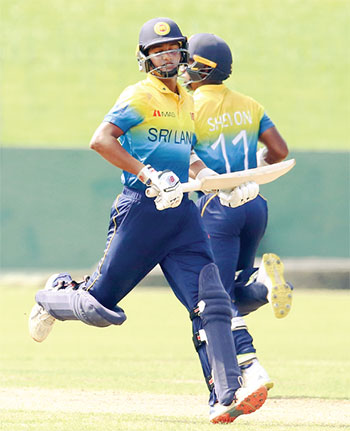 Deciding to bat first, the second wicket pair of Chamindu Wickramasinghe and Sadisha Rajapaksa put on a massive stand of 223 runs as both went on to score centuries. That stand provided the key for Sri Lanka Under 19s victory. It was the second Youth ODI century for Wickramasinghe as the St. Anthony’s, Katugastota all rounder scored 111 runs inclusive of eight fours and two sixes. His first Youth ODI century was scored in the home series against Bangladesh.
When he got out, the team had posted 262 runs leaving the middle order batsmen with seven overs to accelerate the run rate with Rajapaksa. Rajapaksa went on to compile a valuable 131 runs in just 119 balls. The Royal College, Colombo batsman’s knock included 11 fours and two sixes. Wellalage provided the finishing touches to the innings scoring an unbeaten 34 in 24 balls. He scored three fours and a six.
The team posted over 300 runs for the second time with as many as five batsmen not facing a single ball. In their first match Sri Lanka Youth team beat Kuwait by 274 runs.
Sri Lanka Under 19s will now meet their Bangladesh counterparts in the last group match on Tuesday.
Scores:
Sri Lanka U19s 322
for 4 in 50 overs (Chamindu Wickramasinghe 111, Shevon Daniel 17, Sadisha Rajapaksa 131, Dunith Wellalage 34n.o.; Mohammad Aadil Alam 2/46)
Nepal U19s 262
all out in 47.5 overs (Santosh Karki 34, Dev Khanal 28, Arjun Saud 64, Basir Ahamad 43, Bibek Yadav 46; Matheesha Pathirana 3/49, Raveen de Silva 3/35)

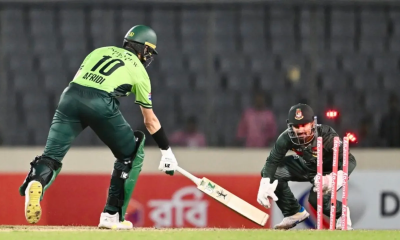



Pakistan have complained to match referee Neeyarmur Rashid over the on-field umpire Kumar Dharmasena’s decision to allow Bangladesh to take an lbw review off the penultimate ball of the third ODI in Mirpur. ESPNcricinfo has learnt the Pakistan management registered their complaint on the grounds that they believe Bangladesh took the review after a replay of the delivery flashed up on the big screen.
The decision to take the review, and its ultimate consequences helped Bangladesh assume an unassailable position in the game. Before that delivery, Pakistan needed 12 to win off two balls. Rishad Hossain flighted one up onto leg stump that spun down the leg side, away from Shaheen Afridi. The umpire called it a wide as it went down leg. After brief discussions, Bangladesh decided to take a review for lbw, even though, to the naked eye, the ball was nowhere near Afridi’s legs or any part of his body.
*As per the playing conditions, the fielding team can seek a review for a dismissal only once they have appealed. Also, the appeal can be made any time before the next delivery is bowled. It could not be ascertained whether the on-field umpire, after signalling the wide, informed Bangladesh that in case they want to review, they would need to appeal for lbw or whether Bangladesh asked for the review themselves. Only once the review is signalled by the on-field umpire does the 15-second timer start.
Pakistan have argued normal protocols were not followed, with the big screen at the stadium showing the ball passing the bat, and potentially giving Bangladesh enough information to suggest it may have made contact. Pakistan are also understood to be aggrieved at the possibility Bangladesh were allowed to review outside the maximum 15 seconds within which such a decision must be made. No timer appeared on the broadcast, so whether Bangladesh reviewed in time could not be independently confirmed.
However, the reason for Afridi’s visible frustration became clear as soon as the DRS went to Hawk-Eye, with a spike at the moment the ball passed the bottom of his bat, suggesting it had kissed the toe end and could not, therefore, be a wide. Bangladesh lost the review, but the wide decision was reversed and the equation became 12 in one ball. Afridi was stumped off the final delivery and swung his bat over the stumps in frustration. It secured victory for Bangladesh by 11 runs, and a 2-1 series win.
It is not yet clear yet what action the PCB wants from the match referee, though it is believed they expect at minimum a public acknowledgment that an error was made.
The decision is the second in as many games Pakistan have felt they may have come out the wrong side of. Salman Agha was run out after being caught outside his crease trying to hand the ball to Mehidy Hasan Miraz in the second ODI. Agha’s frustration spilled over and he had heated words before throwing his bat and gloves down, earning him a demerit point.
[Cricinfo]

Today marks the 30th anniversary of Sri Lanka’s unforgettable World Cup triumph. Ask any Sri Lankan where they were on the 17th March 1996 and chances are they will recall it in vivid detail. It was a red-letter day for a small island nation that punched above its weight, became world champions and changed the course of its cricket forever.
It had been a crazy, turbulent month. The Central Bank bombing had shaken the country to its core, crippling the economy and casting a shadow over the tournament. Australia and the West Indies refused to travel to Colombo, forfeiting their games amid security fears. Yet capable hands steadied the ship. Foreign Minister Lakshman Kadirgamar and cricket board president Ana Punchihewa ensured the show went on, steering the nation through stormy waters.
Adversity, as it often does, forged resolve. The troubled times brought the country together and the team responded by playing the brand of cricket that would become their trademark; fearless, inventive and unapologetically bold. Sri Lanka went through the tournament unbeaten, finding a man for every crisis and a solution for every problem.
The signs had been there from 1994 onwards. Sri Lanka were knocking on the door, threatening to do something special, and when the big stage arrived, they did not merely walk through it, they kicked the door down.
Three years earlier, Sir Garry Sobers had been asked who might break his world record of 365 in a Test innings. The great West Indian reckoned the race was between Brian Lara, Sachin Tendulkar and Aravinda de Silva. Aravinda never quite threatened that particular milestone, but what he did in Lahore remains etched in cricketing folklore. His majestic century in the final, steering a tense run chase with the composure of a grandmaster, remains one of the finest innings played under pressure. Kumar Sangakkara may have better numbers, but for many Sri Lankans Aravinda remains the darling of their cricketing hearts. Travel anywhere in the cricketing world, India, Pakistan, New Zealand or the West Indies and once people learn you are from Sri Lanka, the inevitable question follows: “What is Aravinda doing these days?”
Then there was Sanath Jayasuriya, the man who turned the Powerplay into a demolition derby. Bowlers barely had time to loosen their shoulders before the ball was disappearing over midwicket. His whirlwind starts tore attacks to shreds and rewrote the playbook of one-day cricket. Such was his impact that England captain Michael Atherton famously suggested the ICC should intervene and rethink the playing conditions. Jayasuriya had simply taken the first 15 overs away from them, lock, stock and barrel. Limited-overs cricket has never quite been the same since.
At the helm was Arjuna Ranatunga, a captain cut from rare cloth. Leadership, after all, is not just about calling the shots on the field but about standing by your men when the chips are down. Ranatunga literally opened the doors of his house to more than half a dozen members of that World Cup squad, treating them like family and backing them through thick and thin. Like Allan Border, Clive Lloyd and Imran Khan before him, Arjuna was a leader of men whose tactical acumen and fighting spirit sometimes overshadowed his considerable contributions with the bat.
Every great side also has its unsung heroes. Asanka Gurusinha was one of them. Naturally an aggressive striker of the ball, he curbed his instincts and played the anchor role, allowing the stroke-makers around him to cut loose. That willingness to put the team before personal glory summed up the camaraderie and collective spirit that defined the side.
The World Cup win did more than fill trophy cabinets , it changed the game at home. Cricket in Sri Lanka turned professional almost overnight. Players who once juggled day jobs with the demands of international sport found themselves with central contracts and proper match fees. Schools across the island embraced the game and its popularity soared, inspiring a new generation to pick up bat and ball.
Some argue that Sri Lanka later rested on their laurels. While other nations took a leaf out of our book and modernised their cricket structures, we were slow to move with the times. There may be some truth in that argument.
But what is also true is that players of the calibre of Arjuna, Sanath and Muttiah Muralitharan come along perhaps once in half a century. And as for Aravinda, well, there won’t be another like him, not in our lifetimes.
by Rex Clementine

Sri Lanka registered 3-0 win over Guam as Annaya Norbert, Akesha Silva and Buvindi Jithsara recorded victories in their matches of the 2026 Junior Billie Jean King Cup Asia Oceania Pre-Qualifying Event in Colombo on Monday.
While Annaya Norbert beat Rachel Anne 6-0, 6-1 in the first singles match, Akesha Silva beat Faith Perera 6-1, 6-2 in the second.
In the doubles encounter Annaya Norbet and Buvindi Jithsara beat Faith Perera and Leah san Agustin 6-0, 6-3.
Singapore, Pakistan, Macau, Maldives, Oman, Brunei, Mongolia, Guam, Pacific Oceania, Myanmar, Bhutan and Sri Lanka are the teams taking part in the tournament.

Pakistan lodge official complaint about Bangladesh’s review at end of chase

Showers or thundershowers will occur at several places in the Central, Sabaragamuwa, Southern and Uva provinces after 2.00 pm.

Government’s objective is to ensure the continuous functioning of the country’s economic activities and essential services through effective energy management – President

UN resolution on Iran ‘unbalanced’: FM Herath

Japan provides grant for reinforcement of Cyclone Ditwah damaged bridge

Australian HC debunks misleading travel risk claims for Sri Lanka

‘Dates have the highest sugar content to fight Coronavirus’

Sunday Island 27 December – Headlines

#SundayIsland 17th December – Headlines

Sunday Island – 28th March

Sunday Island Headlines – 21 March

Sunday Island – 21st February – Headlines
-

 Business6 days ago
BOI launches ‘Invest in Sri Lanka’ forum
-

 News5 days ago
Historic address by BASL President at the Supreme Court of India
-

 Sports5 days ago
The 147th Royal–Thomian and 175 Years of the School by the Sea
-

 Sports6 days ago
Royal start favourites in historic Battle of the Blues
-

 News6 days ago
CEBEU warns of operational disruptions amid uncertainty over CEB restructuring
-

 Features6 days ago
Indian Ocean zone of peace torpedoed!
-
 News5 days ago
Power sector reforms jolted by 40% pay hike demand
-

 News3 days ago
Crypto loopholes funnel Lankan funds abroad