
Life style
Amphibians going extinct in SL at a record pace


by Ifham Nizam
Sri Lanka holds the record for nearly 14 per cent of the amphibian extinctions in the world. In other words, of the 130 amphibian extinctions known to have occurred across the globe, 18 extinctions (14 per cent) have occurred in Sri Lanka, says Dr. Anslem de Silva, widely regarded as the father of Herpetology in the country. Speaking to The Sunday Island, the authors of a news book on amphibians, said that this is one of the highest number of amphibian extinctions known from a single country. Some consider this unusual extinction rate to be largely the result of the loss of nearly 70 per cent of the island’s forest cover. Dr. Anslem de Silva, Co-Chairman, Amphibian Specialist Group, International Union for the Conservation of Nature/Species Survival Commission (IUCN/SSC), together with two academics, Dr. Kanishka Ukuwela, Senior Lecture at Rajarata University, Mihintale who is 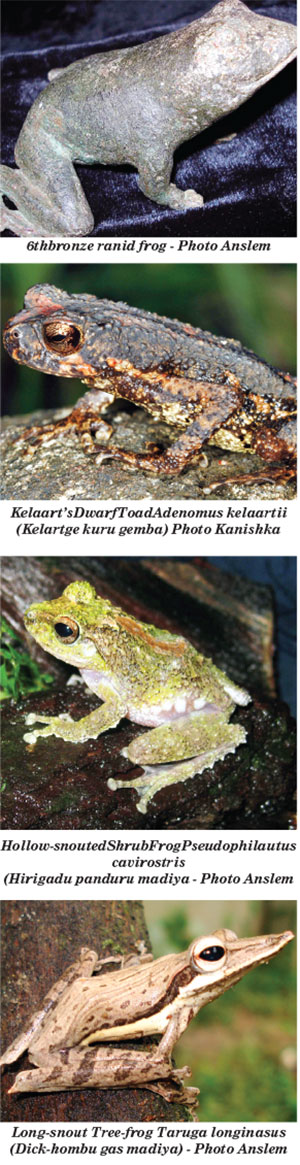 also associated with IUCN/SSC and Dr. Dillan Chaturanga, Lecture at Ruhuna University, Matara had authored this most comprehensive book on amphibians running to nearly 250 pages released last week. The prevalent levels of application of agrochemicals up to few months back, especially in rice fields, and vegetable and tea plantations, have increased over the past three decades. Similarly, the release of untreated industrial wastewater to natural water bodies has intensified. As a consequence, many streams and canals have become highly polluted, they say. The use of pesticides directly decreases the insect population, an important source of food for amphibians. Furthermore, these pollutants can easily make the water in paddy fields and the insects on which the amphibians feed toxic or increase the nitrogen content of the water. The highly permeable skins of amphibians would certainly cause them to be directly affected by these, they add. Amphibian mortality due to road traffic is a widespread problem globally that has been known to be responsible for population reductions and even local extinction in certaininstances. In Sri Lanka, amphibian mortalities due to road traffic are highly prevalent on roads that serve paddy fields, wetlands and forests. Further, they are especially intensified on rainy days when amphibian activity is high, the book explains. Recent studies indicate that amphibian road kills are exacerbated in certain national parks in the country due to increased visitation. According to recent estimates, several thousand amphibians are killed annually due to road traffic.
Professor W. A. Priyanka, PhD (USA), Professor in Zoology, Faculty of Science, University of Peradeniya says the need for a guide to the amphibian fauna of Sri Lanka is obvious, given the currently critical conditions endangering them. Amphibians are an attractive group of animals whose diversity has always sparked interest among the scientific community, creating a vast body of unanswered questions.However, the identification of amphibians has been a challenge due to the lack of a complete and informative guide. The comprehensive pictorial guide provided by the new book should thus be of great benefit to a better understanding of the unique and intriguing nature of these fascinating living beings.The authors have done an outstanding job in compiling this book. An introduction to the guide briefly describes the history, current status, threats and conservation information, along with interesting folklore associated with amphibians. With the clear and informative images, distribution maps and updated status of each species, this guide can easily be comprehended by experts and beginners in the field alike.”I firmly believe that this book will be very useful to undergraduate and postgraduate students in the fields of zoology, biology and environmental science, as well as researchers, wildlife managers and visitors,” Professor Priyanka added.The authors said that like their previous guide to the reptiles of Sri Lanka, A Naturalist’s Guide to the Reptiles of Sri Lanka (de Silva & Ukuwela, 2017, 2020), this book is intended for both naturalists and visitors to Sri Lanka, providing an introduction to the amphibians found here. It features all the extant species of amphibian in this country with colour photographs and quick and easy tips for identification. At the time of writing, 120 species have been recorded within the country and ongoing taxonomic work is certain to add more to this impressive list in the next few years.This guide provides a general introduction to the amphibians of Sri Lanka, a profile of the physiographic, climatic, and vegetation features of the island, key characteristics that can be used in the identification of amphibians and descriptions of each extant amphibian species.Additionally, it presents information on amphibian conservation here and a brief introduction to folklore and traditional treatment methods for combating poisoning due to amphibians in this country. The species descriptions are arranged under their higher taxonomic groups(orders and families), and further grouped in their respective genera.The descriptions are organized in alphabetical order by their scientific names. Every species covered is accompanied by one or more colour photograph of the animal. Each account includes the vernacular name in English, the current scientific name, the vernacular name in Sinhala, a brief history of the species, a description with identification features, and details of habitat, habits and distribution (both here and outside the country).Key external identification features of the species, such as body form, skin texture and coloration, are provided, to help in the quick identification of an animal in the field.It must be noted that according to Sri Lanka’s wildlife laws, amphibians cannot be captured or removed from their natural habitats without official permits, which must be obtained in advance from the Department of Wildlife Conservation.Sri Lanka is home to an exceptional diversity of amphibians. Currently, the island nation boasts of 112 species of amphibians of which 98 are restricted to the country. However, nearly 60 per cent of this magnificent diversity is threatened with extinction. To make matters worse, very little attention is paid by the conservation authorities or the public. The last treatise on the subject was published 15 years ago. However, many changes have taken place since then and hence an updated compilation was a major necessity. This book by the three authors intends to popularize the study of amphibians by the general public by filling this large void. Historical aspects
Sri Lanka is one of the few countries in the world where conservation and protection of its fauna and flora has been practiced since pre-Christian times. There is much archaeological, historical and literary evidence to show that from ancient times amphibians have attracted the attention of the people of this island.
This is evident by the discovery of an ancient bronze cast of a frog (see photo) discovered during excavations conducted by the Department of Archaeology and the Central Cultural Fund. Strati-graphic evidence from the excavation sites indicate that these objects belong to the sixth to eighth centuries AD (Anuradhapura and Jetavanārāma museum records). Beliefs that feature the ‘good’ qualities of frogs and association with nature. These beliefs have some positive effects on the conservation of amphibians, perhaps one reason that Sri Lanka harbours a diverse assemblage of frogs. Absence of frogs and toads in agricultural fields indicates impending crop failure, it is believed.
The authors have specially thanked Managing Director John Beaufoy of John Beaufoy Publishing Ltd, for publishing many books promoting Sri Lanka diversity.


By Ifham Nizam
The sixth edition of the “Beauty of Sri Lanka” Photography Exhibition is set to unfold across North America this April, transforming the power of visual storytelling into a compelling platform for cultural diplomacy, environmental advocacy and nation branding.
Organised by the America Sri Lanka Photographic Art Society in collaboration with key diplomatic and institutional partners, including the Embassy of Sri Lanka in Washington, D.C., the Permanent Mission of Sri Lanka to the United Nations, the Consulate General of Sri Lanka in Los Angeles and Toronto, and the Sri Lanka Tourism Promotion Bureau, the exhibition will run from April 22 to May 4 across Los Angeles, Toronto, New York and Washington, D.C.
Held in conjunction with Earth Day, the exhibition continues to evolve as a globally recognised initiative that brings together art, conservation and international engagement. What began as a photography showcase has now matured into a dynamic soft-power platform that tells Sri Lanka’s story to the world—through its landscapes, biodiversity, and deeply rooted cultural heritage.

Photographers from Sri Lanka at Nigara State Park
The 2026 tour will feature prestigious venues that reflect its growing international stature. These include the iconic Church of Scientology Celebrity Centre International, Metro Hall in Toronto—marking the exhibition’s debut in Canada—the Permanent Mission in New York, and the Sri Lankan Embassy in Washington, D.C., as part of the widely celebrated Passport D.C. event. Each venue represents not only a geographic expansion but also a widening of the exhibition’s global audience and influence.

Exhibition
At its heart, “Beauty of Sri Lanka” is a vivid narrative of a nation’s natural and cultural wealth. From the mist-covered central highlands and pristine coastal belts to dense rainforests teeming with endemic wildlife, the exhibition captures Sri Lanka’s ecological richness through the lenses of talented photographers. These images serve as both an invitation to explore and a reminder of the urgent need to protect fragile ecosystems.
This year’s programme takes a significant step further by integrating real-world environmental action. The “ReTree Los Angeles” initiative, launched in line with Earth Day, focuses on tree planting, urban restoration and community engagement. It also includes a children’s painting competition aimed at fostering environmental awareness among the younger generation. Organisers believe that nurturing creativity at an early age can instil a lifelong commitment to conservation.
Adding a scientific dimension to the event, Dr. Sarath Gunapala will deliver the keynote address on “The Journey of Infrared Photography,” exploring how advanced imaging techniques can reveal unseen dimensions of the natural world. His participation highlights the exhibition’s interdisciplinary approach, where art meets science to deepen understanding and appreciation.
The exhibition will also feature a vibrant cultural segment designed to immerse international audiences in Sri Lanka’s living traditions. A carefully curated lineup of performances—including the sacred Wes Pooja, the dramatic Naga Raksha mask dance, the rhythmic Thelme ritual dance and the light-hearted Salu Paliya—will bring to life the island’s folklore, rituals and performing arts heritage. These performances are expected to add colour, rhythm and emotional depth to the visual experience offered by the photographic displays.
ASPAS President Suria Perera emphasised that the exhibition is more than a display of images. “It is a celebration of Sri Lanka’s identity—its natural beauty, its cultural vibrancy, and its responsibility to future generations,” she said. “Through photography and community engagement, we aim to inspire a deeper connection between people and the environment.”
Over the years, the exhibition has drawn a diverse audience, including diplomats, policymakers, conservationists, art collectors and members of the Sri Lankan diaspora. Its ability to connect these varied groups underscores its role as a bridge between cultures, fostering dialogue and mutual understanding while strengthening Sri Lanka’s global presence.
The continued support of diplomatic missions, cultural institutions and tourism authorities has been instrumental in elevating the exhibition’s profile. Their collaboration reinforces the role of art as a powerful tool in shaping perceptions, building partnerships and promoting sustainable tourism.
As the 2026 edition prepares to open its doors, “Beauty of Sri Lanka” stands as a testament to the island nation’s enduring appeal and its commitment to conservation. It is not merely an exhibition, but a movement—one that celebrates beauty, inspires responsibility and connects Sri Lanka to the world through the universal language of art.

This holiday season, City of Dreams Sri Lanka invites guests to step into the heart of a truly Sri Lankan celebration with Signature Avurudu—a four-day cultural experience taking place.
Blending time-honoured traditions with contemporary flair, the festivities promise to capture the spirit of the Aluth Avurudda (Sinhala and Tamil New Year) in all its colour, rhythm, and warmth. From the moment guests arrive, they will be welcomed into a space transformed with festive décor, echoing the charm of a village celebrations brought to life in the city.
At the centre of the celebration is the Pahan Pujava, a symbolic lamp lighting ceremony led by the management, setting a tone of unity, prosperity, and new beginnings. This meaningful ritual reflects the essence of the New Year—a time to pause, reflect, and step into the new year with hope and positivity.
Throughout the four days, guests can experience the rich cultural heritage of Sri Lanka through a series of traditional performances. The rhythmic beats of raban and drums, alongside vibrant dance acts, will fill the air, creating an atmosphere that is both nostalgic and celebratory. Adding to the experience are elegantly dressed Sri Lankan hostesses, offering a warm, authentic welcome that embodies the island’s renowned hospitality.
No Avurudu celebration is complete without its flavours, and City of Dreams Sri Lanka delivers a feast to remember. Guests can indulge in an array of traditional sweets and savouries, alongside curated Avurudu-themed buffets and creative beverages inspired by local ingredients. Passing canapés and festive treats ensure there is something to enjoy at every turn—whether you’re reminiscing over childhood favourites or discovering new twists on beloved classics.
Designed as a celebration for all, Signature Avurudu brings together families, friends, and visitors from around the world to share in the joy of the season. It is a reminder that Avurudu is more than a festival—it is a feeling of togetherness, renewal, and shared happiness.
This April, celebrate the sights, sounds, and tastes of Avurudu at City of Dreams Sri Lanka—where tradition meets modern celebration, and every moment feels like home.

Students of S. Thomas’ College recently demonstrated commendable performance at two international sailing events held in India: the inaugural Indian Sailing Regatta and the 4th North-East Regatta. Both events featured participation from foreign teams, including Sri Lanka, Taiwan, Malaysia, Russia, Great Britain, South Korea, Singapore, and India.
The inaugural Indian Sailing League (ISL), held at Umiam Lake, Shillong, India, marked a significant milestone in the sport and was prominently featured in The Times of India. The ISL is a first-of-its-kind franchise-based sailing league, bringing together 14 teams, 182 sailors, and 58 international participants from eight countries.
The ISL follows a concept similar to the Cricket Indian Premier League, where top sailors are “bid” and selected into franchise teams representing different regions. The competition introduced an innovative team-based format in which the best sailor from each team in each category competed, combining multiple race formats such as fleet racing, team racing, marathon races, and rig-and-race challenges. This pioneering structure, widely regarded as a first in global sailing history, has significantly enhanced the spectator appeal and competitive depth of the sport, while promoting youth, women, and high-performance sailing on a single platform.
At the first Indian Sailing Regatta, in the Boys’ Optimist category, Haren Wickramatillake secured 3rd place and was also awarded a special medal for his courage during the rig and race event. Dhiren Perera achieved 3rd place in the rig and race event alongside his team member.
At the 4th North-East Regatta, performances continued to be noteworthy. In the Main Optimist Boys category, Haren Wickramatillake was placed 6th, while Shem Fernando secured 19th place out of 32 participants. In the Junior Green Fleet Optimist Boys category, Anuruth Tennakoon achieved 2nd place and Dhiren Perera was placed 4th out of 10 participants. In the ILCA 4 Boys category, Akaine Ubayasiri was placed 11th out of 22 participants.
These achievements highlight the high level of skill, determination, and sportsmanship demonstrated by the young sailors, while also reflecting Sri Lanka’s strong presence in an emerging and globally significant sailing platform.
Upcoming international sailing events, featuring students of S. Thomas’ College, include the Asian Beach Games 2026, to be held in China ,in April 2026, and the International Optimist Dinghy Association (IODA) competition, scheduled to take place at Port City, in Sri Lanka, in December 2026. These events will provide valuable international exposure and further opportunities for the young college sailors to compete at a high level.

Sanju Samson and Jamie Overton deliver first points for Chennai Super Kings

Arya, Prabhsimran and Shreyas help Punjab Kings ace another 200-plus chase

Beauty of Sri Lanka in focus: Global showcase blends art, diplomacy and conservation

Showers expected in the Western, Sabaragamuwa, Central, Southern, North-western and Uva provinces and in Ampara, Batticaloa and Polonnaruwa districts after 1.00 p.m.

Heat index likely to increase up to ‘Caution level’ at some places in the Northern, North-central, North-western, Western, Sabaragamuwa, Southern and Eastern provinces and Monaragala district

Sun directly overhead Cheddikulam, Kebithigollewa, Gomarankadawala and Nilaveli about 12:11 noon. today [12]

‘Dates have the highest sugar content to fight Coronavirus’

Sunday Island 27 December – Headlines

#SundayIsland 17th December – Headlines

Sunday Island – 28th March

Sunday Island Headlines – 21 March

Sunday Island – 21st February – Headlines
-

 News6 days ago
Lankan-origin actress Subashini found dead in India
-

 News4 days ago
AG: Coal procurement full of irregularities
-

 Business3 days ago
Israeli attack on Lebanon triggers local stock market volatility
-

 Business4 days ago
Hayleys Mobility introduces Premium OMODA C9 PHEV
-

 Business3 days ago
HNB Assurance marks 25 years with strategic transformation to ‘HNB Life’
-

 News15 hours ago
CEB orders temporary shutdown of large rooftop solar systems
-

 Sports4 days ago
DS to face St. Anthony’s in ‘Bridges of Brotherhood’ cricket encounter
-

 News6 days ago
UN Regional Director launches SL’s first Country Gender Equality Profile during official visit