
News
Biodiversity treaty exploited by corporations, says MONLAR


Some treaties and conventions devised to preserve Sri Lanka’s genetic heritage and traditional knowledge have now become tools for multinational corporations to legally exploit genetic resources and traditional knowledge of indigenous peoples worldwide, Sajeewa Chamikara of Movement for Land and Agricultural Reform (MONLAR) said in a statement on Friday (22).
Chamikara has said that he recently attended the 16th Conference of the Parties (COP16) to the Convention on Biological Diversity (CBD), held in Cali, Colombia, and that it became clear to him that the CBD has strayed far from its original purpose of conserving biodiversity. Instead, it now serves as a platform for multinational corporations, particularly from countries like Japan, to legally exploit genetic resources and traditional knowledge of indigenous peoples worldwide, he said.
Chamikara said The Nagoya Protocol, adopted at COP10 in Nagoya, Japan, in October 2010, was intended to promote access to genetic resources and ensure fair and equitable benefit-sharing (ABS).
“However, discussions at COP16 revealed that this protocol has become a tool for corporations to subtly appropriate genetic resources and the traditional knowledge of local communities for commercial gain. Article 8(j) of the CBD, which emphasizes in-situ conservation and the use of traditional knowledge for innovation, is being co-opted for corporate interests. Delegates from countries like Japan and South Africa, alongside corporate representatives, actively explored ways to commercialize these invaluable resources,” he said.
Pharmaceutical and agricultural corporations, especially those developing seeds and related products, are increasingly using artificial intelligence (AI) and digital sequence information (DSI) technologies to develop new products and economic models. This trend hints at a future where corporations leverage AI and DSI to create synthetic life forms, he said.
“This trajectory poses a grave threat to biodiversity-rich tropical countries like Sri Lanka. Multinational corporations could use patents to legally appropriate genetic resources and traditional knowledge, monopolizing industries such as agriculture, healthcare, and food production. This would deepen existing inequalities, giving rise to what can only be described as digital colonialism—where corporations dominate global resources and markets through advanced technologies,” he said.
To counter this trend, it is essential to build a broad-based movement that includes rural farmers, environmental activists, and concerned citizens. Such a movement must challenge corporate dominance over agriculture and protect food sovereignty, Chamikara said.
“Only through collective resistance can we prevent the aggressive exploitation of agricultural genetic resources and traditional knowledge. Sri Lanka, which has yet to ratify the Nagoya Protocol, must firmly resist doing so in the future. We must educate policymakers about the risks of such agreements and advocate for the preservation of our genetic heritage and traditional knowledge. By safeguarding these resources, we can protect our national interests and ensure equity in the use of biodiversity,” Chamikara said.


Bus fares have been increased by 12.19% with effect from midnight today [23rd March 2026].
The minimum fare will be increased from Rs 27 to Rs 30 while the maximum fare of Rs2159/- will be increased to 2422/-
Latest News
Public will not be served as Computer system failure at Department of Registration of Persons

The Acting Commissioner General of Registration of Persons has announced that due to an unexpected failure of the computer system of the Department of Registration of Persons, all services, including the one day service will not be held on Tuesday (24th March) at the Head Office and all Provincial offices.

Latest News
Heat Index at Caution Level in the Western, Sabaragamuwa, Southern and North-western provinces and in Anuradhapura, Mannar and Vavuniya districts
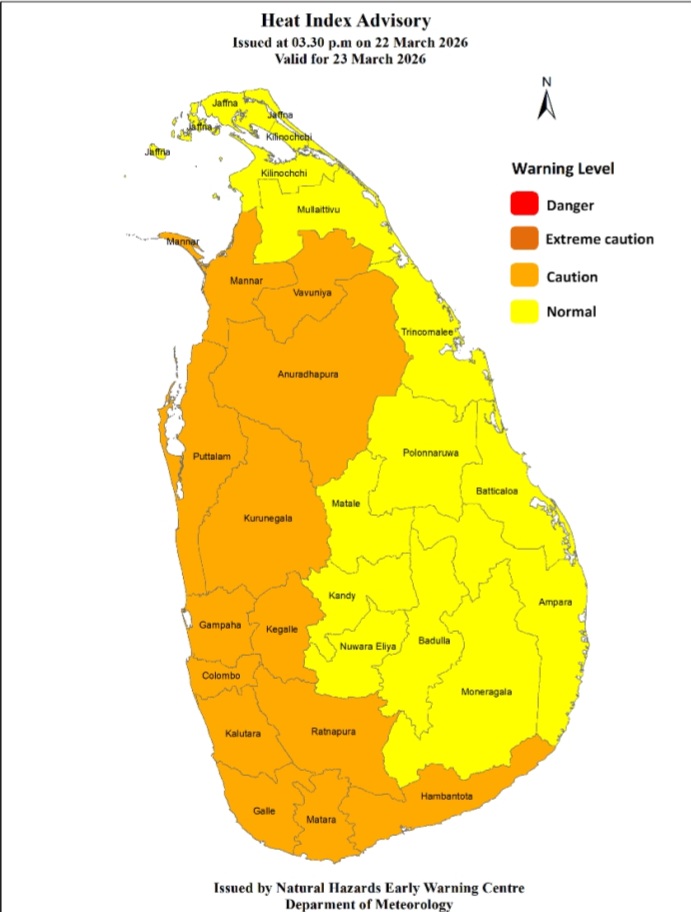
Warm Weather Advisory
Issued by the Natural Hazards Early Warning Centre of the Department of Meteorology
at 3.30 p.m. on 22 March 2026, valid for 23 March 2026.
The Heat index, the temperature felt on human body is likely to increase up to ‘Caution level’ at some places in the Western, Sabaragamuwa, Southern and North-western provinces and in
Anuradhapura, Mannar and Vavuniya districts.
The Heat Index Forecast is calculated by using relative humidity and maximum temperature and this is the condition that is felt on your body. This is not the forecast of maximum temperature. It is generated by the Department of Meteorology for the next day period and prepared by using global numerical weather prediction model data.

Effect of the heat index on human body is mentioned in the above table and it is prepared on the advice of the Ministry of Health and Indigenous Medical Services.
ACTION REQUIRED
Job sites: Stay hydrated and takes breaks in the shade as often as possible.
Indoors: Check up on the elderly and the sick.
Vehicles: Never leave children unattended.
Outdoors: Limit strenuous outdoor activities, find shade and stay hydrated.
Dress: Wear lightweight and white or light-colored clothing.
Note:
In addition, please refer to advisories issued by the Disaster Preparedness & Response Division, Ministry of Health in this regard as well. For further clarifications please contact 011-7446491.

Two killed when Air Canada jet hits fire truck at NYC’s LaGuardia Airport

Bus fares increased by 12.19% from midnight today [23]
Public will not be served as Computer system failure at Department of Registration of Persons

Trump says he is postponing strikes on Iran power plants after ‘productive’ talks on ending war

Asia stocks slide as US and Iran threaten to escalate war

Heat Index at Caution Level in the Western, Sabaragamuwa, Southern and North-western provinces and in Anuradhapura, Mannar and Vavuniya districts

‘Dates have the highest sugar content to fight Coronavirus’

Sunday Island 27 December – Headlines

#SundayIsland 17th December – Headlines

Sunday Island – 28th March

Sunday Island Headlines – 21 March

Sunday Island – 21st February – Headlines
-

 News6 days ago
CIABOC questions Ex-President GR on house for CJ’s maid
-

 News7 days ago
Sri Lankan marine scientist Asha de Vos honoured at UNGA opening
-

 News7 days ago
Australian HC debunks misleading travel risk claims for Sri Lanka
-

 News5 days ago
Bailey Bridge inaugurated at Chilaw
-
 Latest News7 days ago
Wednesdays declared a government holiday with effect from 18th March
-

 News5 days ago
Pay hike demand: CEB workers climb down from 40 % to 15–20%
-

 News4 days ago
CIABOC tells court Kapila gave Rs 60 mn to MR and Rs. 20 mn to Priyankara
-

 Editorial6 days ago
Couple QR-based quota with odd-even rationing