
News
BASL concerned about impact of economic crisis on rule of law and democracy

The Bar Association of Sri Lanka (BASL) has said that it is gravely concerned about the signs of a looming economic crisis in Sri Lanka and its possible impact on the rule of law and democracy and on the living conditions of the people.
Secretary to the BASL, Rajeev Amarasuriya has said that the spiraling inflation, shortages of essential goods including cooking gas, the unavailability of foreign currency, people’s inability to remit monies overseas, the downgrading of Sri Lanka’s ratings by multiple international rating agencies, the temporary closure of the oil refinery at Sapugaskanda, reports of the operations of certain foreign airlines being suspended, warnings of a possible power crisis are all indicators which demonstrate the urgency of the need for the government to address the economic crisis without any further delay.
Text of the BASL statement: “A downturn in the economy can have far reaching adverse consequences to the Rule of Law and Governance of a Country. At its worst, economic decline can result in a complete breakdown of Law and Order, but even prior to that, serious repercussions flow from growing financial hardships that have to be borne by citizens that perpetuates inequality and the ability of citizens to enjoy or vindicate their rights, be they public or private rights. It goes without saying that the worst affected by economic hardship are the most vulnerable in society,” Amarasuriya said
Given below are excerpts of the press release: “It is an undisputed fact that since March 2020 there has been a gradual erosion of foreign reserves from approximately USD 7 billion. Although it was announced by the Central Bank that the reserves have increased to USD 3 billion, it remains to be ascertained how much of that are usable reserves to repay the debt and used to redress the prevailing balance of payments crisis. Even out of the available reserves a large proportion contains moneys obtained in the form of short-term foreign exchange swaps.
“There have been several sovereign credit ratings downgrades in the corresponding period by all the major credit rating agencies. The latest being the downgrades by Fitch Rating Agency to CC and Standard and Poor’s (S & P) to CCC. The International Sovereign Bonds yields across all tenures have remained in double digits for over a period of 2 years. This has made rollover of maturing sovereign bonds not feasible.
“There have also been reports of a flight of foreign capital both from the equities and as well as the money markets. Foreign participation in both markets at present is only negligible. The Economist magazine named Sri Lanka as one of the most vulnerable countries to the expected fallout in emerging markets from the anticipated raising of interest rates by the Federal Reserve of the United States. Debt to GDP from approximately 85% in 2019 is now estimated to have risen to approximately 104% of GDP. However, in the same period the government revenue as a percentage of the GDP has fallen from approximately 12% to 10%. Year on Year headline inflation in the month of November 2021 was recorded at 9.92% and December 2021 recorded a double digit figure of 12%, the highest in the past 7 years. The Net International Reserve Position of the Country has been negative for over three months consecutively. All of this has resulted in the scarcity of foreign exchange to sustain essential imports.
“The ability of the government to meet its total dollar requirements of approximately USD 6.9 billion in 2022 is being questioned, although the Central Bank has pledged that such commitments will be met. Questions as to the stability of the financial sector are also being raised.
“The BASL notes with deep concern the statement made in late December by the Joint Chambers of Commerce calling upon the government that if actions as envisaged by the recently announced Roadmap by the Central Bank of Sri Lanka are not materialized within the anticipated timeframes to reconsider other alternative courses of action available to the country such as engaging with the IMF to explore the funding options they can offer. The Joint Chambers have warned that if conditions do not improve many local companies would look to relocate their business operations overseas and that the ability to attract Foreign Direct Investment (FDI) into the country will be constrained.
“The BASL acknowledges that the government has been confronted with extraordinary challenges in the form of the pandemic which has caused disruptions to the economic activities. It also recognizes the fact that the government has taken measures to address the challenges arising thereof. Similarly, the Government has sought to undertake remedial measures to address the fallout from the prevalent crisis consequent to the loss of access to financial markets and the resulting paucity of foreign exchange domestically thereof. However, none of those measures have brought about the desired results and have failed to build confidence to reverse the flight of foreign capital from the equities and money markets. Neither have these steps resulted in regaining access to international financial markets to raise debt.
“Enjoyment of a living standard based on desired lifestyle choices and income has become a challenge. Our members who are mostly self-employed are particularly vulnerable and adversely impacted by these events as savings and assets form the bedrock of their economic safety net. Some of the measures taken by the Government have directly impeded the ability of our members to perform their professional duties, particularly the purported regulation that compels the conversion of foreign inflows into rupees within a stipulated time period.
“We believe that the present crisis is the crescendo of the crisis emanating from the systematic undermining of the rule of law and governance based on executive convenience and expediency rather than on institutional independence and autonomy over a long period of time by successive governments.
“In these circumstances, the BASL calls upon the government to seek the assistance of acknowledged independent and non-partisan experts both domestically and internationally and also of multilateral institutions that have a proven record of providing resources financially as well as in the form of technical expertise that will enable sustainable solutions to this crisis. It is our belief that such assistance will result in the prescriptions that manifest to the world Sri Lanka’s belief in institutions as a country where effective governance is not contingent on personalities. It will manifest the fact that Sri Lanka has the desire and institutional capacity to respond to the exigencies brought by the present crisis via prescriptions that subscribe to the Rule of Law. Moreover, it is our belief that only such a response will create the institutional framework that ensures the efficient collection of revenue and the result in the efficient allocation of scarce resources and the formulation of monetary policy that ensures economic stability rather than a permissive one which facilitates executive expediency and convenience. The achievement of these outcomes is in our opinion indispensable to resolve the crisis at hand.”

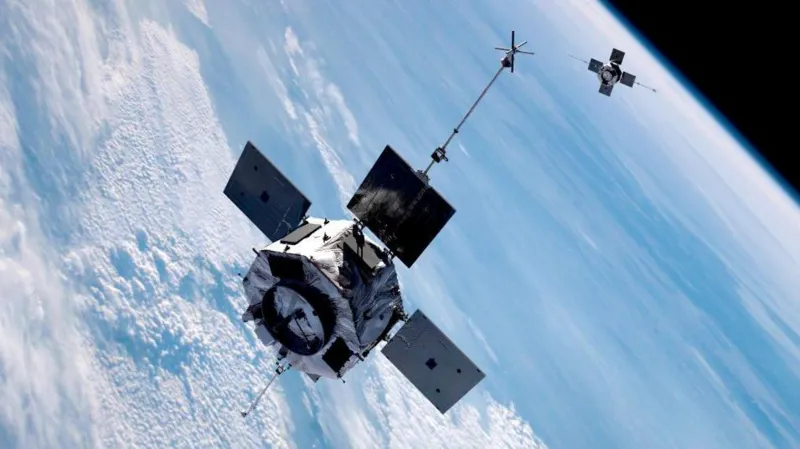
A Van Allen Probe spacecraft weighing more than 1,300lb (600kg) is expected to re-enter Earth’s atmosphere almost 14 years after its launch, Nasa says.
The spacecraft is projected to re-enter around 19:45 EDT (23:45 GMT) on Tuesday the US Space Force predicted, according to Nasa, though there is a 24-hour margin of “uncertainty” in the timing.
The Van Allen Probe A, which launched in 2012, is expected mostly to burn up as it travels through the atmosphere, though some components may survive.
The space agency said there is a one in 4,200 chance of being harmed by a piece of the probe, which it characterised as “low” risk.
The spacecraft and its twin, Van Allen Probe B, were on a mission to gather unprecedented data on Earth’s two permanent radiation belts.
It was not immediately clear where in Earth’s atmosphere the satellite is projected to re-enter. The BBC has contacted Nasa for further detail.
Nasa and the US Space Force have said they will monitor the re-entry and update any predictions.
The mission, which was originally designed to last two years, went on for almost seven. It ended after the spacecrafts ran out of fuel and were no longer able to orient themselves toward the Sun.
The probes flew through rings of charged particles trapped by Earth’s magnetic field from 2012 to 2019, in order to study how particles were gained and lost, per Nasa.
Those rings, called the Van Allen belts, shield Earth from cosmic radiation, solar storms and streaming solar wind, which are harmful to humans and can damage technology.
The mission made significant discoveries, including the first data that show the existence of a transient third radiation belt, which can form during times of intense solar activity, Nasa said.
Van Allen Probe B is not expected to re-enter the Earth’s atmosphere before 2030.
[BBC]

Prime Minister Dr. Harini Amarasuriya visited the International Rice Research Institute (IRRI) headquarters in Los Baños, Laguna, Philippines, on 11 March 2026, and held bilateral discussions with Yvonne Pinto, Director General of IRRI, focusing on strengthening cooperation in the field of rice research and sustainable agricultural development.
During the meeting, discussions centered on rice cultivation in Sri Lanka, including the key challenges faced by Sri Lankan paddy farmers. The Prime Minister highlighted issues affecting the sector such as productivity constraints, climate-related impacts, and the need to support farmers through improved agricultural practices and technological innovations.
Both sides also discussed the importance of introducing modern techniques and research-driven approaches to rice cultivation in order to enhance productivity and ensure long-term food security. In this regard, IRRI shared insights on ongoing global research initiatives aimed at improving rice varieties, strengthening climate resilience, and promoting sustainable farming practices.
The discussion further focused on the potential for expanded collaboration between Sri Lanka and IRRI, particularly in areas such as research partnerships, knowledge sharing, and capacity building for Sri Lankan agricultural institutions and farmers. The Prime Minister emphasized Sri Lanka’s interest in strengthening cooperation with IRRI to support the development of the country’s rice sector and to improve the livelihoods of paddy farmers.
The visit reaffirmed the importance of science-based agricultural innovation and international collaboration in addressing food security challenges and enhancing sustainable rice production in Sri Lanka.

(Prime Minister’s Media Division)
Latest News
Heat Index at ‘Caution level’ at some places in the Western, Sabaragamuwa, Southern and North-western provinces and in Monaragala and Mannar districts

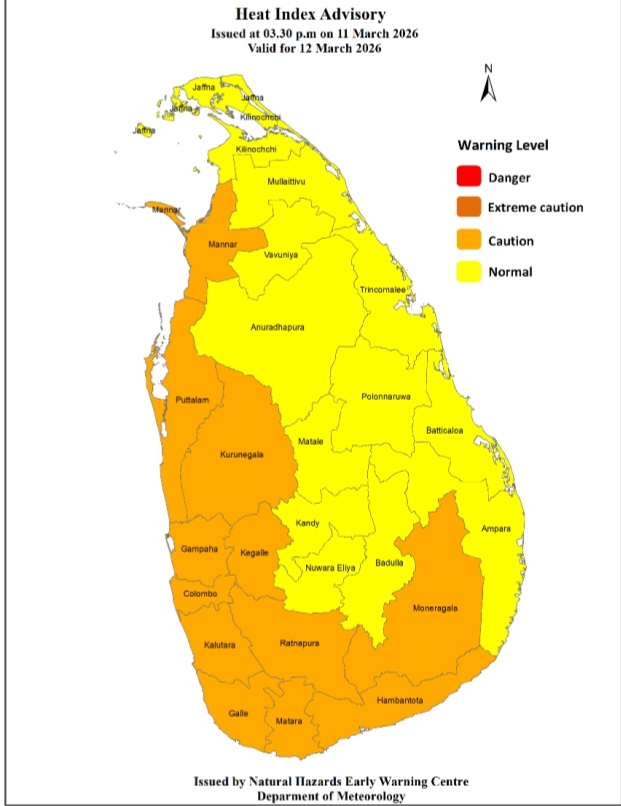
Warm Weather Advisory
Issued by the Natural Hazards Early Warning Centre of the Department of Meteorology at 3.30 p.m. on 11 March 2026, valid for 12 March 2026.
The public are warned that the Heat index, the temperature felt on human body is likely to increase up to ‘Caution level’ at
some places in the Western, Sabaragamuwa, Southern and North-western provinces and in Monaragala and Mannar districts.
The Heat Index Forecast is calculated by using relative humidity and maximum temperature and this is the condition that is felt on your body. This is not the forecast of maximum temperature. It is generated by the Department of Meteorology for the next day period and prepared by using global numerical weather prediction model data.

Effect of the heat index on human body is mentioned in the above table and it is prepared on the advice of the Ministry of Health and Indigenous Medical Services.
ACTION REQUIRED
Job sites: Stay hydrated and takes breaks in the shade as often as possible.
Indoors: Check up on the elderly and the sick.
Vehicles: Never leave children unattended.
Outdoors: Limit strenuous outdoor activities, find shade and stay hydrated.
Dress: Wear lightweight and white or light-colored clothing.
Note:
In addition, please refer to advisories issued by the Disaster Preparedness & Response Division, Ministry of Health in this regard as well.
For further clarifications please contact 011-744649

Jemimah Rodrigues, Harmanpreet Kaur, Mitchell Starc and Kuldeep Yadav among ESPNcricinfo award winners for 2025

China approves ‘ethnic unity’ law requiring minorities to learn Mandarin

Nasa spacecraft weighing 1,300lb due to re-enter Earth’s atmosphere

Chinese national arrested over attempt to smuggle 2,000 queen ants from Kenya

Attacks reported on three more cargo ships in Gulf, with oil price back near $100

PM Visits the International Rice Research Institute (IRRI)

‘Dates have the highest sugar content to fight Coronavirus’

Sunday Island 27 December – Headlines

#SundayIsland 17th December – Headlines

Sunday Island – 28th March

Sunday Island Headlines – 21 March

Sunday Island – 21st February – Headlines
-

 News7 days ago
University of Wolverhampton confirms Ranil was officially invited
-

 News6 days ago
Peradeniya Uni issues alert over leopards in its premises
-

 News7 days ago
Female lawyer given 12 years RI for preparing forged deeds for Borella land
-

 News4 days ago
Repatriation of Iranian naval personnel Sri Lanka’s call: Washington
-
 News7 days ago
Library crisis hits Pera university
-

 News6 days ago
Wife raises alarm over Sallay’s detention under PTA
-

 News7 days ago
‘IRIS Dena was Indian Navy guest, hit without warning’, Iran warns US of bitter regret
-
 Latest News7 days ago
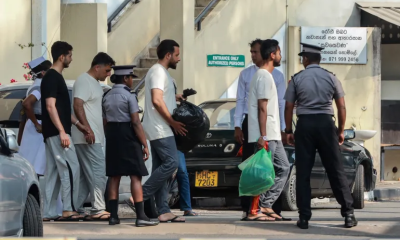
Sri Lanka evacuates crew of second Iranian vessel after US sunk IRIS Dena