
News
Banks cannot provide US dollars even at Rs.345


by Sanath Nanayakkare
All licensed commercial banks in the country are still facing a huge crunch in foreign exchange inflow, although inward remittances can be converted to Sri Lanka rupees at a much higher rate since the Central Bank of Sri Lanka floated the Sri Lanka rupee.
This was revealed in a report released by the Lanka IOC.
It says that exporters are not coming forward for conversion of foreign currency, even at the rates higher than official ones.
Lanka IOC, a subsidiary of Indian Oil Corporation that operates retail petrol/diesel stations in Sri Lanka, says that the local currency has depreciated further and while the Central Bank’s TT selling rate is Rs.330 as of now, the licensed commercial banks are not able to provide US dollars even at the rate of Rs.345.
“Since the Central Bank floated the rupee on 7 March 2022, the local currency has been constantly devaluing against the dollar and currently hovering around Rs. 330 per US$, having shot up from the level of Rs. 203. This has made fuel import much costlier,” Lanka IOC notes.
The company says that rupee devaluation by more than 60% during the last one-month since 7th March 2022, compelled them to again increase its retail selling prices of gasoline by Rs 35/ltr and gasoil price by Rs 75/ltr.
“Even though international prices are stable since last one week amid the surge in COVID cases in China and preparation of the International Energy Agency for releases of oil reserves, the local currency depreciation is significantly increasing the cost of fuel imports”, Lanka IOC says.
LIOC Managing Director Manoj Gupta says, “Unstable currency rates and steep rupee depreciation has directly impacted the landed cost of gasoil and gasoline making them expensive by an equivalent amount per litre. Our current losses are exorbitantly high considering at current exchange rate and international prices leaving no other option but to increase the prices of gasoil and gasoline. In view of uncertainty in the global market coupled with Sri Lanka country risk, most of the suppliers are not participating in the tenders or quoting high premium for supply of gasoil and gasoline. Despite this price increase, there would still be heavy losses being suffered by the company. Lanka IOC has always remained committed towards the economic and social upliftment of Sri Lanka. We are very much disturbed and find it painful to pass on the impact of currency devaluation to our customers, but absolutely left with no option to ensure our sustenance and maintain an uninterrupted fuel supply.”
“We will review the selling prices on a periodic basis and would be more than happy to give some relief to our customers by reducing the prices as and when the situation improves and the currency appreciates and stabilises,” Gupta says.



During an operation conducted in the dark hours of 27 Dec 25, the Sri Lanka Navy seized an Indian fishing boat and apprehended 03 Indian fishermen while they were poaching in Sri Lankan waters, south of the Delft Island in Jaffna.
The seized boat and Indian fishermen (03) were brought to the Kreinagar Jetty and were handed over to the Fisheries Inspector of Jaffna for onward legal proceedings.

Admiral of the Fleet Wasantha Karannagoda said that he is still waiting for the government’s response to the UK sanctions imposed on three ex-military officers, including him, and a former member of the LTTE.
The former Navy Chief said so in response to The Island query whether he was aware of the position taken by a three-member ministerial committee, consisting of Foreign Minister Vijitha Herath, Justice and National Integration Minister Harshana Nanayakkara and Deputy Defence Minister Maj. Gen (retd) Aruna Jayasekera.
The government named the committee in the wake of the UK declaration of travel bans and asset freezes in respect of Karannagoda, General Shavendra Silva, General Jagath Jayasuriya and Vinayagamoorthy Muralitharan, also known as Karuna. Maj. Gen. Jayasekera said that they inquired into the issue at hand.
Karannnagoda said that he would like to know the government’s recommendations if the ministerial committee briefed the Cabinet as per a decision taken by the Cabinet of Ministers. Karannagoda said that the issue should have been taken at the highest level as various interested parties continue to humiliate the war-winning military by targeting selected individuals.
Other sources, familiar with the issues at hand, told The Island that the government was yet to announce its stand.
Sources pointed out that the Opposition has been silent on what they called a matter of utmost national importance.
Cabinet spokesman Dr. Nalinda Jayathissa is on record as having described the UK move as a unilateral move and that committee was formed to examine the developments and recommend appropriate measures to the Cabinet.
Foreign Minister Herath told The Island the government was not successful in getting the British to withdraw sanctions. Describing the UK decision as unilateral, the Miniser said that the government conveyed its concerns but the UK didn’t change its stand.
The Island raised the issue with Minister Herath and Admiral Karannagoda in the wake of British MP of Sri Lankan origin, Uma Kumaran requesting the UK Foreign Secretary Yvette Cooper to expand on the government’s sanctions imposed on the four above-mentioned persons.
During a Foreign Affairs Committee meeting on 16 December, the MP for Stratford and Bow highlighted the lack of accountability and political will from the current Sri Lankan government to address war crimes and mass atrocities committed in Sri Lanka.
Sources said that David Lammy, who served as Secretary of State for Foreign, Commonwealth and Development Affairs at the time of the declaration of sanctions, had no qualms in declaring that the action taken against four Sri Lankans was in line with a commitment he made during the election campaign to ensure those responsible wouldn’t be allowed impunity. The UK government statement quoted Lammy as having said that this decision ensured that those responsible for past human rights violations and abuses were held accountable.
By Shamindra Ferdinando
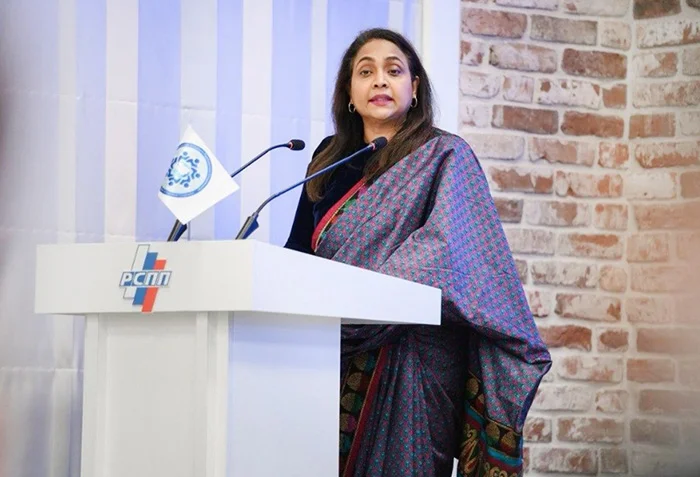
Sri Lankan Ambassador to the Russian Federation, Shobini Gunasekera recently presented a conceptual framework of seven key vectors that defined contemporary international relations and facilitated dialogue among States. She made the presentation at XI Moscow International Financial and Economic Forum held under the theme “Building Bridges: Partnership without Borders”.
In her address, the Ambassador emphasised that these vectors represent the channels through which ideas circulate, trade expands, and peace is strengthened, serving as guiding principles for cooperation amid global uncertainties. The seven key vectors highlighted were economic ties as a foundation for long-term stability; political choice and diplomacy through dialogue and multilateral engagement; security cooperation to address cross-border threats; cultural linkages through education, tourism, and professional exchanges; technological advancement, particularly in digital systems and artificial intelligence; environmental stewardship through collective action on renewable energy and climate change; and humanitarian obligations, including disaster relief and development cooperation.
Drawing on Sri Lanka’s experience, the Ambassador illustrated the practical application of these principles by highlighting the country’s strategic location in the Indian Ocean, its role as a trade and logistics hub, and its active engagement in regional groupings such as BIMSTEC and the Indian Ocean Rim Association, where the Russian Federation serves as a Dialogue Partner.
The potential for enhanced Sri Lanka–Russia bilateral cooperation was underscored, particularly through complementarities between Russia’s technological and energy expertise and Sri Lanka’s logistical capabilities and maritime infrastructure. She noted that such synergies could support joint initiatives in trade, innovation, tourism, and logistics, while cultural and scientific exchanges would further strengthen mutual understanding between the two countries.
Concluding her remarks, the Ambassador stated that sustained progress requires dialogue, mutual respect, and forward-looking partnerships capable of shaping a shared and stable future.

Navy seizes an Indian fishing boat poaching in northern waters

Mandhana, Shafali and Ghosh help India edge run-fest to go 4-0 up

Showers predicted in several provinces today (29th December)

Delay in govt. response to UK sanctions on ex-military chiefs, and others causes concern

Sri Lanka outlines seven key vectors of international cooperation at Moscow forum

Sri Lanka third most preferred destination for Indians

‘Dates have the highest sugar content to fight Coronavirus’

Sunday Island 27 December – Headlines

#SundayIsland 17th December – Headlines

Sunday Island – 28th March

Sunday Island Headlines – 21 March

Sunday Island – 21st February – Headlines
-

 News7 days ago
Members of Lankan Community in Washington D.C. donates to ‘Rebuilding Sri Lanka’ Flood Relief Fund
-

 News5 days ago
British MP calls on Foreign Secretary to expand sanction package against ‘Sri Lankan war criminals’
-

 Features7 days ago
General education reforms: What about language and ethnicity?
-
 News7 days ago
Suspension of Indian drug part of cover-up by NMRA: Academy of Health Professionals
-
 Sports5 days ago
Chief selector’s remarks disappointing says Mickey Arthur
-
 News4 days ago
Street vendors banned from Kandy City
-

 Editorial7 days ago
A very sad day for the rule of law
-

 News7 days ago
US Ambassador to Sri Lanka among 29 career diplomats recalled