
Sports
Babar masterclass gives Colombo Strikers thrilling win

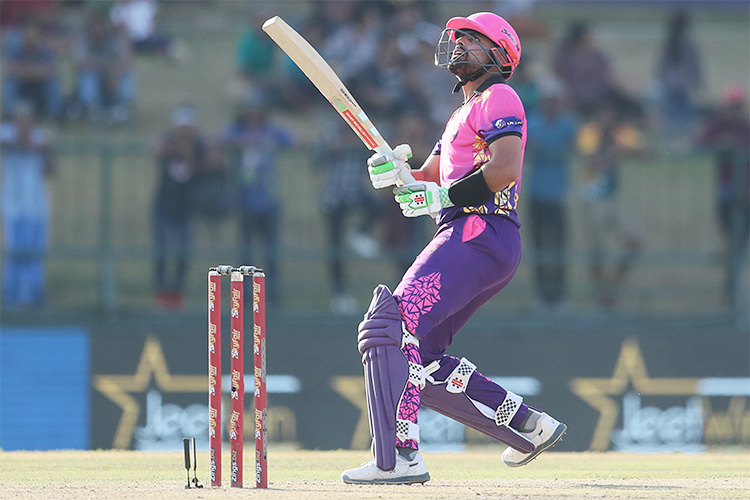
Colombo Strikers stayed in the hunt in the Lanka Premier League with a thrilling seven-wicket win over Galle Titans at Pallekele yesterday.
Galle the table toppers faced bottom-paced Colombo yesterday and a defeat could have made things extremely difficult for Niroshan Dickwella’s side to make it to the knockout stage. But a thrilling win gave them some breathing space although they need to do a bit of work with their Net Run Rate.
Colombo owed it to their star performer Babar Azam, who made a terrific hundred to enable his side to chase down the stiff target of 189.
Babar may not be one of the modern-day greats of T-20 cricket where he takes bowlers to the cleaners, but he has proved that with proper cricketing strokes and a bit of smartness, you can dominate the shortest format of the game as well. How Sri Lankans fans will be wishing that their young stars too remain grounded like the Pakistan skipper.
How Dickwella skippers this team ahead of Babar remains one of the great mysteries of LPL. Or for that matter how Kusal Mendis captains Dambulla over Dhananjaya de Silva is another mystery. This indeed is a funny game.
Batting with Babar, was a good learning experience as well for young Sri Lankan cricketers like Pathum Nissanka, who shared a 111-run stand for the first wicket, and Nuwanindu Fernando, who added 55 runs for the second wicket.
Babar’s 104 came off 59 balls with eight fours and five sixes.
The game was evenly poised with Colombo needing 75 runs in the last seven overs. The 14th over bowled by Akila Dananjaya proved to be a game-changing one as Babar targeted the off-spinner by smashing 20 runs off that over making the equation 56 needed from the last six overs.
Babar was dropped on 89 by Richard Ngarava off his own bowling. He completed the hundred and was dismissed in the last over with Colombo needing 14 runs.
Mohammad Nawaz was promoted up to the order and he scored 14 runs off the next four balls including a six and a four off Kasun Rajitha to seal the game in Colombo’s favour.
Amidst Babar’s heroics, the efforts of Pathum Nissanka were overshadowed. The opening batter posted 54 off 40 with five fours and one six.
Galle started off well with the openers adding 87 runs in 47 balls. After such a prolific start, they should have looked to score something in the region of 200 but there wasn’t much firepower in the batting.
Colombo’s spinners Mohammad Nawaz, Lakshan Sandakan and Ramesh Mendis did well to pull things back.
It was Lasith Croospulle (36) and Shevon Daniel (49) who had given their team a terrific start. Both look terrific prospects for the future, particularly the left-handed Daniel. But both of them are also sloppy fielders and unless they improve their fielding they should not make it to the senior side although anything is possible under the current selection panel.
Daniel and Croospulle aren’t alone. It’s sad to see that so many young players neglecting the vital aspect of fielding. SLC has introduced several steps to address the issue, but the desired results haven’t been there and maybe they should introduce attractive cash prizes every game for the best fielder.
Brief Scores:
Galle Titans
188-3 (20)
(Lasith Croospulle 36, Shevon Daniel 49, Tim Seifert 54*, Lakshan Sandakan 1-29)
Colombo Strikers
189-3 (19.5)
(Pathum Nissanka 54, Babar Azam 104, Tabraiz Shamsi 2-27)
Result:
Colombo Strikers beat Galle Titans by seven wickets








It was the Amelia Kerr show at Basin Reserve on Wednesday as she played the sort of innings that would go into cricket folklore if it were played at a World Cup instead of a bilateral series, to completely hog the limelight in a match with three other knocks of note and a total of 696 runs in 99.4 overs. Amelia scored 179 not out in 139 balls. And as New Zealand crossed South Africa’s 346 with two balls left, it became the highest successful chase in women’s ODI history.
The result hardly seemed like when New Zealand, faced with a chase of 347, lost Suzie Bates in the fifth over, bowled by Ayabonga Khaka. Amelia settled in fast, but by the midway stage, New Zealand were four down, Kayla Reyneke striking twice and Sune Luus once as Georgia Plimmer, Maddy Green and Brooke Halliday all fell without making a significant contribution.
Amelia finally found the partner she needed in Isabella Gaze, the wicketkeeper-batter at No. 6. Together, the two of them 120 runs in 82 balls, Amelia scoring 47 of those runs in 34 balls to Gaze’s enterprising 68 in 48, studded with 11 fours.
By the time Gaze fell, becoming the first of two wickets in the game for Masabata Klaas, New Zealand had bounced right back and were in with a strong sniff. Amelia, by then on 113 off 97 balls, looked in the mood.
And then, with the lower-order batters for company, Amelia did what she had to: speed up. She scored a-run-a-ball 23 in a 40-run stand with Izzy Sharp, then 25 in 12 balls with her sister Jess, Rosemary Mair came and went, and then Amelia finished the job in the company of debutant Kayley Knight with two balls left. Amelia had reached her century – her fifth in ODIs, which includes a double-century – off 90 balls, and the 79 she scored after that came off just 49 more.
Earlier, South Africa would have felt happy with their performance with the bat after New Zealand had won the toss and asked them to bat, having lost the first game batting first, though not out of choice.
New Zealand struck early, removing Tazmin Brits in the eighth over, but then had to wait till the 28th before they got lucky again. In between, Laura Wolvaardt (69 in 74 balls) and Anneke Bosch (91 in 90) had added 132 runs in 124 balls, and South Africa were clearly on top.
South Africa continued to get strong partnerships with many of their batters settling in and showing form: 44 between Bosch and Luus (40), 34 between Luus and Sinalo Jafta (37), 40 between Jafta and Chloe Tryon (52*), 36 in just 18 balls between Tryon and Nadine de Klerk (18), and 25 in 12 balls for the unbroken seventh wicket between Tryon and Reyneke (9*). All of that added up to a very healthy total despite Bree Illing’s 3 for 60 and Knight’s 2 for 65, and South Africa would have expected the finish the night with the series in the bag, till Amelia decided otherwise.
Brief scores:
New Zealand Women 350 for 8 in 49.4 overs (Amelia Kerr 179*, Isabella Gaze 68; Ayabonga Khaka 3-51, Kayla Reyneke 2-54, Masabata Klaas 2-61) beat South Africa Women 346 for 6 (Anneke Bosch 91, Laura Wolvaardt 69, Chloe Tryon 52*, Sune Luus 40; Bree Illing 3-60, Kaylee Knight 2-65) by two wickets
[Cricinfo]

Shreyas Iyer has been fined for Punjab Kings’ slow over-rate against Gujarat Titans on Tuesday. This being PBKS’ first such offence of the season, Iyer was fined INR 12 lakh.

Punjab Kings 165 for 7 in 19.1 overs (Cooper Connolly 72*, Prabhsimran Singh 37, Shreyas Iyer 18, Xavier Bartlett 11*; Kagsio Rabada 1-13, Ashok Sharma 1-31, Rashid Khan 1-29, Washington Sundar 1-27, Prasidh Krishna 3-29) beat Gujarat Titans 162 for 6 in 20 overs (Sai Sudarshan 13, Shubman Gill 39, Joss Buttler 38, Glenn Phillips 25, Washington Sundar 18, Rahul Tewatia 11*; Marco Jansen 1-20, Vijayakumar Vyshak 3-34, Yuzvendra Chahal 2-28) by three wickets
Gujarat Titans (GT) stopped Punjab Kings (PBKS) in their tracks but could not stop them from going over the finish line in New Chandigarh. Cooper Connolly steered the hosts home in a chase that began authoritatively before taking nervy turns.
Prabhsimran Singh led the initial charge alongside Connolly before Prasidh Krishna initiated a collapse that derailed the chase. But with help from Marco Jansen and Xavier Bartlett, Connolly took PBKS home with five balls to spare.
GT had a sub-par outing with the bat, with three of their top four getting off to good starts but none of them capitalising. Yuzvendra Chahal was back to his best, taking out Shubman Gill and Jos Buttler, who top-scored with 39 and 38 respectively.
PBKS’ bowlers conceded 14 extras, 11 of which were wides, four of them coming in the final over by Arshdeep Singh. Perhaps the more relevant stat separating the teams was that GT hit three sixes in their innings and PBKS as many as 14.
Chahal came on with GT well set on 65 for 1 off 7 overs. He bowled slow, and varied his lines against Gill to dismiss him fourth time in the IPL. This time, it was a slog sweep that carried to deep midwicket.
There were a couple of near-chances in the 11th over, one a caught-and-bowled chance off Buttler and then one off Glenn Phillips, who hit an airy four that went just wide of Shreyas Iyer at cover. Chahal returned in the 16th, after a three-over break, with Buttler batting on 38 off 30 and itching for runs. Two dots later, Buttler looked to clear long-on but Bartlett used his height and reach to take an excellent high catch.
Vijaykumar Vyshak bowled across phases and found success later in the innings. Buttler and Gill took him on initially, hitting two fours and a six in his first two overs, the sixth and eighth of the GT innings. He came back and got Glenn Phillips to hole out to long-off in the 14th.
He saved the best for the death, bowling slower balls, either into the pitch or pitched right up. The first variant got Washington Sundar caught, cutting to deep point, and the latter had Shahrukh Khan slogging to deep square leg.
The pitch seemed flat early on as Gill, Sai Sudharsan and Buttler started with a flurry of fours. Nine in the first six overs, in fact. There were drives, pulls and flicks, and a gorgeous back-foot punch by Buttler off Vyshak.
The slowdown came in the middle overs, which saw GT make 77 for 3. Buttler faced 14 dots in his 33-ball 38, Gill, having rocketed to 27 off 15, made just 12 off his last 12 balls.
Phillips got off to a promising start on GT debut, hitting Chahal for a six and a four within his first eight balls at the crease. He missed out on a couple of boundaries because of Marco Jansen’s fielding at long-off. In the end, three of the top-four batters got to 25 but none went past 39.
After Kagiso Rabada dismissed Priyansh Arya cheaply, Connolly and Prabhsimran took him on: they hit three sixes in the fourth over, the same as GT’s innings tally.
Connolly then used Ashok Sharma’s pace to carve a length ball over cover point. He then hit two sixes off successive Rashid overs while Prabhsimran did the same off Washington Sundar.
However, Prabhsimran couldn’t get going against Rashid. He faced eight balls and scored just two before charging the legspinner and finding Prasidh at long-on. PBKS were 83 for 1 in the tenth over.
The momentum didn’t flag with that wicket, as Shreyas hit sixes off back-to-back short balls from Ashok. But out of nowhere, Prasidh dismissed the PBKS captain, who chipped a half-volley straight to deep midwicket.
This brought about a burst of T20-style wickets where the field mattered more than the quality of the ball. Nehal Wadhera cut a shortish slower ball straight to cover. Shashank Singh, looking to run the ball to deep third, nicked to the keeper off Prasidh. Marcus Stoinis, off Prasidh again, carved a shortish ball to deep third. PBKS had lost four wickets in the space of 16 balls for eight runs.
At 121 for 6, with PBKS needing 42 off 30, the game was flipping. But Connolly was ice-cool against Rabada. He punished two short balls to bookend the 16th over, the first cut over backward point for four to bring up his fifty and the last one pulled over square leg for six.
The pressure was eased at the other end as Jansen and Bartlett pulled Prasidh for sixes in the 17th and 19th overs respectively. That was where PBKS effectively sealed the game.
Brief scores:
Punjab Kings 165 for 7 in 19.1 overs (Cooper Connolly 72*, Prabhsimran Singh 37, Shreyas Iyer 18, Xavier Bartlett 11*; Kagsio Rabada 1-13, Ashok Sharma 1-31, Rashid Khan 1-29, Washington Sundar 1-27, Prasidh Krishna 3-29) beat Gujarat Titans 162 for 6 in 20 overs (Sai Sudarshan 13, Shubman Gill 39, Joss Buttler 38, Glenn Phillips 25, Washington Sundar 18, Rahul Tewatia 11*; Marco Jansen 1-20, Vijayakumar Vyshak 3-34, Yuzvendra Chahal 2-28) by three wickets
[Cricinfo]

Amelia Kerr hits 139-ball 179* as New Zealand pull off record chase to level series

Punjab Kings fined for slow over-rate

Ice-cool Connolly leads nervy Punjab Kings home on IPL debut

Showers expected in the Western, Sabaragamuwa and Southern provinces in the evening or night

Heat Index at Caution Level in the Western, Sabaragamuwa, Southern, Eastern, North-western, Northern and North-central provinces and in Monaragala district

Urea shortage threatens Yala harvest: Experts

‘Dates have the highest sugar content to fight Coronavirus’

Sunday Island 27 December – Headlines

#SundayIsland 17th December – Headlines

Sunday Island – 28th March

Sunday Island Headlines – 21 March

Sunday Island – 21st February – Headlines
-

 Features5 days ago
A World Order in Crisis: War, Power, and Resistance
-

 News6 days ago
Energy Minister indicted on corruption charges ahead of no-faith motion against him
-

 News7 days ago
US dodges question on AKD’s claim SL denied permission for military aircraft to land
-

 Business7 days ago
Dialog Unveils Dialog Play Mini with Netflix and Apple TV
-

 Sports6 days ago
SLC to hold EGM in April
-

 Opinion6 days ago
When elephants fight, it is the grass that suffers
-

 Latest News7 days ago
A strong Technical and Vocational Education and Training (TVET) system equips individuals with practical, relevant, and future-oriented skills helping to innovate responsibly towards a greener and sustainable future – PM
-

 Features6 days ago
Lest we forget