
News
The country requires a strong Executive Presidency to navigate the Post-Covid world says Milinda Moragoda

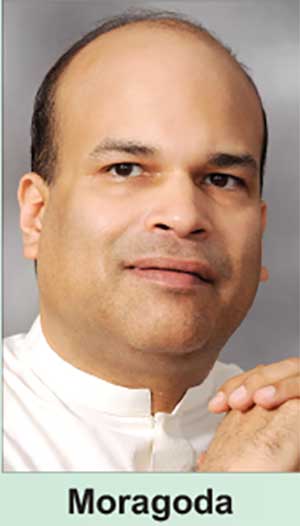
Milinda Moragoda, former Cabinet Minister and founder of the Pathfinder Foundation spoke about the need for Sri Lanka to be fast and agile in order to face the economic, social and international challenges of the Post-Covid environment.
He stated that: ‘there is no disputing the fact that the country benefited from having strong executive decision-making during the early stages of the pandemic. And as a result, many lives were saved.
Disappointingly, no major political party has yet put forward a coherent governance and governing structure for the nation in their policy platforms.
‘Each has been predictably very chameleon-like when addressing issues related to constitutional and governance-structure related matters in their manifestos. This is especially unfortunate in light of the dysfunctional relationship that now exists between the Executive and the Legislature and the proven potential for gridlock, both a result of the enactment of the 19th Amendment.’
Against this backdrop, without any coherent or credible proposals thus far having been presented by any major political party, Moragoda proposes that all thoughtful Sri Lankans take up the following points for their consideration, discussion and if appropriate advocacy :
A. The establishment of a strong Executive Presidency that can act decisively and yet be ultimately accountable to Parliament. After all, the presidency is the only office elected by all Sri Lankan voters. Thus, the individual occupying this post will be implicitly accountable to all citizens, be they from Kankesanturai or Dewinuwara.
B. An independent legislature that will promulgate legislation and act as a
responsible check and balance to Executive excess. This legislature
should be elected on a first-past-the-post basis with a small percentage
of members being chosen through a proportional representation system.
This change should lead to a stable parliament where most members are
directly accountable to their constituencies and citizens. The preference
vote system which has only created chaos and in-fighting should be
dispensed with.
C. The Provincial Councils should be abolished and empowered local
councils set up to address the day-to-day issues of the citizenry.
D. An empowered Senate should be created to represent minority and
regional interests.
Moragoda further pointed out that ‘Forty-two years have passed since the establishment of Sri Lanka’s Executive Presidency and that all those who criticize this form of government have still not been able to convince Sri Lankans of any better option. Notably, when the opportunity for abolishing the presidential system presented itself in 2015, the then government was unable or unwilling to conduct a referendum to abolish the presidency. And, as we are now on the verge of facing the most challenging period in our post-Independence history, the need of the hour is a strong executive.’
To lend further context to his point he noted that: ‘The first conception of a Presidential system was forged in the late 18th century after the American war of Independence against the British. Extensive debates surrounding the extent of the powers of an Executive Presidency took place during the drafting of the American Constitution. One of the founding fathers and authors of the US Constitution, Alexander Hamilton, argued for a strong Executive leader making the point that:
” ‘A feeble Executive implies a feeble execution of the government. A feeble execution is but another phrase for a bad execution, and a government ill-executed, whatever it may be in theory, must be, in practice, a bad government.’”
‘In the final analysis Sri Lanka cannot afford to have a crippled government especially at this critical juncture where a large number of lives and livelihoods are at stake.








In terms of the provisions of the Establishments Code on payment of festival advance to government officers, there’s a possibility of obtaining rupees 10,000/- as an advance for celebrating festivals of Theipongal, Ramazan, Sinhala and Hindu New Year, Wesak, Deepavali, and Christmas as well as for pilgrimages (Sri Paada pilgrimage and Hajj pilgrimage).
Provisions have been given to recover the said advance in 08 installments or if required earlier without interest. It has been proposed by the Budget 2026 to increase the said festival advance up to rupees 15,000/-.
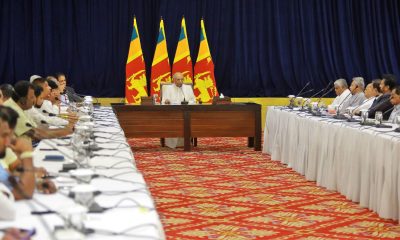
Accordingly, the Cabinet of Ministers granted approval to the proposal submitted by the Minister of Public Administration, Provincial Councils and Local governments to revise the relevant provisions so that the festival advance can be increased up to rupees 15,000/- .
As per the approval given by the cabinet meeting held on 02-06-2025, action is being taken at present to offer the underutilized lands/properties of the Sri Lanka State Plantation Corporation, the Janatha Etate Development Board, and the Elkaduwa Plantation Company which are under the Ministry of Plantation and Community Infrastructure which have been identified under stage one to suitable investors.
Accordingly, the Cabinet of Ministers has approved the proposal presented by the Minister of Plantations and Community Infrastructure to provide following lands/properties on a lease basis to the suitable investors for optimal utilization following the prescribed procurement procedure.
• underutilized lands/properties identified under stage two owned by the Sri Lanka State Plantation Corporation, the Janatha Estate Development Board, and the Elkaduwa Plantation
Company,
• The Mawarala watte land and the Tea factory 40.48 hectares in extent, located in Matara District belonging to the Tea Shakthi Fund.
• The underutilized land of 1,541 hectares in extent of Kondachchi Estate is enjoyed by the Sri Lanka Cashew Corporation.
The drafting of the National Fisheries and Aquaculture Policy has commenced with the objective of equitable distribution of the benefits of the fisheries industry and the sustainable management of fisheries and aquaculture. This policy has been updated from time to time according to current requirements. However, steps have not been taken to obtain the approval of the Cabinet of Ministers for that purpose.
According to the policy declaration of the present government, ‘Vistas of Prosperity and Splendor’ the National Fisheries and Aquaculture Policy has been redrafted, updating the aforementioned policy in line with the economic and development objectives of the government.
The recommendations of the Department of National Planning have been received for the drafted policy.
Accordingly, the Cabinet of Ministers has approved the proposal presented by the Minister of Fisheries, Aquaculture, and Marine
Resources to implement the National Fisheries and Aquaculture Policy, integrating it with other relevant policies.

Festival advance for government officers to be increased
Providing underutilized lands/properties to suitable investors for optimal utilization.
Implementation of the National Fisheries and Aquaculture Policy

Expressions of Interest called to develop selected locations within the Pelawatte Sugar Factory premises
Minimum purchasing price of Samba and Kiri Samba paddy incresed

Showers in the Northern, North-central, Uva, Western, Eastern, Sabaragamuwa, North-western and Central provinces and Galle and Matara districts

‘Dates have the highest sugar content to fight Coronavirus’

Sunday Island 27 December – Headlines

#SundayIsland 17th December – Headlines

Sunday Island – 28th March

Sunday Island Headlines – 21 March

Sunday Island – 21st February – Headlines
-
 News2 days ago
Sajith: Ashoka Chakra replaces Dharmachakra in Buddhism textbook
-

 Business3 days ago
Dialog and UnionPay International Join Forces to Elevate Sri Lanka’s Digital Payment Landscape
-

 Features2 days ago
The Paradox of Trump Power: Contested Authoritarian at Home, Uncontested Bully Abroad
-

 Features2 days ago
Subject:Whatever happened to (my) three million dollars?
-

 News2 days ago
Level I landslide early warnings issued to the Districts of Badulla, Kandy, Matale and Nuwara-Eliya extended
-

 News2 days ago
National Communication Programme for Child Health Promotion (SBCC) has been launched. – PM
-

 News2 days ago
65 withdrawn cases re-filed by Govt, PM tells Parliament
-

 Opinion4 days ago
The minstrel monk and Rafiki, the old mandrill in The Lion King – II