
News
Activists slam Lanka’s bid to seek X-Press Pearl compensation in Singapore

(Mongabay) Environmental activists have questioned the decision to file for compensation in Singapore instead of Sri Lanka for a 2021 ship sinking that became the worst maritime disaster in the country’s history, saying there’s less likelihood of winning adequate compensation overseas.
The Sri Lankan government is filing a lawsuit in Singapore for compensation nearly two years since the worst maritime disaster in the country’s history. But activists say it waited too long and would have stood a better chance of adequate compensation had the lawsuit been filed in Sri Lanka.
Speaking before parliament on April 25, Justice Minister Wijeyadasa Rajapakshe confirmed that the Department of the Attorney General had filed legal action before Singapore’s International Commercial Courts (SICC) to claim compensation for the extensive environmental damage caused by the burning and sinking of the Singapore-flagged freight ship the X-Press Pearl in May 2021.
“The decision to lodge the lawsuit in Singapore courts was done in consultation with a group of independent local and international lawyers as Singapore’s legal system is better equipped to handle this type of complex maritime legal battles,” Rajapakshe said.
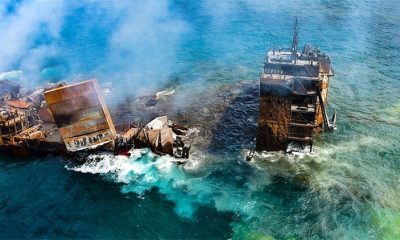
The sinking of the fire-stricken ship, carrying tons of plastic pellets and toxic chemicals, is considered Sri Lanka’s worst maritime disaster to date. The plastic pellets, known as nurdles, fouled an extensive arc of Sri Lanka’s southwestern shore, with volunteer crews hard at work cleaning up the billions of grain-sized pellets for months on end.
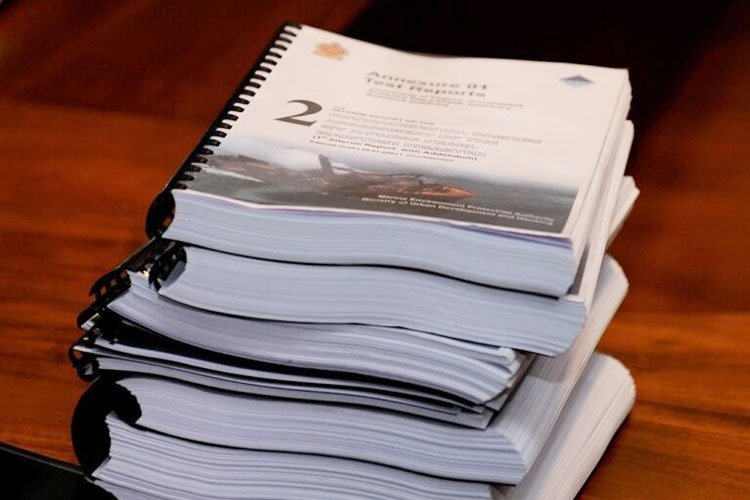
A 40-member expert committee convened by the Marine Environment Protection Authority (MEPA) to assess the environmental damage issued its second interim report in January this year, in which it put a price on the disaster: $6.4 billion.
Maritime rules require a claim for compensation to be filed within two years of the occurrence of the accident. The Singapore-flagged X-Press Pearl caught fire in Sri Lankan waters on May 20, 2021, and sank several days later. But the long wait without filing action has caused anxiety among activists, who have criticized the government for not moving fast enough.
Part of the delay was due to the complexity of the environmental assessment. There was very little baseline data for the expert committee to compare against, especially in the maritime context, which required them to assess damage scenarios over the short, mid- and long terms, said Dharshanie Lahandapura, former chair of the MEPA.
The group of experts continues to monitor the impacts of pollution caused by the disaster. The National Aquatic Resources Research and Development Agency (NARA) is also monitoring impacts to the marine environment, while the Department of Wildlife Conservation (DWC) is assessing the fallout on marine life, Lahandapura told Mongabay.
Based on the future findings, there could be more claims, given that the nurdles and other chemicals are likely to have long-lasting effects, Lahandapura said.
But waiting until just weeks before the two-year deadline “is unacceptable as the strategy should be to file it first without waiting for the outcome of the expert committee evaluation,” said Ravindranath Dabare, a lawyer and chair of the Centre for Environmental Justice (CEJ), a Colombo-based NGO.
“Within the first week of the X-Press Pearl disaster, CEJ filed the first case in local courts to push the authorities to take necessary actions, and subsequently two more cases to expedite the proceedings as the work was lagging,” Dabare told Mongabay.
The X-Press Pearl accident occurred within a few kilometers of the Colombo coast, well within Sri Lanka’s jurisdiction. That renders “the shipping company … a part of our local case and their representatives do participate in the court hearings, so there was no barrier to filing a case in Sri Lankan courts,” Dabare said.
He added the evidence is available in Sri Lanka, as are the experts who conducted the environmental damage assessment. Hiring Singapore-based lawyers will incur a higher cost, in addition to the cost of overseas travel — something Sri Lanka can ill afford as it reels from the worst economic crisis in its history, Dabare said.
“The existing Marine Environment Protection Act and the general law have provisions that enable Sri Lanka to file the lawsuit locally,” said Dan Malika Gunasekera, an expert on international maritime law.
He also noted there’s a limit to the amount of compensation that Sri Lanka can claim when lodging the case in Singapore.
“We must get the compensation from the insurer of the X-Press Pearl, who is in the United Kingdom, and on this basis, it may be better to file in the U.K. than Singapore,” Gunasekera told Mongabay.
Even then, the U.K. would also limit compensation to 19.5 million pounds ($24 million). In Sri Lanka, however, there would be no such cap.
Justice Minister Rajapakshe said the government would appoint a British lawyer to negotiate the compensation limitation set in the U.K. for the insurers. He reiterated the position that prospects for a favorable outcome are better in those overseas courts than in Sri Lanka.
Rajapakshe pointed to the case of the oil tanker New Diamond, which caught fire off Sri Lanka’s eastern coast about eight months before the X-Press Pearl incident. Three compensation claims were filed in Sri Lanka’s commercial courts in the New Diamond case, but they came up against various constraints. This, Rajapakshe said, influenced the decision to take the X-Press Pearl case before the Singapore courts.
Ayesh Ranawaka, a maritime expert and former commissioned officer with the Sri Lankan Navy, agreed that the Singapore courts represented a better chance of getting justice in the X-Press Pearl case. This doesn’t mean the local justice system is weak, he told Mongabay, just that there are too many disagreements at the local level about how to proceed.
If the Sri Lankan position is divided, the other party can take advantage of that, Ranawaka said. But when filing in Singapore, the Sri Lankan parties would at least come to a common position. They would also have international laws to fall back on, so the opportunity for justice may be higher, Ranawaka said.
As the government and activists debate what should be the correct course of action to demand compensation, it’s clear that Sri Lanka needs a clear strategy to handle these kinds of marine disasters, Ranawaka said.
“Sri Lanka needs to look beyond the X-Press Pearl incident and treat it as an eye-opener to ensure a proper maritime policy to avoid future mishaps,” he said.


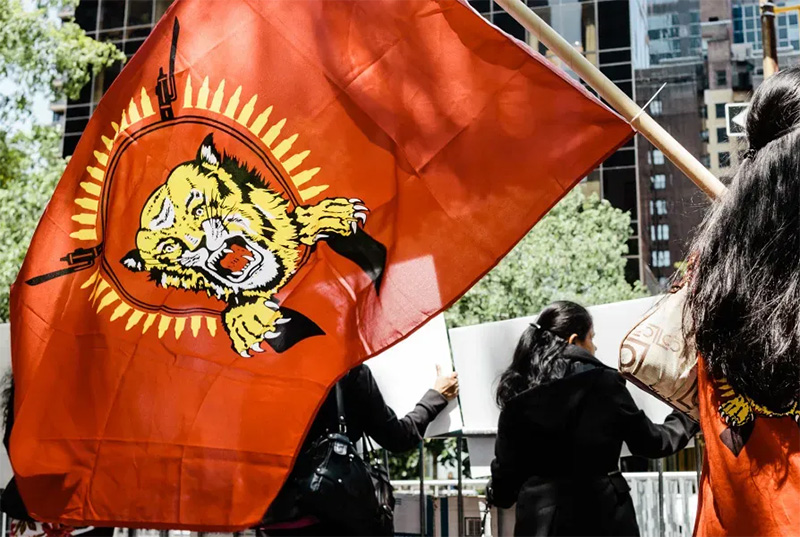
The NPP government has issued a new extraordinary gazette renewing and extending Sri Lanka’s long-standing ban on the LTTE and several Tamil diaspora organisations and individuals, continuing to designate them as “terrorists”.
The gazette, published recently, replaces a previous gazette issued in May 2025 and reaffirmed the proscription of a wide range of Tamil political and advocacy bodies operating around the world, alongside dozens of named individuals. The government alleged both the organisations and individuals listed are involved in “terrorism-related activities”.
The organisations blacklisted by the Sri Lankan government include:
• Liberation Tigers of Tamil Eelam (LTTE)
• Tamil Rehabilitation Organisation (TRO)
• Tamil Coordinating Committee (TCC)
• World Tamil Movement (WTM)
• Transnational Government of Tamil Eelam (TGTE)
• World Tamil Relief Fund (WTRF)
• National Council of Canadian Tamils (NCCT)
• Tamil Youth Organisation (TYO)
While the majority of the designations mirror those contained in the May 2025 gazette, the latest document updates identification details and addresses for a number of individuals and introduces at least one additional organisation to the list. All entries have been reissued under new reference numbers for 2026, though the underlying allegations and framing remain unchanged.
Successive governemnts have maintained a sweeping proscription regime against Tamil diaspora groups and individuals. A ban can make it a criminal offence for Sri Lankan citizens to maintain contact with these organisations or their members, severely restricting political engagement and stifling links between the diaspora and the Tamil homeland.
The original mass listings were introduced in 2014 under the administration of Mahinda Rajapaksa. Despite repeated outcry, subsequent governments have continued to uphold and renew the proscription regime, even after the Rajapaksas were voted out of power.

Police yesterday (12) obtained an injunction order from the Kaduwela Magistrate’s court against the protest launched by National Freedom Front (NFF) leader and former Minister Wimal Weerawansa opposite the Education Ministry, Isurupaya, at Battaramulla.
Police informed Weerawansa of the court order. In line with the court order, the police informed Weerawansa that the road near the Ministry should not be obstructed and that no sound amplification equipment be used while the GCE Advanced Level (A/L) examination is in progress. The examination, put off due to Cyclone Ditwah, recommenced yesterday.
News
Chinese Foreign Minister Wang Yi expresses optimism that Sri Lanka is on the right path to progres

Minister of Foreign Affairs, Foreign Employment and Tourism Vijitha Herath held productive discussions with his Chinese counterpart Wang Yi today (12/01), during the latter’s brief visit to Sri Lanka.
The meeting aimed at further strengthening bilateral engagement and advancing the Strategic Cooperative Partnership between the two countries. Both Ministers reaffirmed the longstanding friendship and time-tested cooperation between Sri Lanka and China rooted in centuries of exchanges and consolidated since the establishment of diplomatic relations seven decades ago. The discussion also focused on enhancing partnership in the areas of trade, investment, development cooperation and tourism.
Minister Herath extended deep appreciation to the Government and the people of China for the steadfast support extended to Sri Lanka following cyclone Ditwah and requested further support for the second phase of resettlement, relocation and rebuilding, particularly for the restoration of affected infrastructure including identified roads, railways and bridges that are vital to connectivity, economic recovery and daily lives of people. Minister Wang assured China’s fullest support for this initiative and expressed confidence that Sri Lanka will continue its rapid recovery under the leadership of President Anura Kumara Disanayaka. He also welcomed the people-centric policies of the Government and expressed optimism that Sri Lanka is on the right path toward fulfilling aspirations of its people.
Minister Herath expressed appreciation for China’s constructive role in international fora and reiterated Sri Lanka’s firm commitment to the One China Policy and China’s sovereignty and territorial integrity.
Both Ministers also recalled the successful high level exchanges in the recent past, including visits of the President and the Prime Minister of Sri Lanka to China in 2025.

Govt. extends ban on LTTE

Police obtain court order banning Wimal’s protest

Chinese Foreign Minister Wang Yi expresses optimism that Sri Lanka is on the right path to progres

India plans to restore northern regular train services to pre-Ditwah frequencies before traditional New Year 2026

Inauguration of first Bailey Bridge under Indian assistance package for post-Ditwah reconstruction

SOC acts to prevent undermining of community-based financial institutions by proposed Microfinance and Credit Regulatory Authority Bill

‘Dates have the highest sugar content to fight Coronavirus’

Sunday Island 27 December – Headlines

#SundayIsland 17th December – Headlines

Sunday Island – 28th March

Sunday Island Headlines – 21 March

Sunday Island – 21st February – Headlines
-

 News2 days ago
Sajith: Ashoka Chakra replaces Dharmachakra in Buddhism textbook
-

 Business2 days ago
Dialog and UnionPay International Join Forces to Elevate Sri Lanka’s Digital Payment Landscape
-

 Features2 days ago
The Paradox of Trump Power: Contested Authoritarian at Home, Uncontested Bully Abroad
-

 Features2 days ago
Subject:Whatever happened to (my) three million dollars?
-

 News2 days ago
Level I landslide early warnings issued to the Districts of Badulla, Kandy, Matale and Nuwara-Eliya extended
-

 News2 days ago
National Communication Programme for Child Health Promotion (SBCC) has been launched. – PM
-

 News2 days ago
65 withdrawn cases re-filed by Govt, PM tells Parliament
-

 Opinion4 days ago
The minstrel monk and Rafiki, the old mandrill in The Lion King – II