
Sports
A benchmark in rugby coaching and a trophy for Petes

By A Special Sports Correspondent
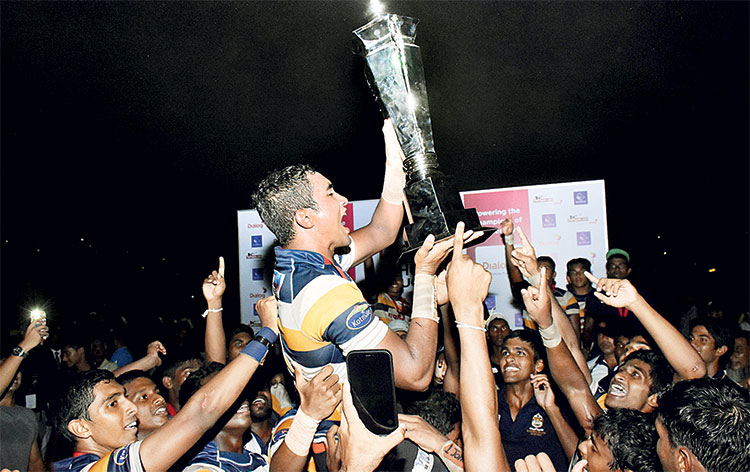
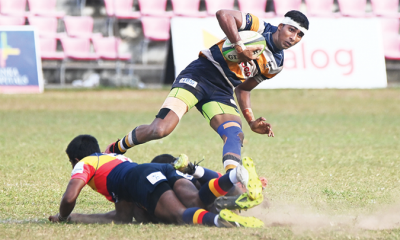
St. Peter’s College made amends for the restricted season in 2022 by bagging the 2023 Dialog-sponsored Inter-school Under 19 Fifteen-a-side League Rugby Tournament under the captaincy of Ashain Madugasge and the coaching of Sanath Martis. The Peterites, before this present winning spree, bagged the league tournament way back in 2010 under skipper Keith Gurusinghe. That year too, the Peterites were coached by Martis.
Last year the school from Bambalapitiya was penalised for fielding an ineligible player, but all that was sent into oblivion when they came back fighting and with a purpose this season to bag the all-important Dialog sponsored league plum with a smashing 28-17 win over Isipatana in a deciding game which was played at their own den on August 19 (Saturday). The game was deciding for St. Peter’s and not for Isipatana because Royal was the second-best side carrying both potential and accumulated points to finish as runners-up even before they kicked off their final game against St. Anthony’s. This game, played in Kandy, eventually went in favour of the boys from Reid Avenue. Isipatana finished third followed by St. Anthony’s Katugastota, which can take a bow for securing a top four finish this season.
The Peterites never created that hype to be title contenders despite an early season shocker in their maiden game for 2023 where they made Royal eat humble pie. Schools like Royal, Trinity and Isipatana saw their fixtures being lined up in such a manner that they were more in the limelight than St. Peter’s. The manner in which Royal and Trinity got mileage for their Bradby Shield encounter and the way in which the media hounded these two schools put the rest of the teams in the competition in a position of being less noticed. Isipatana could be an exception to this thinking, but the crowds that were present at Pallakele for the first leg of the Bradby Shield and for the return leg at Royal Sports Complex this year can dwarf the spectator presence at other important matches this season.
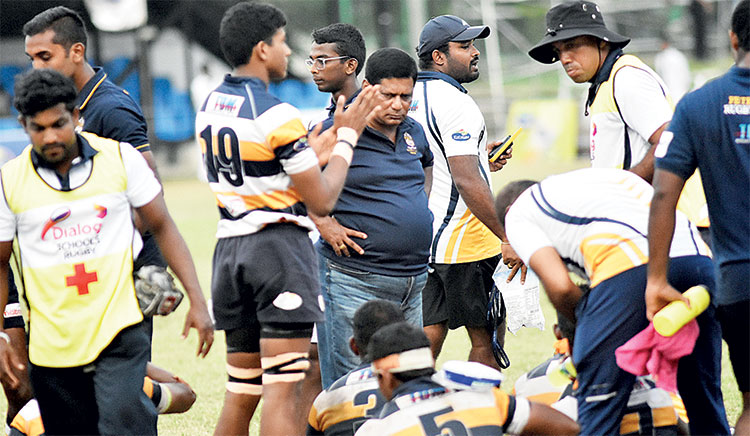
Veteran coach Sanath Martis is a person who is obsessed with result-oriented coaching and helped St. Peter’s strike gold this season. (Pix by Kamal Wanniarachchi)
But the Peterites pegged on during the season securing wins over Dharmaraja (34-7), Trinity (22-10), Zahira (56-7), Science (29-0), Vidyartha (66-10) before smashing the daylights out of St. Anthony’s (39-0) in the first Super Round fixture and later downing Isipatana. Apart from Martis being present on the field in his ‘ship captain’ like style mention must be made of assistant coaches Rajiv Perera and Banuka Nanayakkara for their contributions to the side. Skipper Madugasge will be remembered for leading this champion side which had in their ranks solid players in the likes of Vindya de Mel, Kushan Tharindu, Sudesh Jayawickreme, Dineth Ranasinghe and Yumeth Shihara to name a few.
Royal playing under lock forward Randul Senanayake did well to finish second in the points table. They were coached this season by Dushanth Lewke. Isipatana might not like the manner in which they finished the season because this was a side to watch this year with some incredible players in their ranks in the likes of skipper Nawin Kanishka, Shehandu de Costa, Shahid Zumri, Kalindu Silva, Heshan Randimal, T. Ranaweera, Chamindu Chirath and playmaker Rinesh Silva, who finished the season as the highest points scorer (89).
If one considers the coaches employed this season Martis once again underscored that little valued saying ‘old is gold’. This is an era where the young coaches in rugby are considered ‘laptop coaches’ and are hunting for strategies and information on the internet 24×7. If one takes coaches like Nawaz (S. Thomas’), Fazil Marija (Trinity), Srinath Sooriyabandara (St. Anthony’s ), Lewke and Saliya Kumara (Isipatana) they have played this game at a much higher level than Martis and have age and technology on their side. But this veteran coach marshaled his team in a manner that they maintained consistency and made it to a podium finish. This coaching maestro showed the younger rugby coaches that he still has it in him to see a side through a season and take his chargers to safe port when the season concludes.
This writer remembers the character ‘the old fisherman’ in Ernest Hemingway’s Nobel Prize-winning book ‘the old man and the sea’-first published in 1952 in England. The old man in that book makes one last voyage into the sea and makes a prized catch, but is defeated by the sharks out in the waters. The old man is obsessed with the word ‘luck’ and sees luck eluding him as the curtains come down on his career as a fisherman. Maybe Martis has a few more years to engage in coaching in a manner that people and players around him feel his presence. He can still make the opposite teams shake from their foundations with the way he thinks, coaches and produces results. He could still be the person out there who can set the benchmark for coaches who have made coaching their profession. He will bid adieu one day which is not far away in the future. And when he does he will make people ask “what will life be for Martis when he moves away from the oval-shaped ball, the green grassy fields and children who play rugby union”. This writer asks this question instead, ‘what would rugby coaching in Sri Lanka be without Martis’?











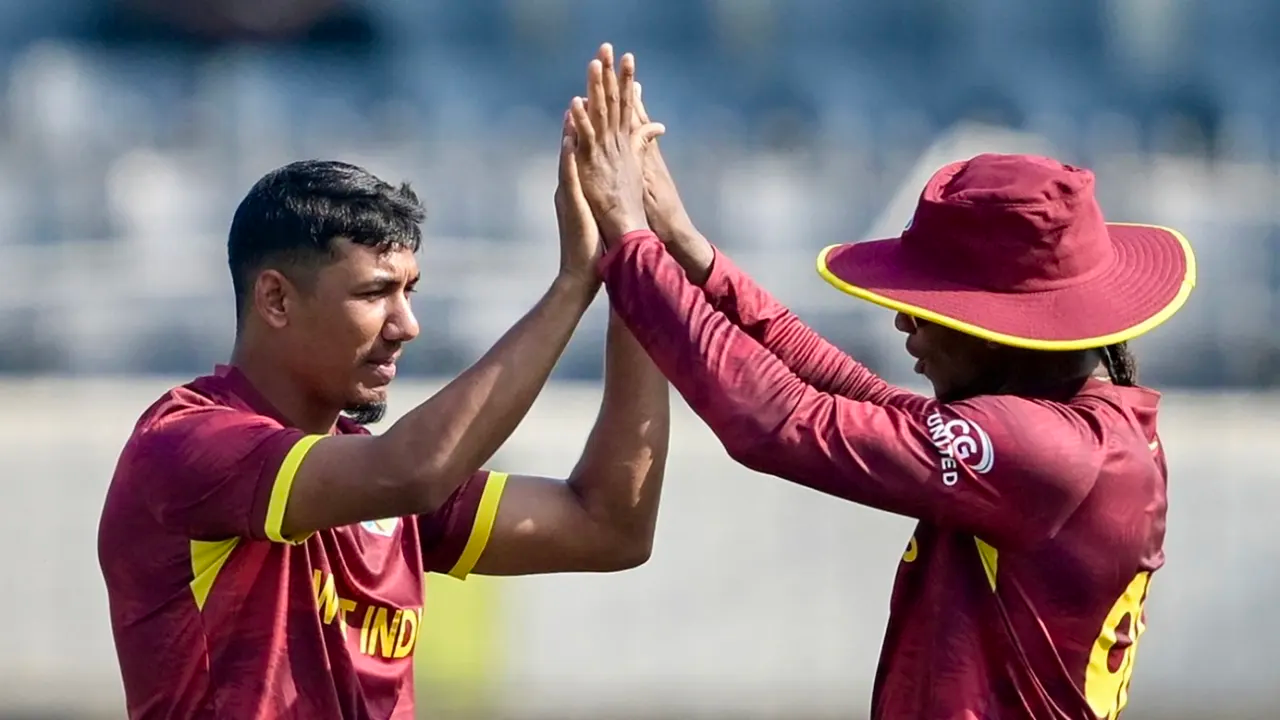
West Indies 114 for 3 (Hetmyer 48, Hope 48) beat South Africa 118 for 6 (de Kock 28, Motie 3-17) by 6 runs – DLS
West Indies claimed a consolation win in a match reduced to 10 overs a side at the Wanderers, to hand South Africa defeat in their first T20I in pink. With no ODIs scheduled in South Africa this summer, the annual fixture to raise awareness and funds for breast cancer treatment took place in the shortest format, and was made even shorter after prolonged delays for lightning.
Still, the sell-out crowd got their money’s worth in an entertaining encounter as both teams left everything on the field in their final competitive fixture before next month’s T20 World Cup.
With the series already won, South Africa may not be too unhappy with the outcome, especially as their middle order, untested in game one and two, had a hit out while West Indies’ ability to hold their nerve under pressure will stand them in good stead ahead of a major tournament. They secured a narrow win after two heavy defeats to leave South Africa with something to smile about.
West Indies’ innings started 75 minutes later than the scheduled 6pm start time after lightning strikes were spotted by the pilot in the flyover just before play. The match was reduced to 16 overs a side at that stage and West Indies came out swinging.Shai Hope carved the first ball through the covers for four and Johnson Charles also tried to take it on but Aiden Markram put a short over in place and Charles hit Ngidi straight to him for a three-ball duck.
Hope kept driving but it was Shimron Hetmyer, who arrived at the crease with neither a helmet nor a cap, who turned it on. He sent Ngidi into the stands and onto a spectator’s forehead for six (sidenote: the fan received a medical check-up) and then cleared deep backward square for six more. Hope hit Keshav Maharaj’s opening over for 18 but Markram kept faith in spin and brought himself on in the firth over. Hetmyer cut his first ball for four, then sent him over deep square leg for six and then Hope, off the last ball of the over, pulled Markram into the stands.
Linde delivered a tight second over but West Indies were in a strong position on 66 for 1 after six before the players were forced off again, as more lightning was spotted. Another hour’s delay reduced the match to 10 overs a side, which meant West Indies had just four overs left to bat when play resumed.
Corbin Bosch’s death-bowling was on display early with an over of good length deliveries before Hetmyer and Hope took on Maharaj again. His second over cost 20 but had some success when Hope hit him to Bosch at long-off. Rovman Powell sent Kwena Maphaka’s first and fifth ball for six and then gave Brevis a catch at deep cover before Hetmyer finished off. He ended the innings with his sixth six to finish on 48* off 22 balls. West Indies scored 114 for 3 in 10 overs and South Africa’s target was adjusted up to 125.
Quinton de Kock, fresh off of century at SuperSport Park, got South Africa to a perfect start with 19 runs off the opening over but Markram couldn’t get going in the same way. He top-edged Akeal Hosein straight up and Hosein did well to take the catch as Hetmyer ran in from extra cover and the pair were fortunate to avoid a collision. South Africa sent in Dewald Brevis ahead of Ryan Rickelton at No.3, and it was almost an early mistake. Brevis was dropped on 2 by Romario Shepherd at midwicket – making it West Indies’ third big-name drop in as many games (Markram in match one, Rickelton in match two) – and they would have wondered how costly it would be.
At first, they got rewarded at the other end. De Kock could not clear long-off and was caught on the rope by Powell to give Gudakesh Motie his first wicket of the series. Then, Rickelton and Brevis then combined for a 28-run stand off 11 balls, with two sixes each, but neither could sustain the momentum. Rickelton picked out Holder at long-on to become Motie’s second and Brevis, on 17, got a taste of his own medicine when he fell to a relay catch between Powell and Holder in the same over. South Africa were 63 for 4 after six overs, and needed 62 runs to win off the next four.
Jason Smith, picked as a finisher for the T20 World Cup, made his case with 20 off the first seven balls but did not get any strike in the penultimate over. South Africa needed 27 off 12 balls and Tristan Stubbs reduced that to 15 off the last five balls before he gave Smith strike to try and finish off. Shamar Joseph, in his first appearance in this series, was tasked with the final over. He went yorker length and took out Smith’s middle stump with his third ball, to leave South Africa needing nine runs off two balls. Bosch was dropped off the second last ball of the match when he skied Joseph to Powell at long-on and broke his bat in the process. He also didn’t ground the bat as he ran so South Africa were one-short, had to score eight off one and lost by six runs.
Brief scores:
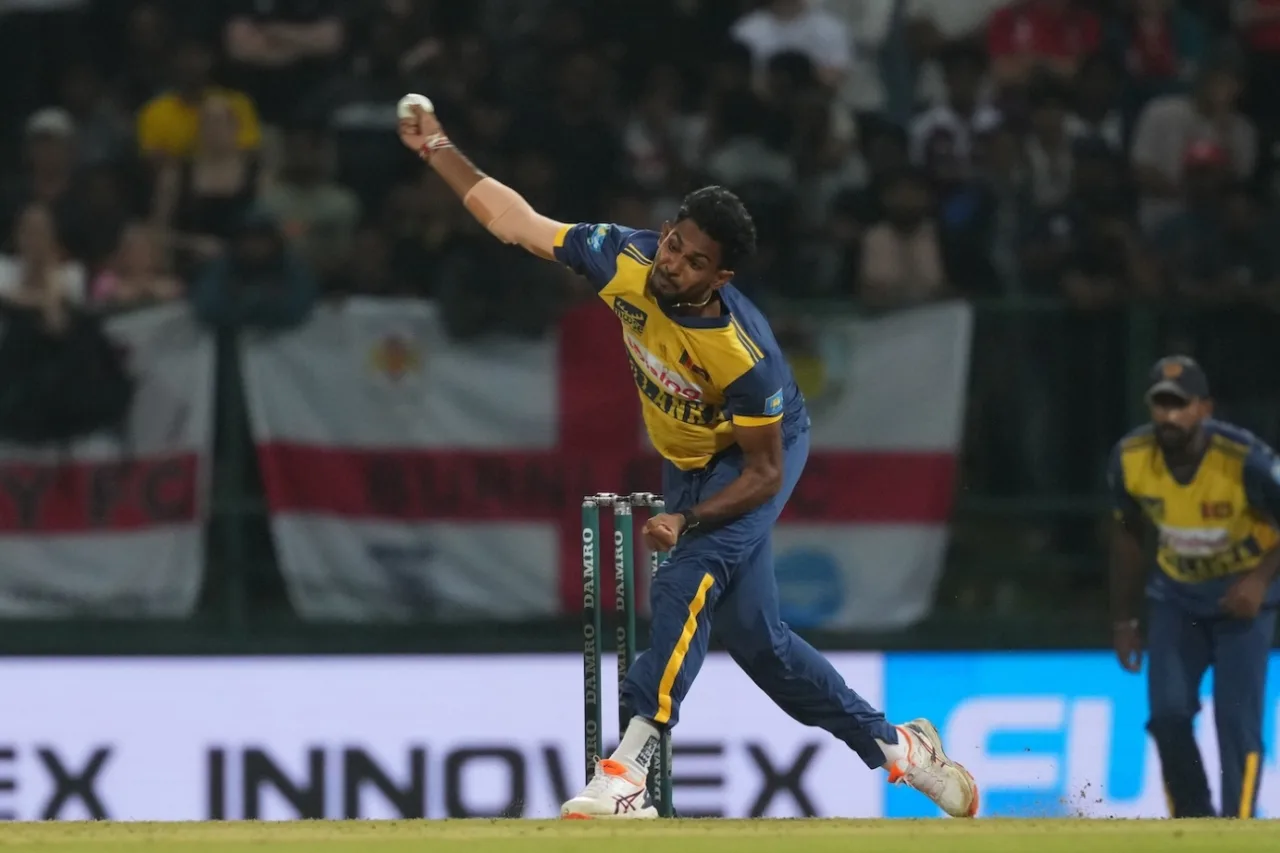
If there was one positive from Sri Lanka’s defeat to England in the first T20I, it was how well their bowlers kept England’s batters in check on a batter-friendly surface. Particularly Matheesha Pathirana.
Pathirana, the 23-year-old slinger, returned figures of 1 for 18 across his four overs – and it might have been two had Pathum Nissanka not grassed a chance in the deep – but his impact was immense, as evident in ESPNcricinfo’s MVP index, where he was only behind Adil Rashid, whose 3 for 19 ripped through Sri Lanka’s batting.
The target of 134 off 17 overs (later revised to 115 in 15) proved too low to defend, but the margin of defeat – 11-runs via DLS – was not as wide as it might have been given the nature of the pitch.
On a good batting surface, seamers in particular suffered – Sam Curran and Eshan Malinga went at around 12 an over, while Jofra Archer and Jamie Overton both went at over seven. But Pathirana ticked along at an economy rate of 4.5.
He did so bowling his entire repertoire, from quick yorkers – he was hovering in the mid-140s, with his quickest delivery clocking 148kph – to pace-off length deliveries and spicy short ones. Even more impressive was the fact that he bowled two of his overs inside the powerplay. Pathirana is renowned for his death-overs exploits, but here, with a sub-par total to defend, Sri Lanka called on their strike bowler to take the new ball.
“Even though I’ve practiced to bowl in the powerplay, there was no plan as such for me to bowl there today,” Pathirana said after the game. “It just so happened that our score was lower than we wanted, so it was decided that I would bowl in the powerplay.”
Pathirana’s control was impressive. Wides have been an issue in the past – a common trade-off for a slingy action such as his – but on Friday night, there were just three across his spell.”Honestly I didn’t do anything major, just simple, basic things. The main thing was increasing the number of repetitions in practice. If there is any improvement, that’s the reason”
“Over the last year, year-and-a-half, along with my injuries, it was a challenging period,” he said. “I lost my rhythm. I’ve worked very hard to get back to this level. And then more recently Mali aiya [Lasith Malinga] was here in Sri Lanka helping out, as well all the coaches at SLC – not just one – all of them helped me get here.”
The impact of fellow slinger Malinga cannot be understated. Malinga has long been a proponent of target-based training drills, and hours of repetitive practice. And most recently he has been working as Sri Lanka’s fast-bowling coach in the lead-up to the T20 World Cup.
“Honestly I didn’t do anything major, just simple, basic things,” Pathirana said. “The main thing was increasing the number of repetitions in practice. If there is any improvement, that’s the reason. In terms of practice I increased it greatly.”
It’s a sharp turn in fortunes for Pathirana, who had only played two T20Is for Sri Lanka in 2025 – owing to a combination of poor form and injuries – and had been released by Chennai Super Kings [CSK] following IPl 2025. He had since been picked up by Kolkata Knight Riders (KKR), but that was more of an educated punt than anything based on tangible data.
Among the criticisms levied at Pathirana during this period was that his release point was not as low as it used to be. Stephen Fleming, the CSK coach, in fact pointed out this very fact when talking about the quick bowler’s decline in IPL 2025.
On Friday, Pathirana’s release point was lower than in recent times but still not as low as during his breakout season. He explained that his change in action had largely been involuntary, and down to a fairly serious shoulder injury he had been nursing.
“Yes,” he responded when asked if his release point had changed. “In the recent past, I was playing with a fairly major shoulder injury. So I think my body just automatically changed the release point. Even now I am doing rehab in between matches, and I think that’s why I’m seeing an improvement, and so you can see that the release point is getting to what it used to be.”
A fit and firing Pathirana is crucial for Sri Lanka, and with Dushmantha Chameera waiting in the wings, as well as Eshan Malinga ticking along well – he picked up two wickets on Friday with clever variations – Sri Lanka’s seam contingent at least looks in rude health heading into the World Cup.
[Cricinfo]
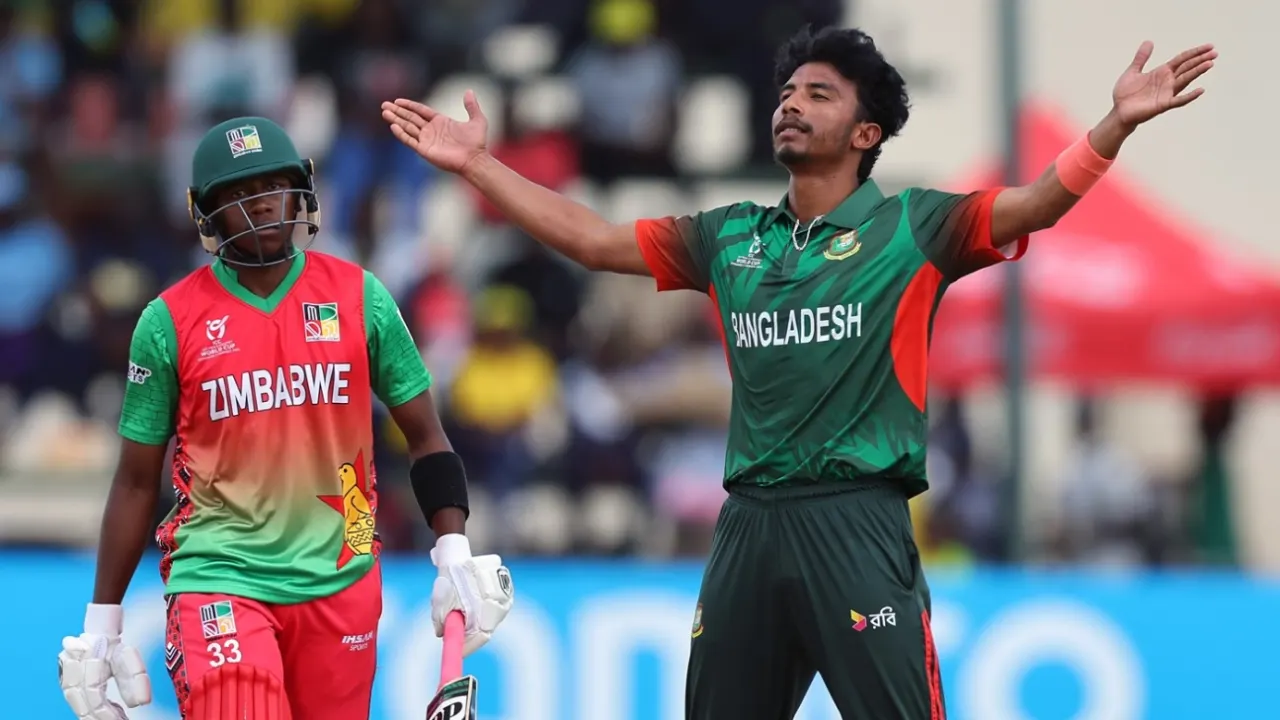
A clinical five-for from Iqbal Hossain Emon set up a consolation win for Bangladesh in their final match of the Super Six and this edition of the Under-19 World Cup. Chasing 254, Simbarashe Mudzengerere’s 70 was the only meaningful contribution in a chase that fizzled out with Zimbabwe reduced to 54 for 5, then 104 for 7.
Emon took out both the openers in his opening spell en route to scalping four of the first five wickets to fall in the Zimbabwe chase. Al Fahad complemented him with the new ball and thereafter, taking three wickets for 39 runs in his own spell – this included the final wicket of the chase as well, when he knocked over Webster Madhidhi.
The most significant resistance in Zimbabwe’s innings was the 64-run partnership between Mudzengerere and Shelton Marzvitorera – the highest for the ninth wicket for them in Youth ODIs. However, by then, the required rate had long climbed out of reach, and Al Fahad’s slow bouncer dismissed Mudzengerere to snuff out any hopes of a miracle.
Earlier, Bangladesh’s innings had been set up by captain Azizul Hakim’s 59 off 87. His steady knock, from No. 3, came to an abrupt end when Tatenda Chimugoro had him nicking behind to the keeper. Rizan Hossan came close to a half-century himself, but was prised out on 47 by Michael Blignaut. Bangladesh were reduced to 153 for 4, then 211 for 8 with less than four overs to go.
The Zimbabwe bowlers, who had kept control of the economy rate throughout a disciplined bowling effort, gave away 22 runs off Webster Madhidhi in the final over of the innings. Emon and Fahad were at the forefront of this attack too: they hit him for 4, 4, 2 wides, 4 and 6 to close out their innings, with the momentum swinging back to Bangladesh in their most productive over of the day.
The duo’s burst with the new ball ensured Bangladesh remained on top for the rest of the contest. Zimbabwe and Bangladesh are both knocked out of contention for the semi-finals at this World Cup, but by the time Fahad took the final wicket of the defense, the latter had something to celebrate.
Brief scores:
Bangladesh Under 19s 253 for 9 in 50 overs (Azizul Hakim 59, Rizan Hossan 47; Tatenda Chimugoro 2-49, Shelton Mazvitoerera 2-44, Michael Blignaut 2-41) beat Zimbabwe Under 19s 179 in 48.4 overs (Simbarashe Mudzengerere 70, Shelton Mazvitorera 42*; Iqbal Hossain Emon 5-24, Al Fahad 3-39) by 74 runs
[Cricinfo]

West Indies seal consolation win in ten-over shootout

In order to safeguard the future of the country, a quality human resource must be developed. – Prime Minister

Pathirana: ‘My body just automatically changed the release point’ after injury

U 19 World Cup: Emon five-for gives Bangladesh consolation win against Zimbabwe

Showers will occur at times in the Northern, North-Central, North-western, Eastern and Uva provinces and in Matale and Nuwara Eliya districts

Police face 32,000-officer shortage:IGP

‘Dates have the highest sugar content to fight Coronavirus’

Sunday Island 27 December – Headlines

#SundayIsland 17th December – Headlines

Sunday Island – 28th March

Sunday Island Headlines – 21 March

Sunday Island – 21st February – Headlines
-

 Business6 days ago
ComBank, UnionPay launch SplendorPlus Card for travelers to China
-
 Business3 days ago
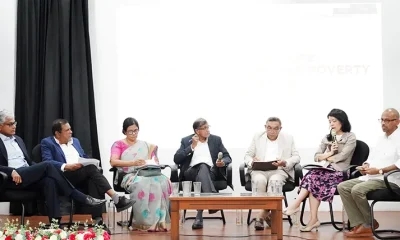
Climate risks, poverty, and recovery financing in focus at CEPA policy panel
-

 Opinion2 days ago
Sri Lanka, the Stars,and statesmen
-

 Business1 day ago
Hayleys Mobility ushering in a new era of premium sustainable mobility
-

 Opinion6 days ago
Luck knocks at your door every day
-

 Business1 day ago
Advice Lab unveils new 13,000+ sqft office, marking major expansion in financial services BPO to Australia
-

 Business1 day ago
Arpico NextGen Mattress gains recognition for innovation
-

 Editorial1 day ago
Govt. provoking TUs