
Features
22A is 19A Minus and does not help alleviate crisis


By Dr. Jayampathy Wickramaratne,
President’s Counsel
The long-awaited 22 nd Amendment to the Constitution Bill (22A) of the Gotabaya-Wickremesinghe government (or, should we say, the SLPP Government in which UNPer Ranil Wickremesinghe is Prime Minister?) was published in the Gazette on 29 June 2022. This means it could be placed on the Order Paper of Parliament seven days after that. Citizens and citizens’ organisations would be able to challenge the Bill in the Supreme Court within seven days of the Bill being so placed. As this is a constitutional amendment requiring a two-thirds majority in Parliament, the only question that can be raised before the Court is whether the People must approve it at a Referendum.
President Gotabaya Rajapaksa has just finished the first half of his term. The 20 th Amendment to the Constitution (20A) that he and the SLPP said was essential to develop the country by strengthening the Presidency is just 20 months old. What happened under his watch need not be recounted. The attack on the Aragalaya by SLPP goons, obviously with the blessings of highly placed leaders, led to the resignation of Premier Mahinda Rajapaksa. The President, with all his powers, could neither stop the attacks nor the violence that ensued all over the country. It was then that the beleaguered President offered to go back to the 19th Amendment to the Constitution and even hinted that he was amenable to the Parliament deciding to abolish the Presidential form of government, two of the main demands of the Aragalaya and also of the majority of the people. A survey conducted by the Centre for Policy Alternatives (CPA) in April 2022 revealed that 74% of the respondents wished for the complete abolition of the Executive Presidency compared to 50.3% in October-November 2021. The results of the “Mood of the Nation” poll conducted by Verité Research show that the Government’s approval rating for June 2022 is a mere 3%.
The SLPP and President Gotabaya then pulled a masterstroke by inviting the UNP’s lone MP, Ranil Wickremesinghe, to be Prime Minister. This was a setback to the Aragalaya, with many of its upper and middle-class supporters thinking that Wickremesinghe had a magic wand to cure the country of the economic ills caused by the Rajapaksas. Such hopes are receding fast, but the country is yet to see the Aragalaya picking up again, although that will be only a matter of time.
That the Government is making good use of the sense of hopelessness amongst the people is clear from the contents of 22A. It is nowhere near what was promised.
President’s powers regarding PM and Ministers and dissolution of
Parliament
Under 19A, Ministers and Deputy Ministers were appointed by the President on the advice of the Prime Minister, a provision that significantly strengthened Parliament. The power that the President had to remove the Prime Minister at will was taken away. The unconstitutional removal of Premier Wickremasinghe by President Sirisena resulted in the infamous 52-day constitutional crisis, which ended in a massive defeat for the latter. 20A did away with many of the provisions of 19A, including the requirement that the President should appoint Ministers and Deputy Ministers on the advice of the Prime Ministers. The President’s power to remove the Prime Minister was restored.
22A seeks to bring back the requirement of the Prime Minister’s advice, but there is a catch. It would not apply during the present Parliament. Where the President is of the opinion that the Prime Minister has lost the confidence of Parliament, the Prime Minister can be removed but only during this Parliament. Under 19A, the removal of the Prime Minister was a matter solely for Parliament. The Cabinet of Ministers stands dissolved if Parliament passes a vote of no-confidence on the Government or the statement of government policy or the Budget is defeated — Article 48 (2). One recalls the occasion such a thing happened under 19A. Although Mahinda Rajapakse was appointed to replace Wickremesinghe who was unconstitutionally dismissed, Speaker Karu Jayasuriya recognised Rajapakse as Prime Minister as there was no court order to the contrary. Rajapakse was given the Prime Minister’s seat in Parliament and was referred to by the Speaker as “Hon. Prime Minister”. Immediately after a vote of no-confidence against the Government was passed, the Speaker referred to Rajapakse as “Hon. Member Mahinda Rajapaksa”. Rajapakse did know what hit him and was visibly upset.
The provisions of Article 48 (2) have been retained under 20A as Article 49 (2) with identical wording, and 22A does not seek to make any change thereto. When the Constitution is so clear as to how the Prime Minister can be dismissed along with the other Ministers by Parliament, why allow the President to dismiss a Prime Minister at all? That a new Prime Minister appointed to replace the one that has been removed by the President can be defeated on the floor of the House or that the removal can be challenged in the Supreme Court is no answer. Why open the doors to manipulation in the meanwhile? The country saw the horse-trading that followed the removal of Premier Wickremesinghe. Some MPs were one day with Sirisena and Rajapaksa and the next day with Wickremesinghe. The number of times a particular MP crossed sides defied counting. Empowering the President to remove the Prime Minister while Article 49 (2) is retained is arbitrary and violates the fundamental right to equality and equal protection guaranteed by Article 12 (1) of the Constitution. It also undermines Parliament and thus the sovereignty of the People guaranteed by Article 3. The writer submits that this would require approval at a Referendum.
Under 19A, the President could have dissolved Parliament within the first four and a half years only if Parliament requested dissolution by a two-thirds majority. 20A changed this to provide that the President could dissolve Parliament during the first half of its term if Parliament so requested by a simple majority. 22A does not seek to change this.
Constitutional Council
Under 19A, the Speaker, Prime Minister and Leader of the Opposition were ex officio members of the Constitutional Council (CC), while the President would nominate one MP. Five persons were nominated jointly by the Prime Minister and the Leader of the Opposition, two of them being MPs. In making such nominations, they were required to consult the leaders of political parties and independent groups represented in Parliament to ensure that the CC reflects the pluralistic character of Sri Lankan society, including professional and social diversity. One MP was nominated by the MPs belonging to parties other than those to which the Prime Minister and the Leader of the Opposition belonged. The three persons from outside Parliament shall be persons of eminence and integrity who have distinguished themselves in public or professional life and who are not members of any political party. Parliament shall approve their nomination. In practice, such approval was a mere formality as they were nominated jointly and after a consultative process.
22A, while re-establishing the CC, seeks to make a crucial change. The five persons referred to are not appointed pursuant to the joint nomination of the Prime Minister and the Leader of the Opposition. One MP is nominated by the Government Parliamentary Group, and the other MP is nominated by the party to which the Leader of the Opposition belongs.The three persons from outside are nominated not jointly by the Prime Minister and the Leader of the Opposition but by the Speaker in consultation with them. The smaller parties are not consulted.
Several issues arise. If the Speaker is partisan (and there have been several such Speakers), the Government could ensure that all three CC members from outside are their own nominees. The Government, by virtue of its majority, would have no difficulty getting Parliamentary approval. The smaller parties would have no say in the nomination of these three persons. Thus, in the current Parliament, parties such as the TNA, NPP, EPDP, TNPF etc., who together account for twenty-five MPs, would not be consulted.
22A says that in nominating the two MPs and the three persons from outside Parliament, the Members of Parliament shall ensure that the CC reflects the pluralist character of Sri Lankan society. This would be most difficult as they would be nominated by separate processes. Under 19A, on the other hand, that was ensured as the nomination was jointly by the Prime Minister and the Leader of the Opposition after consulting the leaders of all parties in Parliament.
More time to challenge Bills
The 1978 Constitution originally provided for a Bill to be published in the Gazette seven days before it is placed on the Order Paper and for a challenge to the Bill to be made in the Supreme Court within one week from there. 19A extended the minimum period for publication to fourteen days. 20A reverted the period to seven days. 22A makes no change but seeks to increase the period for a challenge to fourteen days. This is salutary.
A damper on a consensus government
It is now clear that for Sri Lanka to obtain international assistance to tide over the present crisis, there must be an administration that enjoys cross-party support. This does not necessarily mean that all parties in Parliament must be represented in the Cabinet of Ministers or that party leaders should be in the Cabinet. One party might opt out of the Cabinet but still support the administration. Another party might decide it would be represented in the Cabinet by a few senior members but not by its leader.
If 22A becomes law in its present form, no opposition party or even MPs who have opted to be independent would be inclined to join the government because of the powers that the President would continue to have during the term of this Parliament.
22A proposes that the current President would retain the powers mentioned above during the term of the present Parliament and not during his entire term. This gives us an indication of the President’s current plan. Clearly, he has no intention of calling a general election during his term of office. If he had, 22A would have provided that the said powers would be retained for the complete duration of his period. It also shows that the SLPP knows it will be defeated if a general election is held ahead of time.



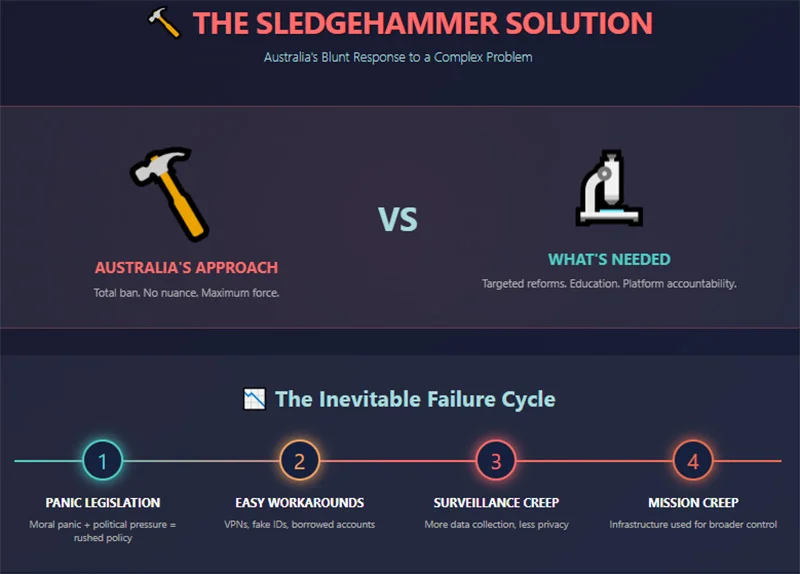
 When governments panic, they legislate. When they legislate in panic, they create monsters. Australia’s world-first ban on social media for under-16s, which came into force on 10 December, 2025, is precisely such a monster, a clumsy, authoritarian response to a legitimate problem that threatens to do more harm than good.
Prime Minister Anthony Albanese hailed it as a “proud day” for Australian families. One wonders what there is to be proud about when a liberal democracy resorts to blanket censorship, violates children’s fundamental rights, and outsources enforcement to the very tech giants it claims to be taming. This is not protection; it is political theatre masquerading as policy.
The Seduction of Simplicity
The ban’s appeal is obvious. Social media platforms have become toxic playgrounds where children are subjected to cyberbullying, addictive algorithms, and content that can genuinely harm their mental health. The statistics are damning: 40% of Australian teens have experienced cyberbullying, youth self-harm hospital admissions rose 47% between 2012 and 2022, and depression rates have skyrocketed in tandem with smartphone adoption. These are real problems demanding real solutions.
But here’s where Australia has gone catastrophically wrong: it has conflated correlation with causation and chosen punishment over education, restriction over reform, and authoritarian control over empowerment. The ban assumes that removing children from social media will magically solve mental health crises, as if these platforms emerged in a vacuum rather than as symptoms of deeper societal failures, inadequate mental health services, overworked parents, underfunded schools, and a culture that has outsourced child-rearing to screens.
Dr. Naomi Lott of the University of Reading hit the nail on the head when she argued that the ban unfairly burdens youth for tech firms’ failures in content moderation and algorithm design. Why should children pay the price for corporate malfeasance? This is akin to banning teenagers from roads because car manufacturers built unsafe vehicles, rather than holding those manufacturers accountable.
The Enforcement Farce
The practical implementation of this ban reads like dystopian satire. Platforms must take “reasonable steps” to prevent access, a phrase so vague it could mean anything or nothing. The age verification methods being deployed include AI-driven facial recognition, behavioural analysis, government ID scans, and something called “AgeKeys.” Each comes with its own Pandora’s box of problems.
Facial recognition technology has well-documented biases against ethnic minorities. Behavioural analysis can be easily gamed by tech-savvy teenagers. ID scans create massive privacy risks in a country that has suffered repeated data breaches. And zero-knowledge proof, while theoretically elegant, require a level of technical sophistication that makes them impractical for mass adoption.
Already, teenagers are bragging online about circumventing the restrictions, prompting Albanese’s impotent rebuke. What did he expect? That Australian youth would simply accept digital exile? The history of prohibition, from alcohol to file-sharing, teaches us that determined users will always find workarounds. The ban doesn’t eliminate risk; it merely drives it underground where it becomes harder to monitor and address.
Even more absurdly, platforms like YouTube have expressed doubts about enforcement, and Opposition Leader Sussan Ley has declared she has “no confidence” in the ban’s efficacy. When your own political opposition and the companies tasked with implementing your policy both say it won’t work, perhaps that’s a sign you should reconsider.
The Rights We’re Trading Away
The legal challenges now percolating through Australia’s High Court get to the heart of what’s really at stake here. The Digital Freedom Project, led by teenagers Noah Jones and Macy Neyland, argues that the ban violates the implied constitutional freedom of political communication. They’re right. Social media platforms, for all their flaws, have become essential venues for democratic discourse. By age 16, many young Australians are politically aware, engaged in climate activism, and participating in public debates. This ban silences them.
The government’s response, that child welfare trumps absolute freedom, sounds reasonable until you examine it closely. Child welfare is being invoked as a rhetorical trump card to justify what is essentially state paternalism. The government isn’t protecting children from objective harm; it’s making a value judgment about what information they should be allowed to access and what communities they should be permitted to join. That’s thought control, not child protection.
Moreover, the ban creates a two-tiered system of rights. Those over 16 can access platforms; those under cannot, regardless of maturity, need, or circumstance. A 15-year-old seeking LGBTQ+ support groups, mental health resources, or information about escaping domestic abuse is now cut off from potentially life-saving communities. A 15-year-old living in rural Australia, isolated from peers, loses a vital social lifeline. The ban is blunt force trauma applied to a problem requiring surgical precision.
The Privacy Nightmare
Let’s talk about the elephant in the digital room: data security. Australia’s track record here is abysmal. The country has experienced multiple high-profile data breaches, and now it’s mandating that platforms collect biometric data, government IDs, and behavioural information from millions of users, including adults who will need to verify their age to distinguish themselves from banned minors.
The legislation claims to mandate “data minimisation” and promises that information collected solely for age verification will be destroyed post-verification. These promises are worth less than the pixels they’re displayed on. Once data is collected, it exists. It can be hacked. It can be subpoenaed. It can be repurposed. The fine for violations, up to AUD 9.5 million, sounds impressive until you realise that’s pocket change for tech giants making billions annually.
We’re creating a massive honeypot of sensitive information about children and families, and we’re trusting companies with questionable data stewardship records to protect it. What could possibly go wrong?
The Global Domino Delusion
Proponents like US Senator Josh Hawley and author Jonathan Haidt praise Australia’s ban as a “bold precedent” that will trigger global reform. This is wishful thinking bordering on delusion. What Australia has actually created is a case study in how not to regulate technology.
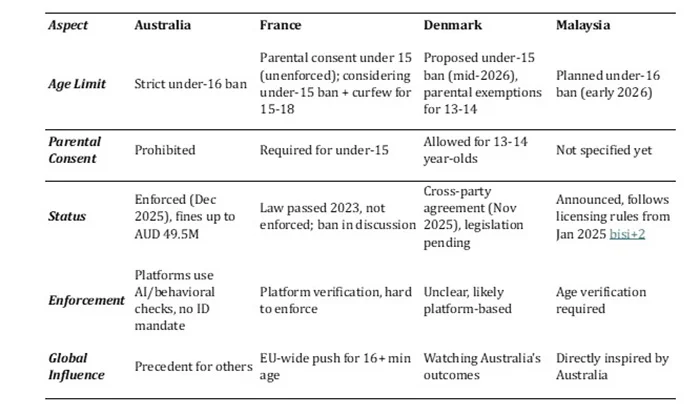
France, Denmark, and Malaysia are watching, but with notable differences. France’s model includes parental consent options. Denmark proposes exemptions for 13-14-year-olds with parental approval. These approaches recognise what Australia refuses to acknowledge: that blanket prohibitions fail to account for individual circumstances and family autonomy.
The comparison table in the document reveals the stark rigidity of Australia’s approach. It’s the only country attempting outright prohibition without parental consent. This isn’t leadership; it’s extremism. Other nations may cherry-pick elements of Australia’s approach while avoiding its most draconian features. (See Table)
The Real Solutions We’re Ignoring
Here’s what actual child protection would look like: holding platforms legally accountable for algorithmic harm, mandating transparent content moderation, requiring platforms to offer chronological feeds instead of engagement-maximising algorithms, funding digital literacy programmes in schools, properly resourcing mental health services for young people, and empowering parents with better tools to guide their children’s online experiences.
Instead, Australia has chosen the path of least intellectual effort: ban it and hope for the best. This is governance by bumper sticker, policy by panic.
Mia Bannister, whose son’s suicide has been invoked repeatedly to justify the ban, called parental enforcement “short-term pain, long-term gain” and urged families to remove devices entirely. But her tragedy, however heart-wrenching, doesn’t justify bad policy. Individual cases, no matter how emotionally compelling, are poor foundations for sweeping legislation affecting millions.
Conclusion: The Tyranny of Good Intentions
Australia’s social media ban is built on good intentions, genuine concerns about child welfare, and understandable frustration with unaccountable tech giants. But good intentions pave a very particular road, and this road leads to a place where governments dictate what information citizens can access based on age, where privacy becomes a quaint relic, and where young people are infantilised rather than educated.
The ban will fail on its own terms, teenagers will circumvent it, platforms will struggle with enforcement, and the mental health crisis will continue because it was never primarily about social media. But it will succeed in normalising digital authoritarianism, expanding surveillance infrastructure, and teaching young Australians that their rights are negotiable commodities.
When this ban inevitably fails, when the promised mental health improvements don’t materialize, when data breaches expose the verification systems, and when teenagers continue to access prohibited platforms through VPNs and workarounds, Australia will face a choice: double down on enforcement, creating an even more invasive surveillance state, or admit that the entire exercise was a costly mistake.
Smart money says they’ll choose the former. After all, once governments acquire new powers, they rarely relinquish them willingly. And that’s the real danger here, not that Australia will fail to protect children from social media, but that it will succeed in building the infrastructure for a far more intrusive state. The platforms may be the proximate target, but the ultimate casualties will be freedom, privacy, and trust.
Australia didn’t need a world-first ban. It needed world-class thinking. Instead, it settled for a world of trouble.
(The writer, a senior Chartered Accountant and professional banker, is Professor at SLIIT, Malabe. The views and opinions expressed in this article are personal.)

A prominent feature of the first year of the NPP government is that it has not engaged in the institutional reforms which was expected of it. This observation comes in the context of the extraordinary mandate with which the government was elected and the high expectations that accompanied its rise to power. When in opposition and in its election manifesto, the JVP and NPP took a prominent role in advocating good governance systems for the country. They insisted on constitutional reform that included the abolition of the executive presidency and the concentration of power it epitomises, the strengthening of independent institutions that overlook key state institutions such as the judiciary, public service and police, and the reform or repeal of repressive laws such as the PTA and the Online Safety Act.
The transformation of a political party that averaged between three to five percent of the popular vote into one that currently forms the government with a two thirds majority in parliament is a testament to the faith that the general population placed in the JVP/ NPP combine. This faith was the outcome of more than three decades of disciplined conduct in the aftermath of the bitter experience of the 1988 to 1990 period of JVP insurrection. The manner in which the handful of JVP parliamentarians engaged in debate with well researched critiques of government policy and actions, and their service in times of disaster such as the tsunami of 2004 won them the trust of the people. This faith was bolstered by the Aragalaya movement which galvanized the citizens against the ruling elites of the past.
In this context, the long delay to repeal the Prevention of Terrorism Act which has earned notoriety for its abuse especially against ethnic and religious minorities, has been a disappointment to those who value human rights. So has been the delay in appointing an Auditor General, so important in ensuring accountability for the money expended by the state. The PTA has a long history of being used without restraint against those deemed to be anti-state which, ironically enough, included the JVP in the period 1988 to 1990. The draft Protection of the State from Terrorism Act (PSTA), published in December 2025, is the latest attempt to repeal and replace the PTA. Unfortunately, the PSTA largely replicates the structure, logic and dangers of previous failed counter terrorism bills, including the Counter Terrorism Act of 2018 and the Anti Terrorism Act proposed in 2023.
Misguided Assumption
Despite its stated commitment to rule of law and fundamental rights, the draft PTSA reproduces many of the core defects of the PTA. In a preliminary statement, the Centre for Policy Alternatives has observed among other things that “if there is a Detention Order made against the person, then in combination, the period of remand and detention can extend up to two years. This means that a person can languish in detention for up to two years without being charged with a crime. Such a long period again raises questions of the power of the State to target individuals, exacerbated by Sri Lanka’s history of long periods of remand and detention, which has contributed to abuse and violence.” Human Rights lawyer Ermiza Tegal has warned against the broad definition of terrorism under the proposed law: “The definition empowers state officials to term acts of dissent and civil disobedience as ‘terrorism’ and will lawfully permit disproportionate and excessive responses.” The legitimate and peaceful protests against abuse of power by the authorities cannot be classified as acts of terror.
The willingness to retain such powers reflects the surmise that the government feels that keeping in place the structures that come from the past is to their benefit, as they can utilise those powers in a crisis. Due to the strict discipline that exists within the JVP/NPP at this time there may be an assumption that those the party appoints will not abuse their trust. However, the country’s experience with draconian laws designed for exceptional circumstances demonstrates that they tend to become tools of routine governance. On the plus side, the government has given two months for public comment which will become meaningful if the inputs from civil society actors are taken into consideration.
Worldwide experience has repeatedly demonstrated that integrity at the level of individual leaders, while necessary, is not sufficient to guarantee good governance over time. This is where the absence of institutional reform becomes significant. The aftermath of Cyclone Ditwah in particular has necessitated massive procurements of emergency relief which have to be disbursed at maximum speed. There are also significant amounts of foreign aid flowing into the country to help it deal with the relief and recovery phase. There are protocols in place that need to be followed and monitored so that a fiasco like the disappearance of tsunami aid in 2004 does not recur. To the government’s credit there are no such allegations at the present time. But precautions need to be in place, and those precautions depend less on trust in individuals than on the strength and independence of oversight institutions.
Inappropriate Appointments
It is in this context that the government’s efforts to appoint its own preferred nominees to the Auditor General’s Department has also come as a disappointment to civil society groups. The unsuitability of the latest presidential nominee has given rise to the surmise that this nomination was a time buying exercise to make an acting appointment. For the fourth time, the Constitutional Council refused to accept the president’s nominee. The term of the three independent civil society members of the Constitutional Council ends in January which would give the government the opportunity to appoint three new members of its choice and get its way in the future.
The failure to appoint a permanent Auditor General has created an institutional vacuum at a critical moment. The Auditor General acts as a watchdog, ensuring effective service delivery promoting integrity in public administration and providing an independent review of the performance and accountability. Transparency International has observed “The sequence of events following the retirement of the previous Auditor General points to a broader political inertia and a governance failure. Despite the clear constitutional importance of the role, the appointment process has remained protracted and opaque, raising serious questions about political will and commitment to accountability.”
It would appear that the government leadership takes the position they have been given the mandate to govern the country which requires implementation by those they have confidence in. This may explain their approach to the appointment (or non-appointment) at this time of the Auditor General. Yet this approach carries risks. Institutions are designed to function beyond the lifespan of any one government and to protect the public interest even when those in power are tempted to act otherwise. The challenge and opportunity for the NPP government is to safeguard independent institutions and enact just laws, so that the promise of system change endures beyond personalities and political cycles.
by Jehan Perera

 A new batch arrived at our Faculty again. Students representing almost all districts of the country remind me once again of the wonderful opportunity we have for promoting social and ethnic cohesion at our universities. Sadly, however, many students do not interact with each other during the first few semesters, not only because they do not speak each other’s language(s), but also because of the fear and distrust that still prevails among communities in our society.
General education reform presents an opportunity to explore ways to promote social and ethnic cohesion. A school curriculum could foster shared values, empathy, and critical thinking, through social studies and civics education, implement inclusive language policies, and raise critical awareness about our collective histories. Yet, the government’s new policy document, Transforming General Education in Sri Lanka 2025, leaves us little to look forward to in this regard.
The policy document points to several “salient” features within it, including: 1) a school credit system to quantify learning; 2) module-based formative and summative assessments to replace end-of-term tests; 3) skills assessment in Grade 9 consisting of a ‘literacy and numeracy test’ and a ‘career interest test’; 4) a comprehensive GPA-based reporting system spanning the various phases of education; 5) blended learning that combines online with classroom teaching; 6) learning units to guide students to select their preferred career pathways; 7) technology modules; 8) innovation labs; and 9) Early Childhood Education (ECE). Notably, social and ethnic cohesion does not appear in this list. Here, I explore how the proposed curriculum reforms align (or do not align) with the NPP’s pledge to inculcate “[s]afety, mutual understanding, trust and rights of all ethnicities and religious groups” (p.127), in their 2024 Election Manifesto.
Language/ethnicity in the present curriculum
The civil war ended over 15 years ago, but our general education system has done little to bring ethnic communities together. In fact, most students still cannot speak in the “second national language” (SNL) and textbooks continue to reinforce negative stereotyping of ethnic minorities, while leaving out crucial elements of our post-independence history.
Although SNL has been a compulsory subject since the 1990s, the hours dedicated to SNL are few, curricula poorly developed, and trained teachers few (Perera, 2025). Perhaps due to unconscious bias and for ideological reasons, SNL is not valued by parents and school communities more broadly. Most students, who enter our Faculty, only have basic reading/writing skills in SNL, apart from the few Muslim and Tamil students who schooled outside the North and the East; they pick up SNL by virtue of their environment, not the school curriculum.
Regardless of ethnic background, most undergraduates seem to be ignorant about crucial aspects of our country’s history of ethnic conflict. The Grade 11 history textbook, which contains the only chapter on the post-independence period, does not mention the civil war or the events that led up to it. While the textbook valourises ‘Sinhala Only’ as an anti-colonial policy (p.11), the material covering the period thereafter fails to mention the anti-Tamil riots, rise of rebel groups, escalation of civil war, and JVP insurrections. The words “Tamil” and “Muslim” appear most frequently in the chapter, ‘National Renaissance,’ which cursorily mentions “Sinhalese-Muslim riots” vis-à-vis the Temperance Movement (p.57). The disenfranchisement of the Malaiyaha Tamils and their history are completely left out.
Given the horrifying experiences of war and exclusion experienced by many of our peoples since independence, and because most students still learn in mono-ethnic schools having little interaction with the ‘Other’, it is not surprising that our undergraduates find it difficult to mix across language and ethnic communities. This environment also creates fertile ground for polarizing discourses that further divide and segregate students once they enter university.
More of the same?
How does Transforming General Education seek to address these problems? The introduction begins on a positive note: “The proposed reforms will create citizens with a critical consciousness who will respect and appreciate the diversity they see around them, along the lines of ethnicity, religion, gender, disability, and other areas of difference” (p.1). Although National Education Goal no. 8 somewhat problematically aims to “Develop a patriotic Sri Lankan citizen fostering national cohesion, national integrity, and national unity while respecting cultural diversity (p. 2), the curriculum reforms aim to embed values of “equity, inclusivity, and social justice” (p. 9) through education. Such buzzwords appear through the introduction, but are not reflected in the reforms.
Learning SNL is promoted under Language and Literacy (Learning Area no. 1) as “a critical means of reconciliation and co-existence”, but the number of hours assigned to SNL are minimal. For instance, at primary level (Grades 1 to 5), only 0.3 to 1 hour is allocated to SNL per week. Meanwhile, at junior secondary level (Grades 6 to 9), out of 35 credits (30 credits across 15 essential subjects that include SNL, history and civics; 3 credits of further learning modules; and 2 credits of transversal skills modules (p. 13, pp.18-19), SNL receives 1 credit (10 hours) per term. Like other essential subjects, SNL is to be assessed through formative and summative assessments within modules. As details of the Grade 9 skills assessment are not provided in the document, it is unclear whether SNL assessments will be included in the ‘Literacy and numeracy test’. At senior secondary level – phase 1 (Grades 10-11 – O/L equivalent), SNL is listed as an elective.
Refreshingly, the policy document does acknowledge the detrimental effects of funding cuts in the humanities and social sciences, and highlights their importance for creating knowledge that could help to “eradicate socioeconomic divisions and inequalities” (p.5-6). It goes on to point to the salience of the Humanities and Social Sciences Education under Learning Area no. 6 (p.12):
“Humanities and Social Sciences education is vital for students to develop as well as critique various forms of identities so that they have an awareness of their role in their immediate communities and nation. Such awareness will allow them to contribute towards the strengthening of democracy and intercommunal dialogue, which is necessary for peace and reconciliation. Furthermore, a strong grounding in the Humanities and Social Sciences will lead to equity and social justice concerning caste, disability, gender, and other features of social stratification.”
Sadly, the seemingly progressive philosophy guiding has not moulded the new curriculum. Subjects that could potentially address social/ethnic cohesion, such as environmental studies, history and civics, are not listed as learning areas at the primary level. History is allocated 20 hours (2 credits) across four years at junior secondary level (Grades 6 to 9), while only 10 hours (1 credit) are allocated to civics. Meanwhile, at the O/L, students will learn 5 compulsory subjects (Mother Tongue, English, Mathematics, Science, and Religion and Value Education), and 2 electives—SNL, history and civics are bunched together with the likes of entrepreneurship here. Unlike the compulsory subjects, which are allocated 140 hours (14 credits or 70 hours each) across two years, those who opt for history or civics as electives would only have 20 hours (2 credits) of learning in each. A further 14 credits per term are for further learning modules, which will allow students to explore their interests before committing to a A/L stream or career path.
With the distribution of credits across a large number of subjects, and the few credits available for SNL, history and civics, social/ethnic cohesion will likely remain on the back burner. It appears to be neglected at primary level, is dealt sparingly at junior secondary level, and relegated to electives in senior years. This means that students will be able to progress through their entire school years, like we did, with very basic competencies in SNL and little understanding of history.
Going forward
Whether the students who experience this curriculum will be able to “resist and respond to hegemonic, divisive forces that pose a threat to social harmony and multicultural coexistence” (p.9) as anticipated in the policy, is questionable. Education policymakers and others must call for more attention to social and ethnic cohesion in the curriculum. However, changes to the curriculum would only be meaningful if accompanied by constitutional reform, abolition of policies, such as the Prevention of Terrorism Act (and its proxies), and other political changes.
For now, our school system remains divided by ethnicity and religion. Research from conflict-ridden societies suggests that lack of intercultural exposure in mono-ethnic schools leads to ignorance, prejudice, and polarized positions on politics and national identity. While such problems must be addressed in broader education reform efforts that also safeguard minority identities, the new curriculum revision presents an opportune moment to move this agenda forward.
(Ramya Kumar is attached to the Department of Community and Family Medicine, Faculty of Medicine, University of Jaffna).
Kuppi is a politics and pedagogy happening on the margins of the lecture hall that parodies, subverts, and simultaneously reaffirms social hierarchies.
by Ramya Kumar

Navy seizes an Indian fishing trawler poaching in Sri Lankan waters north of Talaimannar

Several spells of showers may occur in Central, Uva and Eastern provinces and in Polonnaruwa and Mullaittivu districts

India’s External Affairs Minister meets Sri Lanka PM

Shafali 69 not out , spinners lead India’s rout of Sri Lanka

Sri Lanka’s coastline faces unfolding catastrophe: Expert

SOC examines proposed amendments to the Microfinance and Credit Regulatory Authority Bill

‘Dates have the highest sugar content to fight Coronavirus’

Sunday Island 27 December – Headlines

#SundayIsland 17th December – Headlines

Sunday Island – 28th March

Sunday Island Headlines – 21 March

Sunday Island – 21st February – Headlines
-

 News2 days ago
Members of Lankan Community in Washington D.C. donates to ‘Rebuilding Sri Lanka’ Flood Relief Fund
-
 News7 days ago
Pope fires broadside: ‘The Holy See won’t be a silent bystander to the grave disparities, injustices, and fundamental human rights violations’
-

 News7 days ago
Pakistan hands over 200 tonnes of humanitarian aid to Lanka
-

 Business6 days ago
Unlocking Sri Lanka’s hidden wealth: A $2 billion mineral opportunity awaits
-

 News6 days ago
Army engineers set up new Nayaru emergency bridge
-

 News7 days ago
Officials of NMRA, SPC, and Health Minister under pressure to resign as drug safety concerns mount
-

 News7 days ago
Expert: Lanka destroying its own food security by depending on imported seeds, chemical-intensive agriculture
-

 Editorial7 days ago
Flawed drug regulation endangers lives