
News
13 A: Political parties miss Ranil’s Feb. 04 deadline for submitting their proposals


Udaya compares constitutional threat with Indonesian crisis in late ’90s
By Shamindra Ferdinando
The government hasn’t received proposals from political parties regarding President Ranil Wickremesinghe’s decision to implement the 13th Amendment to the Constitution fully.
President Wickremesinghe, on January 26, requested party leaders to furnish their suggestions, if any, by Feb. 04 as he intended to brief Parliament on Feb. 08 as regards the implementation of land and police powers.
Political parties, represented in Parliament, had not responded to President Wickremesinghe’s request so far, authoritative sources told The Island. Responding to another query, sources said that the President’s Office hadn’t received proposals in support of President Wickremesinghe’s declaration or against it.
Several political parties, including the main Opposition Samagi Jana Balavegaya (SJB) and the Janatha Vimukthi Peramuna (JVP) spurned the President’s invitation.
Having declared his intention to fully implement the 13th Amendment to the Constitution, enacted in Nov. 1987, during Thai Pongal celebrations, in Jaffna, on January 15th, 2023, President Wickremesinghe warned party leaders on January 26 he would go ahead with plans unless the parliament repealed it. Both declarations were made in the presence of Prime Minister Dinesh Gunawardena.
Sources noted that though several political parties declared opposition and some issued statements supportive of the President’s move, they haven’t submitted proposals in writing.
President Wickremesinghe prorogued Parliament, on January 27, the day after setting Feb. 04 as the deadline for political parties to submit proposals. The new session of Parliament begins on Feb. 08.Sri Lanka Podujana Peramuna (SLPP) General Secretary, Sagara Kariyawasam, MP, told The Island that the decision to fully implement the controversial amendment shouldn’t be taken hastily.
“We are certainly not opposed to the devolution of power. However, we cannot under any circumstances support an agenda that may cause chaos,” National List MP said.
The Attorney-at-Law said so when The Island asked him whether the ruling party submitted its proposals to President Wickremesinghe.The lawmaker said that there was no requirement to do so as he on behalf of the SLPP explained to the January 26 meeting chaired by President Wickremesinghe why 13th Amendment shouldn’t be fully implemented without examining the ground situation.
“Seven past Presidents didn’t do that. Why didn’t they do so? We’ll have to study why they refrained from granting police and land powers in spite of them being part of that Amendment. If the reasons that compelled them not to do so no longer exist, we can consider the proposals,” lawmaker Kariyawasam said.
Declaring SLPP’s commitment to maximum possible devolution, MP Kariyawasam warned of dire consequences if decisions were made on the basis of language and religion.The SLPP that secured 145 seats at the last general election remains the largest party in parliament though over two dozen MPs quit the government group.
MP Kariyawasam emphasized that they couldn’t act recklessly on the issue at hand.Those who quit the SLPP parliamentary group, too, have strongly opposed the full implementation of the 13th Amendment. Pivithuru Hela Urumaya (PHU) leader Udaya Gammanpila, MP, compared the developing crisis here with Western project that divided Indonesia in the late 90s.Attorney-at-Law Gammanpila explained how Western countries exploited the economic crisis in Indonesia to compel Jakarta to grant independence to East Timor.
Addressing a public rally at Dehiwela on Feb. 02 in support of Nidahas Janatha Sandhanaya contesting March 09 Local Government polls, former Power and Energy Minister said that the challenge faced by Sri Lanka owing to the continuing balance of payments and debt crises was very much similar to the circumstances leading to East Timor independence.
The 13th Amendment would split Sri Lanka on ethnic lines, the Colombo District MP warned.The MP recalled how external powers created an environment that compelled Indonesian President Suharto to resign in May 1998 to pave the way for Megawati Setiawati Sukarnoputri to win the next presidential election. The MP said that Sukarnoputri granted independence to East Timor.




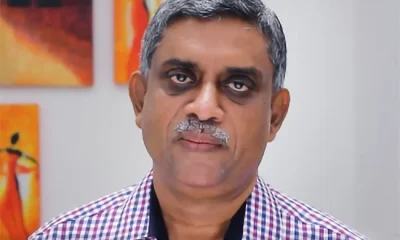



Prime Minister Dr. Harini Amarasuriya visited the International Rice Research Institute (IRRI) headquarters in Los Baños, Laguna, Philippines, on 11 March 2026, and held bilateral discussions with Yvonne Pinto, Director General of IRRI, focusing on strengthening cooperation in the field of rice research and sustainable agricultural development.
During the meeting, discussions centered on rice cultivation in Sri Lanka, including the key challenges faced by Sri Lankan paddy farmers. The Prime Minister highlighted issues affecting the sector such as productivity constraints, climate-related impacts, and the need to support farmers through improved agricultural practices and technological innovations.
Both sides also discussed the importance of introducing modern techniques and research-driven approaches to rice cultivation in order to enhance productivity and ensure long-term food security. In this regard, IRRI shared insights on ongoing global research initiatives aimed at improving rice varieties, strengthening climate resilience, and promoting sustainable farming practices.
The discussion further focused on the potential for expanded collaboration between Sri Lanka and IRRI, particularly in areas such as research partnerships, knowledge sharing, and capacity building for Sri Lankan agricultural institutions and farmers. The Prime Minister emphasized Sri Lanka’s interest in strengthening cooperation with IRRI to support the development of the country’s rice sector and to improve the livelihoods of paddy farmers.
The visit reaffirmed the importance of science-based agricultural innovation and international collaboration in addressing food security challenges and enhancing sustainable rice production in Sri Lanka.

(Prime Minister’s Media Division)
Latest News
Heat Index at ‘Caution level’ at some places in the Western, Sabaragamuwa, Southern and North-western provinces and in Monaragala and Mannar districts

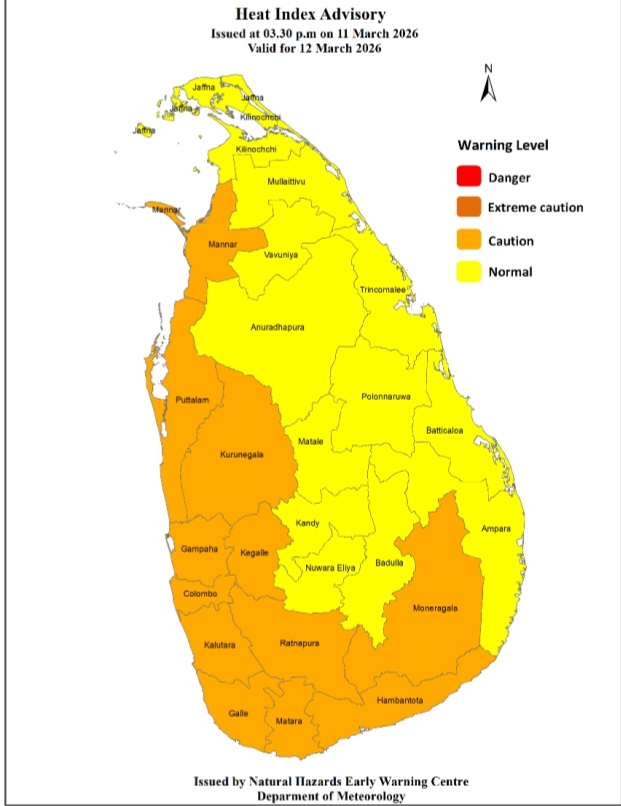
Warm Weather Advisory
Issued by the Natural Hazards Early Warning Centre of the Department of Meteorology at 3.30 p.m. on 11 March 2026, valid for 12 March 2026.
The public are warned that the Heat index, the temperature felt on human body is likely to increase up to ‘Caution level’ at
some places in the Western, Sabaragamuwa, Southern and North-western provinces and in Monaragala and Mannar districts.
The Heat Index Forecast is calculated by using relative humidity and maximum temperature and this is the condition that is felt on your body. This is not the forecast of maximum temperature. It is generated by the Department of Meteorology for the next day period and prepared by using global numerical weather prediction model data.

Effect of the heat index on human body is mentioned in the above table and it is prepared on the advice of the Ministry of Health and Indigenous Medical Services.
ACTION REQUIRED
Job sites: Stay hydrated and takes breaks in the shade as often as possible.
Indoors: Check up on the elderly and the sick.
Vehicles: Never leave children unattended.
Outdoors: Limit strenuous outdoor activities, find shade and stay hydrated.
Dress: Wear lightweight and white or light-colored clothing.
Note:
In addition, please refer to advisories issued by the Disaster Preparedness & Response Division, Ministry of Health in this regard as well.
For further clarifications please contact 011-744649


The government’s sweeping electricity sector restructuring programme ran into fresh turbulence yesterday, with authorities warning that meeting a 40 percent salary increase, demanded by striking power sector unions, could push electricity tariffs up by nearly 100 percent.
Chairman of the National Transmission Network Service Provider (NTNSP), Nusith Kumaratunga, issuing the warning at a media briefing, said the additional salary burden would significantly escalate operating costs in the newly formed power sector companies.
According to Kumaratunga, granting the 40 percent salary increase would raise the monthly wage bill by about Rs. 1.8 billion, amounting to nearly Rs. 22 billion annually, placing enormous pressure on the already fragile financial position of the electricity sector.
“If that additional burden is passed on to consumers, electricity tariffs may have to increase by close to 100 percent,” he said.
The briefing was organised by the management of the successor companies created following the restructuring of the Ceylon Electricity Board (CEB).
Kumaratunga said electricity sector trade unions had presented 64 demands in the wake of the restructuring exercise.
“Out of the 64 demands, 62 have already been agreed to,
while the remaining two have been referred to President Anura Kumara Dissanayake for discussion,” he said.
He explained that the majority of the demands related to the continuation of privileges previously enjoyed by employees under the CEB structure.
“During the initial round of discussions itself, the boards of directors agreed to 59 of those demands,” he noted.
Among the concessions already granted was the continuation of bonus payments, similar to those previously paid by the CEB, at least temporarily, until a performance-based incentive system is introduced.
The management had also agreed to grant an allowance of Rs. 11,000, in addition to the existing cost-of-living allowance, bringing the average additional monthly benefit to around Rs. 17,000 per employee, he said.
Kumaratunga stressed that management had approved all demands that could be granted at the ministerial level.
However, he said the proposed 40 percent salary increase would be difficult to justify, particularly at a time when other segments of the public service were not receiving similar benefits.
He also revealed that unions had requested that a 25 percent salary adjustment, granted to senior executives in 2024, be extended to all employees, with retrospective effect from January 1, 2024.
Granting such a request would require amending an existing Cabinet decision, which the boards of directors of the newly established companies do not have the authority to do, Kumaratunga explained.
He pointed out that the newly created electricity sector companies had only commenced operations on Monday, and their work had already been disrupted by the ongoing trade union action.
“It is difficult to understand why the strike continues when the vast majority of demands have already been addressed,” he said.
However, the Ceylon Electricity Board Engineers’ Union clarified that the 40 percent salary increase was not their primary demand.
Union representatives said that the electricity sector employees were originally due for a salary revision in January 2027, but the ongoing restructuring had raised concerns that the scheduled increase might not materialise.
“That is why we requested at least a reasonable percentage increase in order to secure some form of salary revision,” a senior electrical engineer said.
The dispute comes at a critical moment as the government presses ahead with the unbundling of the CEB into separate generation, transmission and distribution entities, a reform programme, officials say, is aimed at improving efficiency and attracting investment to Sri Lanka’s troubled power sector.
However, the restructuring has been strongly opposed by trade unions, which argue that the reforms could undermine employee security and weaken state control over a strategic national utility.
With industrial action continuing and tariff hikes looming as a possibility, the confrontation between the government and electricity sector unions appears set to intensify in the coming days.
By Ifham Nizam

PM Visits the International Rice Research Institute (IRRI)

Heat Index at ‘Caution level’ at some places in the Western, Sabaragamuwa, Southern and North-western provinces and in Monaragala and Mannar districts

Showers or thundershowers will occur at several places in the Western and Sabaragamuwa provinces and in Galle, Matara, Kandy and Nuwara-Eliya districts after 2.00 pm.

Power sector reforms jolted by 40% pay hike demand

UN scientific research ship here amidst ban on such vessels

Prez assures energy supplies for the time being

‘Dates have the highest sugar content to fight Coronavirus’

Sunday Island 27 December – Headlines

#SundayIsland 17th December – Headlines

Sunday Island – 28th March

Sunday Island Headlines – 21 March

Sunday Island – 21st February – Headlines
-

 News6 days ago
University of Wolverhampton confirms Ranil was officially invited
-

 News5 days ago
Peradeniya Uni issues alert over leopards in its premises
-

 News6 days ago
Female lawyer given 12 years RI for preparing forged deeds for Borella land
-

 News3 days ago
Repatriation of Iranian naval personnel Sri Lanka’s call: Washington
-
 News6 days ago
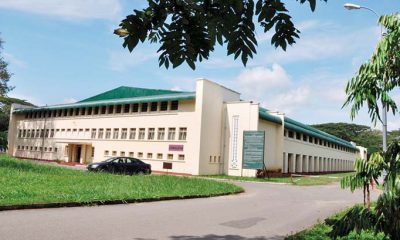
Library crisis hits Pera university
-

 News5 days ago
Wife raises alarm over Sallay’s detention under PTA
-

 News6 days ago
‘IRIS Dena was Indian Navy guest, hit without warning’, Iran warns US of bitter regret
-
 Latest News6 days ago
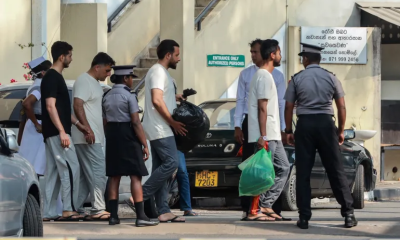
Sri Lanka evacuates crew of second Iranian vessel after US sunk IRIS Dena