
Latest News
Zadran 177, Omarzai five-wicket haul knock England out

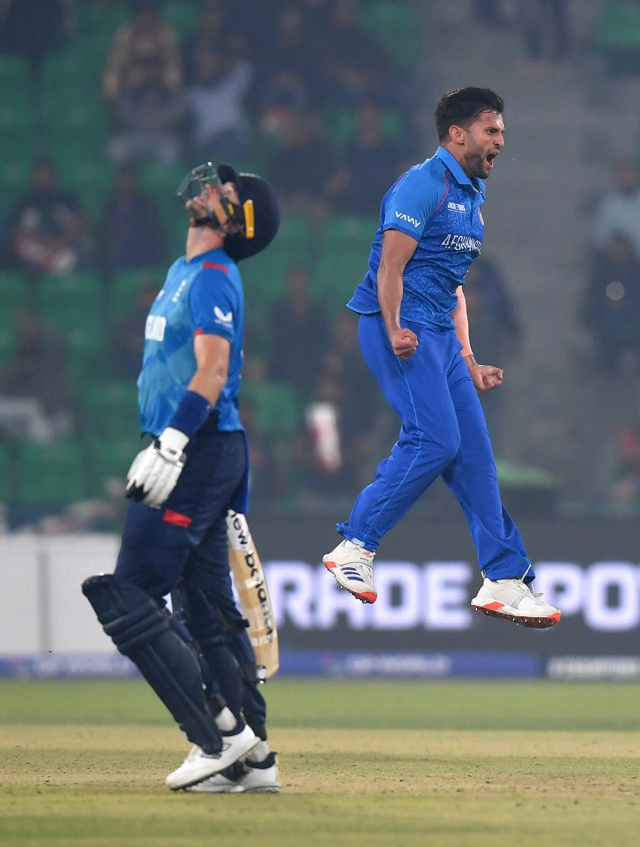
The politicians hadn’t wanted this game to go ahead, but who could have wished to deny the scenes of raw euphoria that unfolded in Lahore, as Afghanistan completed the double they had set in motion at the 2023 World Cup and dumped England out of the Champions Trophy in a wildly undulating, anxious scramble for glory.
Eight runs was the margin when – with Mark Wood hobbled and all the recognised batters gone – Adil Rashid swung for the hills off the penultimate ball of the match and picked out the man of the hour, Ibrahim Zadran, whose take in front of the dug-out was completed with the same coolness with which he had compiled his exceptional knock of 177 from 146 balls – an innings that had simply been too good to fail.
Much the same could have been said for England’s main man of their 326-run chase, Joe Root, whose 120 from 111 balls was his 17th in the ODI format but, remarkably, his first since the 2019 World Cup. Had he had a bit more support, and had he not been racked with cramp going into the final push, his run-a-ball tempo might have been more than sufficient to seize the day. Instead, he was undone by an effort ball from the indefatigable Azmatulllah Omarazi, whose five-wicket haul followed a priceless knock of 41 from 31 balls that had helped to pull his own team out of a tailspin.
Speaking straight afterwards, a shell-shocked Jos Buttler insisted he would not be making any “emotional” statements about his future as captain, but acknowledged the fundamental lack of confidence that had contributed to his team’s downfall.
After Afghanistan had opted to bat first, Jofra Archer’s three-wicket powerplay onslaught should by rights have settled the contest there and then. And yet, from 37 for 3 in the ninth over, Zadran and his captain Hashmatullah Shahidi focussed solely on survival until the point that their 103-run fourth-wicket stand had, almost imperceptibly, transformed itself into a platform for a thrillingly smooth acceleration.
Ultimately Afghanistan’s scorecard told the exact tale of their innings. Three single-figure scores at the top – for a combined total of 14 runs from 28 balls – then a trio of 40s, at ever increasing tempos, from Shahidi, Omarzai and the forty-something himself, Mohammad Nabi, whose 24-ball onslaught was a typically ageless display from a player who has been on every step of this Afghanistan journey, right from their exploratory tour of England as a de facto club side way back in 2006.
And then, underpinning it all, a performance of rare majesty from Zadran, whose sixth hundred in 35 ODI innings was not only the highest by an Afghan in the format, but the best in Champions Trophy history, trumping the 165 that Ben Duckett had posted against Australia in the previous fixture at Lahore.
It was a controlled explosion of an innings, and one of the most impressive ODI performances that can ever have been compiled. Zadran showed the tenacity to hang tough while England’s quicks were dominating the early exchanges, but after reaching his first fifty from 65 balls, he marched through to his hundred from 41 more, then clattered along at a near 200 strike-rate thereafter.
By the time he holed out to square leg at the start of the 50th over, Zadran had worked his way so smoothly through the gears that England had been left with scarcely any agency in their predicament. This was summed up when Wood, who had already spent 38 minutes off the field after his left knee gave way midway through his fourth over, was forced to leave the field once again, this time for good and with two overs of his allocation unused.
It had been a typically masochistic effort from Wood, whose willingness to bust a gut for the cause has never been in doubt. But England’s desperation to get him back into the fray there epitomised their threadbare resources. In a throwback to the sort of bit-part tactics that dominated ODI cricket in the 1980s and 1990s, Joe Root and Liam Livingstone had been charged with cobbling together 12 overs between them. But when, with nowhere else to turn, Root’s offspin was served up to the hard-swinging Nabi, two massive leg-side sixes ensued in a 23-run 47th over.
Not even Archer could stem the tide. He’d already been crashed for a six and three fours by Zadran, now in overdrive, who then launched a slower ball in Archer’s final over over long-on to seize Duckett’s record.
England’s target of 326 was daunting but not insurmountable, as they themselves had discovered on this same ground on Saturday night, when their own hefty total of 351 for 8 had been hunted down by Australia with 15 balls to spare. And yet, it was close to double the sort of target that England might at one stage had envisioned.
The scoreboard pressure was quickly brought to bear. Phil Salt started with a confident thump for four that telegraphed the trueness of the surface, but then lost his off bail as he tried to pull a skiddy length ball from Omarzai. And though Jamie Smith is undoubtedly a name for the future, it’s debatable whether he is the No.3 for the present. Certainly his dismissal was guileless in the extreme: a no-look gallop at the irrepressible Nabi, who skidded his offbreak through a touch quicker, to claim a wicket with the first ball of his spell for the third ODI in a row.
Where there was Root, there was hope, as he and Duckett set about rebuilding the innings much as they had done from an identical starting point against Australia. But after what ought to have been a costly drop from Shahidi at mid-off, when Duckett had 29, Rashid Khan stepped up with a skiddier full length, and sent his man on his way via DRS, just nine runs later.
The errors thereafter came with wearying inevitability. Harry Brook looked a million dollars for his first 20 balls, then got caught in two minds as he popped a tame return catch to Nabi for 25, whereupon Buttler – a player whose form seems so overwhelmingly dominated by his mindset – barely survived his first 12 runs before finally landing a slap for six to seemingly ignite his stay. But then, after one more slog-sweep for six off Nabi, Buttler was undone by Omarzai’s energetic lengths, as he spliced a pull straight to midwicket for 38.
Now it was all on Root. For the first 90-odd balls of his innings, England’s anchorman might as well have been on a serene stroll in Iqbal Park, with his innings scarcely deviating from a run-a-ball tempo. But then, after reaching his 50 from 50 and his hundred from 98, he felt the early onset of cramp, and with 58 still required from six overs, he inverted his stance into a Buttler-style ramp, and pinged his only six over the keeper’s head.
But it was too much to ask for Root to walk the innings home. He kept looking for the angles, and found one final sublime deflection for four through backward square, but at the precise moment at which Afghanistan’s own innings had gone into overdrive, he attempted a flick over deep third off another skidder Omarzai lifter, and was sent on his way via a scuff of the gloves to the keeper.
Jamie Overton seemed to have got the memo with the long-levered finish that he had so long promised but rarely delivered, but having brought the chase within reach with 32 from 28 balls, he attempted another takedown and found long-on with 17 still needed. And though Jofra Archer seemed to be riding his luck with an under-edge for four and a sprawling reprieve at deep cover, he was unable to close it out either. Thirteen from eight was needed when he flung his hands through an Omarzai slower ball, for Nabi in the deep to make no mistake.
Minutes later, it was all done and dusted. Afghanistan march onto what could have been another politically charged showdown with Australia, with a place in the semi-finals at stake, having already crushed the hopes of their new favourite tournament bunnies. Irrespective of the situation in their homeland, a remarkable set of players have once again epitomised the hope and escapism in tough times that only sport can provide.
Brief scores:
Afghanistan 325 for 7 in 50 overs (Ibrahim Zadran 177, Azmatullah Omarzai 41,Hashmatullah Shahidi 40, Mohammad Nabi 40; Joffra Archer 3-64, Liam Livingstone 2-28) beat England 317 in 49.5 overs (Ben Duckett 38, Harry Brook 25, Joe Root 120, Joss Buttler 38, Jamie Overton 32; Azmatullah Omarzai 5-58, Mohammad Nabi 2-57) by eight runs
[Cricinfo]



Salman Ali Agha said that he would have done things ‘differently”, after Mehidy Hasan Miraz ran him out in controversial circumstances in the second ODI in Dhaka.
Agha, who made 64 from 62 balls, had been backing up at the non-striker’s end when Mohammad Rizwan drove the ball back towards him. He was still out of his ground as Mehidy swooped round behind him in an attempt to gather, and Agha had appeared ready to pass the ball back to the bowler before Mehidy reached down to grab it first and throw down the stumps.
Agha reacted furiously to the dismissal, throwing his gloves and helmet down in disgust at the decision. However, he later came to the post-match press conference, ahead of captain Shaheen Shah Afridi and player of the match Maaz Sadaqat, to clear the air.
“I think sportsman spirit has to be there,” Agha said. “What he [Mehidy] has done is in the law. I think if he thinks it’s right, it’s right, but if you ask me my perspective, I would have done differently. I would have gone for sportsman spirit. We haven’t done this [type of thing] previously, we would never do that in the future as well.”
Agha explained that he had been trying to pick up the ball to give to Miraz, thinking it was likely to have been called dead. “Actually, the ball hit on my pad and then my bat,” he said. “So I thought he can’t get me run-out now, because the ball already hit on my pad and my bat.
“I was just trying to give him the ball back. I was not looking for the run or anything like that, but he already decided [to make the run-out].”
Agha however regretted his angry reaction. “It was just heat-of-the-moment kind of stuff,” he said. “If you ask me what would I have done, I would have done things differently. But it was everything, whatever happened after that, it was in the moment.”
He was also involved in a robust exchange with Bangladesh wicketkeeper Litton Das, though he didn’t divulge many of the details.
“I can’t remember what I was saying and I can’t remember what he was saying,” he said. “I’m sure I wasn’t saying nice things, and I’m sure he wasn’t saying nice stuff as well. But it was just heat of the moment, so we are fine.
Asked if he had patched things up with Mehidy, Agha said: “I haven’t yet, but don’t worry, I’ll find him.”
Pakistan won the match by 128 runs via the DLS method.
[Cricinfo]
Latest News
US embassy in Baghdad hit by strike as Trump says military targets ‘obliterated’ on Iran’s key oil island
The US embassy in Baghdad, Iraq, has been hit by a missile – video shows fire and smoke rising in the aftermath.
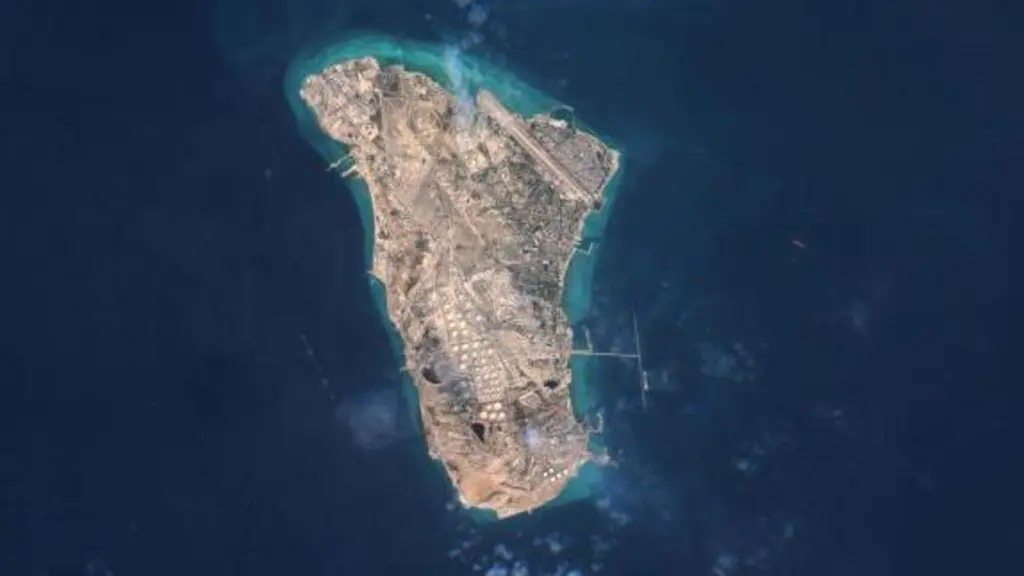
Meanwhile, President Donald Trump says “every military target” on Iran’s key oil island has been “totally obliterated”, but there was no damage to oil infrastructure.
Kharg Island is a tiny but strategic terminal in the northern Gulf, 22 miles off the coast of Iran In response, Tehran warns oil and energy infrastructure belonging to firms that co-operate with the US will be “turned into a pile of ashes” if Iran’s energy facilities are attacked
Elsewhere in the Middle East: Israel and Iran both warn of fresh attacks, and at least 12 medical staff have been killed in an Israeli strike in Lebanon
Meanwhile, more US Marines and warships are expected to be deployed to the Middle East, two officials tell BBC’s partner CBS News
[BBC]

The Bahrain and Saudi Arabia Grands Prix that were scheduled for next month are set to be cancelled as a result of the war in the Middle East.
A formal decision to call off the races has not yet been made but is expected before the end of the weekend.
Freight would need to start being shipped to the Middle East in the coming days. With no sign of the conflict between the US/Israel and Iran coming to a conclusion, holding the races would put personnel at too great a risk.
Neither event will be replaced, with the season being cut to 22 grands prix and F1 taking a commercial hit of more than £100m, given Bahrain and Saudi Arabia pay two of the highest hosting fees.
The race in Bahrain was scheduled to be on 12 April with Jeddah the following weekend.
Consideration was given to holding events at Portimao in Portugal, Imola in Italy or Istanbul Park in Turkey.
But it was accepted that the time to organise a race at any of those locations was too short, and there was little chance of securing a hosting fee.
The decision will mean there is a five-week break between the Japanese Grand Prix on 29 March and Miami on 3 May.
(BBC)

Agha calls for ‘sportsman spirit’ after controversial dismissal

US embassy in Baghdad hit by strike as Trump says military targets ‘obliterated’ on Iran’s key oil island

Showers or thundershowers will occur at several places in the Western, Sabaragamuwa, Central, North-western and Uva provinces and in Galle, Matara, Mannar and Anuradhapura districts after 2.00 pm.

Bahrain & Saudi Arabia Grands Prix to be cancelled

Pink Floyd guitar sold for record-breaking $14.6m

Promoting Local Industries is a key priority of the Government – PM

‘Dates have the highest sugar content to fight Coronavirus’

Sunday Island 27 December – Headlines

#SundayIsland 17th December – Headlines

Sunday Island – 28th March

Sunday Island Headlines – 21 March

Sunday Island – 21st February – Headlines
-

 News6 days ago
Repatriation of Iranian naval personnel Sri Lanka’s call: Washington
-
 Features6 days ago
Winds of Change:Geopolitics at the crossroads of South and Southeast Asia
-

 News5 days ago
Prof. Dunusinghe warns Lanka at serious risk due to ME war
-

 Sports4 days ago
Royal start favourites in historic Battle of the Blues
-

 Sports3 days ago
The 147th Royal–Thomian and 175 Years of the School by the Sea
-
 News3 days ago
Historic address by BASL President at the Supreme Court of India
-
 Business7 days ago
Seven decades of sartorial excellence: The legacy of Linton Master Tailors in Kandy
-

 News4 days ago
CEBEU warns of operational disruptions amid uncertainty over CEB restructuring