
News
Yusuf says his stand on 19 A never an issue for CC ire


‘All CC members enjoy equal rights’
By Shamindra Ferdinando
Constitutional Council member Javid Yusuf said yesterday that the Constitutional Council (CC) had not made an issue of his call for taking a stand on the much-debated 19th Amendment to the Constitution on a civil society platform in the run-up to the Aug.5 general election.
Attorney-at-law Yusuf said so in response to a query raised by The Island.
Outgoing Chairman of the CC and former Speaker Karu Jayasuriya chaired its final meeting on August 3 – two days before the election, at the Speaker’s official residence.
Asked whether the CC had taken up for discussion his declaration against the moves to do away with the 19th Amendment at its last meeting or the outgoing Chairman raised it with him on some other occasion, Yusuf said: “The answer to both questions is in the negative.”
Addressing a civil society gathering at the New Town Hall, on July 8, Yusuf declared his strong opposition to the high-profile campaign by the ruling Sri Lanka Podujana Peramuna (SLPP) to abolish the 19th Amendment enacted at the onset of the yahapalana administration.
Yusuf was among three civil society members of the 10-member CC. Of the seven other members, the Speaker, Prime Minister and the Opposition Leader held ex-officio positions.
A member of the now defunct CC told The Island that Yusuf, in his capacity as a member of the apex body couldn’t be faulted for taking a stand on the 19th issue as Premier Mahinda Rajapaksa, in spite of him being a CC member, did the same.
The former pointed out that except for the then Chairman Jayasuriya, six of his parliamentary colleagues represented in the CC either backed moves to abolish the 19th Amendment or opposed the SLPP project.
In spite of the SLPP making unprecedented electoral gains at the commencement of the releasing 2020 general election results, civil society grouping, ‘Freedom: People’s Collective’ that campaigned for the continuance of the 19th Amendment still believed the required two-thirds majority couldn’t be achieved by the ruling coalition.
Prof. Rohan Samarajiva, while acknowledging a comfortable victory for the ruling party at the 2020 General Election said that two-thirds was impossible under the Proportional Representation system. The academic who appeared on the platform of ‘Freedom: People’s Collective’ with Yusuf told The Island that a two-thirds was beyond the SLPP’s capability.
Meanwhile, UNP Colombo District candidate Oshala Herath yesterday told The Island that he was quite disappointed by the failure on the part of the CC at least to make a reference to serious allegation he made to the then Chairman himself as regards the irregularities in the registration of the Samagi Jana Balavegaya (SJB). The CC couldn’t under any circumstance absolve itself of the responsibility for the conduct of the Election Commission.
Herath pointed out that the CC and the former Speaker commended the EC without taking into consideration serious accusations directed at the latter over its conduct. Herath said that he moved the Supreme Court against the SJB registration as the EC in no uncertain terms confirmed irregularities taking place in the process. The civil society activist vowed to go ahead with his campaign regardless of the heavy defeat suffered by the UNP.
Herath lambasted the poll monitors for remaining silent on what was going on. They complained, he said about the display of propaganda and campaign advertisement on social media whereas far bigger irregularities took place at the very place responsible for managing the parliamentary election, Herath said.
The CC will meet again after the new parliament begins sittings on Aug 20.
Herath alleged that all political parties to varying degrees cooperated with the EC.

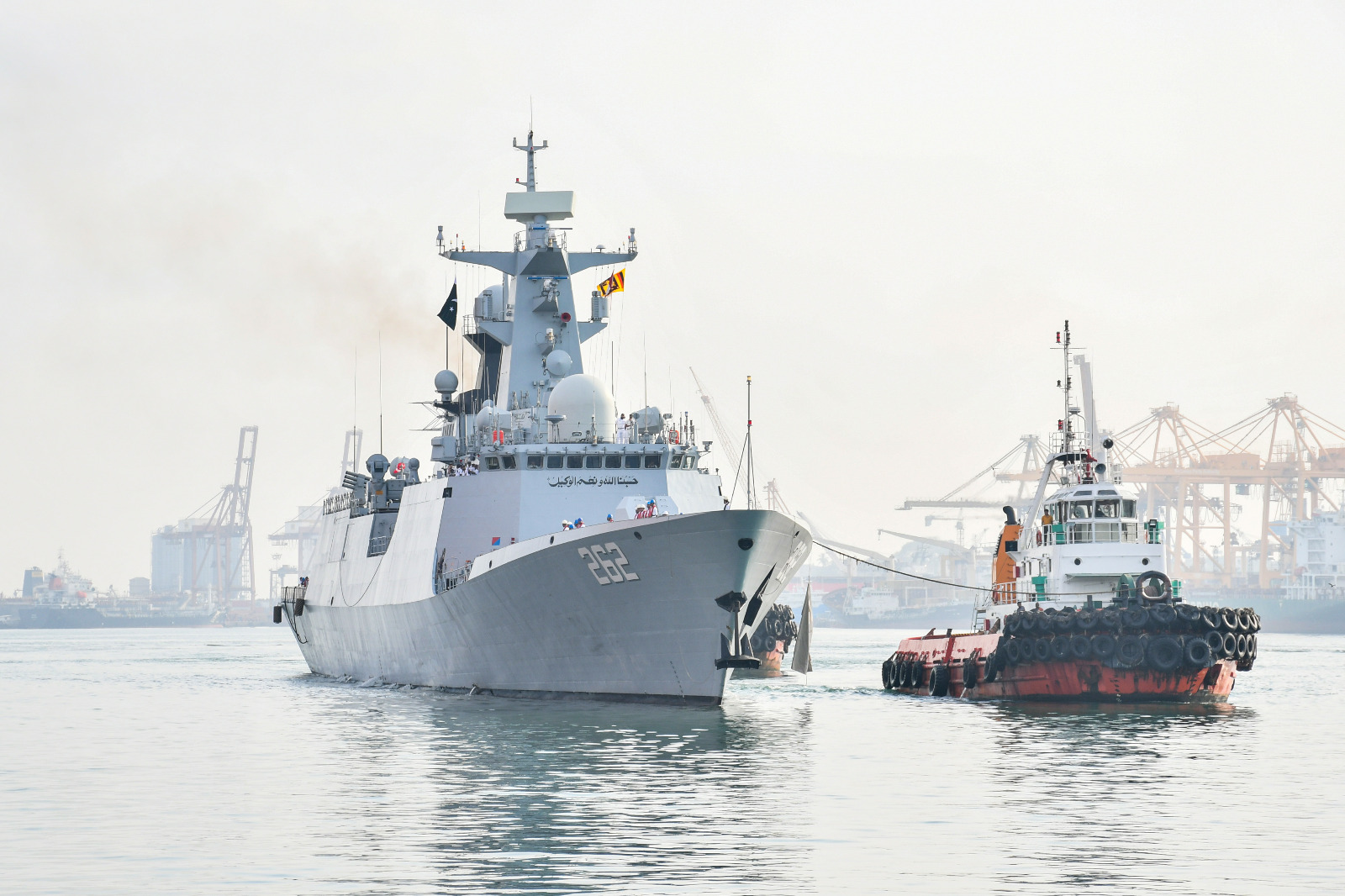
The Pakistan Navy Ship (PNS) TAIMUR and ASLAT arrived at the Port of Colombo on a goodwill visit on 12 Apr 26.
The visiting ships were welcomed by the Sri Lanka Navy in
compliance with naval traditions.
The duo of ships is commanded by Captain NIAMAT SAEED KHAN (PNS TAIMUR) and Captain NADIR MATEEN AFRIDI (PNS ASLAT).
Meanwhile, the ships are expected to conduct a Bilateral Naval Exercise LION STAR V with the Sri Lanka Navy in Colombo seas.
Latest News
Heat index likely to increase up to ‘Caution level’ at some places in the Northern, North-central, North-western, Western, Sabaragamuwa, Southern and Eastern provinces and Monaragala district


Warm Weather Advisory
Issued by the Natural Hazards Early Warning Centre at 3.30 p.m. on 11 April 2026, valid for 12 April 2026
The Heat index, the temperature felt on the human body is likely to increase up to ‘Caution level’ at some places in the Northern, North-central, North-western, Western, Sabaragamuwa, Southern and Eastern provinces and Monaragala district.
The Heat Index Forecast is calculated by using relative humidity and maximum temperature and this is the condition that is felt on your body. This is not the forecast of maximum temperature. It is generated by the Department of Meteorology for the next day period and prepared by using global numerical weather prediction model data.

Effect of the heat index on human body is mentioned in the above table and it is prepared on the advice of the Ministry of Health and Indigenous Medical Services.
ACTION REQUIRED
Job sites: Stay hydrated and takes breaks in the shade as often as possible.
Indoors: Check up on the elderly and the sick.
Vehicles: Never leave children unattended.
Outdoors: Limit strenuous outdoor activities, find shade and stay hydrated.
Dress: Wear lightweight and white or light-colored clothing.
Note: In addition, please refer to advisories issued by the Disaster Preparedness & Response Division, Ministry of Health in this regard as well. For further clarifications please contact 011-7446491.
Latest News
Sun directly overhead Cheddikulam, Kebithigollewa, Gomarankadawala and Nilaveli about 12:11 noon. today [12]

On the apparent northward relative motion of the sun, it is going to be directly over the latitudes of Sri Lanka from 05th to 15th of April in this year.
The nearest areas of Sri Lanka over which the sun is overhead today (12th) are Cheddikulam, Kebithigollewa, Gomarankadawala and Nilaveli about 12:11 noon.

PNS TAIMUR & ASLAT arrive in Colombo

Sanju Samson and Jamie Overton deliver first points for Chennai Super Kings

Arya, Prabhsimran and Shreyas help Punjab Kings ace another 200-plus chase

Beauty of Sri Lanka in focus: Global showcase blends art, diplomacy and conservation

Showers expected in the Western, Sabaragamuwa, Central, Southern, North-western and Uva provinces and in Ampara, Batticaloa and Polonnaruwa districts after 1.00 p.m.

Heat index likely to increase up to ‘Caution level’ at some places in the Northern, North-central, North-western, Western, Sabaragamuwa, Southern and Eastern provinces and Monaragala district

‘Dates have the highest sugar content to fight Coronavirus’

Sunday Island 27 December – Headlines

#SundayIsland 17th December – Headlines

Sunday Island – 28th March

Sunday Island Headlines – 21 March

Sunday Island – 21st February – Headlines
-

 News6 days ago
Lankan-origin actress Subashini found dead in India
-

 News4 days ago
AG: Coal procurement full of irregularities
-

 Business3 days ago
Israeli attack on Lebanon triggers local stock market volatility
-

 News19 hours ago
CEB orders temporary shutdown of large rooftop solar systems
-

 Business4 days ago
Hayleys Mobility introduces Premium OMODA C9 PHEV
-

 Business3 days ago
HNB Assurance marks 25 years with strategic transformation to ‘HNB Life’
-

 Sports4 days ago
DS to face St. Anthony’s in ‘Bridges of Brotherhood’ cricket encounter
-

 News6 days ago
UN Regional Director launches SL’s first Country Gender Equality Profile during official visit