
News
Work on Delhi’s second international airport to begin in August


Will be Asia’s biggest and world’s fourth largest
BY S VENKAT NARAYAN
Our Special Correspondent
NEW DELHI, July 30: Delhi’s second international airport, known as the Noida International Airport (NIA), will enter the construction stage in August for its main terminal building and runway. They have to be completed within the next 25 months. Its deadline for launching commercial flights is September 29, 2024.It will be Asia’s biggest airport and the fourth largest in the world. The distance between the present Delhi airport and the NIA is 31km.
The building and the runway will be built by Tata Project Limited (TPL), which has been awarded the engineering, procurement and construction (EPC) contract for NIA.A spokesperson for Yamuna International Airport Private Limited (YIAPL), the special purpose vehicle of NIA concessionaire Zurich AG, said the terminal building and runway will be ready by the last quarter of 2024. The agreement has a stiff penalty clause of one million Indian rupees per day if the deadline is missed as per the agreement signed by the Government of Uttar Pradesh and Zurich AG.
NIA, which will become the second international airport in the National Capital Region (NCR) is meant to handle 12 million passengers annually. Besides the terminal building and the 3,900-metre-long runway, Tata Projects will also construct airside infrastructure, roads, utilities, landside facilities and other ancillary buildings.
The entire airport project is slated to be built over four phases by the end of 2061. By the end of the 40-year concession period of Zurich AG, there will be two terminal buildings and an equal number of runways. The airport master plan is prepared to accommodate the demand throughout the 40-year concession period with two runways.
The airport will open with a single runway and a terminal capacity to handle 12 million passengers per year. By the end of the concession in 2061, it will be developed with two parallel runways and additional terminal capacity to serve 70 million passengers, said the official.
The initial terminal building will cover 102,000 sqm. The second one is envisaged to be much bigger, about three times in size. The plan for the second runway accommodates a bigger strip of 4,150 metres. “We also plan to develop a ground transportation centre that will feature a multimodal transit hub, housing metro and high-speed rail stations, taxi, bus services and private parking,” the official added.
The UP government is still exploring options to connect the airport, which is in Jewar off the Yamuna Expressway, to Noida and Delhi. Metro is one of the options being explored.
In its first monthly report to NIAL, the state government’s special purpose vehicle to oversee and coordinate on the airport project, Engineers India Limited (EIL) has informed that construction of a support building has started at the airport site. Besides that, an 11kV capacity substation has also been set up at the site to meet the initial power requirement of the airport, officials said.
EIL has been appointed to oversee construction work of the airport. NIAL CEO Arun Vir Singh said: “The boundary wall work of the airport is almost complete. The airport is also expected to get an explosive licence by next month as fuel will be stored at the site.”


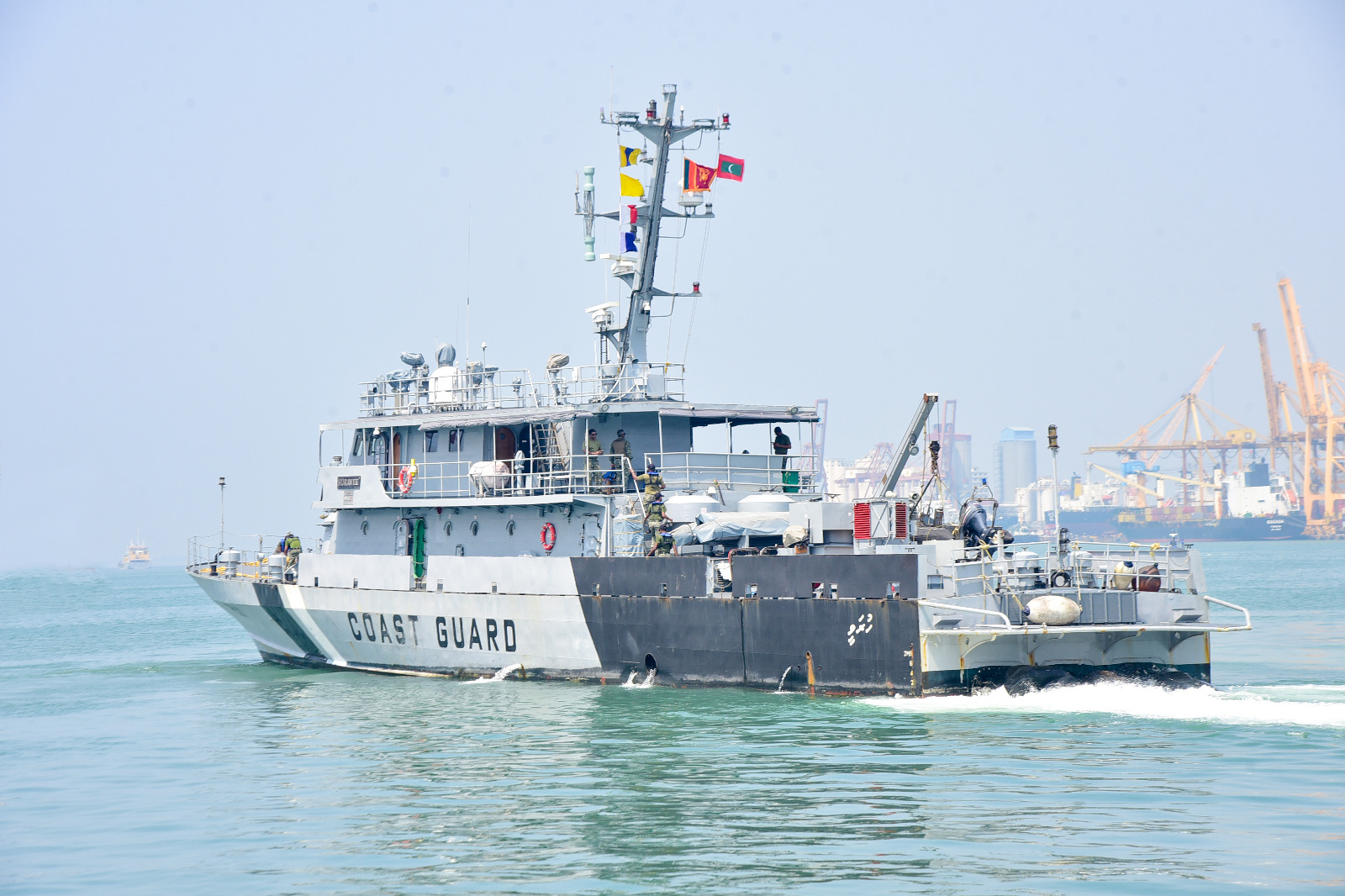
The Maldives Coast Guard Ship Huravee which arrived in Sri Lanka for replenishment purposes, departed the island on 04 Mar 26.
In accordance with naval tradition, the Sri Lanka Navy extended a customary farewell to the departing ship at the Port of Colombo

A day after a US submarine sunk an Iranian Navy warship off the coast of Sri Lanka, the Foreign Minister of Iran, Sayed Abbas Araghchi, has warned that the US would “pay bitterly” for targeting a ship in international waters, The Tribune has reported.
Araghchi posted on social media platform X on Thursday saying, “The US has perpetrated an atrocity at sea, 2,000 miles away from Iran’s shores.”
The frigate IRIS Dena, a guest of India’s Navy carrying almost 130 sailors, was struck in international waters without warning, said the Iran Foreign Minister, adding, “Mark my words: The US will come to bitterly regret the precedent it has set.”
US Secretary of War, Pete Hegseth, on Wednesday confirmed that a US submarine fired a torpedo and sank the Iranian Navy vessel IRIS Dena west of Sri Lanka.
In a way, the Iran and US-Israel conflict has reached close to the Indian coast. The strike today at sea was almost 4,000 kms away from Iran, significantly expanding the radius of war. Already, fearing Iranian missile strikes, several US warships have moved eastward towards India.
These ships are in international waters. India has denied that any US Navy assets were using Indian ports. The Iranian ship, hit on Wednesday, was returning after participating in the international fleet review and exercise Milan hosted by India at Visakhapatnam.
The Iranian ship went down with almost 130 sailors on board missing. The Sri Lankan Navy, acting on a distress call, rescued 32 of the Iranian sailors. Hegseth confirmed the act by the US forces, saying the ship was hit in the Indian Ocean, stating, “an Iranian warship that thought it was safe in international waters. .. Instead, it was sunk by a torpedo”.
Hegseth did not name the Iranian ship that was attacked. But earlier, the Sri Lankan Navy reported the distress call from IRIS Dena when it was some 40 kms west of Galle, located on the south-western part of the island country. On February 16, the Iranian ship had sailed into the port of Visakhapatnam, where seventy-four nations participated.
Warships from Australia, Japan, South Korea, Russia, and dozens of others were anchored alongside the now-sunk Iranian vessel. Iran’s Navy Commander, Rear Admiral Shahram Irani, held talks with India’s Chief of Naval Staff on strengthening maritime security cooperation.
The theme was “United through Oceans.” Notably, the US Navy was supposed to send the guided-missile destroyer USS Pinckney to the exercise Milan; however, the ship was diverted to Singapore on February 15. The US did not field its warship in Milan, which had ships from Russia and Iran.
The exercise ended on February 25. Three days later, on February 28, the United States and Israel launched Operation Epic Fury. The IRIS Dena was transiting home. This morning at 5:08 a.m. local time, the IRIS Dena issued a distress call. Sri Lanka’s Foreign Minister, Vijitha Herath, informed parliament that two navy vessels and an aircraft were deployed. Thirty crew members were rescued and admitted to Karapitiya Hospital in Galle.
The Straits Times reported 32 critically wounded survivors. Reuters reported 101 missing and 78 wounded. The Sri Lankan Navy spokesman said the operation was conducted in line with the International Convention on Maritime Search and Rescue.

The Public Utilities Commission of Sri Lanka (PUCSL) has warned of a possible risk of power cuts due to the use of inferior quality coal affecting generation capacity at the Lakvijaya Power Plant, according to a recent commission report.
The commission said the risk to the continuous electricity supply was assessed based on the peak demand forecast submitted by the Ceylon Electricity Board (CEB) for 2026.
According to the report, the analysis assumed that hydropower plants could contribute up to 1,300 MW to meet the night peak demand, while the Lakvijaya Power Plant (LVPS) would be able to contribute only up to 690 MW due to a capacity shortfall, assuming a 40 MW generation capacity reduction from each unit.
The PUCSL said the assessment was carried out taking into account the planned maintenance schedule submitted by the CEB. Under the schedule, Unit 1 of the Lakvijaya plant is due to undergo maintenance checks and repairs in June for a period of 25 days, while Unit 2 is scheduled for maintenance in July for another 25 days.
The report also noted that the 270 MW West Coast Power Plant is scheduled to undergo maintenance in April for 10 days, while the 150 MW Kelanitissa Combined Cycle Power Plant (KCCP 2) is expected to undergo maintenance during May, June and July.
Under normal conditions, the report said, there is a potential risk of a generation capacity shortage if electricity demand reaches 3,030 MW in April, 3,070 MW in June and 3,000 MW in July.
The highest recorded night peak demand so far in 2026 was 2,949 MW on February 25.
The PUCSL further warned that if one coal unit or any major power plant becomes unavailable from the existing generation mix, there would be a significant risk of a generation capacity shortage to meet the night peak demand, particularly during April, June and July.
Energy sector analysts said the use of substandard coal could further aggravate operational challenges at the Norochcholai plant, potentially affecting generation efficiency and reliability if corrective measures are not taken promptly.
By Ifham Nizam

Tiny possum and glider thought extinct for 6,000 years found in remote West Papua

Maldives Coast Guard Ship Huravee departs island

Cost to US for war on Iran is $3.7bn in first 100 hours, says think tank

More than 120 killed in Israel’s Lebanon attacks as Beirut, south, east hit

Hungary confirms it is holding seven Ukrainian bank workers and $80m

US and Venezuela agree to resume diplomatic ties after Maduro capture

‘Dates have the highest sugar content to fight Coronavirus’

Sunday Island 27 December – Headlines

#SundayIsland 17th December – Headlines

Sunday Island – 28th March

Sunday Island Headlines – 21 March

Sunday Island – 21st February – Headlines
-
 Features5 days ago
Brilliant Navy officer no more
-
 Opinion5 days ago
Sri Lanka – world’s worst facilities for cricket fans
-

 Features5 days ago
A life in colour and song: Rajika Gamage’s new bird guide captures Sri Lanka’s avian soul
-

 Business2 days ago
Cabinet nod for the removal of Cess tax imposed on imported good
-

 Features6 days ago
Overseas visits to drum up foreign assistance for Sri Lanka
-

 Features6 days ago
Sri Lanka to Host First-Ever World Congress on Snakes in Landmark Scientific Milestone
-

 News2 days ago
Legal experts decry move to demolish STC dining hall
-
 Latest News2 days ago
Around 140 people missing after Iranian navy ship sinks off coast of Sri Lanka