
Sports
Why Oman became home to Sri Lanka’s Duleep Mendis

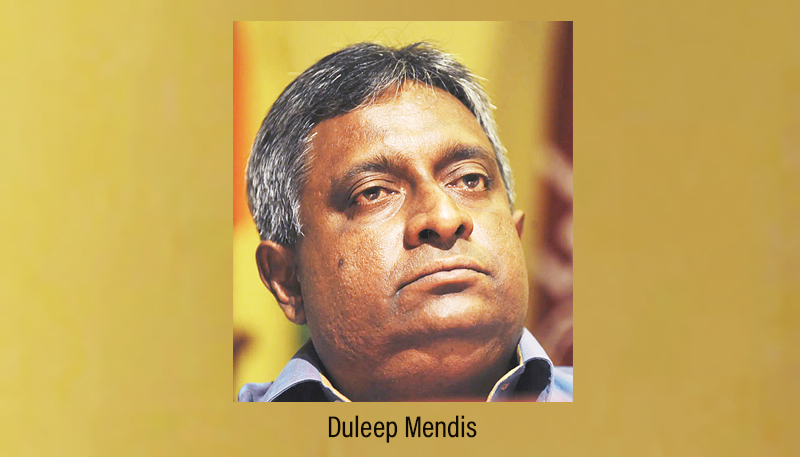
When Duleep Mendis first arrived in Muscat to help a budding nation find its footing in international cricket, he expected his stay to be brief. That was 13 years ago.
The 2026 tournament in India and Sri Lanka is Oman’s fourth T20 World Cup and Mendis has been around for the whole journey. He had not expected to stay and find a second home in a desert nation that has grown into a competitive force in Associate cricket.
“Initially I went for one or two years and ended up being there for about 14 years now,” Mendis, the Oman head coach, says while in his old stomping grounds, Colombo, where they are based for all their Group B matches.
“Pankaj Khimji, Chairman of Oman Cricket asked me how long I was going to keep shuffling up and down and whether I would like to come and settle down,” Mendis says. “By that time, I found out it was the right place. And more than anything I must say the people who were administering Oman cricket were fantastic guys.”
What Mendis found was rare in international sport. While many coaches battle board interference, he had a group of leaders who offered him a “free hand” to build.
“I liked very much working for the board because they gave me the authority. There were many proposals that we took forward. You are given a free hand and there were times that we failed, but you correct it and go forward.”
To comprehend the breadth and depth of growth in Oman cricket during Mendis’ tenure, one must first take a step back. When he started, their infrastructure was minimal. Founded in 1979 by the late Kanaksi G Khimji, Oman Cricket became an Affiliate Member of the ICC in 2000, gained T20I status in 2015, three years after Mendis joined and ODI status in 2019. Today, Muscat boasts world-class facilities that rival those in most Test nations.
The academy features a state-of-the-art indoor facility with seven pitches (fast, slow and ordinary) in a fully air-conditioned environment, while barren land has been replaced by “beautiful lush green” turf, with the government recently gifting the board three additional grounds.
While centred in Muscat, Mendis is pushing to take the game to Salalah and Sohar, to ensure cricket isn’t just a capital city sport. However, the road to the top division of international cricket has not been without complications.
The transition from “honorary” board to professional entity reached breaking point following the 2024 T20 World Cup when 11 senior players, including stars like Aqib Ilyas and Zeeshan Maqsood, clashed with the board over unpaid prize money.
The fallout was severe. The board suspended central contracts and because residency in Oman is often tied to these sporting visas, several players were forced to leave the country.
While the board eventually pledged to clear all dues by July 2025, attributing the delay to procedural hurdles, the incident highlighted friction in a rapidly evolving system.
For Mendis, who views the board members as “passionate guys who only wanted to do well,” these obstacles were part of the journey.
“I would say the hurdles were there, you had to just cross it,” Mendis says philosophically. “When the obstacles are coming, we discuss it as a panel and try to take constructive decisions. We are an Associate country, and there is a big difference from Associate to Test.”
Mendis is a realist regarding priorities in the region. He understands that in the Gulf Cooperation Council, of which Oman is a part, the focus is on white-ball cricket, which fits the working schedules of their player pool.
“The infrastructure and everything is suited for the white-ball game,” Mendis says. “Most of them are there for work, though that is slightly changing now. When the team does well, people start talking… it’s like back in ’96 when we [Sri Lanka] won the World Cup.”
As a batter who faced the world’s most fearsome bowlers in the 1970s and 80s, Mendis views the modern game with a nuanced eye. While he marvels at the athleticism, he sees a decline in the purer arts.
“Modern day cricket is completely different… it is almost like athletes playing. But I would say batting technique and standards have dropped a little.”
But despite that, he does envy the security the modern player has compared to his era. “Today you can come into cricket and say I will make it a career. That is an advantage.”
[Cricinfo]
by Madushka Balasuriya



India produced a ruthless, near-flawless performance to retain the T20 World Cup title they won in the Caribbean two years ago, steamrolling New Zealand by 96 runs in Sunday’s final in Ahmedabad.
The Kiwis, who had marched into the final after ending South Africa’s unbeaten run in the Calcutta semi-final, ran into a blue wall. India piled up a daunting 255 for five after being asked to bat and then bundled New Zealand out for 159 with an over to spare, sealing one of the most emphatic wins in a World Cup final.
India had been given a wake-up call earlier in the tournament when South Africa handed them a heavy defeat in the Super Eight stage, leaving them needing four straight wins to lift the trophy. From that point on, Surya Kumar Yadav’s men put their foot on the accelerator and never looked back, playing like a side on a mission and delivering the knockout punch when it mattered most.
It was a triumph built not just on star power but on depth and system. India’s conveyor belt of talent keeps churning out match-winners, and their bench strength is the envy of the cricketing world. You may grumble about their strong-arm tactics in the corridors of power, but there is no denying the machine they have built. The result is domination across formats – men’s, women’s and Under-19 – echoing the era of Australian supremacy. At the moment, India are the team everyone else is chasing.
The victory was India’s biggest in T20 World Cup history and made them the first team to win the title three times. Former captains Rohit Sharma, who led the side to the 2024 crown and M.S. Dhoni, the architect of the inaugural triumph in 2007, were present at the venue to witness another chapter of Indian cricketing glory.
New Zealand, however, got their sums wrong. Their seamers stuck to predictable pace and failed to mix things up, allowing India’s openers to cash in during the powerplay.
Abhishek Sharma and Sanju Samson came out all guns blazing, racing to 98 for the first wicket in just 7.1 overs and putting the Kiwis immediately on the back foot. Abhishek set the tone with a blistering 52 off 22 balls, while Samson anchored the charge with a sparkling 89 off 46 deliveries, peppered with five fours and eight towering sixes.
Samson had been India’s banker throughout the tournament, striking three consecutive half-centuries during the campaign and walking away with the Player of the Series award.
The fireworks did not stop there. Ishan Kishan chipped in with a breezy 54 off 25 balls at number three as India threatened to push past the 270 mark. New Zealand managed to drag things back slightly at the death, but chasing 256 in a World Cup final was always going to be a bridge too far.
India’s bowlers then applied the squeeze. Jasprit Bumrah led the charge with a masterclass in fast bowling, finishing with figures of four for 15 and walking away with the Man of the Match award as New Zealand’s chase fizzled out quickly.
Rex Clementine in Ahmedabad
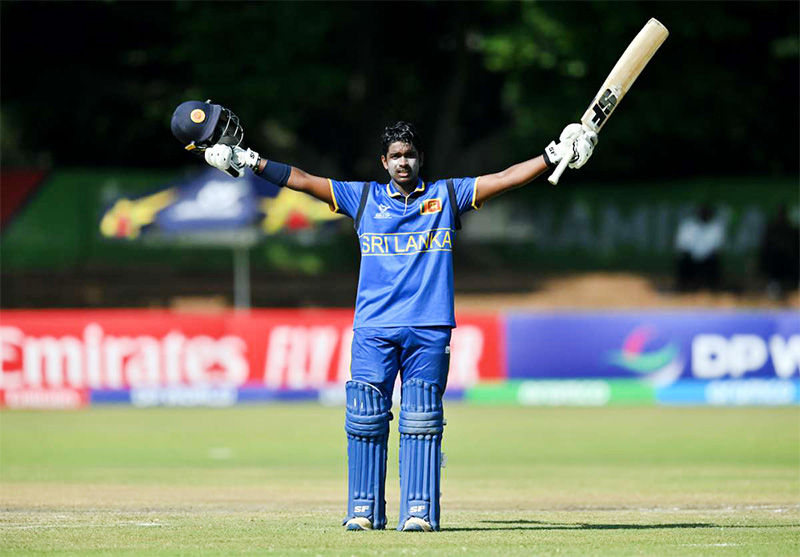
Sri Lanka Under-19 player Viran Chamuditha produced a superb all-round performance to power St. Servatius’ College Matara to a convincing innings and 55-run victory over Lumbini College in their Under-19 Division I Tier ‘A’ cricket tournament match played at the BRC Ground on Monday.
Chamuditha, who had earlier dazzled with the bat, went on to claim a match haul of ten wickets to seal an emphatic win for the Matara school.
After being forced to follow on when they were dismissed for 112 runs in their first innings, Lumbini showed some resistance in the second innings. Pasindu Maheesha, Linoth Methmal and Jayanitha Mendis offered brief fightbacks as they batted for nearly 50 overs, but the side was eventually bowled out for 183 runs.
Chamuditha led the bowling attack with a fine five wicket hal for 48 runs, sharing eight wickets in the innings with Lasindu Ramanayake. The pair had also been the main wicket takers in the first innings as St. Servatius’ dominated with the ball.
The foundation for the comprehensive victory had earlier been laid by the Servatius’ top order who piled up an imposing 350 for six wickets in 50 overs.
Heshan Madushanka top-scored with a fluent 128 runs off 147 deliveries, an innings studded with 16 boundaries and a six. Opener Risinu Kithmuka provided early impetus with a brisk 64 off 47 balls.
Chamuditha then capped the innings with a blistering knock of 83 runs off just 31 balls, smashing eight fours and six sixes. The explosive innings came after the young all-rounder had broken batting records at the ICC Youth World Cup, further underlining his immense potential.
With both bat and ball, Chamuditha’s outstanding display ensured St. Servatius’ completed a dominant victory.


Five members of the Iranian women’s football team have been granted humanitarian visas in Australia after their elimination in the Asian Cup, the government in Canberra says.
Immigration Minister Tony Burke said the women “were moved to a safe location” by Australian police. He said other squad members had been told they are welcome to stay in the country.
The women had been due to fly home, but supporters had raised fears for their safety after the team declined to sing the national anthem ahead of their match against South Korea last week.
This prompted criticism in Iran, with one conservative commentator accusing the team of being “wartime traitors” and pushing for harsh punishment.
Australia’s humanitarian visa programme grants permanent protection to refugees and people in humanitarian need. Visa holders can live, work and study in the country.
Speaking early on Tuesday, Burke said the five players were happy for their names to be confirmed as Fatemeh Pasandideh, Zahra Ghanbari, Zahra Sarbali, Atefeh Ramazanzadeh, and Mona Hamoudi.
“They want to be clear they are not political activists. They are athletes who want to be safe,” he said, adding that talks had been going on over several days.
He said that on Monday “it was made clear that there were five women who wanted to be able to stay in Australia”.
The group left their hotel the same day and were moved to a safe location by police.
Burke said he met the women at that location and then signed off for their applications to go onto humanitarian visas – a process completed at about 01:30 local time on Tuesday (15:30 GMT Monday).
“I say to the other members of the team, the same opportunity is there. Australia has taken the Iranian women’s soccer team into our hearts. These women are tremendously popular in Australia.
“But we realise they are in a terribly difficult situation with the decisions that they’re making,” the Australian minister said.
Australian Prime Minister Anthony Albanese later confirmed that the five players had been given humanitarian visas.
On Sunday evening, hundreds of supporters surrounded the Iranian Lionesses’ coach as it left the stadium on the Gold Coast, with chants of “save our girls”.
On Monday, the BBC witnessed dramatic scenes inside the team’s five- star hotel when several players left the lobby in a group after speaking to activists.
Shortly after they departed, a second group – including a translator and the head coach – burst in looking panicked, and rushed through the hotel before returning to their rooms.
A family member of one of the women – speaking on condition of anonymity – told Australian news site ABC they were being protected by police, and intended to claim asylum.
“I want to kiss the hands of everyone who helped,” the unnamed relative told ABC.
On Monday, US President Donald Trump took to his Truth Social platform to demand action.
Australia should “give asylum” to the women, Trump said in his initial post. “The US will take them if you won’t,” he added.
Around an hour later, Trump posted again to say he had spoken to Australia’s Prime Minister Anthony Albanese and “five have already been taken care of, and the rest are on their way”.
Trump’s post appeared to also suggest some of the team feared for the safety of their families back in Iran and so felt they must “go back”.
“In any event, the Prime Minister is doing a very good job having to do with this rather delicate situation. God bless Australia!” Trump said.
The Trump administration put all asylum decisions on hold at the end of last year, and has stopped issuing immigrant visas for citizens from dozens of countries including Iran. It has said the administration wants to bring “an end to the abuse” of the system.
Last year, two groups of Iranians – including people whose asylum applications had been unsuccessful – were deported from the US back to Iran. The groups reportedly included members of the LGBT community,who face severe legal and social repercussions in Iran.
[BBC]

Prof. Dunusinghe warns Lanka at serious risk due to ME war

Power sector restructuring completed; new state-owned entities established: Govt.

Pilleyan held over Eastern Uni VC’s 2006 disappearance seeks SC intervention: Case to be taken up on 18 March

Lanka takes part in Thai Red Cross Charity Bazaar

India hammer New Zealand to retain T20 World Cup crown

Advocata Institute highlights regulatory barrier limiting women’s overtime earnings

‘Dates have the highest sugar content to fight Coronavirus’

Sunday Island 27 December – Headlines

#SundayIsland 17th December – Headlines

Sunday Island – 28th March

Sunday Island Headlines – 21 March

Sunday Island – 21st February – Headlines
-

 News4 days ago
University of Wolverhampton confirms Ranil was officially invited
-

 News5 days ago
Legal experts decry move to demolish STC dining hall
-

 News4 days ago
Female lawyer given 12 years RI for preparing forged deeds for Borella land
-

 News3 days ago
Peradeniya Uni issues alert over leopards in its premises
-

 Business5 days ago
Cabinet nod for the removal of Cess tax imposed on imported good
-

 News4 days ago
Library crisis hits Pera university
-

 News3 days ago
Wife raises alarm over Sallay’s detention under PTA
-
 Business6 days ago
War in Middle East sends shockwaves through Sri Lanka’s export sector