
News
We will build a society of unity, love and brotherhood instead of one filled with hatred and division- President

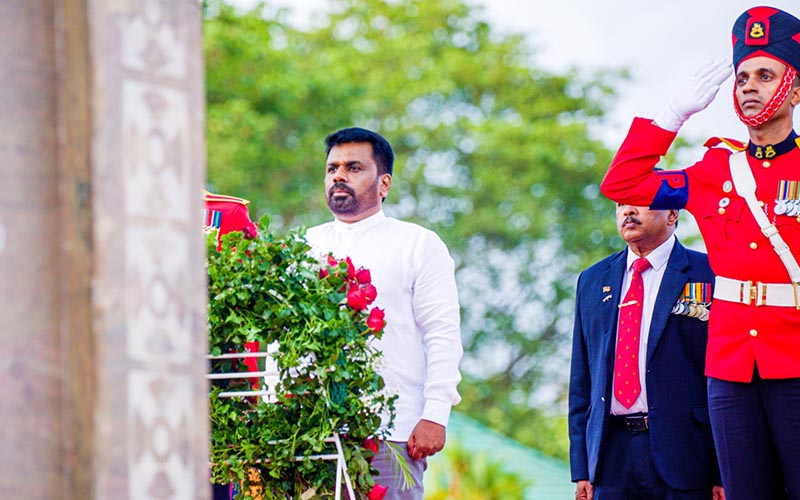
To the parents and wives of our fallen war heroes, I say this; you have made tremendous sacrifices, giving up your children and husbands to bring peace to this homeland. You are remarkable mothers and exceptional wives. What should be the genuine result of that sacrifice? The highest form of justice we can provide for your child, husband, friend or relative is to create enduring peace in this nation.
Standing before this memorial and paying respect is not just an act of remembrance, it is a solemn pledge. A pledge that we will not allow conflict to rise again and that we will build a society of unity, love and brotherhood instead of one filled with hatred and division, said President Anura Kumara Disanayake.
The President made these remarks this afternoon (19), addressing the 16th War Heroes’ Commemoration Ceremony held at the War Heroes’ Memorial in Battaramulla.
The National War Heroes’ Commemoration Ceremony, held to honour the victory that marked the end of a war spanning over three decades, was conducted on Monday(19) afternoon with pride and dignity at the War Heroes’ Memorial in Battaramulla, under the patronage of Commander-in-Chief, President Anura Kumara Disanayake.
Addressing the event, President Disanayake said;
“For decades, our nation endured the horrors of war. This conflict, which inflicted immense suffering on our people and land, was brought to an end years ago. Today, we honour the brave military personnel and officers who sacrificed their lives to achieve this peace. This day holds profound historical significance.
This commemoration is not merely a remembrance of the war’s conclusion but also a pledge to unite all communities, Sinhala, Tamil, Muslim, Burgher and Malay, in building a nation rooted in brotherhood and harmony, rather than allowing divisions to reignite.
Many soldiers sacrificed their lives to bring this war to a conclusion. Their names etched on this memorial stand testament to their sacrifice. Many others were left permanently disabled, while thousands of families still grieve the loss of loved ones. As a nation, we owe them an eternal debt. Their legacy binds us in gratitude and duty.
Yet ‘war’ is synonymous with tragedy and devastation. Those who fought did not seek war for its own sake; they sought peace. Today, we witness the remnants of this devastation, children orphaned, parents bereaved and spouses widowed. Across our land, from North to South, grief knows no ethnicity.
Children who have lost their fathers, parents mourning their children and wives grieving for their husbands continue to live in this homeland, filled with sorrow. I understand that many are looking for their loved ones’ names be it their son’s, husband’s, or child’s among those engraved on the war memorial. We are aware of the deep suffering experienced by our mothers, wives and children. They seek their relatives with a sense of pride, yet are burdened by their grief. This is the reality of war.
War is a tragedy. As a nation that has endured this immense sorrow, it is our duty to ensure that such a conflict does not arise again. We must strive to build a society characterized by peace, unity and compassion, replacing suspicion, anger and hatred with brotherhood and love.
Not only in the South, but also in the North, people hold up photographs of their husbands and children on the streets and mourn their deaths. To every parent, their child is precious. So, as a country that has faced such a massive tragedy, our responsibility today is to prevent such a war from happening again in our country.
Our predecessors endured conflict; ours is a generation still grappling with its residual divisions. But we must resolve to leave our children a nation free from strife, a society anchored not in power struggles but in justice.
What lessons do history, marked by its profound tragedies teaches to us? It serves as a powerful reminder that we must prevent such circumstances from recurring in our nation. The past does not indicate that the next generation should be thrust into another war; rather, it illustrates the possibility of a peaceful existence.
This memorial reminds us that true homage lies in forging unity. Let us vow never to permit division again. Instead, let us build a society where brotherhood triumphs over enmity.
Today, I met soldiers who have spent decades confined to beds, some since 1996 or even 1988. Their tears speak where words fail. We must end this cycle of tragedy. Our duty is to bequeath future generations a united nation, not one fractured by exploitation of ethnic tensions for political gain.
At present it is evident that conflicts, racism and extremism have been strategically exploited at various times to acquire sustain and strengthen power. These issues have not emerged naturally; rather, they have been manipulated to secure authority and to obscure the wrongdoings committed.
There is no justification for the Field Marshal to be incarcerated for over two and a half years. At that time, he and I shared a close relationship. It was power that prevailed, rather than law or justice. History has exploited these conflicts and wars to seize and strengthen power. Our children in both the North and the South have suffered as a result.
The ordinary sons and daughters of mothers and fathers from our villages lost their lives in a war for which there was no legitimate reason, no credible justification and no sincere effort to prevent. That is why we must deeply understand that war is a tragedy. War is destruction. Yet, there are some those repeatedly rejected and defeated who continue to view war as something to be desired, as a thrilling experience. But that is not how society as a whole sees it. Should we continue to be silenced by these loud, aggressive voices? No. All of us must rise together and assert, with one voice, our collective need for peace. Our hearts, our words and our actions must be aligned in support of peace.
Today, Peace is increasingly being portrayed as a sign of betrayal. Reconciliation is being distorted into surrender. But as a progressive society we must raise our voices for more than ever for humanity and compassion. This applies not only within our own country, but across the world. What have the wars and conflicts raging around the globe truly brought us? Victory? No only destruction. That is why I believe we must act with unwavering commitment and clarity in our efforts to achieve lasting peace.
That is why I believe we must work with unwavering resolve for peace. We must dismantle the dangerous narrative that glorifies war the false pleasure drawn from rivers of blood shed to gain or protect power. This glorification must end.
Every soldier, every officer who wears a uniform and holds a weapon in respect of the law hopes that the moment never comes when they have to use that weapon. That is the true prayer of humanism. That should be the collective prayer of our society. Yet, a small group constantly dreams of the moment they might ignite violence with the weapon in their hand. No, our position must be firm, we must build a society where no one ever has the opportunity or justification to raise a weapon against another human being. We must not be afraid to say this clearly.
No one should be subjected to oppression. We must only be bound by truth, by humanity and by compassion. We should never be subjugated to authoritarianism. Therefore, I believe that to transform history into valuable experience, we must become a people who learn lessons from those experiences. We have shed enough blood, so much that our land is soaked with it. We are a nation whose rivers run red with blood, whose tears flow endlessly like great rivers from the eyes of our parents and relatives. We are people who have endured the deepest pains and the most devastating destruction caused by war. If these are our experiences, then we must ensure that such circumstances never arise again in our country.
I have stated before that no one takes up arms for the sake of war itself. Every person who picked up a weapon did so for the sake of peace. We do not fight to wage war, we fight to achieve peace. With that understanding, we know that a long journey still lies ahead of us. The end of the war is only the first step, the next step is to establish lasting peace. Without this, we will only be partial victors, not complete winners. True and full victory can only be achieved by creating peace in this country. Therefore, without fear of obstacles or threats, we must be ready to take every possible step necessary to secure peace.
From every soldier holding a weapon and every officer serving our country, I earnestly ask that you always remain committed to working for the peace of our nation. I urge you to continue being those who strive to establish lasting peace in our country in the future as well. To our parents and wives I say this, your children, your spouses, have dedicated themselves to ending the war on this sacred soil. You are noble mothers and spouses. But what should be the ultimate outcome of their sacrifice? The greatest justice we can achieve for your children, your spouses, your friends, and your relatives is the establishment of peace in this country.
We must build a society where our children will no longer live in fear of war. This is an incredibly difficult task, yet it is one we must successfully accomplish. Although this may not be the ideal moment, I feel compelled to say that in both the North and the South, the flames of ethnic conflict have been rekindled not by any cause other than the struggle for power. The true freedom of our homeland remains elusive; even after ending the war, we have yet to fully secure the complete liberation of our motherland.
What does full freedom of the motherland mean? Even with the current rains, there are regions in the country at risk of flooding and hazards. Can we truly say we are free? Any conflict, no matter how small or where it occurs in the world, affects our nation’s economy and the livelihoods of our people. Are we really free? Today, we are a nation that has lost economic sovereignty. We lack a strong economy that allows us to make independent economic decisions. Therefore, to transform our motherland into a proud nation respected by the world, we must achieve economic transformation.
The supremacy of the rule of law must be firmly established in this country, regardless of any challenges. The world should speak highly of our governance. Our nation must be built as one free from crime and drug menaces. It should be a country without conflict, distrust, or hatred. Only then we can achieve true freedom for our motherland, along with strong and genuine sovereignty. Without this, sovereignty remains merely a phrase on paper, not a reality. We must make this the reality of our motherland.
We both possess an unwavering affection for our motherland. Likewise, we love our people unconditionally. We aspire to transform this land into the most esteemed motherland in the world and to enable its people to enjoy a high standard of living. The essential foundation for this is peace and reconciliation. Therefore, at this critical moment, I firmly believe we must courageously make every possible decision in favour of peace and reconciliation.
The stability, security, spirituality and pride of our fallen heroes who lie ahead of us in this war memorial are all engraved within these walls. We must engrave their spirituality, bravery, courage, and sacrifice into our own lives. Why? to build a more prosperous and peaceful nation. We forever honour in our hearts the heroes who sacrificed their lives to end the war and those who remain permanently disabled because of it. Your dedication, sacrifice, and unwavering courage will become our foundation and inspiration to rebuild this country. For this cause, let us all unite to launch a new struggle a new battle for peace and progress.”

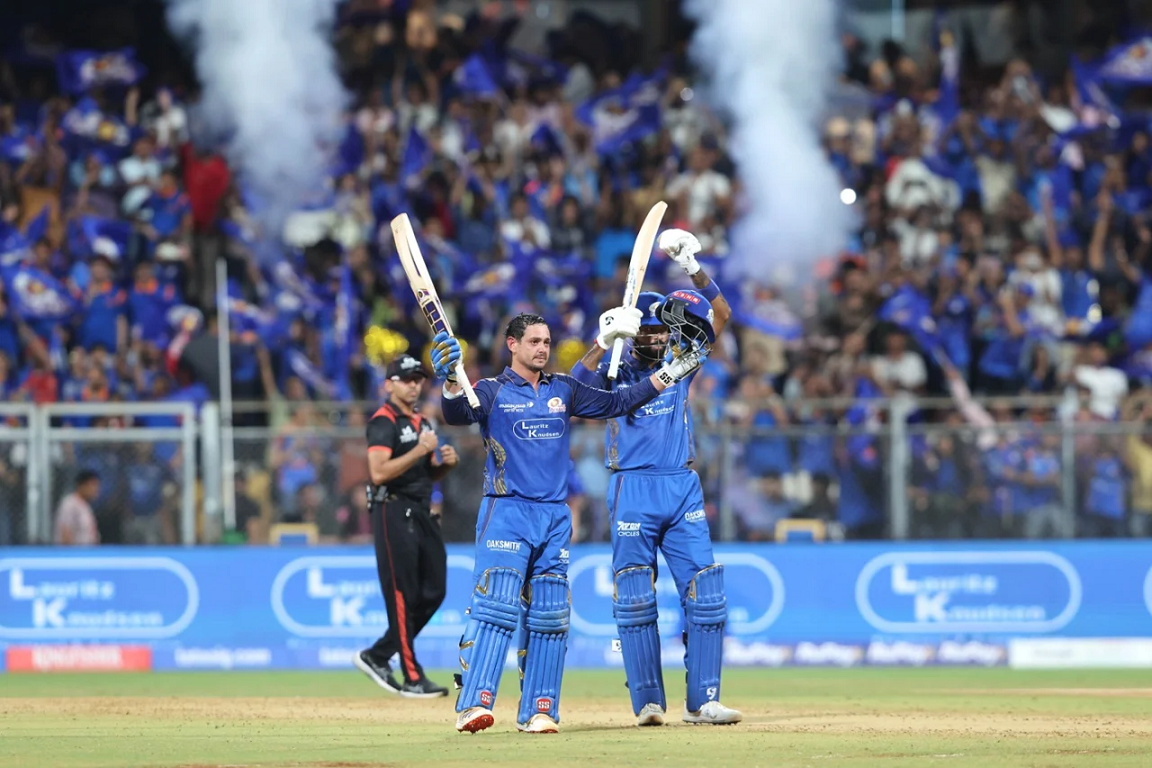
Quinton de Kock’s hundred on his comeback to the Mumbai Indians XI was overshadowed by Prabhsimran Singh and Shreyas Iyer’s demolition of the chase of 196 with 21 balls to spare to keep Punjab Kings unbeaten five games into the season. Arshdeep Singh swung the new ball, reversed the old one, and bowled a quiet over in the middle to lead PBKS’ strangle job on MI, who suffered their fourth successive defeat.
An injury to Rohit Sharma opened the door for de Kock to play his first match of this season and become only the third batter to score a century for three different IPL teams. He scored 112 off 60 balls, Naman Dhir was promoted to No. 4 and scored 50 off 31, but the rest of the MI innings never got going.
Allah Ghazanfar briefly threatened to scupper a typically boisterous PBKS chase with two wickets in the powerplay, but Prabhsimran and Iyer never let MI back in. Like Dhir and de Kock before him, Prabhsimran enjoyed a reprieve on 11, and finished unbeaten 80 off 39 to take his sensational IPL 2026 tally to 211 runs in 122 balls. It was the first time he stayed unbeaten in a successful chase in the IPL.
Iyer scored an equally important 66 off 35, his third consecutive half-century, starting with a four first ball when MI had taken two quick wickets.
Arshdeep came into the match with two wickets and an economy rate of 10.6 in four games this season. Two left-hand openers were the ideal setting for him to improve his performance. The new ball swung in the air and moved off the surface, and Arshdeep kept taking it away from Ryan Rickelton. He beat the bat three times in the first over. In his second, he bowled a wobble-seam ball that ended up on the pads, but Rickelton found deep square leg to perfection.
Arshdeep backed Suryakumar Yadav to walk out expecting movement from left to right, but he angled the seam away, drew a thick edge and doubled his season’s wickets tally in two balls, and also went past 100 IPL wickets.
Even before those two wickets, de Kock signalled dangerous intent with a silken, aerial extra-cover drive first ball off fellow South African Marco Jansen. In Jansen’s next over, Yuzvendra Chahal lost the ball in the lights and missed a sitter from Naman Dhir. In the last over of the powerplay, de Kock gave up on making his ground but Iyer missed the stumps from mid-off.
That drop wasn’t the last error Chahal made. He started his spell by searching and frequently over-pitching and ended up conceding five sixes in his three overs for 45. Dhir hit two of those, the one over extra cover the highlight of his innings.
By the time de Kock got to fifty, MI looked set for a total in excess of 200. From 97 for 2 in 10 overs, de Kock went up a gear even as Dhir caught up with him. At 125 for 2 in 12 overs, PBKS were looking at a challenging target.
The comeback for PBKS began with Jansen conceding just seven in the 13th over, but like in the game against Sunrisers Hyderabad, the lack of pace from Shashank Singh once again produced a game-changing wicket. In his 31-ball 50, Dhir evoked a lot of Hardik Pandya with a compact bat swing and shots that looked quite like the MI captain’s. Pandya himself, though, hardly got anything out of the middle of the bat. He eventually fell for 14 off 12 to what could well end up as the catch of the tournament.
Iyer didn’t even get his name on the scoreboard for this effort at long on: he went full length as he leaped to rein the ball in, caught it in his left hand while airborne, transferred it to his right even as he came down over the boundary, and managed to throw it to Xavier Bartlett before he touched ground.
With the ball reversing, Jansen and Arshdeep bowled excellent yorkers, going for eight and nine in overs 18 and 19. Sherfane Rutherford got four tailing pinpoint yorkers during his five-ball stay for one run. Only 70 came in the last eight, prompting Dhir to say during the innings break that MI were 20 runs short.
The way Priyansh Arya and Prabhsimran tucked into some buffet bowling from Deepak Chahar, it looked like 195 was not 20 short but 40. However, led by Jasprit Bumrah who bowled four straight dots to Arya, Ghazanfar ended up with two wickets in the powerplay: Arya caught at midwicket and Cooper Connolly caught behind.
There was a time when MI had strung together 10 balls for one run and a wicket across the second and third overs of the chase. Prabhsimran cut the 11th for a regulation catch to backward point but Bumrah, wicketless in six straight IPL matches now, dropped it.
When Connolly fell, MI were still hopeful of a comeback. Iyer, though, brought a sense of calm, playing Ghazanfar’s mystery spin like you would offspin. He cover-drove the first ball he faced for four, and PBKS never looked back.
Prabhsimran faced just six balls in the first five overs, which means he did most of the damage with the field spread out. It started when Chahar came back to bowl the eighth over. Prabhsimran charged at him to hit a 90-metre six over wide long-off before tucking one off the hip for four.
Now Prabhsimran began to dominate the strike and the scoring, bringing up his fifty with successive fours off Shardul Thakur in just 23 balls.
Bumrah might be wicketless but his bowling has been good through the season. However, when Iyer pulled him for a disdainful six in the 13th over, it was all over for MI. If there were any doubts remaining with 50 needed off the last seven overs, Prabhsimran dispelled them with a four and a six off Pandya. The end was swift and brutal with even Bumrah finishing with 0 for 41 in his four overs.
Brief scores:
Punjab Kings 198 for 3 in 16.3 overs (Priyansh Arya 15, Prabhsimran 80*, Cooper Connolly 17, Shreyas Iyer 66, Marcus Stoinis 10*; AM Ghazanfar 2-31, Shardul Thakur 1-42 ) beat Mumbai Indians 195 for 6 in 20 overs (Quinton De Kock 112*, Naman Dhir 50, Hardik Pandya 14; Arshdeep Singh 3-22, Marco Jansen 1-30, Shahshank Singh 1-19) by seven wickets
[Cricinfo]
Latest News
Heat Index at Caution Level in the Northern, North-central, North-western, Western, Sabaragamuwa, Eastern and Southern provinces and in Monaragala district
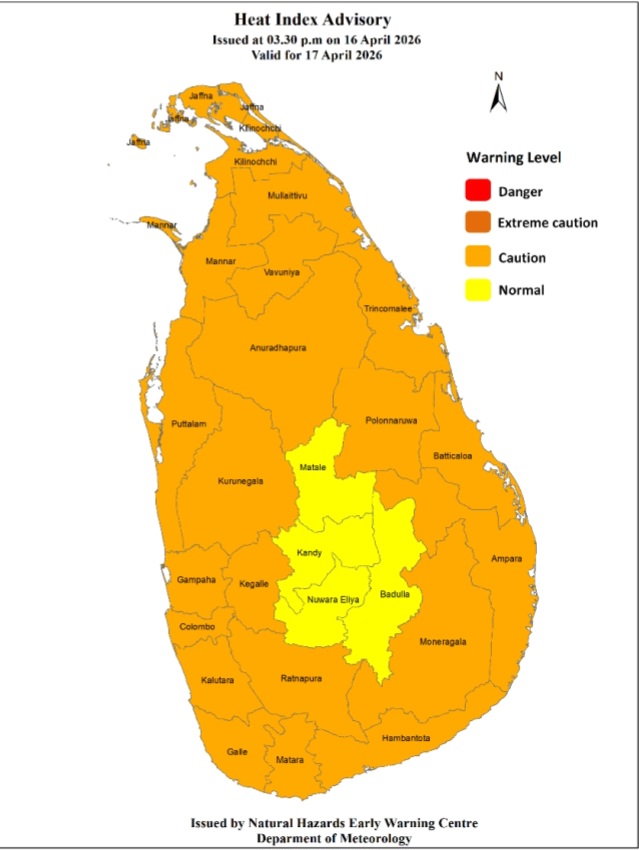
Warm Weather Advisory
Issued by the Natural Hazards Early Warning Centre
Issued at 3.30 p.m. on 16 April 2026, valid for 17 April 2026.
The Heat index, the temperature felt on human body is likely to increase up to ‘Caution level’ at some places in the Northern, North-central, North-western, Western, Sabaragamuwa, Eastern
and Southern provinces and in Monaragala district.
The Heat Index Forecast is calculated by using relative humidity and maximum temperature and this is the condition that is felt on your body. This is not the forecast of maximum temperature. It is generated by the Department of Meteorology for the next day period and prepared by using global numerical weather prediction model data.

Effect of the heat index on human body is mentioned in the above table and it is prepared on the advice of the Ministry of Health and Indigenous Medical Services.
ACTION REQUIRED
Job sites: Stay hydrated and takes breaks in the shade as often as possible.
Indoors: Check up on the elderly and the sick.
Vehicles: Never leave children unattended.
Outdoors: Limit strenuous outdoor activities, find shade and stay hydrated.
Dress: Wear lightweight and white or light-colored clothing.
Note:
In addition, please refer to advisories issued by the Disaster Preparedness & Response Division, Ministry of Health in this regard as well. For further clarifications please contact 011-7446491.

“Auditor General’s reports a matter for Legislature not the Executive”
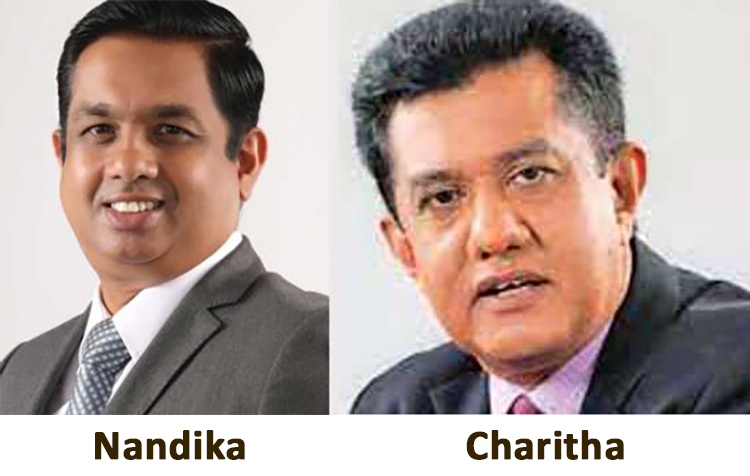
Former Chairman of the Committee on Public Enterprises (COPE) Charitha Herath has said it is the COPE, and not the Secretary to the President, that should have asked the CID to probe irregularities in the procurement of coal for the Lakvijaya power plant.
Dr. Nandika Sanath Kumanayake, who is the Secretary to the President, lodged a complaint with the CID last week seeking an investigation into coal procurement.
No previous Secretary to a President had done so, the former parliamentarian and the Samagi Jana Balawegaya (SJB) Working Committee member said. Herath said so responding to The Island query regarding Kumanayake calling for a probe into coal procurement, since 2009, following the National Audit Office (NAO) report on the controversial procurement process for the 2025/2-26 period.
Herath emphasised that COPE, taking into consideration the growing discontent over coal procurement, especially after the NAO exposed serious irregularities, should have initiated action. Herath cited the National System Operator’s (NSO) seeking an additional electricity tariff increase of 15%, in addition to 10% increase announced on 01 April, for the second quarter, to cover-up Rs 16 bn deficit in power generation, as a matter of grave concern. NSO has cited the prevailing dry weather, the continuing crisis in West Asia, and the low-grade coal that had been procured as primary reasons for the unanticipated shortfall in electricity generation.
Herath said that as the Secretary to the Ministry concerned was the Chief Accounting Officer, the actions of the Secretary to the President caused a technical issue. Prof. Udayanga Hemapala, now under a cloud over the violation of procurement procedures, as confirmed by the NAO, is the Secretary to the Energy Ministry. Herath emphasised the importance of the procedure adopted in appointing a Secretary to a Ministry. “President issues one letter making the appointment. Secretary to the Finance Ministry issues a second letter underscoring the responsibilities of a Ministry Secretary as the Chief Accounting Officer of a particular Ministry,” Herath said.
The second letter emphasised the accountability on the part of the Ministry Secretary regarding public finance and his direct answerability to Parliament.
The ex-COPE Chief pointed out that the Secretary to the President was part of the executive. He was not part of the legislature. If there had been a directive from COPE, that should have been issued to the Secretary to the Energy Ministry, Herath said, emphasising the entire process had to be led by the legislature not the executive. In this instance to make matters worse the finger is also pointed at the executive for being part of the alleged cover up.
The Auditor General, who heads the NAO, is answerable to Parliament, Herath said, pointing out that the AG never sent reports to the Secretary to the President, who, too, comes under the purview of the NAO. The intervention made by the Secretary to the President could set a very bad precedent and it was unfortunate that the NPP, having campaigned on an anti-corruption platform at national elections in 2024 was now struggling to cope up with the major post-Aragalaya coal scandal.
The NAO undertook the examination of the 2025/2-26 coal procurement on a request made by Dr. Nishantha Samaraweera, Galle District lawmaker, representing the ruling NPP.
Lakvijaya, the country’s sole coal power plant, situated at Norochcholai, requires approximately 2.25 mt million annually and is credited with generating 30% to 40% of the overall national electricity requirement.
According to the NAO report, the Energy Ministry had awarded the term tender for the supply of coal to India’s Trident Chemphar Ltd., though it wasn’t properly registered. The NAO also pointed out the failure on the part of the supplier to follow proper procedure in respect of loading and unloading at respective ports.
Herath said that intentionally, or inadvertently, the NPP had erred in handling the investigation. He said after receiving the NAO’s report, COPE could have averted unnecessary controversy by following the laid down procedures. The COPE Chairman could direct the Energy Secretary to inquire into the coal procurement within seven days and submit a report to Parliament. In addition, if there had been any wrongdoing on the part of officials, relevant documents/files should be sent to the CIABOC or the CID.
The COPE, in consultation with the Speaker, could also take up in Parliament as an urgent/emergency issue at the onset of the proceedings, Herath said, adding that an interim report could be presented. On the basis of that report, in terms of the Standing Orders the Parliament could immediately decide to send it to the CID.
In addition to the above mentioned procedures, the COPE could on its own initiate a fresh inquiry and submit a report to Parliament and the country, Herath said. Pointing out that the coal company comes under the purview of the executive and not the legislature, Herath said that actions of the executive could be investigated. Herath explained how the British and the US responded to such situations. Unfortunately, here in Sri Lanka apparently the COPE was being used to clear the Minister concerned while holding the officials responsible for the coal scandal.
In the wake of the NAO report signed by Auditor General Samudrika Jayarathne, the defeat of the no-confidence motion moved against Energy Minister Kumara Jayakody couldn’t be considered a victory for the government, the ex-MP said. In fact, the coal scam has challenged the NPP’s much propagated anti-corruption stance, Herath said, adding that the issue couldn’t be examined without discussing the Energy Minister being indicted over corruption by the Colombo High Court recently.
By Shamindra Ferdinando

No date set for US-Iran talks, as Pakistan pushes to keep diplomacy alive

Arshdeep and Prabhsimran star as Punjab Kings hammer Mumbai Indians

Showers expected in the Western, Sabaragamuwa, Southern and Uva provinces and in Kandy and Nuwara-Eliya districts after 1.00 pm

Israel and Lebanon agree 10-day ceasefire, Trump says

Heat Index at Caution Level in the Northern, North-central, North-western, Western, Sabaragamuwa, Eastern and Southern provinces and in Monaragala district

Ex-COPE head questions Prez Secy’s intervention in coal scam probe

‘Dates have the highest sugar content to fight Coronavirus’

Sunday Island 27 December – Headlines

#SundayIsland 17th December – Headlines

Sunday Island – 28th March

Sunday Island Headlines – 21 March

Sunday Island – 21st February – Headlines
-

 News5 days ago
CEB orders temporary shutdown of large rooftop solar systems
-
 Features5 days ago
From Royal College Platoon to National Cadet Corps: 145 years of discipline, leadership, and modern challenges
-
 Latest News4 days ago
PNS TAIMUR & ASLAT arrive in Colombo
-

 News6 days ago
Anura Solomons passes away
-

 Features5 days ago
CIA’s hidden weapon in Iran
-
 Latest News4 days ago
Prasidh, Buttler set up comfortable win for Gujarat Titans
-

 Business6 days ago
SL’s economic outlook for 2026 being shaped by M-E conflict
-

 Latest News5 days ago
Heat index likely to increase up to ‘Caution level’ at some places in the Northern, North-central, North-western, Western, Sabaragamuwa, Southern and Eastern provinces and Monaragala district