
Sports
Wasim Akram reveals he was addicted to cocaine after playing career ended


Wasim Akram has opened up on his struggle with a cocaine addiction after his playing career ended, in his upcoming autobiography Sultan: A Memoir.Akram, Pakistan’s leading wicket-taker in both Test and ODI cricket, retired in 2003 after an 18-year international career, but continued to travel the world on commentary and coaching assignments. The cocaine habit, he says, began after he retired, when he started to crave a “a substitute for the adrenaline rush of competition”, and ended after the death of his first wife Huma in 2009.
Extracts from his book, published alongside an interview in The Times, paint a frank picture of Akram’s slide into addiction.
“I liked to indulge myself; I liked to party,” he writes. “The culture of fame in south Asia is all consuming, seductive and corrupting. You can go to ten parties a night, and some do. And it took its toll on me. My devices turned into vices.
“Worst of all, I developed a dependence on cocaine. It started innocuously enough when I was offered a line at a party in England; my use grew steadily more serious, to the point that I felt I needed it to function.
“It made me volatile. It made me deceptive. Huma, I know, was often lonely in this time . . . she would talk of her desire to move to Karachi, to be nearer her parents and siblings. I was reluctant. Why? Partly because I liked going to Karachi on my own, pretending it was work when it was actually about partying, often for days at a time.
“Huma eventually found me out, discovering a packet of cocaine in my wallet . . . ‘You need help.’ I agreed. It was getting out of hand. I couldn’t control it. One line would become two, two would become four; four would become a gram, a gram would become two. I could not sleep. I could not eat. I grew inattentive to my diabetes, which caused me headaches and mood swings. Like a lot of addicts, part of me welcomed discovery: the secrecy had been exhausting.”
Akram went into rehab, finding the experience distressing – “The doctor was a complete con man, who worked primarily on manipulating families rather than treating patients, on separating relatives from money rather than users from drugs” – and ended up relapsing.
“Try as I might, part of me was still smouldering inside about the indignity of what I’d been put through. My pride was hurt, and the lure of my lifestyle remained. I briefly contemplated divorce. I settled for heading to the 2009 ICC Champions Trophy where, out from under Huma’s daily scrutiny, I started using again.”
Akram says the cocaine use ended after Huma’s death in October 2009 from the rare fungal infection mucormycosis.
“Huma’s last selfless, unconscious act was curing me of my drug problem. That way of life was over, and I have never looked back.”
Akram has since remarried, and has three children – two sons from his first marriage and a daughter from his second. In his interview with The Times, he said he had written his book for his children.
“I’m a bit anxious about the book,” he said, “but I think once it is out, I’ll be kind of over it. I’m anxious because at my age, I’m 56 and I’ve been diabetic for 25 years, it is just stress, you know . . . it was tough to revisit all the things. I’ve done it for my two boys, who are 25 and 21, and my seven-year-old daughter, just to put my side of the story.” (ESPN)






St. John’s College, Jaffna were just four wickets away from victory at stumps on day two of the Battle of Jaffna Big Match at the Central College Groud Jaffna on Friday.
St. John’s restricted their arch rivals to 120 for six wickets after a valuable century by Uthayanan Abijoyshanth helped them post 247 runs.
Uthayanan’s century was the highlight on the second day as he almost singlehandedly guided the destiny of the visiting team.
He faced just 105 balls for his 121 as he struck 15 fours and four sixes in his knock before being given lbw to Murali Thison who took seven wickets.
Thison completed a match bag of 12 wickets with his big haul of wickets in the second innings.
While Central were largely depending on Thison for wickets in both innings, St. John’s were sharing bowling honours.
Despite having in their ranks Sri Lanka Under 19 paceman Kugathas Mathulan, St. John’s saw Ganeshamoothy Kowsikan (5/41) and Murfin Randyo (3/19) sharing bowling honours in the first inning.
Mathulan took his first wicket of the match in the afternoon on Friday.


Sri Lanka Cricket (SLC) has appointed former Australian cricketer Jamie Siddons as the new head coach of the the women’s team. Siddons, a Level 3 qualified coach, will officially begin his one-year tenure on March 16, 2026.
Siddons takes over from outgoing coach Rumesh Ratnayake, who had quietly concluded his tenure at the end of 2025. And he will be building on some solid foundations.
Appointed in February 2023, Ratnayake oversaw the transformation of the women’s team from bottom-of-the-table scrappers to a regularly competitive force.
While they remain a notch below top tier sides such as Australia and India in terms of consistency, under his guidance, Sri Lanka secured their best-ever return – a historic Asia Cup title in 2024, defeating India in the final.
The inconsistency of the side however was on display throughout his term, as the team struggled at the 2024 T20 World Cup, exiting in the group stage without a win. And despite other highs, including series wins against South Africa and England, the side seemed to have plateaud following a middling home 50-over home World Cup in October.
Siddons however will be taking over a youthful side in the midst of a good run of form, with them this month completing ODI and T20I series wins against West Indies.
His immediate focus will be preparing the squad for the Women’s T20 World Cup set to be held in England this June. His first official assignment is a tour of Bangladesh in April-May.
He brings over two decades of high-level coaching experience to the role, most notably serving as the head coach of the Bangladesh men’s side from 2007-2011, where he lead them to their first overseas Test series win against West Indies.
“Siddons has also served as Head Coach of the South Australia Cricket Team (Redbacks) from 2015 to 2020 and Head Coach of the Wellington Firebirds, New Zealand, from 2011 to 2015,” added an SLC media release.
In his playing career Siddons was a prolific run-scorer in Australian domestic cricket, captaining both South Australia and Victoria, finishing his career with over 10,000 Sheffield Shield runs.
(Cricinfo)
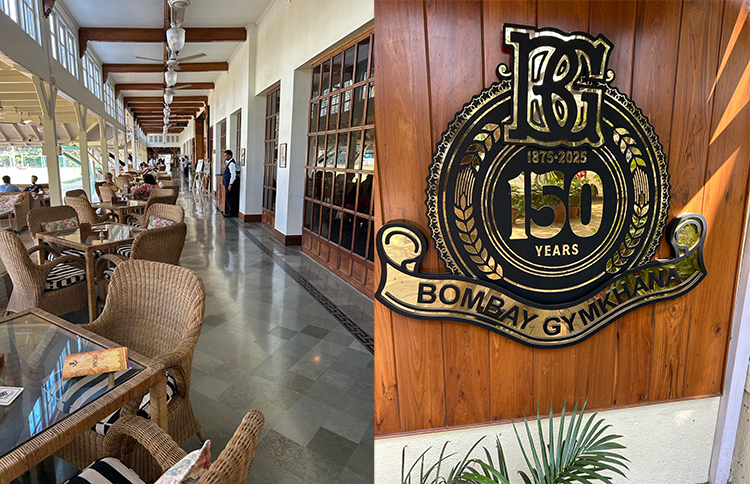
Bombay cannot quite match Colombo when it comes to Test venues. Colombo boasts four Test grounds, while Bombay has three. India’s first ever Test match in 1933 was staged at the historic Bombay Gymkhana, but international cricket soon shifted down the road to the Cricket Club of India, a stone’s throw away, before finally settling along the sweeping Marine Drive at the Wankhede Stadium, which now hosts all men’s international fixtures. Gymkhana and the CCI, meanwhile, play host largely to women’s internationals and domestic cricket.
All three venues are top-notch facilities and there is plenty Sri Lankan clubs could learn from these Indian institutions. Our clubs carry rich traditions and colourful histories, but when it comes to member comfort and modern amenities, there is room to raise the bar.
Bombay Gymkhana, established in 1875, celebrated its 150th anniversary last year and the ground is steeped in history. In its early days it was a club reserved strictly for Europeans, with locals permitted only as workers. That rule had to be bent for India’s inaugural Test in 1933 so that Indian cricketers could walk through its gates. The policy was finally scrapped in 1947 following India’s independence.
Today, membership at the Gymkhana does not come cheap. The entry fee is eye-watering, and corporate entities rather than individuals are the ones who can comfortably afford it.
The club offers a smorgasbord of sporting activities, cricket and rugby among them, although India has yet to make serious strides in the latter. Indoor pursuits such as badminton and table tennis are also available, while those who prefer a quieter afternoon can retreat to rooms dedicated to card games. The billiards and snooker room, immaculately maintained with more than a dozen tables, remains one of the club’s prized attractions. There was a time when Sri Lanka’s own M.J.M. Lafir held court here, the cynosure of all eyes with cue in hand.
For book lovers there is a splendid library and for those who fancy forty winks there is even a siesta room. Several bars and coffee shops dot the premises, while a mini-supermarket caters to members’ daily needs. A well-stocked wine store sells both local and foreign beer and spirits at reasonable prices.
The food, of course, is a feast for the senses, an impressive spread of vegetarian and non-vegetarian dishes that would make even the most seasoned diner loosen the belt a notch.
It is remarkable that such facilities exist right in the heart of the city. That people had the foresight a century and a half ago to set aside acres of prime land purely for recreation speaks volumes of the wisdom of those who were calling the shots.
Bombay as a city too has come on in leaps and bounds over the last two decades. New highways have sprung up, including one that cuts across the sea. An underground tunnel emerges just a stone’s throw away from Wankhede Stadium, easing what was once nightmarish traffic. The metro network now connects most key parts of the city and continues to expand.
For a metropolis that never stops moving, Bombay’s infrastructure push deserves a tip of the cap.
Rex Clementine in Bombay

Dry weather will prevail over the island.

Prompt solutions will be provided for the salary anomalies prevailing within the teacher and principal services — PM

Zelenskyy visits front line as Ukraine and Russia swap 500 prisoners each

UNP concerned about govt.’s silence over US sub sinking Iranian warship in Lanka’s EEZ

Govt. warns of possible adverse developments in the next few weeks due to Gulf conflict

Human rights court orders reparations for forced sterilization case in Peru

‘Dates have the highest sugar content to fight Coronavirus’

Sunday Island 27 December – Headlines

#SundayIsland 17th December – Headlines

Sunday Island – 28th March

Sunday Island Headlines – 21 March

Sunday Island – 21st February – Headlines
-

 Features5 days ago
Brilliant Navy officer no more
-

 Opinion5 days ago
Sri Lanka – world’s worst facilities for cricket fans
-

 News2 days ago
Legal experts decry move to demolish STC dining hall
-

 Features5 days ago
A life in colour and song: Rajika Gamage’s new bird guide captures Sri Lanka’s avian soul
-

 Business2 days ago
Cabinet nod for the removal of Cess tax imposed on imported good
-
 Features6 days ago
Overseas visits to drum up foreign assistance for Sri Lanka
-
 Features6 days ago
Sri Lanka to Host First-Ever World Congress on Snakes in Landmark Scientific Milestone
-

 Latest News2 days ago
Around 140 people missing after Iranian navy ship sinks off coast of Sri Lanka