
Latest News
Verreynne’s brisk 105* gives South Africa 358; Sri Lanka openers steady in pursuit

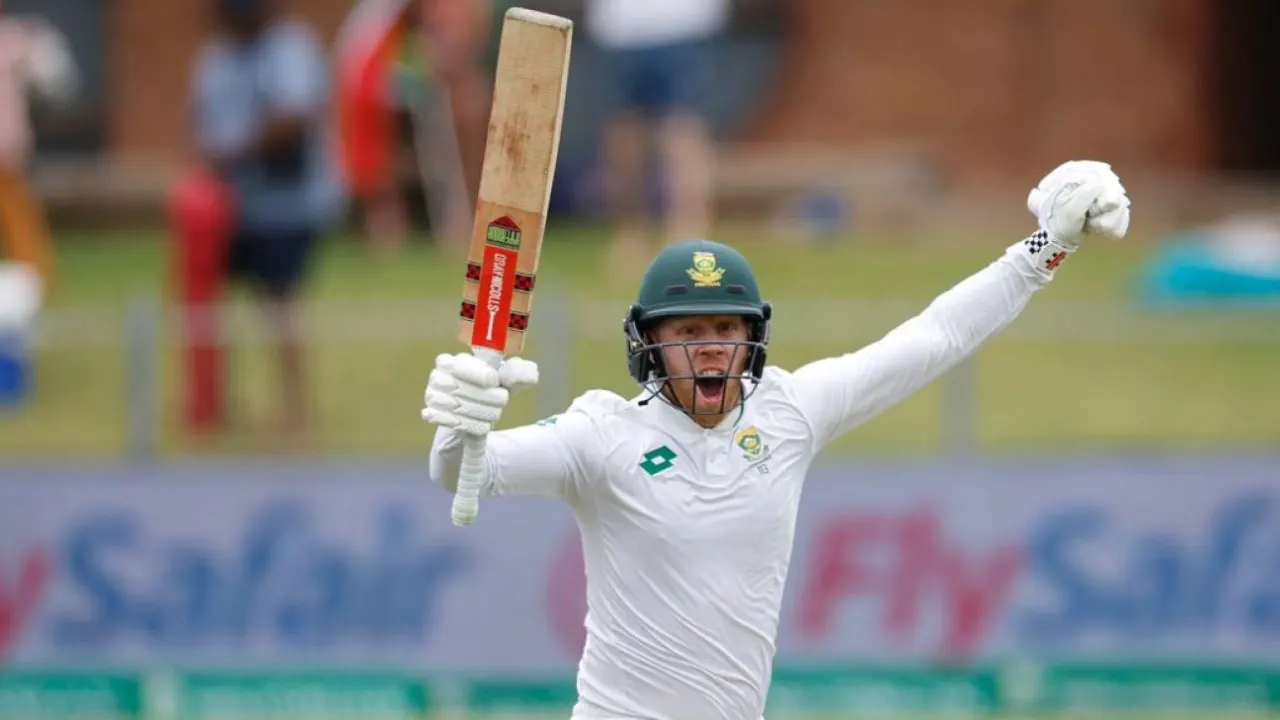
Kyle Verrevnne clobbered bouncer after bouncer after bouncer, crashing six fours and three sixes, on his way to a dynamic third Test century, as South Africa reaped 89 runs for the loss of their last three wickets. En route to that ton, Verreynne forged a 66-run stand with Kagiso Rabada, a period in which his confidence ballooned, just as Sri Lanka were left utterly frustrated, their short-ball plans going awry.
In the end, South Africa motored to a total of 358. Rabada contributed 23 of those runs, and Dane Paterson 9. Verreynne, meanwhile, bludgeoned 57 runs off the 50 balls he faced on the second morning, and remained not out on 105 off 133 balls by innings end.
Sri Lanka’s frontline seamers each took a wicket on day two, with Vishwa Fernando having Keshav Maharaj caught at slip, before Asitha Fernando ended Rabada’s innings, and Lahiru Kumara had Paterson holing out. Kumara claimed the innings’ best figures, taking 4 for 79.
After they had dismissed South Africa, Sri Lanka’s openers had six overs to face before lunch. They were tested by Rabada and Marco Jansen’s zip off the pitch, and the bounce both bowlers generated, with both Dimuth Karunaratne and Pathum Nissanka drawn into playing (and missing) balls in the channel. But they survived this period, with Karunaratne finding one boundary behind square on the off side.
It was a triple-boundary over against Asitha that really got Verreynne’s engine roaring. This being the 99th over of the innings, Sri Lanka had long since decided that the second new ball had stopped swinging, and turned almost solely to bouncers and short deliveries to blast the final two wickets out. They had a deep square leg and a deep midwicket out for Verreynne, but he set himself up for the bouncer by changing his stance to a slightly front-on one, and kept thumping the ball past the deep fielders.
Rabada, who had been shielded from the strike in most overs, but had nevertheless faced more than 30 deliveries now, chipped in with boundaries of his own, some of them fortuitous ones off the edge.
Rabada would soon be bowled by Asitha, going at the stumps for a change. With the No. 11 in, and still on 81, Verreynne yanked the throttle with even more intensity, first smashing Prabath Jayasuriya over cow corner for six, before mowing Asitha Fernando into the banks to get within one strike of a 100, before reaching triple figures with another mighty pull, which sent the ball sailing over fine leg’s head.
The milestone sparked wild celebrations, a bow from Verreynne to the dressing room, and a bear-hug from Paterson. Verreynne himself likely did not anticipate that a century would be on the cards when he began the morning on 48, with seven wickets already down.
Paterson would smack two fours and get out next over. But South Africa had inflicted substantial damage in the 17.1 overs they faced on day two.
Brief scores:[at lunch]
Sri Lanka 19 for no loss (Dimuth Karunaratne 5*, Pathum Nissanka 2*) trail South Africa 358 (Kyle Verreynne 105*, Ryan Rickelton 101, Temba Bavuma 78; Lahiru Kumara 4-79, Vishwa Fernando 2-65, Asitha Fernando 3-102 ) by 339 runs
[Cricinfo]

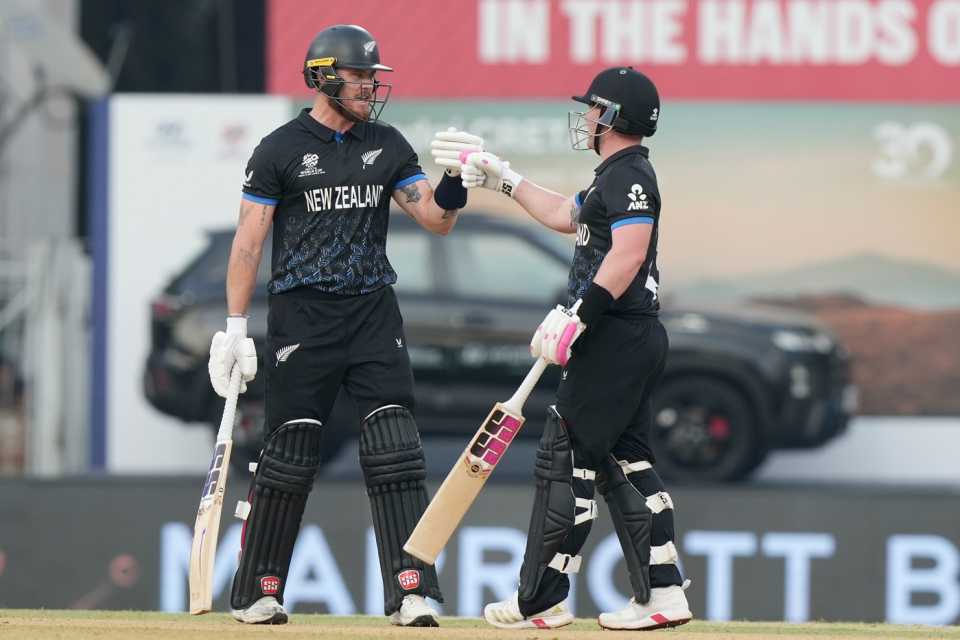
There was the odd hiccup or two. Glenn Phillips bowling the 18th over and giving up 27 runs. James Neesham turning a leg bye into an all-run four with an overthrow. But in the end, New Zealand wrapped up the win that was expected of them against UAE – with all ten wickets and 27 balls to spare – and look in good shape to make the Super Eights.
Finn Allen and Tim Seifert knocked off the entire target of 174 by themselves. In the course of doing that, they recorded the highest partnership for any wicket, by any side, in the T20 World Cup.
An even-paced pitch and its location on the square – making one side of the ground smaller than the other – resulted in the batters really enjoying themselves.
Muhammad Waseem and Alishan Sharafu are the most accomplished players in the UAE line-up and they stepped up – together – to put on a 107-run partnership. It is their second highest for the second wicket in T20Is.
The logic behind their strokeplay really stood out. Sharafu (55 off 47) backed away against Mitchell Santner and carved him over cover point for four. That shot was about getting the odds in his favour – hitting with the turn and to the short boundary. Waseem (66 off 45) backed his upper cut off Matt Henry’s slower bouncer because short third was inside the circle. It was high-percentage cricket in a high-pressure situation.ll
New Zealand’s bowlers had a really tough time against India in the bilateral series leading up to this World Cup. Huffing and puffing against UAE, who had crumbled to 81 all out in a warm-up game in Chennai against Italy, isn’t the kind of confidence boost they’re in need of
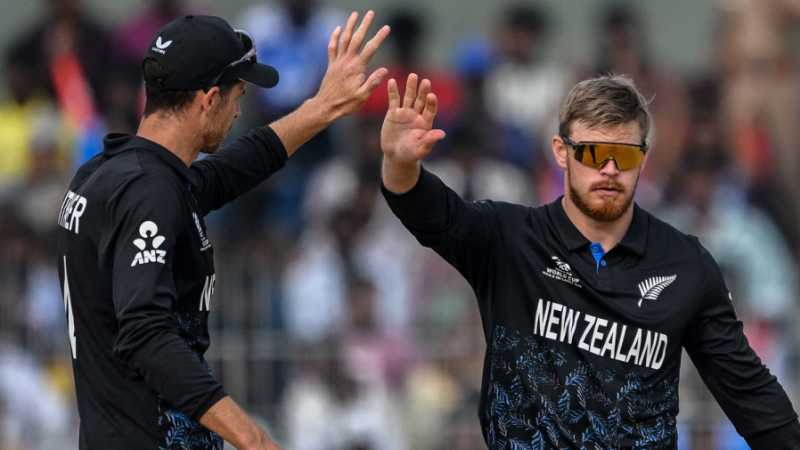
Phillips bowling in the death was odd. The four overs leading up to it had brought only 17 runs and two wickets. This one over alone yielded 27, including a wide, a no-ball four and a free-hit six. All while frontline quick Jacob Duffy had two overs left.
Alle and Seifert knocked off almost half the target in the powerplay itself. The 78 runs they put on together included nine fours and four sixes, which amount to a balls per boundary ratio of 2.77. This is a strength Santner had alluded to in the pre-match press conference ahead of the Afghanistan game, and it came good to take New Zealand to a 2-0 record in the group of death.
Allen showed game awareness when he played out UAE’s pinpoint accurate spin bowler, Haider Ali, and took down their quicks with ease instead. He had tried to do too much against Mujeeb Ur Rahman and lost his stumps during their previous match against Afghanistan. Here, even when Haider tempted him with mid-off up, he held back his big shots.
Seifert backed up his 39-ball fifty on Sunday with a 23-ball fifty today, continuing his path to becoming a high-volume batter instead of his previous version, where he was a high-variance batter. He didn’t have any trouble taking on Haider as the game neared its conclusion, reverse-hitting him for a six and then a four. New Zealand’s bash brothers were in full flow so the chase didn’t last beyond the 16th over.
Brief scores:
New Zealand 175 for 0 in 15.2 overs (Tim Seifert 89*, Finn Allen 84*) beat United Arab Emirates 173 for 6 in 20 overs (Mohamed Waseem 66, Alishan Sharafu 55, Mayanak Kumar 21; Matt Henry 2-37, Jacob Duffy 1-16, Lockie Ferguson 1-35, Mitchell Santner 1-23, Glenn Phillips 1-30) by ten wickets
(Cricinfo)

Sri Lanka allrounder Wanidu Hasaranga has been ruled out of the 2026 T20 World Cup with a hamstring injury he suffered during their opening game aga8nst Ireland in Colombo on Sunday.
Although he completed his spell, taking 3 for 25 in four overs to derail Ireland’s spirited chase of 164, Hasaranga had an MRI scan on Monday that revealed a serious tear in his left hamstring. The report was seen by a specialist in the UK before he was ruled out on Tuesday.
The tear is understood to be related to a previous hamstring injury, though it is not a recurrence exactly. Hasaranga has battled injury for several years now, including a foot complaint
The ICC is yet to approve a replacement but Hasaranga is likely to be replaced in the squad by fellow legspin-bowling allrounder Dushan Hemantha. Although Hemantha, 31, brings roughly the same skillset, he has had only sporadic opportunities at the top level. He has played three T20Is, and has taken four wickets in those matches, with an economy rate of 7.85. Sri Lanka may also drop him straight into the XI – aside from the spinners who played on Sunday, there are no spinners in reserve in the squad.
Hasaranga’s loss is a substantial blow to Sri Lanka’s campaign nevertheless. He is the team’s most accomplished bowler in this format, and has been outstanding with the ball at T20 World Cups, taking 40 wickets and maintaining an economy rate of 6.01 across 20 innings.
Sri Lanka’s second group game is against Oman on February 12 in Pallekele, followed by Australia on February 16 in Pallekele, and finally Zimbabwe in Colombo (RPS) on February 19.
(Cricinfo)
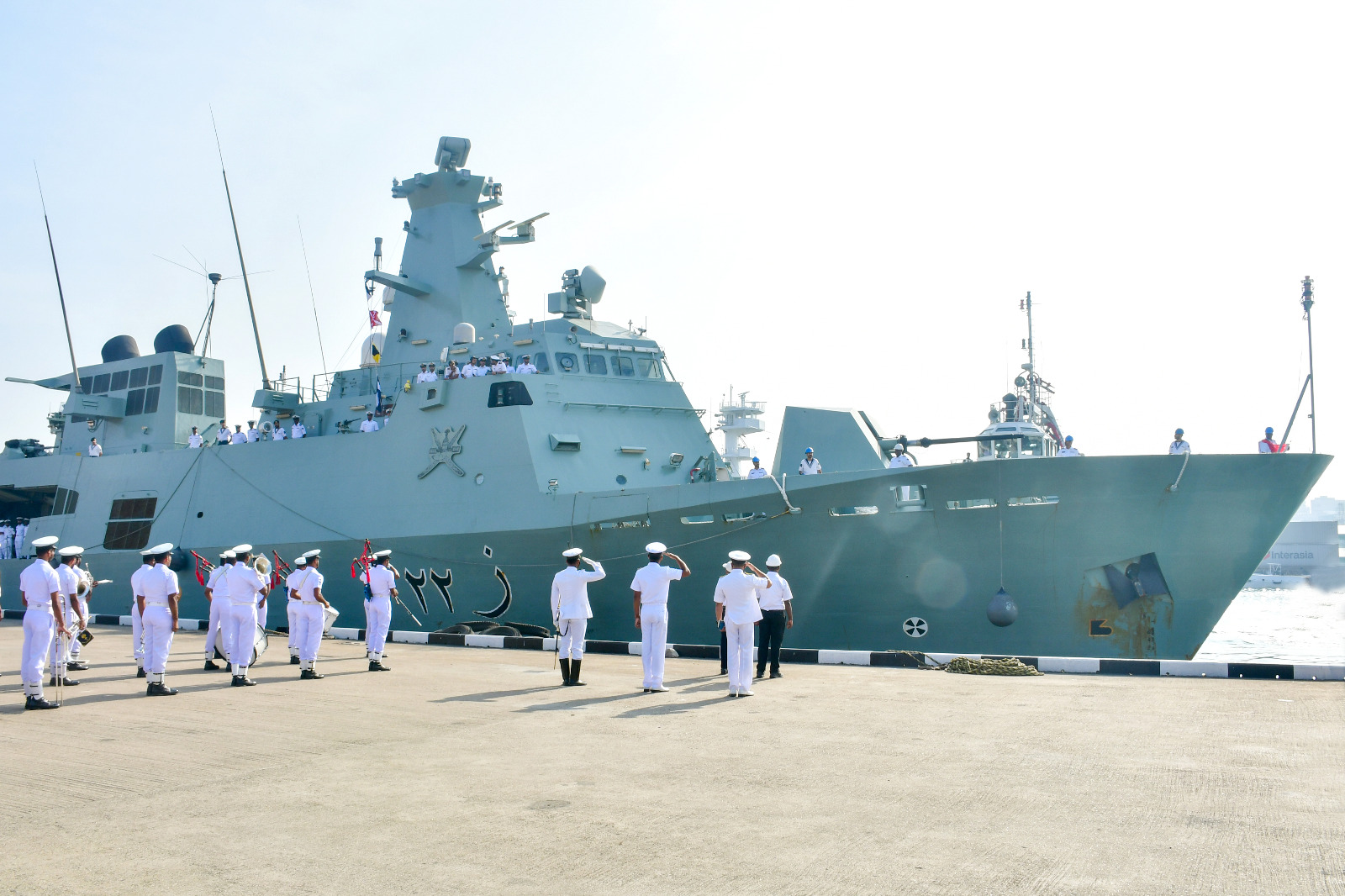
The Royal Navy of Oman Vessel “SADH” arrived at the Port of Colombo on a logistics replenishment visit on Tuesday (10 Feb 26). The Sri Lanka Navy welcomed the visiting ship in
compliance with naval traditions.
The 75m – long ship is commanded by Lieutenant Commander Shaheen Saud Abdul Rahman AI Balushi.
The port call will facilitate professional interaction and goodwill exchanges between the two navies.
During the stay in Colombo, crew members of the ship are expected to visit some tourist attractions in the city of Colombo.

Seifert, Allen fifties help New Zealand gallop to record-breaking win against UAE
All-round de Leede leads Netherlands to thumping win over Namibia

Wanindu Hasaranga ruled out of T20 World Cup with injury

Royal Navy of Oman Vessel “SADH” arrives at Port of Colombo

Spirited USA seek Pakistan scalp after opening day heartbreak

New Zealand brace for unfamiliar opponents UAE

‘Dates have the highest sugar content to fight Coronavirus’

Sunday Island 27 December – Headlines

#SundayIsland 17th December – Headlines

Sunday Island – 28th March

Sunday Island Headlines – 21 March

Sunday Island – 21st February – Headlines
-

 Features3 days ago
My experience in turning around the Merchant Bank of Sri Lanka (MBSL) – Episode 3
-

 Business4 days ago
Zone24x7 enters 2026 with strong momentum, reinforcing its role as an enterprise AI and automation partner
-

 Business3 days ago
Remotely conducted Business Forum in Paris attracts reputed French companies
-
 Business3 days ago
Four runs, a thousand dreams: How a small-town school bowled its way into the record books
-

 Business3 days ago
ComBank and Hayleys Mobility redefine sustainable mobility with flexible leasing solutions
-

 Business4 days ago
HNB recognized among Top 10 Best Employers of 2025 at the EFC National Best Employer Awards
-

 Business4 days ago
GREAT 2025–2030: Sri Lanka’s Green ambition meets a grid reality check
-

 Editorial6 days ago
All’s not well that ends well?