
Latest News
Vastrakar’s career-best four-for leads India to Asian Games final

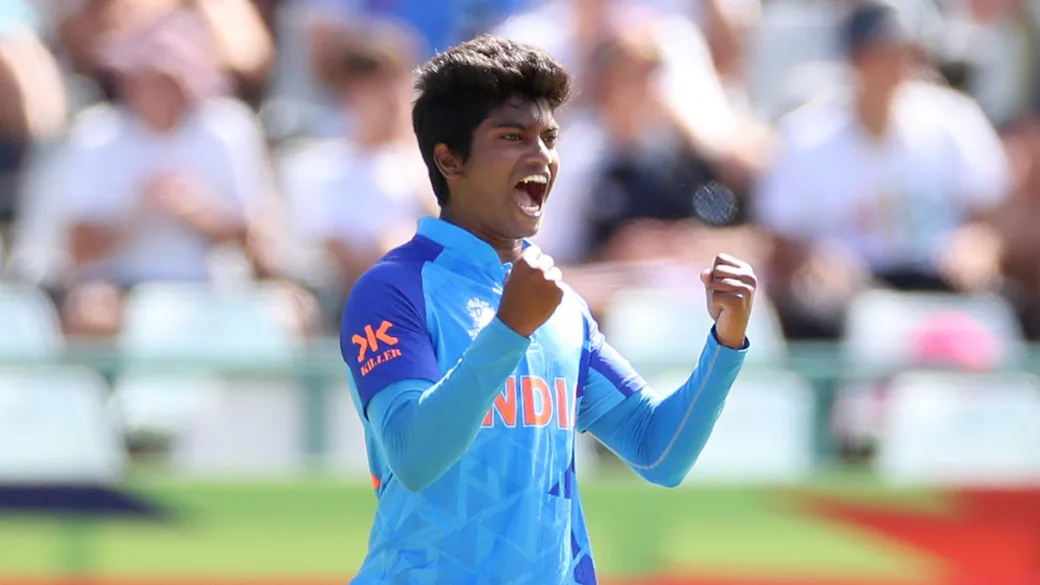
Pooja Vastrakar could have well been watching the Asian Games back home on TV. She was only initially named as a non travelling reserve in the squad, who was to fly back home after a week-long pre-departure camp in Bengaluru. But when Anjali Sarvani pulled up injured a day prior to departure, the direction of Vastrakar’s flight changed from Indore to Hangzhou.
A week later, on Sunday, Vastrakar proved why she should have been considered in the first place. Her career-best T20I figures of 4 for 17 helped skittle Bangladesh for 51 in the semi-final as India vaulted themselves into gold medal contention. Up next in the final on Monday will be the winner of Pakistan versus Sri Lanka in the second semi-final.
India will head into that game knowing their regular captain Harmanpreet Kaur will be available after her two match suspension ended with Sunday’s game, which incidentally was given to her following an acrimonious series against Bangladesh in July.
Vastrakar’s early incision
Nip-backers, outswingers, hard lengths – Vastrakar showed she’s no one-trick pony as she got it to zip around with the new ball. And in the first over itself, she had two wickets with two different deliveries. Shathi Rani was caught behind first ball of the match after being enticed to drive an away-swinger and Shamima Sultana was trapped lbw playing all around one that hit the seam and jagged back to hit her below-the-knee roll.
In her next over, Vastrakar should have had a third but Smriti Mandhana grassed a sitter at mid-off. Sobhana Mostary couldn’t capitalise, managing just one more run, before being dismissed for 8 in Vastrakar’s third straight over inside the powerplay. And it was almost an action replay of the reprieve. Except Mandhana saw this carefully lodge in her palms.
In the next over, debutant Titas Sadhu picked up her maiden wicket with an excellent delivery of her own. Angled in full from wide of the crease, Sadhu had Shorna Akter playing all around a full delivery that held its line to crash into the middle. At 21 for 4 after the powerplay, Bangladesh were tied in knots on a surface that held up considerably, where shot-making wasn’t easy. Under the covers for two full days in the lead-up to the match, the surface seemed a touch unpredictable, which further magnified Bangladesh’s decision to bat early into the contest.
Run outs add to Bangladesh’s misery
It wasn’t just shot selection that hampered Bangladesh, though. Their running between the wickets was equally poor, and accounted for two run outs that should have never been. Nigar Sultana, one of Bangladesh’s most-accomplished batters, was out attempting a single to extra cover where Devika Vaidya swooped in to effect a direct hit at the bowler’s end.
Two balls later, Fahima Khatun was run out without facing a ball when Ritu Moni dabbed one to short third, where Kanika Ahuja fired a direct hit at the striker’s end. Khatun may have survived had she put in a dive; she didn’t. At 25 for 6, Bangladesh were in danger of not lasting the overs. Nahida Akter and Moni helped Bangladesh huff and puff past 50 before they folded in the 18th over, with five of India’s bowlers finishing among the wickets.
Rodrigues helps India cruise home
India’s chase wasn’t without its own initial hitches. Smriti Mandhana was out to Marufa Akter, misjudging the line of her delivery as she lobbed a leading edge to point for 7. Then with the target two blows away, Shafali Verma who seemed in a hurry, especially in trying to muscle her way against spin, perished. Looking to get inside the line and pull, Shafali was beaten by the slowness of the surface as the ball kept a tad low and sneaked through her legs to crash into the stumps. Rodrigues treaded spin with her patented touch game, using the pace of the bowlers to nudge and deflect deliveries into gaps to make a polished unbeaten 20 to see India home in Ahuja’s company with 70 balls to spare.
Brief scores: India 52 for 2 in 8.2 overs (Jemimaah Rodrigues 20*, Shafali Varma 17; Marufa Akter 1-13, Fahima Khatun 1-07) beat Bangladesh 51 all out in 17.5 overs (Nigar Sultana 12, Pooja Vastrakar 4-17, Titas Sadhu 1-10, Amanjot Kaur 1-10, Rajeshwari Gayakwad 1-08, Devika Vaidya 1-00) by eight wickets








All of Pakistan’s squad members from the T20 World Cup have been fined PKR 5 million (US$ 18,000 approx.) each by the PCB following their underwhelming campaign. Pakistan were eliminated from the tournament following the Super Eight stage, missing out on the semi-finals of an ICC men’s event for the fourth successive time – the first such instance in Pakistan’s history.
ESPNcricinfo has learnt that the fines are not for disciplinary reasons, but specifically for what the board deems poor performance at the event. They were imposed immediately following Pakistan’s match against India in the group stages, where a meek showing resulted in a 61-run defeat. They were further told the fines may end up being waived off if Pakistan reached the tournament semi-finals.
Pakistan did get to the second round, thus avoiding a third straight first-round exit, but ran into trouble in the Super Eight group after a washout against New Zealand was followed by defeat to England. New Zealand’s crushing win over Sri Lanka left them relying on other results and a huge victory over Sri Lanka to sneak into the last four. However, their winagainst Sri Lanka was much too narrow to prevent an early exit.
The PCB has come down hard on players in the past, though sanctions have generally been framed as disciplinary. ESPNcricinfo has learned there were no disciplinary issues within the team throughout the tournament, and the fines have been levied specifically for the quality of their on-field performances. That makes the sanctions handed out by the PCB particularly rare, and potentially unprecedented.
The current PCB administration, though, does have form for imposing punishments in the wake of disappointments at major tournaments. Five months earlier, following a narrow defeat to India in the Asia Cup final, the PCB had briefly suspended all No-Objection Certificates (NOCs) issued to players that would have allowed them to take part in T20 leagues through the winter. That suspension, though, was lifted soon after as some of the top players headed to Australia for the BBL.
While the fines will be imposed on all players, Pakistan did have players who enjoyed individual success at the tournament. Sahibzada Farhan broke the record for most runs at a T20 World Cup, and became the only player to score two hundreds at the same event.
[Cricinfo]
Latest News
Iran strikes Qatar and Saudi energy sites as US jets shot down by Kuwaiti ‘friendly fire’
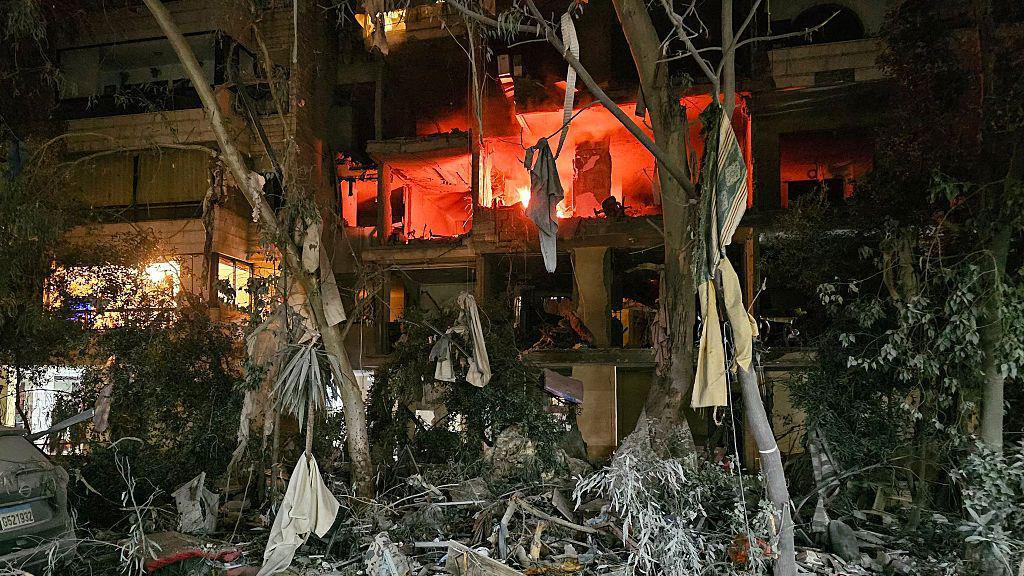
New Iranian strikes have been reported on a major gas plant in Qatar and in Saudi Arabia, where an oil refinery fire is “under control”
The price of gas on international markets has risen sharply – at one point up 42%.
The US and Israel struck Iran on Saturday, killing the country’s Supreme Leader Ayatollah Ali Khamenei. The Israeli military has launched new strikes on Tehran, but the US defense secretary says there will not be “endless war”.
In Kuwait, several US fighter planes have crashed, in what the US military says was “an apparent friendly fire incident” – one plane plummeting to the ground was caught on film.
Meanwhile, the US says a fourth member of its military was killed in Iran’s initial attacks. – it did not say where
The Lebanese health ministry says Israeli attacks in Beirut and southern Lebanon killed at least 31 people – Israel says it was responding to Hezbollah attacks
And in Cyprus, two drones heading for a UK base were intercepted, after an earlier attack on Sunday.
[BBC]
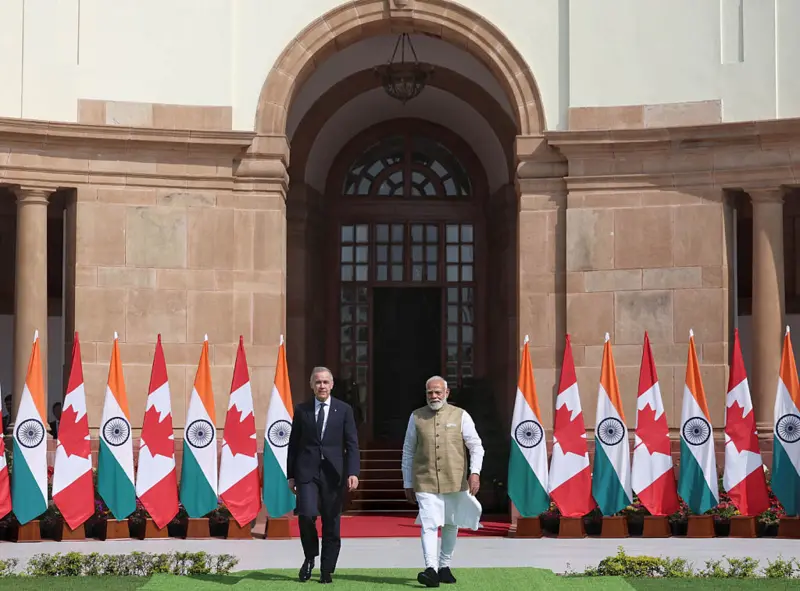
India and Canada’s prime ministers have agreed a number of accords, including a long-term deal to supply uranium to India
After talks in Delhi, Mark Carney said he and Narendra Modi had agreed to conclude an economic partnership agreement by the end of this year. The two leaders are attempting to reset ties that have been strained since 2023 when then PM Justin Trudeau said there were “credible allegations” linking India to the killing of a Sikh separatist leader on Canadian soil
Under Carney, Canada has sought to rebuild engagement with India amid tariff pressure from its largest trading partner, the United States
On Monday, Modi and Carney also agreed to co-operate in areas like critical minerals, clean energy, space and higher education
[BBC]

PCB fines Pakistan players for underwhelming T20 World Cup campaign

Iran strikes Qatar and Saudi energy sites as US jets shot down by Kuwaiti ‘friendly fire’

India and Canada agree series of deals as Carney and Modi reset ties in Delhi

Oil prices rise after ships attacked near Strait of Hormuz

War photographer Paul Conroy dies as tributes paid

Allies of US in the Gulf bear brunt of Iran attacks

‘Dates have the highest sugar content to fight Coronavirus’

Sunday Island 27 December – Headlines

#SundayIsland 17th December – Headlines

Sunday Island – 28th March

Sunday Island Headlines – 21 March

Sunday Island – 21st February – Headlines
-

 Opinion4 days ago
Jamming and re-setting the world: What is the role of Donald Trump?
-
 Features4 days ago
An innocent bystander or a passive onlooker?
-

 Features6 days ago
Building on Sand: The Indian market trap
-
 Opinion6 days ago
Future must be won
-

 Features5 days ago
Ratmalana Airport: The Truth, The Whole Truth, And Nothing But The Truth
-

 Business6 days ago
Dialog partners with Xiaomi to introduce Redmi Note 15 5G Series in Sri Lanka
-
 Business5 days ago
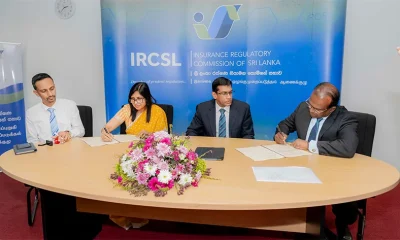
IRCSL transforms Sri Lanka’s insurance industry with first-ever Centralized Insurance Data Repository
-

 Sports7 days ago
CEA halts development at Mandativu grounds until EIA completion