
Latest News
Varun’s five-for in vain as South Africa script comeback win


Tristan Stubbs’ coming-of-age season continued as he batted South Africa to a series-levelling win over India at St George’s Park. Stubbs rescued South Africa from 66 for 6 and shared in a 42-run stand off 20 balls with Gerald Coetzee to end India’s winning streak in T20Is, which extended back 11 matches. In the last month, Stubbs has scored his first Test and ODI centuries and though his 47* in Gqeberha will not go down as a milestone, it was an innings of maturity that turned things around for a struggling South African side.
Since reaching the T20 World Cup final in June, South Africa had played six matches before today and won only one. They appeared to lack a certain structure to their game, which showed glimpses of returning when they put together a complete performance in the field and kept India to 124. The fast bowlers set the tone upfront before the spinners put on a squeeze and all but Keshav Maharaj were among the wickets. Importantly, they removed India’s top three early, and for a combined total of eight runs, and their middle-order had to play catch up. A 37-run stand between Hardik Pandya and Arshdeep Singh for the seventh wicket was the only time India’s scoring rate went above six an over.
Given the target, South Africa may have thought the win would come easily but they were made to work for it. Varun Chakrawarthy’s first international five-for left them reeling while captain Aiden Markam’s poor form remains a concern. It has been 26 innings since he last scored a T20I half-century. South Africa were kept quiet by India’s spinners and as wickets fell, the required run-rate climbed to the point where they needed 40 off the last five overs. Stubbs held his nerve, Coetzee showed his batting prowess and South Africa got home with an over to spare.
Gerald Coetzee – the batter
Coetzee was put on a 12-week conditioning break to work on his bowling, but it seems as though he’s paid as much attention to his batting. After an 11-ball 23 at Kingsmead, with the game all but lost, Coetzee came in with everything at stake at St George’s Park. South Africa were 86 for 7 and needed 39 runs in 26 balls. He was off the mark with a single and that was all the sighting he needed. He dispatched the next ball he faced, a full delivery from Arshdeep Singh, over long-off to relieve the pressure. Stubbs ended the 17th over with a stunning drive through the covers which left South Africa needing 25 runs from 18 balls. Coetzee got that down to 17 off 16 balls with back-to-back boundaries off Avesh Khan, who erred in length. South Africa scored 12 runs off the 18th over and needed 13 off the last 12 balls to level the series.
South Africa insist they have made progress in their batting against spin but then someone like Varun comes along and it doesn’t seem that way. He followed up a career-best in Durban with another in Gqeberha and made India’s modest total appear much bigger than it was. His second ball was a slow googly that Markram, struggling for form, did not pick. Markram slogged, missed and was bowled. The same delivery did Reeza Hendricks in in the next over. Hendricks had just hit Varun for four and was foxed by the wrong ‘un as he played for turn away and was bowled. Then, he changed ends and was equally dangerous from the other side. In his third over, Marco Jansen had no idea what to do against the googly but it was the final over where Varun all but ended South Africa’s hopes. Heinrich Klaasen tried to take him on and could only find long-off and with his next ball, Varun bowled David Miller to claim his five-for.
Cricket has its way of humbling humans and it did to Sanju Samson, who was bowled off the third ball of the innings for a duck, after back-to-back hundreds in his last two matches. The delivery was impressive as Jansen got the ball to seam and then swing but Samson moved too early to give himself room and may have been in a better place to keep it out if he had remained in line. Jansen’s first over was scoreless and South Africa had set the tone. Four balls later, Coetzee and umpire Lubabalo Gcume thought Abhishek Sharma gloved him down the leg side but an immediate review proved otherwise. Coetzee had the last laugh when Abhishek top-edged him to Jansen at short fine. But the moment of the powerplay came when Andile Simelane, who was wicketless on debut in Durban, seared in a yorker to Indian captain Suryakumar Yadav to get his first international wicket. Suryakumar tried to flick it away but was beaten for pace and hit on the pad and did not even bother to review. India were 15 for 3 after four overs and recovered to 34 for 3 after the powerplay.
Tilak Varma smashed Markram towards cover. The ball rocketed towards Miller who moved to his right, reached overhead and plucked it out of the Gqeberha. Tilak stood open-mouthed and stared at Miller in disbelief. At the stands, the spectators’ eyes were the size of saucers. The commentators struggled to get the words out.
‘Oh, my, word’, was the overall sentiment as India slumped to 45 for 4. South Africa stayed sharp in the field and legspinner Nqaba Peter reacted quickly when Hardik drove the ball to him at the end of his second over. Peter got a touch as the ball deflected onto the non-striker’s stumps and Axar Patel was run out.
Hardik scored 19 runs off the first 29 balls he faced and only found the boundary off the 28th as South Africa dried up India’s run-scoring opportunities. The middle overs were heavy going as India scored 24 runs in five overs and went 35 deliveries without scoring a boundary. Finally, in the 18th over, Hardik found his touch. Jansen was brought back on after his first two overs cost only five runs and Hardik immediately punched them through the covers for four. Two balls later, he got under a wider delivery and hit it over extra cover for six and then closed out the over with a ramp shot off a short ball for India’s most profitable over.
Brief scores:
South Africa 128 for 7 in 19 overs (Reeza Hendricks 24, Tristan Stubbs 47*; Arshdeep Singh 1-41, Varun Chakravarthy 5-17, Ravi Bishnoi 1-21) beat India 124 for 6 in 20 overs (Tilak Verma 20, Axar Patel 27, Hardik Pandya 39*; Marco Jansen 1-25, Gerald Coetzee 1-25, Nqabayomzi Peter 1-20, Andile Simelane 1-20, Aiden Markram 1-04) by three wickets
[Cricinfo]

Latest News
Heat Index at ‘Caution Level’ in the Northern, North-central, North-western, Western, Eastern and Southern provinces and in Monaragala district

Warm Weather Advisory
Issued by the Natural Hazards Early Warning Centre
Issued at 3.30 p.m. on 14 April 2026, valid for 15 April 2026.
The Heat index, the temperature felt on human body is likely to increase up to ‘Caution level’ at some places in the Northern, North-central, North-western, Western, Eastern and Southern
provinces and in Monaragala district.
The Heat Index Forecast is calculated by using relative humidity and maximum temperature and this is the condition that is felt on your body. This is not the forecast of maximum temperature. It is generated by the Department of Meteorology for the next day period and prepared by using global numerical weather prediction model data.

Effect of the heat index on human body is mentioned in the above table and it is prepared on
the advice of the Ministry of Health and Indigenous Medical Services.
ACTION REQUIRED
Job sites: Stay hydrated and takes breaks in the shade as often as possible.
Indoors: Check up on the elderly and the sick.
Vehicles: Never leave children unattended.
Outdoors: Limit strenuous outdoor activities, find shade and stay hydrated.
Dress: Wear lightweight and white or light-colored clothing.
Note:
In addition, please refer to advisories issued by the Disaster Preparedness & Response Division, Ministry of Health in this regard as well. For further clarifications please contact 011-7446491.
Latest News
“I extend my heartfelt wishes to all Sri Lankans for a peaceful and joyous Sinhala and Tamil New Year!” – President

President Anura Kumara Dissanayake, issuing a New Year message, extend his heartfelt wishes to all Sri Lankans for a peaceful and joyous Sinhala and Tamil New Year!
The Sinhala and Tamil New Year, which symbolises the aspiration for renewal both physically and spiritually, is the foremost cultural festival of the people of this country.
During the Sinhala and Tamil New Year, traditional customs are upheld, with priority accorded to rituals and religious observances, and activities undertaken collectively at a common auspicious time. This shared cultural practice vividly reflects our nation’s identity before the world, as well as the strong socio-cultural bonds that exist among our communities.
We firmly believe that the future path of national development can only be shaped in harmony with this invaluable culture and our distinguished historical heritage. Accordingly, it must be recalled that all our future development plans have been formulated upon the firm foundation of these precious traditions and cultural values.
Moreover, the common aspiration embodied in the customs and rituals associated with the solar transition is the nurturing of a compassionate individual who values togetherness, respects others, and lives in harmony with nature. I believe that the virtues and values of unity reflected in these New Year traditions should not be confined to these few days alone, but should instead be demonstrated throughout the year in our daily conduct.
In the face of the most significant recent natural disaster challenge encountered in the past year, we demonstrated to the world our resilience and capacity to withstand internal shocks. At the same time, in responding to the external challenges arising from the conflict in the Middle East, the Government has already set in motion a well-planned and effectively managed programme to overcome these difficulties.
As a nation, in overcoming these challenges together, I call upon all of you to further dedicate yourselves to enriching your lives through the values of togetherness, sharing, and solidarity exemplified during the Sinhala and Tamil New Year season.
As we strengthen the achievements we have secured and move forward with unwavering resolve in the face of emerging challenges, I invite everyone to join hands in unity to realise the vision of “A Thriving Nation – A Beautiful Life” for all.
I extend my heartfelt wishes to all Sri Lankans for a peaceful and joyous Sinhala and Tamil New Year!
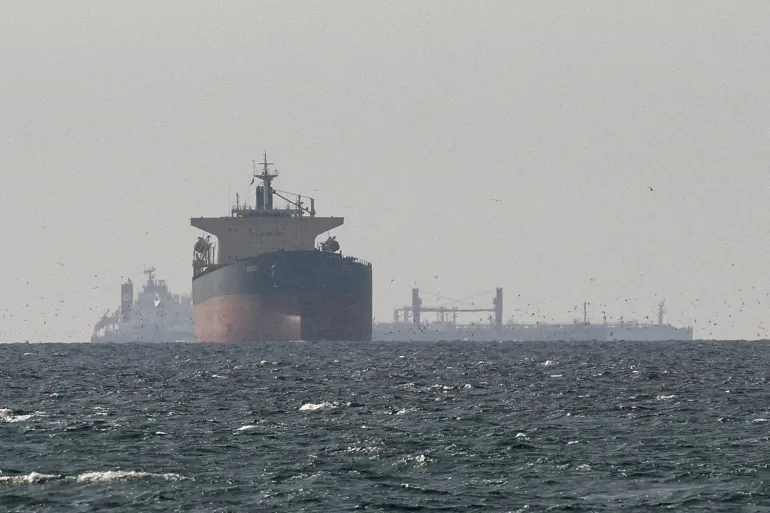
United States President Donald Trump’s planned naval blockade of Iran would further cripple international shipping, exacerbating the energy crisis roiling the global economy, analysts warn.
Oil prices surged above $100 a barrel on Monday after Trump announced that the US Navy would blockade the Strait of Hormuz and “interdict every vessel in international waters that has paid a toll to Iran”
“Iran will not be allowed to profit off this Illegal Act of EXTORTION,” Trump said on Truth Social.
Central Command, the US military’s command responsible for operations in the Middle East, said in a statement the blockade would affect only ships entering and exiting Iranian ports, an apparent scaling-back of Trump’s threat to fully block the strait.
Trita Parsi, cofounder of the US-based Quincy Institute for Responsible Statecraft, said a US blockade would have a cascading impact across the global economy.
“Anything that currently takes more oil off the market will push prices up, which in turn will push gas prices further,” Parsi told Al Jazeera.
Oil could rise above $150 a barrel if the blockade were to trigger retaliation from the Iran-aligned Houthis in Yemen, who could shut down Bab al-Mandeb, a strait that connects the Red Sea to the Gulf of Aden and Indian Ocean, Parsi said.
The strait is an alternative export route for Gulf oil and gas.
A blockade aimed at depriving Iran of revenues would mark a sudden reversal in policy by Washington.
The Trump administration last month announced it would waive some sanctions on Iranian oil exports as a way to help ease the global energy crunch.
Iran has essentially closed the strait since the start of the US-Israeli war on February 28, allowing only a small number of ships to transit after vetting and authorisation.
About 3,200 vessels were stranded west of the strait due to the blockage as of Saturday, according to the maritime intelligence company Windward.
Anas Alhajji, former chief economist at NGP Energy Capital Management, said expected non-Iranian ships would likely keep avoiding the strait despite the US military’s assurances that they will not be impeded because of elevated insurance premiums.
Ships may also fear retaliation from Iran, Alhajji said.
“Therefore, the Trump blockade of the Iranian ports is an actual blockade of the Hormuz Strait,” Alhajji told Al Jazeera.
The resulting rise in oil and gas prices would also cause the cost of chemicals, fertilisers and raw materials used to make plastics to increase, according to analysts.
Cameron Johnson, a senior partner at the Shanghai-based supply chain consultancy Tidalwave Solutions, said he expects prices of many raw materials to rise within several weeks if Trump makes good on his blockade threat.
“The wild card really is the timeframe on this,” Johnson told Al Jazeera.
“If this is a negotiating tactic – remember we still have eight or nine days left of the ceasefire – then it may not really matter. But if this prolongs itself into the end of the month and into the first week of May, you will see prices all over the world spike for raw materials.”
Deborah Elms, head of trade policy at the Hinrich Foundation in Singapore, said the situation for global supply chains could get “much worse” under the blockade.
“Some of the problems are obvious, but many are not. As an example, fabrics will get more expensive,” Elms told Al Jazeera.
“Packaging is already a challenge for firms. Many can’t get blister packs for pills or lids for consumer goods. We can expect consequences for food production later this year and into next year with fertiliser disruptions and lack of supply,” Elms said.
Chad Norville, president of the oil and gas industry news site Rigzone, said Trump’s threat is a further blow to confidence in the situation in the strait ever returning to normal.
The threat alone is likely to drive up insurance premiums for shipping and logistics companies and reduce the volume of trade passing the strait each day, he said.
“Disruptions to shipping and elevated risk in the region were already well established due to the conflict,” Norville told Al Jazeera.
“This threat doesn’t create that baseline. It amplifies it by reinforcing uncertainty around one of the world’s most critical chokepoints.”
[Aljazeera]

Showers will occur at several places in the Western, Sabaragamuwa, Central, Southern, and North-western provinces, and in Anuradhapura district after 1.00 pm.

Heat Index at ‘Caution Level’ in the Northern, North-central, North-western, Western, Eastern and Southern provinces and in Monaragala district

“I extend my heartfelt wishes to all Sri Lankans for a peaceful and joyous Sinhala and Tamil New Year!” – President

US blockade of Iran would worsen global energy crisis, analysts say

Praful Hinge’s stunning debut ends Rajasthan Royal’s four-match winning streak

“Let us resolve, with renewed determination to overcome obstacles and build a better and more prosperous nation” -PM

‘Dates have the highest sugar content to fight Coronavirus’

Sunday Island 27 December – Headlines

#SundayIsland 17th December – Headlines

Sunday Island – 28th March

Sunday Island Headlines – 21 March

Sunday Island – 21st February – Headlines
-

 News3 days ago
CEB orders temporary shutdown of large rooftop solar systems
-

 News6 days ago
AG: Coal procurement full of irregularities
-

 Business5 days ago
Israeli attack on Lebanon triggers local stock market volatility
-
 Features3 days ago
From Royal College Platoon to National Cadet Corps: 145 years of discipline, leadership, and modern challenges
-

 Business6 days ago
Hayleys Mobility introduces Premium OMODA C9 PHEV
-

 Business5 days ago
HNB Assurance marks 25 years with strategic transformation to ‘HNB Life’
-

 Sports6 days ago
DS to face St. Anthony’s in ‘Bridges of Brotherhood’ cricket encounter
-
 Latest News2 days ago
PNS TAIMUR & ASLAT arrive in Colombo