
Business
US court rules many of Trump’s global tariffs are illegal


A US appeals court has ruled that most tariffs issued by US President Donald Trump are illegal, setting up a potential legal showdown that could upend his foreign policy agenda.
The ruling affects Trump’s “reciprocal” tariffs, imposed on most countries around the world, as well as other tariffs slapped on China, Mexico and Canada.
In a 7-4 decision, the US Court of Appeals for the Federal Circuit rejected Trump’s argument that the tariffs were permitted under an emergency economic powers act, calling them “invalid as contrary to law”.
The ruling will not take effect until 14 October to give the administration time to ask the Supreme Court to take up the case.
Trump criticised the appeals court and its ruling on Truth Social, saying: “If allowed to stand, this Decision would literally destroy the United States of America.”
“Today a Highly Partisan Appeals Court incorrectly said that our Tariffs should be removed, but they know the United States of America will win in the end,” he wrote.
“If these Tariffs ever went away, it would be a total disaster for the Country. It would make us financially weak, and we have to be strong.”
Trump had justified the tariffs under the International Emergency Economic Powers Act (IEEPA), which gives the president the power to act against “unusual and extraordinary” threats.
Trump has declared a national emergency on trade, arguing that a trade imbalance is harmful to US national security. But the court ruled that imposing tariffs is not within the president’s mandate, and that setting levies is “a core Congressional power”.
In its judgement, the US Court of Appeals for the Federal Circuit rejected Trump’s argument that the tariffs were permitted under his emergency economic powers, calling the levies “invalid as contrary to law”.
The 127-page ruling says that the IEEPA “neither mentions tariffs (or any of its synonyms) nor has procedural safeguards that contain clear limits on the President’s power to impose tariffs”.
The power to impose taxes and tariffs therefore continues to belong to Congress, the court ruled, and the IEEPA does not override this.
The court wrote that it is unlikely that when Congress passed the law in 1977, it was intended to “depart from its past practice and grant the President unlimited authority to impose tariffs”.
“Whenever Congress intends to delegate to the President the authority to impose tariffs, it does so explicitly, either by using unequivocal terms like tariff and duty, or via an overall structure which makes clear that Congress is referring to tariffs,” the judges wrote.
The ruling comes in response to two lawsuits filed by small businesses and a coalition of US states.
The lawsuits were filed after Trump’s executive orders in April, which imposed a baseline 10% tariff on almost every country in the world, as well as “reciprocal” tariffs on dozens of countries. Trump declared the date to be America’s “liberation day” from unfair trade policies.
In May, the New York-based Court of International Trade declared the tariffs were unlawful. That decision was put on hold during the appeal process.
In addition to those tariffs, Friday’s ruling also strikes down tariffs on Canada, Mexico and China, which Trump argues are necessary to stop the importation of drugs.
However, the decision does not apply to other tariffs, like those imposed on steel and aluminium, which were brought in under a different presidential authority.
Ahead of the ruling, lawyers for the White House argued that invalidating the tariffs would lead to a 1929-style financial collapse, a stock market crash which led to the Great Depression.
“Suddenly revoking the President’s tariff authority under IEEPA would have catastrophic consequences for our national security, foreign policy, and economy,” they wrote in a letter.
“The President believes that our country would not be able to pay back the trillions of dollars that other countries have already committed to pay, which could lead to financial ruin.”
The ruling also raises questions about deals some nations agreed with the US for reduced tariffs rates.
The latest development means the case is now almost certain to head to the US Supreme Court, which has in recent years taken a sceptical view toward presidents who try to implement sweeping new policies that are not directly authorised by Congress.
During Joe Biden’s presidency, the court expanded on what it called the “major questions doctrine” to invalidate Democratic efforts to use existing laws to limit greenhouse gas emissions by power plants and to forgive student loan debt for millions of Americans.
The top court’s nine justices, if they agree to consider the case, could weigh whether Trump’s expansive tariff programme is another example of presidential overreach or if it is sufficiently grounded in law and presidential authority.
Even though the appellate court handed the president a defeat, the White House may take solace in the fact that only three of the court’s 11 judges were appointed by Republicans.
The Supreme Court has six Republican appointees, including three who were selected by Trump himself.


Sri Lanka private healthcare leaders recently pledged an action plan with timelines to address the practical priorities of Sri Lanka’s healthcare sector while making it more viable for local and foreign investments.
The Association of Private Hospitals and Nursing Homes (APHNH) has committed to converting recommendations from its first Healthcare Leadership Summit into a trackable outcome document with defined actions, responsibilities, and timelines, marking a shift from discussion to implementation in sector reform efforts.
The summit held on March 9 at Waters Edge, Colombo, brought together hospital leaders, policymakers, regulators, insurers, and international experts to address practical priorities for Sri Lanka’s healthcare sector.
A key outcome of the summit was APHNH’s plan to consolidate recommendations into a single, trackable charter that will outline specific actions, assign responsibilities, establish timelines, and provide periodic progress updates.
“Our objective is to bring the right decision-makers into one room and focus on what can be implemented, not only what can be discussed, ” said Raveen Wickremesinghe, President of APHNH. “We are committed to taking the inputs from today and converting them into a clear, trackable set of actions that strengthens quality, transparency and public confidence, while supporting national health priorities. “
The summit featured insights from Dr. Hafeez Rahman Padiyath, Dr. Hamdani Anver, and Chandana L. Aluthgama on scaling quality and operational discipline. A keynote and fireside discussion with Dr. Paiboon Eksangsri, President of the Private Hospital Association of Thailand, explored lessons from Thailand’s private healthcare development and conditions for making Sri Lanka more competitive for healthcare investment.
By Sanath Nanayakkare
Business
Atlas SipSavi Naththal Poronduwa records positive public participation, benefiting 10,000 students


Atlas, Sri Lanka’s No. 1 learning brand, successfully concluded Atlas SipSavi Naththal Poronduwa, a national initiative that saw strong public participation in supporting children at risk of dropping out of school due to financial hardship. At a time when more than 22,000 Sri Lankan children leave school each year due to rising economic challenges, the initiative reinforced Atlas Sipsavi’s long-standing ‘No Child Left Behind’ promise by turning seasonal generosity into meaningful educational support.
The initiative reached 10,000 students, with beneficiary schools carefully selected to ensure support reached those most in need. The collected books were distributed to children at risk of dropping out, including those whose education had been disrupted by recent adverse weather, ensuring students had essential learning resources at the start of the new school term. Through its flagship Atlas SipSavi programme, the brand focused on improving access to education by providing essential learning tools, scholarships, and infrastructure to create better learning environments, bringing its purpose of ‘making learning fun’ to life in a meaningful way. As part of the initiative, the public was invited to donate schoolbooks, with each contribution matched one-for-one by Atlas. Donation boxes were placed at all Keells outlets island-wide and at Sarvodaya District Offices, making it easy for communities to take part.
Business
John Keells Logistics expands strategic engagement with CWIT through inter-terminal transport operations
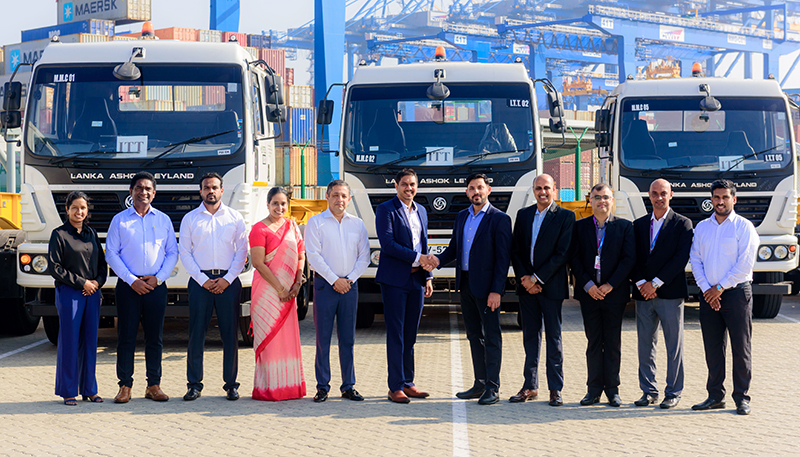
John Keells Logistics (Pvt) Ltd (JKLL), one of Sri Lanka’s leading third-party logistics solutions providers, has successfully expanded its operational engagement with Colombo West International Terminal (Private) Limited (CWIT), through inter-terminal transport services within the Port of Colombo. This enhanced engagement further strengthens CWIT’s efforts to improve operational efficiency, reliability, and scalability across terminal activities.
Inter-terminal transport plays a critical role in modern port operations, requiring high levels of coordination, precision, and operational discipline. JKLL’s appointment for ITT operations reflects CWIT’s confidence in the company’s demonstrated capabilities in managing complex transport operations within a high-throughput port environment.
The ITT operations are underpinned by JKLL’s technology-enabled logistics framework, incorporating real-time fleet tracking, performance monitoring systems, and data-driven operational planning. These capabilities provide enhanced visibility and control over transport movements, while ensuring compliance with established safety, productivity, and service quality standards.
The awarding of this engagement to JKLL is a testament to the successful implementation of the Inter-Terminal Vehicle (ITV) operations undertaken by John Keells Logistics at CWIT during the previous year. The ITV assignment was executed through structured operating procedures and disciplined service delivery, contributing to improved cargo movement, operational coordination, and service continuity within the terminal. The performance outcomes of the ITV operations provided the basis for the subsequent expansion of the partnership into ITT services.

Agha calls for ‘sportsman spirit’ after controversial dismissal

US embassy in Baghdad hit by strike as Trump says military targets ‘obliterated’ on Iran’s key oil island

Showers or thundershowers will occur at several places in the Western, Sabaragamuwa, Central, North-western and Uva provinces and in Galle, Matara, Mannar and Anuradhapura districts after 2.00 pm.

Bahrain & Saudi Arabia Grands Prix to be cancelled

Pink Floyd guitar sold for record-breaking $14.6m

Promoting Local Industries is a key priority of the Government – PM

‘Dates have the highest sugar content to fight Coronavirus’

Sunday Island 27 December – Headlines

#SundayIsland 17th December – Headlines

Sunday Island – 28th March

Sunday Island Headlines – 21 March

Sunday Island – 21st February – Headlines
-

 News6 days ago
Repatriation of Iranian naval personnel Sri Lanka’s call: Washington
-
 Features6 days ago
Winds of Change:Geopolitics at the crossroads of South and Southeast Asia
-

 News5 days ago
Prof. Dunusinghe warns Lanka at serious risk due to ME war
-

 Sports4 days ago
Royal start favourites in historic Battle of the Blues
-

 Sports3 days ago
The 147th Royal–Thomian and 175 Years of the School by the Sea
-

 News3 days ago
Historic address by BASL President at the Supreme Court of India
-

 Business7 days ago
Seven decades of sartorial excellence: The legacy of Linton Master Tailors in Kandy
-

 News4 days ago
CEBEU warns of operational disruptions amid uncertainty over CEB restructuring