
Midweek Review
UNP finally admits MR saved country from terrorism

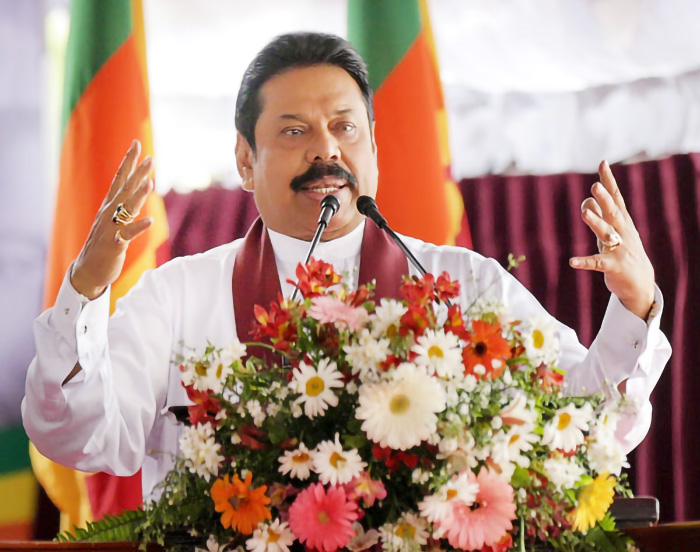
Former UNP Minister Harin Fernando publicly declared for the first time that Mahinda Rajapaksa led the country, ignoring all those pundit nay sayers and brought the war against the Liberation Tigers of Tamil Eelam (LTTE) to a successful end. The ex-parliamentarian also emphasised that Ranil Wickremesinghe restored the collapsed national economy. The UNPer was referring to the crushing of the LTTE militarily in May 2009 and Wickremesinghe completing the remainder of the ousted President Gotabaya Rajapaksa’s 5-year term won at the Nov 2019 presidential election.
Fernando said so addressing ‘Maha Jana Handa’ organised at the Nugegoda Ananda Samarakoon Open Air Theatre last Friday (21). Unfortunately, Fernando’s leader Ranil Wickremesinghe who actually proposed a high-profile joint Opposition campaign against the Jathika Jana Balawegaya (JJB) government and the war winning President Mahinda Rajapaksa conveniently skipped the Nugegoda rally. That, however proved how fed up the masses are with the current dispensation for breaking virtually all their promises by turning right, but nothing to show for it, after signaling left for so long promising a mythical revolutionary state, while causing so much death and destruction along the way with two abortive uprisings. Masses came in record numbers to the Nugegoda rally despite it being led by relative minnows in the opposition.
Wickremesinghe certainly owed an explanation regarding his absence as it was, he who proposed 1,000 meetings against the NPP/JVP government, at the UNP’s 79th convention held on Sept 20, this year at Sri Jayewardenepura Kotte. It was themed ‘Let’s Stand Together.’
The UNP hitherto never publicly acknowledged the fact that Mahinda Rajapaksa’s bold leadership ensured Sri Lanka’s triumph over the separatist terrorist LTTE. The significance of Fernando’s declaration was lost in political rhetoric as speakers challenged President Anura Kumara Dissanayake (AKD). SLPP National List MP and National Organizer Namal Rajapaksa vowed to topple the NPP at the first given opportunity unless AKD fulfilled promises made in the run-up to 2024 presidential election.
Among notable absentees was SLPP founder and former renowned political strategist Basil Rajapaksa. The nonattendance of the main Opposition Samagi Jana Balawegaya (SJB) leader Sajith Premadasa, who is also the Opposition Leader, as well as all constituent members of the SJB underscored the overall weakness of the initiative. The failure on the part of ‘Maha Jana Handa’ organisers to reach a consensus with the SJB regarding a tangible plan of action cannot be overemphasised.
Former Prime Minister and MEP leader Dinesh Gunawardena who backed Ranil Wickremesinghe candidature at the last presidential election also skipped the Nugegoda rally.
The SJB with 40 MPs is the second largest political party in the current parliament. Therefore, the SJB’s absence made the whole effort meaningless symbolically, but the enthusiasm of the massive crowd that converged there, despite all types of impediments put in their way, without doubt once again showed the growing unpopularity of the current dispensation. The SJB is very much unlikely to change its stand regarding participation in the current initiative unless an agreement with the UNP could be finalised. The SJB wouldn’t under any circumstances throw its weight behind any political initiative that failed to acknowledge the situation on the ground.
But the groundswell of disappointment with the JVP led government for having betrayed many of their longstanding ideals and also failing to deliver many of their election promises, may result in even SJB being overlooked by masses for other alternatives.
The UNP doesn’t represent the current parliament whereas Ranil Wickremesinghe backed New Democratic Front (NDF) at the last parliamentary election secured five seats, including two National List slots. The NDF group consists of Chamara Sampath Dassanayake, Anuradha Jayaratne, Rohitha Abeygunawardena, Ravi Karunanayake (NL) and Faizer Musthapha (NL). Of them, only Dassanayake joined the rally where he was one of the main speakers.
Namal Rajapaksa’s SLPP parliamentary group consists of just three MPs, hence the urgent need to bring the SJB into the fold. But that wouldn’t be possible unless ‘Maha Jana Handa’ recognised the SJB’s standing among opposition political parties and groups.
Harin Fernando, tasked by Wickremesinghe to organise countrywide meetings in his fiery speech appealed to the SJB while lambasting the Janatha Vimukthi Peremuna (JVP) for ruination of the country. Let me discuss Fernando’s declaration regarding Mahinda Rajapaksas bringing what the UNP dubbed an unwinnable war to an end and how that party pursued a despicable political strategy at the expense of post-war Sri Lanka.
A relentless offensive
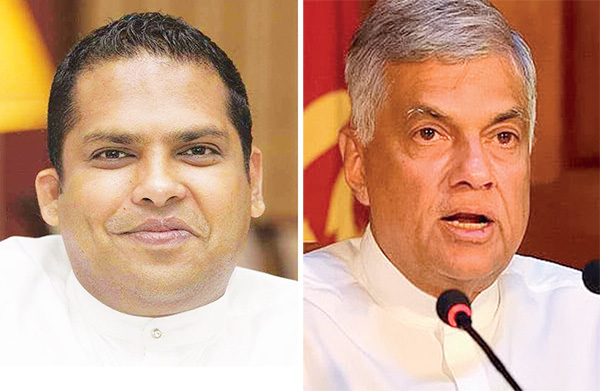
Harin Fernando / Ranil Wickremesinghe
The UNP never believed in battle-field victory over the LTTE. Wickremesinghe operated on the assumption that the LTTE could reverse the ground situation with a devastating counter offensive on the Vanni front. That had been the general opinion among the Western and Indian diplomatic community here and the Tamil speaking community living outside the Northern Province. But those who lived in the North knew that there hadn’t been a similar multi-pronged ground offensive before.
But still the UNP felt that the LTTE could deliver a massive blow on the Vanni front and cause irreparable damage to the war effort. The LTTE’s last desperate bid to regain the initiative went awry in February 2009 and two months later the Army delivered a knockout blow to the enemy at Anandapuram. That was the end of their once formidable conventional military capacity. The destruction of the LTTE floating arsenals on the high seas during 2006-2007 period by Vice Admiral Wasantha Karannagoda’s Navy and the strategic air campaign conducted by the SLAF under AM Roshan Gunetilleke’s leadership facilitated the overall campaign.
Against the backdrop of Harin Fernando’s long-overdue admission, it would be pertinent to mention that President Mahinda Rajapaksa refused to heed combined UK (David Miliband)-French (David Kouchner) demand to halt the offensive. That bid to throw a lifeline to the LTTE was made in late April 2009 as the ground forces were engaged in their final push to break the back of the LTTE as they were cornered into an ever-decreasing patch of land. That courageous decision ensured Sri Lanka’s triumph over terrorism that plagued the country since 1983.
When David Miliband and Bernard Kouchner met President Rajapaksa at Chandrikawewa, the younger man is reported to have brazenly told President Rajapaksa, “Mr. President we want you to agree to a ceasefire. We cannot be passive spectators. There has to be a lull in the fighting.”
President Rajapaksa’s response was: “Secretary Miliband, I want to tell you we are no longer a colony. Empirical experience has shown that ceasefires only prolong the war. It would be a gross betrayal of our country to permit the Tigers to recuperate and return to war – as they have done on countless occasions.”
Historian and the creator of Thuppahi’s blog Michael Roberts revealed the exchange on the basis of what the then Foreign Secretary Palitha Kohana and International Trade Minister Prof. G. L. Peiris had told him (https://thuppahis.com/2018/07/02/how-mahinda-rajapaksa-rebuffed-david-miliband/).
Any other leader would have succumbed to that kind of big power pressure against the backdrop of the US sending a military team here to explore the possibility of evacuating terrorist leader Velupillai Prabhakaran, his family and top lieutenants.
The UNP remained silent about the joint UK-French attempt. Wickremesinghe who always boasts of his close connections with western governments may have been aware of the UK-French bid. Had Wickremesinghe intervened on behalf of the country/armed forces and issued a statement opposing a European backed ceasefire at that time he and the UNP could have saved face. Unfortunately, he played politics with the issue much to their own detriment.
Wickremesinghe went a step further, he joined hands with the Tamils National Alliance (TNA) that represented the LTTE’s interests both in and outside parliament (2001 to 2009) and the JVP to field war winning Army Commander at the 2010 presidential election. In hindsight that decision caused a ripple effect and contributed to the overall deterioration of the political party system.
Harin Fernando’s praise of Mahinda Rajapaksa wouldn’t absolve his party of treacherous betrayal of the victorious armed forces as well as the then political leadership at the Geneva-based Human Rights Council (HRC) in Oct 2015. In fact, the UNP worked closely with the JVP from 2009/2010 to 2019 when the latter decided to quit the alliance to contest the 2019 presidential election.
Lessons from Nugegoda
Among those who had been on the front row of the Nugegoda rally were SLPP General Secretary Sagara Kariyawasam, Prof. G. L. Peiris, Nimal Siripala de Silva, Vajira Abeywardena, Udaya Gammanpila, Tiran Alles, Mahinda Amaraweera, Duminda Dissanayake and Lasantha Alagiyawanna.
Prof. Peiris as the government’s chief negotiator during peace talks with the LTTE between 2002 and 2003 period is one of the few politicians fully aware of the developments that led to breakdown of talks in April 2003 and resumption of war in August 2006. Prof. Peiris also served as foreign minister in the post-war period and was closely associated with efforts to counter war crimes accusations. Harin Fernando’s declaration, about the way Sri Lanka brought the war to a successful conclusion may help the country to counter Geneva war crimes allegations. Unfortunately, the UNP worked overtime against President Rajapaksa thereby betraying the country by co-sponsoring an accountability resolution in Oct 2015.
The JVP though not represented in the cabinet fully backed the Sirisena-Wickremesinghe led yahapalana administration that co-sponsored the Geneva resolution
The Nugegoda rally was silent on the Geneva betrayal. Speakers on the Nugegoda platform couldn’t have referred to that outright treachery in Geneva as the UNP had joined ‘Maha Jana Handa.’ Nugegoda platform was also conveniently silent on ongoing investigations into accountability issues. In fact, ‘Maha Jana Handa’ conveniently avoided contentious issues ranging from Memorandums of Understandings (MoUs) with India in April this year to formalisation of collaboration between the Montana National Guard, U.S. Coast Guard District 13, and the Sri Lanka Armed Forces under the U.S. Department of Defence’s State Partnership Programme (SPP) earlier this month.
Against the backdrop of the UPFA first entering into Acquisition and Cross-Servicing Agreement (ACSA) in 2007 and then UNP-SLFP yahapalanaya extending the same in 2017, Nugegoda platform couldn’t have accused the NPP of undermining sovereignty. Similarly, they couldn’t have attacked the NPP over the IMF agenda as all of them accepted that formula by the passage of the Economic Transformation Bill in July 2024 without a vote.
The failure on their part at least to mention India taking over 51% stake of the Colombo Dockyard Limited (CDL) for USD 52 mn within weeks after the signing of seven MoUs proved that Nugegoda rally simply didn’t take key developments into consideration. The success of a rally cannot be under any circumstances gauged by the presence of a sizable crowd as people do not on their own attend political rallies. The meeting addressed by President Anura Kumara Dissanayake at Tangalle on the day before the Nugegoda rally is a case in point. At least one third of the Tangalle gathering happened to be serving military and police in civies and government officials and the rest brought in by the party. The only difference at Tangalle and Nugegoda had been loud speakers outside the venue at Tangalle whereas ‘Maha Jana Handa’ was denied the same citing the on-going Advance Level examination. NDF lawmaker Chamara Sampath Dassanayake quite rightly pointed out this at the Nugegoda meeting.
The SJB and UNP need to address their internal issues as soon as possible. Sajith Premadasa and Ranil Wickremesinghe cannot further delay in reaching a consensus on the leadership issue. If they do not set aside their petty squabbling for the greater good of the country the people themselves might consign them to the dust bin of history. The setback suffered at Nugegoda must compel them to unify the two parties to face the NPP as the SLPP with just three MPs in current parliament cannot be expected to give leadership to the combined Opposition. It would be a grave mistake on the Opposition’s part to think that it can achieve the transformation of the JVP’s three MPs to 159. Such a massive change would never have been possible without Aragalaya that caused political upheaval and turned the party system upside down.
The SLPP now down to just three from near 2/3 majority in 2020 shouldn’t forget that the indictments were forwarded to the Colombo High Court by the Attorney General in late January this year, alleging that Namal Rajapaksa misappropriated funds to the tune of Rs 70 mn received from the Indian real estate company Krrish for the development of rugby in Sri Lanka.
Disastrous UNP strategy
The UNP still seems unable to come to terms with the situation. In spite of the party being reduced to a nonentity with no parliamentary representation at the moment and no hope of coming back at the next national elections, that party is still trying to reach a consensus with the SJB at the latter’s expense. Their effort is geared to safeguard Ranil Wickremesinghe’s leadership at any cost. They haven’t realised Wickremesinghe’s folly in contesting the last presidential election as an independent candidate thereby causing a split in the vote that ensured Anura Kumara Dissanayake’s victory at the presidential election. Dissanayake polled 5.6 mn votes whereas Sajith Premadasa and Ranil Wickremesinghe polled 4.3 mn and 2.2 mn votes respectively.
The bottom line is that Wickremesinghe and the former UNP deputy leader Premadasa polled 6.5 mn votes, 900,000 votes more than Dissanayake who also failed to secure 50% of the vote. Regardless of that, the UNP pursued a strategy that only helped the NPP to consolidate its position with a resounding victory at the parliamentary election last November, three months after the presidential poll.
Instead of reaching a consensus with the SJB, Wickremesinghe caused political mayhem by contesting under the NDF symbol gas cylinder. That move divided the SLPP, undermined the SJB and delivered a knockout blow to the UNP. The NDF that had never been represented in parliament secured five seats, including two NL slots while the SLPP ended up with just three seats including one NL slot. The UNP that secured one NL slot at the 2020 parliamentary election was reduced to zero at the 2024 general election.
Harin Fernando’s declaration at the Nugegoda rally that Wickremesinghe restored the collapsed national economy is debatable. The Treasury bond scams perpetrated in 2015 February and 2016 March under Wickremesinghe’s watch by Singaporean Arjuna Mahendran who served as the Governor of the Central Bank at that time remains a thorny issue. Having compelled President Maithripala Sirisena to appoint close associate Mahendran as the Governor regardless of him being a foreign passport holder Wickremesinghe cannot absolve himself of the responsibility for Treasury bond scams.
Mahendran was allowed to leave the country. The Singaporean remains at large. Those who now represent the SJB protected Mahendran and engaged in cover up of Treasury bond scams throughout yahapalanaya (2015 to 2019). The then UNPer and current SJB lawmaker Sujeewa Senasinghe went to the extent of authoring a booklet denying Treasury bond scams while others undermined the COPE (Committee of Public Enterprises) process intended to identify the culprits.
The JVP, too, cooperated in that cover-up. It would be pertinent to mention that the JVP transformed the party in 2009/2010 to align with the UNP. That partnership completely changed the JVP. That transformation took place during the late Somawansa’s leadership. Anura Kumara Dissanayake who succeeded Somawansa in 2014 has taken the party to the next level. Securing both presidency and unprecedented 2/3 majority in parliament is certainly not a simple task and he has achieved the impossible as the leader of both JVP and NPP.
However, the President’s continuing success depends largely on the failure on the part of the sharply divided Opposition to reach a consensus on a workable plan of action. The resolution of the SJB-UNP dispute is the key to adoption of a successful Opposition strategy.

Midweek Review
Opp. MP’s hasty stand on US air strikes in Nigeria and Sri Lanka’s foreign policy dilemma

Israel’s recognition of Somaliland on 26 December, 2025, couldn’t have taken place without US approval. The establishment of full diplomatic ties with Somaliland, a breakaway part of Somalia, and Israeli Foreign Minister Gideon Saar’s visit to that country, drew swift criticism from Somalia, as well as others. Among those who had been upset were Türkiye, Saudi Arabia and the African Union.
The US-backed move in Africa didn’t receive public attention as did the raid on Venezuela. But, the Somaliland move is definitely part of the overall US global strategy to overwhelm, undermine and belittle Russia and China.
And on the other hand, the Somaliland move is a direct challenge to Türkiye, a NATO member that maintains a large military presence in Somalia, and to Yemen based Houthis who had disrupted Red Sea shipping, in support of Hamas, in the wake of Israeli retaliation over the 07 October, 2023, raid on the Jewish State, possibly out of sheer desperation of becoming a nonentity. The Israeli-US move in Africa should be examined taking into consideration the continuing onslaught on Gaza and attacks on Lebanon, Iran, Syria, Yemen, and Qatar.
Many an eyebrow was raised over Opposition MP Dr. Kavinda Jayawardana’s solo backing for the recent US air strikes in Nigeria.
The Gampaha District Samagi Jana Balawegaya (SJB) lawmaker handed over a letter to the US Embassy here last week applauding US President Donald Trump’s order to bomb Nigeria on Christmas Day. The letter was addressed to President Trump
( https://island.lk/kavinda-lauds-us-president-trumps-actions-to-protect-christians-in-nigeria/)
The former UNPer who had been in the forefront of a high-profile campaign demanding justice for the 2019 Easter Sunday terror victims, in an obvious solo exercise praised Trump for defending the Nigerian Christian community. The US bombing targeted Islamic State Terrorists (ISIS) operating in that country’s northwest, where Muslims predominate.
The only son of the late UNP Minister Dr. Jayalath Jayawardana, he seemed to have conveniently forgotten that such military actions couldn’t be endorsed under any circumstances. Against the backdrop of Dr. Jayawardana’s commendation for US military action against Nigeria, close on the heels of the murderous 03 January US raid on oil rich Venezuela, perhaps it would be pertinent to seek the response of the Catholic Church in that regard.
President Trump, in a wide-ranging interview with the New York Times, has warned of further strikes in case Christians continued to be killed in the West African nation. International media have disputed President Trump’s claim of only the Christians being targeted.
Both Christians and Muslims – the two main religious groups in the country of more than 230 million people – have been victims of attacks by radical Islamists.
The US and the Nigerian government of President Bola Tinubu reached a consensus on Christmas Day attacks. Nigeria has roughly equal numbers of Christians – predominantly in the south – and Muslims, who are mainly concentrated in the north.
In spite of increasingly volatile global order, the Vatican maintained what can be comfortably described as the defence of the national sovereignty. The Vatican has been critical of the Venezuelan government but is very much unlikely to throw its weight behind US attacks on that country and abduction of its President and the First Lady.
Dr. Jayawardana’s stand on US intervention in Nigeria cannot definitely be the position of the main Opposition party, nor any other political party represented in Parliament here. The National People’s Power (NPP) government refrained from commenting on US attacks on Nigeria, though it opposed US action in Venezuela. Although the US and Nigeria have consensus on Christmas Day attacks and may agree on further attacks, but such interventions are very much unlikely to change the situation on the ground.
SL on US raid
Let me reproduce Sri Lanka’s statement on US attacks on Venezuela, verbatim:
“The Government of Sri Lanka is deeply concerned about the recent developments in Venezuela and is closely monitoring the situation.
Sri Lanka emphasises the need to respect principles of international law and the UN Charter, such as the prohibition of the use of force, non-intervention, peaceful settlement of international disputes and the sovereignty and territorial integrity of states.
Sri Lanka attaches great importance to the safety and well-being of the people of Venezuela and the stability of the region and calls on all parties to prioritize peaceful resolution through de-escalation and dialogue.
At this crucial juncture, it is important that the United Nations and its organs such as the UN Security Council be seized of the matter and work towards a peaceful resolution taking into consideration the safety, well-being and the sovereign rights of the Venezuelan people.”
That statement, dated 05 January, was issued by the Foreign Affairs, Foreign Employment and Tourism Ministry. Almost all political parties, represented in Parliament, except one-time darling of the LTTE, Illankai Thamil Arasu Kadchi (ITAK), condemned the US attacks on Venezuela and threats on Cuba, Colombia and Iran. The US is also targeting China, Russia and even the European Union.
Dr. Jayawardana requested coverage for his visit to the US Embassy here to hand over his letter, hence the publication of his ‘love’ letter to President Trump on page 2 of the 09 January edition of The Island.
There had never been a previous instance of a Sri Lankan lawmaker, or a political party, endorsing unilateral military action taken by the US or any other country. One-time Western Provincial Council member and member of Parliament since 2015, Jayawardana should have known better than to trust President Trump’s position on Nigeria. Perhaps the SJBer felt that an endorsement of US action, allegedly supportive of the Nigerian Catholic community, may facilitate his political agenda. Obviously, the Opposition MP endorsed US military action purely for domestic political advantage. The lawmaker appears to have simply disregarded the growing criticism of US actions in various parts of the world.
The German and French response to US actions, not only in Venezuela, but various other regions, as well, underscore the growing threat posed by President Trump’s agenda.
French President Emmanuel Macron and German leader Frank-Walter Steinmeier have sharply condemned US foreign policy under Donald Trump, declaring, respectively, that Washington was “breaking free from international rules” and the world risked turning into a “robber’s den”.
US threat to annex Greenland at the expense of Denmark, a founding member of the North Atlantic Treaty Organisation (NATO) ,and the grouping itself, has undermined the post WWII world order to such an extent, the developing crisis seems irreversible.
Focus on UAE
Indian Army Chief Gen. Upendra Dwivedi visited the United Arab Emirates on 05 and 06 January. His visit took place amidst rising tension on the Arabian Peninsula, following the Saudi-led military coalition launching air attacks on Yemen based Southern Transitional Council (STC) whose leader Aidarous al-Zubaid was brought to Abu Dhabi.
In the aftermath of the Saudi led strikes on Yemen port, held by the STC, the UAE declared that it would withdraw troops deployed in Yemen. The move, on the part of UAE, seems to be meant to de-escalate the situation, but the clandestine operation, undertaken by that country to rescue a Saudi target, appeared to have caused further deterioration of Saudi-UAE relations. Further deterioration is likely as both parties seek to re-assert control over the developing situation.
From Abu Dhabi, General Dwivedi arrived in Colombo on a two-day visit. Like his predecessors, General Dwivedi visited the Indian Army memorial at Pelawatte, where he paid respects to those who paid the supreme sacrifice during deployment of the Indian Army here – 1987 July to 1990 March. That monument is nothing but a testament to the foolish and flawed Indian policy. Those who portray that particular Indian military mission as their first major peace keeping operation overseas must keep in mind that over half a dozen terrorist groups were sponsored by India.
Just over a year after the end of that mission, one of those groups – the LTTE (Liberation Tigers of Tamil Eelam) -assassinated Congress leader Rajiv Gandhi, the former Premier who sent the military mission here.
India never accepted responsibility for the death and destruction caused by its intervention in Sri Lanka. In fact, the Indian action led to an unprecedented situation when another Sri Lankan terrorist group PLOTE (People’s Liberation Organisation of Tamil Eelam) mounted a raid on the Maldives in early Nov. 1988. Two trawler loads of PLOTE cadres were on a mission to depose Maldivian President Maumoon Abdul Gayoom on a contract given by a disgruntled Maldivian businessman. India intervened swiftly and brought the situation under control. But, the fact that those who had been involved in the sea-borne raid on the Maldives were Indian trained and they left Sri Lanka’s northern province, which was then under Indian Army control, were conveniently ignored.
Except the LTTE, all other major Tamil terrorist groups, including the PLOTE, entered the political mainstream in 1990, and over the years, were represented in Parliament. It would be pertinent to mention that except the EPDP (Eelam People’s Democratic Party) all other Indian trained groups in 2001 formed the Tamil National Alliance (TNA), under the leadership of Illankai Thamil Arasu Kadchi (ITAK), to support the separatist agenda in Parliament. Sri Lanka’s triumph over the LTTE, in May 2009, brought that despicable project to an end.
The Indian Army statement on General Dwivedi’s visit here, posted on X, seemed like a propaganda piece, especially against the backdrop of continuing controversy over the still secret Indo-Lanka Memorandum of Understanding on defence that was entered into in April last year. Within months after the signing of the defence MoU, India acquired controlling stake of the Colombo Dockyard Ltd., a move that has been shrouded in controversy.
Indian High Commissioner Santosh Jha’s response to my colleague Sanath Nanayakkara’s query regarding the strategic dimension of the India–Sri Lanka Defence Cooperation Agreement following the Indian Army Chief’s recent visit, the former was cautious in his response. Jha asserted that there was “nothing beyond what is included” in the provisions of the pact, which was signed by President Anura Kumara Dissanayake and has generated controversy in Sri Lanka due to the absence of public discourse on its contents.
Framing the agreement as a self-contained document focused purely on bilateral defence cooperation, Jha said this reflected India’s official position. By directing attention solely to the text of the agreement, the High Commissioner indicated that there were no unstated strategic calculations involved, aligning with the Sri Lankan Foreign Minister’s recent clarification that the pact was not a military agreement but one that dealt with Indian support.
Nanayakkara had the opportunity to raise the issue at a special media briefing called by Jha at the IHC recently.
Julie Chung departs
The US attack on Venezuela, and the subsequent threats directed at other countries, including some of its longtime allies, should influence our political parties to examine US and Indian stealthy interventions here, leading to the overthrowing of President Gotabaya Rajapaksa, in July 2022.
The US Embassy in Colombo recently announced that Julie Chung, who oversaw the overthrowing of Gotabaya Rajapaksa, would end her near four-year term. Former Indian High Commissioner in Colombo Gopal Baglay, who, too, played a significant role in the regime change project, ended his term in December 2023 and took up position in Canberra as India’s top diplomat there.
Both Chung and Baglay have been accused of egging on the putsch directly by urging Aragalaya time Speaker Mahinda Yapa Abeywardena, on 13 July, 2022, to take over the presidency. Former Minister Wimal Weerawansa and top author Sena Thoradeniya, in their comments on Aragalaya accused Chung of unprecedented intervention, whereas Prof. Sunanada Maddumabanadara found fault with Baglay for the same.
The US Embassy, in a statement dated 07 January, 2026, quoted the outgoing US Ambassador as having said: “I have loved every moment of my time in Sri Lanka. From day one, my focus has been to advance America’s interests—strengthening our security partnerships, expanding trade and investment, and promoting education and democratic values that make both our nations stronger. Together, we’ve built a relationship that delivers results for the American people and supports a free, open, and secure Indo-Pacific.”
The Embassy concluded that statement reiterating the US commitment to its partnership with Sri Lanka and to build on the strong foundation, established during Ambassador Chung’s nearly four-year tenure.
Sri Lanka can expect to increasingly come under both US and Indian pressure over Chinese investments here. It would be interesting to see how the NPP government solves the crisis caused by the moratorium on foreign research vessel visits, imposed in 2024 by the then President Ranil Wickremesinghe. The NPP is yet to reveal its position on that moratorium, over one year after the lapse of the ban on such vessels. Wickremesinghe gave into intense US and Indian pressure in the wake of Chinese ship visits.
In spite of US-India relations under strain due to belligerent US actions, they are likely to adopt a common approach here to undermine Sri Lanka’s relations with China. But, the situation is so dicey, India may be compelled to review its position. The US declaration that a much-anticipated trade deal with India collapsed because Indian Prime Minister Narendra Modi hasn’t heeded President Trump’s demand to call him.
This was revealed by US Commerce Secretary Howard Lutnick in the ‘All-In Podcast’ aired on Thursday, 08 January. The media quoted Indian spokesman Randhir Jaiswal as having said on the following day: “The characterisation of these discussions in the reported remarks is not accurate.” Jaiswal added that India “remains interested in a mutually beneficial trade deal between two complementary economies and looks forward to concluding it.”
Sri Lanka in deepening dilemma
Sri Lanka, struggling to cope up with post-Aragalaya economic, political and social issues, is inundated with foreign policy issues.
The failure on the part of the government and the Opposition to reach consensus on foreign policy challenges/matters has further weakened the country’s position. If those political parties represented in Parliament at least discussed matters of importance at the relevant consultative committee or the sectoral oversight committee, lawmaker Jayawardana wouldn’t have endorsed the US bombing of Nigeria.
Sri Lanka and Nigeria enjoy close diplomatic relations and the SJB MP’s unexpected move must have caused quite a controversy, though the issue at hand didn’t receive public attention. Regardless of the US-Nigerian consensus on the Christmas Day bombing, perhaps it would be unwise on the part of Sri Lanka to support military action at any level for obvious reasons.
Sri Lanka taking a stand on external military interventions of any sort seems comical at a time our war-winning military had been hauled up before the Geneva Human Rights Council for defending the country against the LTTE that had a significant conventional military capacity in addition to being “the most ruthless terrorist organisation” as it was described by the US Federal Bureau of Investigation. The group capitalised on experience gained in fighting the Indian Army during 1987 July-1990 March period and posed quite a threat. Within five months after the resumption of fighting, in June 1990, the LTTE ordered the entire Muslim population to leave the predominantly Tamil northern province.
No foreign power at least bothered to issue a statement condemning the LTTE. MP Jayawardana’s statement supporting US military action in support of Christian community should be examined in Sri Lanka’s difficult battle against terrorism that took a very heavy toll. Perhaps, political parties represented in Parliament, excluding those who still believe in a separatist project, should reexamine their stand on Sri Lanka’s unitary status.
By Shamindra Ferdinando

Seeing a new kind of head ornament on a recent reproduction of the iconic Avukana Buddha statue, made me ponder how the Enlightened One would have looked in real life, and what relationship that may or may not have with Buddhist iconography. Obviously, there is no record or evidence of any rendering of the Buddha made by an artist who saw him alive, but there are a few references to his appearance in the Pali Sutta Pitaka, that affirms, as he himself has said, Buddha was nothing other than a human being, albeit an extraordinarily intelligent one (Dhammika 2021).
Before enlightenment, Siduhath Gotama was described as having black hair and a beard. One account describes him as “handsome, of fine appearance, pleasant to see, with a good complexion and a beautiful form and countenance” (D.I,114). Venerable Ananda has said, “It is wonderful, truly marvelous how serene is the good Gotama’s presence, how clear and radiant is his complexion. Just as golden jujube fruit in the autumn is clear and radiant … so too is the good Gotama’s complexion” (A.I,181). If Venerable Ananda’s comparison is correct, Gotama must have been of what is called ‘Wheatish’ complexion common in present-day North India, which is described as typically falling between fair and dusky complexions, exhibiting a light brown hue with golden or olive undertones (Fitzpatrick scale Type III to VI).
The Buddha is also described as a slim tall person; slim, perhaps, as a result of practising asceticism before enlightenment and spartan life thereafter. As he aged, he also suffered from back pain and other ailments, according to Sutta Pitaka.
Artists’ imagination
We need not argue that the depictions of the Buddha we see across countries, in various media, are the imaginations of the artists influenced by their local cultures and traditions. The potentially controversial aspect regarding Buddhist iconography is the depiction of his hair, which is almost universal. There are several references in the Sutta Pitaka, where various Brahmin youths derogatorily referred to the Buddha as “bald-pated recluse” (MN 81). There is no reason to believe that he would have been any different from the rest of the Bhikkhus who had and have clean shaven heads. In fact, when King Ajatasattu visited the Buddha for the first time, he had trouble identifying the Buddha from the rest of the sangha, and an attendant had to help the king.
In early Buddhist art, the Buddha was represented by the wheel of dhamma, Bodhi tree, throne, lotus, the footprints, or a parasol. For example, in the carvings of Sanchi temple built in the third century BCE, the Buddha is depicted by some of these symbols, but never in human form. Depiction of the Buddha in human form has started around the first century CE in two places, Gandhara and Mathura. In both places, the Buddha is depicted with hair, and not as a “bald-pated recluse” the way the Sutta Pitaka depicts him.

Figure 1. Bimaran Casket
No scholarly agreeement
So, the question is who started this artistic trend, was it the Gandhara artists under the Greek influence or the Mathura artists following their own traditions? There is no scholarly agreement on this; Western scholars think it was the Greek influence that made presenting the Buddha in human form while Ananda Coomaraswamy presents another theory (Coomaraswamy 1972).
The earliest dateable representation of the Buddha in human form is found on the Bimaran casket found during the exploration of a stupa near Bimaran, Afghanistan in 1834. It has been dated to the first century CE using the coins found along with it, that also depict and refer to the Buddha by name in Greko-Bactrian. This reliquary, a gold cylinder embossed with figures and artwork, is on display at the British Museum (Figure 1). Under the Hellenistic influence, it must have been natural for the Gandhara artists to represent a revered or divine figure in human form; Greeks have been doing it for millennia. The standing Buddha figure is depicted wearing the hair in the form of a knot over the crown. In other carvings from the same period, most male figures are shown with the same hair style. Also, it appears that both Spartan men and women tied their hair in a knot over the crown of the head, known as the “Knidian hairstyle” (Wikipedia). The Gandhara sculpture is famous for the Hellenistic style of realism (Figure 2).

Figure 2. Gandhara statue from 1-2
century CE
Coomaraswamy’s reasoning
Coomaraswamy reasons that the Bhakti movement – the loving devotion of the followers towards the deities, is the reason for the emergence of Buddha figure in Mathura. We cannot say for sure if the Gandhara art induced the Mathura artists to break away from their tradition of aniconic symbolism. What is clear is that they have been influenced by the trend to elevate religious leaders to divinity, to impress the followers and compete or to outdo the practices of other religions. This tradition, which predates the Buddha, has introduced the concept of the thirty-two characteristics or marks of great personalities.
It is this trend that has introduced divine interventions and other mysticisms to Buddhism and culminated in famous poems as Asvagosha’s Buddhacharithaya and exegeses as Lalithavistara a few centuries later and continues to date. Instead of following realism as the Gandhara artists did, Mathura artists have followed this tradition and incorporated the thirty-two characteristics of a great person into their representation of the Buddha figure.
Some of these marks are described as “… there is a protuberance on the head, this is, for the great man, the venerable Gotama, a mark of a great man; the hair bristles, his bristling hair is blue or dark blue, the color of collyrium, turning in curls, turning to the right; the tuft of hair between the eyebrows on his forehead is very white like cotton; he is golden in color, has skin like gold; eyes very blue, like sapphires; under the soles of his feet there are wheels, with a thousand rims and naves, complete in every way…(DN 30, M 91). Thus, the tradition of adding the protuberance referred to as Usnisha to Buddha statues started.
Buddhist traditions in different forms
This practice has been adopted by all Buddhist traditions in different forms. The highly effective outcome of incorporating these great marks into the statuary is that it has created a globally recognisable symbol that is independent of the artist’s skills, cultural affiliation or the medium used. Without such distinct features, we would have difficulty in distinguishing the depictions of the Enlightened One from those of other monks or other religious leaders such as Mahaveera. Nevertheless, in addition to its spiritual aspect, Buddhist iconography has been a flourishing art form, which has allowed human talent and ingenuity to thrive over millennia.
Let us not forget that artistic expression is a fundamental right. Interestingly, the curly hair on the Buddha statues made the early European Indologists to think that the Buddha was an African deity (Allen 2002).
Sri Lankan Buddhist art
Sri Lankan Buddhist art is said to be related to Amaravathi style; all Sri Lankan statues are depicted with curling hair bristles turning to right. The presence and prominence of the usnisha on local statues vary depending on the period. Toluvila statue, prominently displayed at the National Museum, is considered the earliest dateable statue in Sri Lanka. It is dated to 3rd or 4th century CE, has a less prominent usnisha and lacks the elongated ear lobes; it is said to be influenced by the Mathura school.
Since Dambulla temple dates to third century BCE, one wonders if the magnificent reclining statue in Cave 1 could be earlier than the Toluvila statue. There are several bronze statues from Anuradhapura period without usnisha. Towards late Anuradhapura period, usnisha is beginning to be replaced with rudimentary Siraspatha, which represents a flame. This addition evolved over time and became a very prominent feature during the Kandyan period and replaced the traditional usnisha completely (Figure 3).

Figure 3. Kandyan era statue with
Siraspatha
Incomparable workmanship
Then the question is how does the Avukana statue, which belongs to the early Anuradhapura period, have a siraspatha that is not compatible with the style of the period or the incomparable workmanship of the statue itself? I have come across two explanations. According to the Sinhala Encyclopedia, the original siraspatha was destroyed and a cement replacement was installed in recent times, likely in the early 20th century.
The other version is that the statue never had a siraspatha like many other contemporary stone statues. For example, the Susseruwa (Ras Vehera) statue, which is identical in style, and likely a contemporary work, does not have a siraspatha. During the Buddhist revival, a group of devotees from a Southern town felt that the lack of a siraspatha on such a great statue as a major deficiency, and they ceremoniously installed the crude cement ornament seen today.
This raises the question: which is more valuable, preservation and protection of archeological treasures or reconstruction to meet modern expectations and standards? For example, what would have been more impressive, the Mirisavetiya Stupa as it was found before the failed reconstruction attempts, or the current version that is indistinguishable from modern concrete constructs? Even though, one can assume it was done in good faith. What if the Mihintale Kanthaka Chetiya were covered under brick and concrete to convert into a finished product? Would it increase or decrease its archeological value?
Differences between reality and iconography
None of that should matter in following the Buddha Dhamma. In theory. However, when the influence of Buddhist iconography is deeply rooted in devotee’s mind, it is impossible to imagine the Buddha as a normal human being, with or without a clean-shaven head and a brown complexion. The failure to see the difference between reality and iconography or art, poetry, and literature can be detrimental as it could distort the fact that Dhamma is the truth discovered by a human being, and it is accessible to any human, here and now. That is responsible, at least in part, for the introduction of mysticism, myths, and beliefs that are rapidly sidelining of Dhamma.
How often do we think of Enlightened One as a humble mendicant who roamed the Ganges Valley barefoot, in the beating sun, and resting at night on the folded outer robe spread under a tree. Sadly, iconography and other associated myths have driven us too far away from reality and Dhamma.
Up until I was six years old, we lived in a place up in the Balangoda hills that had a kaolin (kirimeti) deposit. The older students in the school used it for various handcrafts, but for the youngsters, it was playdough, even though we had never heard of that term. After witnessing an artist working on a Buddha statue at the local temple, my friend Bandara and I made Buddha statues of all types and sizes. If any of them were to survive for a few thousand years at the site where the schools stood, future archaeologists may wonder if a primitive tribe existed there (of course carbon dating will show otherwise). Like that, looking at some of the thousands of statues that pop up on every street corner, the purpose of which varies, sometimes I wonder if they were made by a civilisation that was yet to finesse the art of sculpture or by kids having access to kirimeti. No wonder birds take liberty to exercise their freedom of expression.
by Geewananda Gunawardana

What better way to express freedom’s heart-cry,
Decry decades-long chains that bind,
And give oneself wings of swift relief,
As is happening now in some restive cities,
Where the state commissar’s might is right,
Than to sing one’s cause out or belt it out,
The way the Rock Musician on stage does,
Raw, earthy, plain and no-holds-barred…..
So the best of Rock artistes, then and now,
You may take a deep bow to rousing applause.
By Lynn Ockersz

Showery condition over the island is expected to reduce from tomorrow (15th)

USA’s Ali Khan claims having been ‘denied’ India visa ahead of T20 World Cup

At least 28 dead as crane collapses onto train in Thailand

Fair weather will prevail except for a few showers in the Uva, Eastern, Western and Central provinces and in Galle, Matara and Rathnapura districts

Trump cancels US-Iran meetings, urges protesters to take over institutions

Govt. bows to pressure, shelves Grade 6 reforms

‘Dates have the highest sugar content to fight Coronavirus’

Sunday Island 27 December – Headlines

#SundayIsland 17th December – Headlines

Sunday Island – 28th March

Sunday Island Headlines – 21 March

Sunday Island – 21st February – Headlines
-

 Business4 days ago
Dialog and UnionPay International Join Forces to Elevate Sri Lanka’s Digital Payment Landscape
-
 News3 days ago
Sajith: Ashoka Chakra replaces Dharmachakra in Buddhism textbook
-

 Features3 days ago
The Paradox of Trump Power: Contested Authoritarian at Home, Uncontested Bully Abroad
-

 Features4 days ago
Subject:Whatever happened to (my) three million dollars?
-

 News3 days ago
Level I landslide early warnings issued to the Districts of Badulla, Kandy, Matale and Nuwara-Eliya extended
-

 News3 days ago
65 withdrawn cases re-filed by Govt, PM tells Parliament
-

 News3 days ago
National Communication Programme for Child Health Promotion (SBCC) has been launched. – PM
-

 Opinion6 days ago
The minstrel monk and Rafiki, the old mandrill in The Lion King – II