
News
UNESCAP trains Lankan women entrepreneurs on promoting business through E-Commerce and Digital Marketing

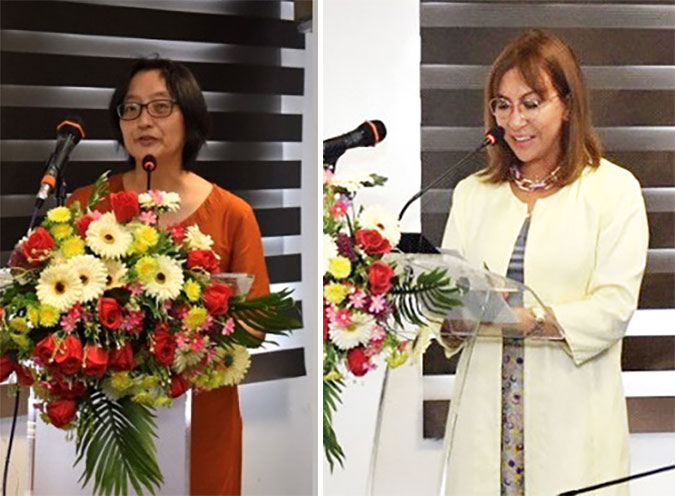
The National Training for Women Entrepreneurs on Promoting Business through E-Commerce and Digital Marketing initiated by the Sri Lanka Embassy and Permanent Mission to UNESCAP in Thailand was held from 01-03 November 2022 at Suhurupaya, Battaramulla.The training was jointly organized with the South and South-West Asia Office of the Economic and Social Commission for Asia and the Pacific (UNESCAP) in New Delhi (ESCAP-SSWA) and seven prime Government institutions in Sri Lanka with the objective to facilitate and support women entrepreneurs in Sri Lanka and to expand women’s e-commerce and digital marketing initiative in Sri Lanka.
Under the project “E-Commerce Capacity Building for Women-led Micro Small and Medium Enterprises (MSMEs) in South Asia” of the UNESCAP, 85 women entrepreneurs nominated by the Sri Lanka Export Development Board, National Crafts Council, Spices and Allied Products Marketing Board, Ministry of Women, Child Affairs & Social Empowerment, Industrial Development Board, Sri Lanka Handicrafts Board and Institute for Agro-Technology & Rural Sciences of the University of Colombo were provided hands on experience during the three day program. Suveera Saxena and Deepali Gotadke of the ESCAP-SSWA were the resource persons.
The inaugural address of the National Training was delivered by Minister of Plantation Industries and Industries, Dr. Ramesh Pathirana and welcome remarks were delivered by Director and Head, ESCAP-SSWA, Mikiko Tanaka and UN Resident Coordinator in Sri Lanka, Hanaa Singer-Hamdy.
Secretary of the Ministry of Industries of Sri Lanka, J. M. Thilaka Jayasundara, Associate Chief Digital Economy Officer, Information and Communication Technology Agency of Sri Lanka (ICTA), Sachindra Samararatne and Former Chairperson, LOLC Holdings, Rohini Nanayakkara joined the panel discussion on “Policy advocacy for creating opportunities for women entrepreneurs of Sri Lanka”
At the end of the training, the Chairman, Sri Lanka Export Development Board, Suresh De Mel delivered a special address and concluding remarks were made by Chairman, National Crafts Council of Sri Lanka, Sampath Erahapola and Chairperson, Spices and Allied Products Marketing Board, Kumudini Gunasekara.
Director and Head ESCAP-SSWA Mikiko Tanaka had bilateral meetings with Minister of Plantation Industries and Minister of Industries of Sri Lanka Dr. Ramesh Pathirana, Minister of Education Dr. Susil Premajayantha, State Minister of Foreign Affairs Tharaka Balasuriya, Foreign Secretary Aruni Wijewardane, Director General of the Sustainable Development Council Chamindry Saparamadu, Deputy Secretary to the Treasury R.M.P. Rathnayake and Director General-Planning of the Ministry of Transport & Highways, Chinthaka Hettiarachchi during her visit.





The Pakistan Navy Ship (PNS) TAIMUR and ASLAT arrived at the Port of Colombo on a goodwill visit on 12 Apr 26.
The visiting ships were welcomed by the Sri Lanka Navy in
compliance with naval traditions.
The duo of ships is commanded by Captain NIAMAT SAEED KHAN (PNS TAIMUR) and Captain NADIR MATEEN AFRIDI (PNS ASLAT).
Meanwhile, the ships are expected to conduct a Bilateral Naval Exercise LION STAR V with the Sri Lanka Navy in Colombo seas.
Latest News
Heat index likely to increase up to ‘Caution level’ at some places in the Northern, North-central, North-western, Western, Sabaragamuwa, Southern and Eastern provinces and Monaragala district


Warm Weather Advisory
Issued by the Natural Hazards Early Warning Centre at 3.30 p.m. on 11 April 2026, valid for 12 April 2026
The Heat index, the temperature felt on the human body is likely to increase up to ‘Caution level’ at some places in the Northern, North-central, North-western, Western, Sabaragamuwa, Southern and Eastern provinces and Monaragala district.
The Heat Index Forecast is calculated by using relative humidity and maximum temperature and this is the condition that is felt on your body. This is not the forecast of maximum temperature. It is generated by the Department of Meteorology for the next day period and prepared by using global numerical weather prediction model data.

Effect of the heat index on human body is mentioned in the above table and it is prepared on the advice of the Ministry of Health and Indigenous Medical Services.
ACTION REQUIRED
Job sites: Stay hydrated and takes breaks in the shade as often as possible.
Indoors: Check up on the elderly and the sick.
Vehicles: Never leave children unattended.
Outdoors: Limit strenuous outdoor activities, find shade and stay hydrated.
Dress: Wear lightweight and white or light-colored clothing.
Note: In addition, please refer to advisories issued by the Disaster Preparedness & Response Division, Ministry of Health in this regard as well. For further clarifications please contact 011-7446491.
Latest News
Sun directly overhead Cheddikulam, Kebithigollewa, Gomarankadawala and Nilaveli about 12:11 noon. today [12]

On the apparent northward relative motion of the sun, it is going to be directly over the latitudes of Sri Lanka from 05th to 15th of April in this year.
The nearest areas of Sri Lanka over which the sun is overhead today (12th) are Cheddikulam, Kebithigollewa, Gomarankadawala and Nilaveli about 12:11 noon.

PNS TAIMUR & ASLAT arrive in Colombo

Sanju Samson and Jamie Overton deliver first points for Chennai Super Kings

Arya, Prabhsimran and Shreyas help Punjab Kings ace another 200-plus chase

Beauty of Sri Lanka in focus: Global showcase blends art, diplomacy and conservation

Showers expected in the Western, Sabaragamuwa, Central, Southern, North-western and Uva provinces and in Ampara, Batticaloa and Polonnaruwa districts after 1.00 p.m.

Heat index likely to increase up to ‘Caution level’ at some places in the Northern, North-central, North-western, Western, Sabaragamuwa, Southern and Eastern provinces and Monaragala district

‘Dates have the highest sugar content to fight Coronavirus’

Sunday Island 27 December – Headlines

#SundayIsland 17th December – Headlines

Sunday Island – 28th March

Sunday Island Headlines – 21 March

Sunday Island – 21st February – Headlines
-

 News6 days ago
Lankan-origin actress Subashini found dead in India
-

 News4 days ago
AG: Coal procurement full of irregularities
-

 Business3 days ago
Israeli attack on Lebanon triggers local stock market volatility
-

 News23 hours ago
CEB orders temporary shutdown of large rooftop solar systems
-

 Business4 days ago
Hayleys Mobility introduces Premium OMODA C9 PHEV
-

 Business3 days ago
HNB Assurance marks 25 years with strategic transformation to ‘HNB Life’
-

 News6 days ago
UN Regional Director launches SL’s first Country Gender Equality Profile during official visit
-

 Sports4 days ago
DS to face St. Anthony’s in ‘Bridges of Brotherhood’ cricket encounter