
News
Understanding listed sustainability bonds and how Bank of Ceylon positions itself for a changing capital market


Sustainability is reshaping global finance, tremendously. Over the past, sustainable bonds have become a defining feature of responsible investment, bridging the gap between capital markets and long-term environmental and social goals. Now, as Sri Lanka prepares to deepen its green finance ecosystem, the conversation around sustainable debt instruments is moving from policy to practice.
Unlike traditional bonds that raise funds for general corporate or government purposes, sustainable bonds are designed to channel capital toward projects that deliver measurable positive social or environmental benefits. Green, social, and sustainability bonds fall within this rapidly expanding asset class, guided by frameworks such as the International Capital Market Association (ICMA) Sustainability Guidelines and aligned with the United Nations Sustainable Development Goals (UN SDGs). Globally, such issuances surpassed US$ 1.1 trillion in cumulative value by 2024, according to the World Bank, and this indicates investor appetite for instruments that merge profit with purpose.
In essence, a sustainable bond allows issuers to raise funds for new and existing projects that advance both environmental and social outcomes, from green projects in sectors such as renewable energy, energy-efficient construction, waste management and clean transportation to financial inclusion, women empowerment, MSME development, and access to essential services such as healthcare, and education. Green bonds, social bonds and sustainability bonds constitute the three main sustainable bond types where green and social bonds aim to raise capital to fund projects with environmental or social benefits respectively, while sustainability bonds finance projects with both positive social and environmental outcomes. What differentiates these instruments from standard corporate or government bonds is their strict requirement for transparency, use-of-proceeds monitoring, and impact reporting. Investors are purchasing returns and also accountability, often verified by independent evaluators.
In Sri Lanka, the regulatory sector is gradually aligning with these international norms. With the approval of the Securities and Exchange Commission of Sri Lanka (SEC), the Colombo Stock Exchange (CSE) introduced frameworks to facilitate green and sustainable finance, building on the Sustainable Finance Roadmap developed by the Central Bank of Sri Lanka (CBSL) in collaboration with the International Finance Corporation (IFC) in 2019. That roadmap called on financial institutions to integrate environmental, social, and governance (ESG) considerations into credit and investment decisions while encouraging the creation of sustainable financial products.
Recognising the crucial role of finance in addressing environmental and social challenges, CSE introduced the ‘GSS+ Bonds’ Regulatory Framework in March 2025 to facilitate listing of green, social, sustainability and other related bond types. This initiative, developed in collaboration with the Asian Development Bank and the SEC, modernizes the previous listing rules, replacing the term “Sustainability Bonds” with an inclusive “GSS+ Bonds” category.
Today, the country’s capital market is better prepared than ever to host such instruments. The CSE’s debt securities board has seen growing investor interest in listed debentures, with several issuances in recent years attracting strong oversubscription. Although most have been conventional or Basel III-compliant debt instruments, the momentum hints at a wider shift. As ESG principles gain traction among institutional and high-net-worth investors, the market is beginning to recognize sustainable bonds as both a credible and necessary evolution.
In fact, recent debt IPOs on the CSE have shown that investors are increasingly seeking more than yield. They are seeking alignment with values. The oversubscription of multiple corporate bond issuances in the recent past, despite economic uncertainty, reflected a steady rebound in investor confidence. Analysts note that the next frontier for the domestic bond market will be sustainability-themed instruments, which can attract international participation and diversify Sri Lanka’s funding base while supporting the country’s environmental and social commitments.
Against this backdrop, Bank of Ceylon (BOC) has been strengthening the foundations for what could become a transformative chapter in its history. The Bank’s approach to sustainability is not limited to philanthropy or compliance. It is built on a structured 3P framework, People, Planet, and Profit, which guides every aspect of its strategic and operational decision-making.
Sustainability is the cornerstone of long-term resilience and national value creation of BOC. The Bank’s efforts include a comprehensive Environmental and Social Management System (ESMS) that screens lending activities for environmental and social impacts, ensuring compliance with the National Environmental Act No. 47 of 1980 and other local regulations. BOC has also aligned its strategy with the UN Sustainable Development Goals (SDGs), committing to embed ESG principles across its value chain.
This commitment is evident in tangible results, showcased in the Bank’s recognition by the Green Building Council of Sri Lanka, which presented BOC with the Green Business Leadership Award 2024 and the Green Commitment Excellence Award 2024 for its sustainable practices and environmental stewardship. The Bank’s own operational footprint is under transformation as well and it continues to pursue its target of becoming a carbon-neutral entity.
At the governance level, the Board of Directors provides oversight through a dedicated Sustainability Committee, ensuring that sustainability considerations are integrated into policy and performance targets. This structure allows the Bank to balance its commercial goals with its social and environmental mandate, an alignment increasingly demanded by regulators, investors, and international partners alike.
To meet the next stage of market evolution, BOC’s Investment Banking Division has been positioned as a bridge between the Bank’s core banking operations and the capital market. It liaises with the Bank’s sustainability division, lending divisions that serve corporate clients and retail segments and the ESMS unit to deliver customized financial solutions that align with emerging ESG standards. Leveraging its longstanding relationships and institutional credibility, the division is prepared to facilitate new types of financial instruments, linking purpose-driven investors with meaningful domestic projects.
The potential for sustainability bonds in Sri Lanka also aligns with national economic priorities. As the country rebuilds confidence after a challenging economic cycle, sustainable finance offers a pathway to attract concessional capital, strengthen fiscal discipline, and support green growth. The Central Bank’s Sustainable Finance Roadmap 2025 highlights the need for innovative financing to achieve low-carbon and inclusive development, while the Ministry of Finance’s ongoing work on a national climate finance strategy is expected to facilitate the financing of sustainable development initiatives and building resilience to climate challenges in the country.
For issuers, these developments create both opportunity and responsibility. The transparency requirements for sustainability bonds mean that borrowers must demonstrate measurable outcomes and continuous reporting. For institutions like Bank of Ceylon, which already operates under strong governance and disclosure practices, this regulatory rigor aligns well with existing frameworks. Its planned ESG Road Map, set to achieve compliance with IFRS S1 and S2 sustainability standards by 2025, portrays its readiness for the level of accountability that sustainable finance demands.
The emergence of sustainability bonds therefore represents a deeper evolution in how finance is understood and practiced. It challenges institutions to look beyond quarterly returns and toward the social contract embedded in their role as capital intermediaries. For Bank of Ceylon, this evolution is a natural extension of its national mission and decades-long legacy as Sri Lanka’s leading state-owned commercial bank.
As sustainable investments expand globally, the question is not whether Sri Lanka will follow, but how effectively it can position itself within this shift. The regulatory groundwork is being laid, investor sentiment is turning, and financial institutions are aligning their strategies with new expectations. In that sense, BOC’s steady build-up of sustainability frameworks, reinforced by external assurance and a strong internal audit function, together with its integrated investment banking capability, are precursors to what could become a landmark move in Sri Lanka’s financial market.
Bank of Ceylon’s enduring strength, security, and stability as the Banker to the Nation remain unmatched, with total assets exceeding Rs. five trillion. The Bank’s Investment Banking Division offers a comprehensive suite of services that extend beyond traditional banking, including financial advisory for listed and unlisted debt issues such as debentures, perpetual bonds, green, social, and sustainability bonds, as well as securitizations, corporate restructuring, and private equity transactions.
Over the years, the Investment Banking Division has raised more than Rs. 100 billion through listed and unlisted debt instruments for the Bank. In 2024, it successfully raised Rs. 15 billion through a Basel III debenture issue and is now preparing to offer sustainability bonds, reinforcing its commitment to sustainable financing. The Bank has also received in-principle approval from the Securities and Exchange Commission of Sri Lanka (SEC) to function as a Corporate Finance Advisor. The Division also provides underwriting services for initial public offerings (IPOs) and supports financing for large infrastructure and development projects.
Bank of Ceylon is a Professional Clearing Member of the Colombo Stock Exchange (CSE) and provides trustee and custodian services for unit trust funds and corporate clients, with funds exceeding Rs. 500 billion.
In addition, the Division operates a dedicated business unit for wealth management clients under the SEC’s Investment Manager license.
For more information:
Investment Banking: Chandima – 011 244 8348 / 076 781 3312
Wealth Management: Roshini – 011 244 0081 / 074 275 4931

News
The Government is taking steps to regulate early childhood education to ensure quality education while enhancing the professionalism of preschool teachers. — PM


Prime Minister Dr. Harini Amarasuriya stated that the Government is taking steps to maintain early childhood education within an appropriate regulatory framework, while ensuring quality education by enhancing the professionalism of preschool teachers.
The Prime Minister made these remarks while participating in the awareness programme for preschool teachers of the Puttalam District on the National Early Childhood Education Curriculum Framework, held under the theme “A Safe World for Children, A Creative Future Generation” on Friday [16th of January] at the Sudasuna Hall in Chilaw.
The Prime Minister stated,
“The main objective of our government in 2024 was to bring about a transformative change in this country. We bear a major responsibility in achieving that transformation. When we assumed office, one of our primary responsibilities was to build a stable and resilient economy. However, I believe that with equal responsibility and commitment, our government has prioritized creating a transformative change in the education system of the country. We assumed office with that objective in mind. The discussions within our party and political movement on the necessary changes in education did not begin recently. They are the result of a long-standing process.
This transformation cannot be achieved overnight or within a single year. It is a step-by-step process. When implementing this decisive and qualitative change within the education system, it is essential to consider the system as a whole. We made this intervention by examining every stage of a child’s educational journey. Therefore, we have recognized early childhood education, from age one to age five, as an integral part of education and development.
Thereby, Early childhood development is viewed as the very first step of our education structure. At present, early childhood education exists in an unregulated manner. Our aim is to develop this early childhood education in an organized and systematic way, while enhancing the professionalism of teachers and ensuring quality education within an appropriate regulatory framework.
Accordingly, the Ministry of Women and Child Affairs and the Ministry of Education have jointly appointed a committee and initiated discussions to formulate a policy and curriculum framework for early childhood education. During the past year, we developed the preschool curriculum framework. We are working towards implementing a unified curriculum across all preschools in a structured manner. It is essential to integrate early childhood development with primary, secondary, and university education. Early childhood development is one of the most critical stages of an individual’s life. The responsibility of socializing the child, introducing them to society in a structured manner, and nurturing a disciplined, empathetic individual lies with you. This is not something that can be achieved at the primary level or beyond.
There is a common criticism that children are not taught letters and numbers at preschool. However, early childhood development is not about formal schooling. It is about helping children to develop their social skills.
It is also an objective of our government to ensure that both preschools and schools become places where parents can confidently leave their children, knowing they are safe.
We are aware of the issues relating to your allowances and pensions. Discussions have been held in this regard between the Ministry of Education and the Ministry of Women and Child Affairs. Granting due recognition to preschool certificates during school admissions is also very important, and the government’s attention has been drawn to all these matters”.
The event was attended by Minister of Public Administration, Provincial Councils and Local Government prof. Chandan Abayarathna; Members of Parliament Gayan Janaka, Hiruni Wijesinghe, and Mohamed Faisal; officials of the North Western Province Early Childhood Education Development Authority; and a large number of preschool teachers from the Puttalam District.
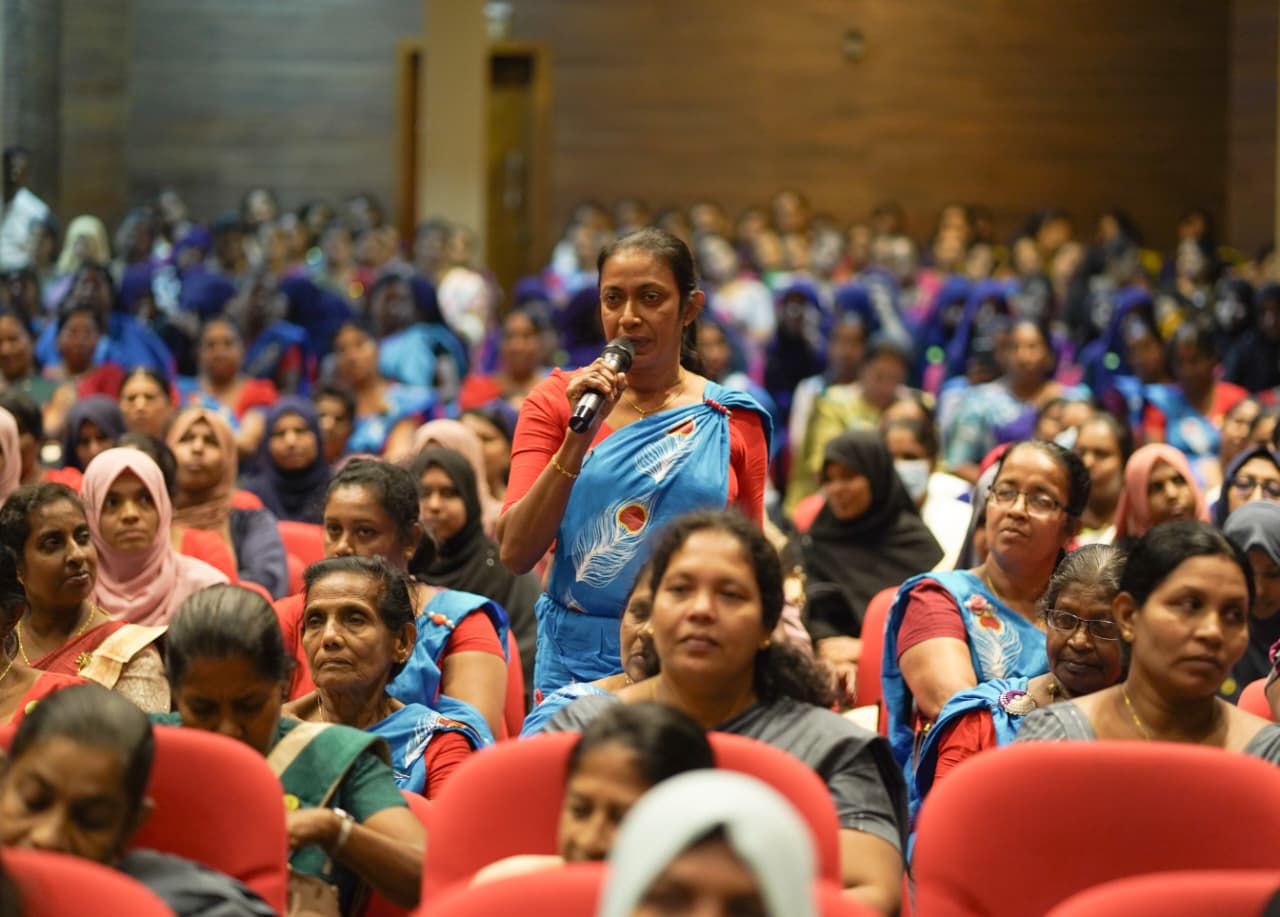

[Prime Minister’s Media Division]


Police have stepped up their crackdown on organised crime, after securing Interpol Red Notices for 95 suspects believed to be hiding overseas.
Police Spokesman SSP F. U. Wootler told a media briefing yesterday that the move marked a major escalation in efforts to track down and extradite high-profile figures linked to organised crime syndicates and online fraud networks.
He said the strategy was already producing results. In 2024, Sri Lanka secured the return of 10 suspects through Interpol channels, while a further 11 were extradited in 2025 to face legal proceedings.
In addition to Red Notices, authorities have relied on formal legal mechanisms to overcome jurisdictional barriers. “During the 2024–2025 period, 21 suspects were extradited under the Extradition Act,” SSP Wootler said.
The briefing coincided with three more fugitives being escorted back to Sri Lanka yesterday following the issuance of Interpol Red Notices.
SSP Wootler said many of the fugitives had continued to coordinate criminal activities here from abroad, including sophisticated online scams, underscoring the importance of international cooperation.
Two male suspects, for whom Red Notices had been issued and who were overseas, and a female suspect wanted in connection with defrauding state funds, were flown back.
Following their arrival yesterday morning at Katunayake Airport, they were taken into custody by a team of officers from the CID.
The arrested suspects are residents of Kandana and Uragasmanhandiya, aged 30 and 52, respectively. The female suspect is a 56-year-old resident of Mount Lavinia.
The suspect residing in Kandana is an individual wanted in connection with an attempted murder. It has been revealed that while overseas, he is connected to a range of crimes, including orchestrating a shooting incident that resulted in a homicide in the Kandana area on 2025.07.03. This suspect has been handed over to the Officer-in-Charge of the Kelaniya Division for further investigations.
The one hailing from Uragasmanhandiya is a suspect wanted in connection with carrying out homicides using sharp weapons and being involved in a series of organised crimes in the Uragasmanhandiya area. This suspect has been handed over to the Officer-in-Charge of the Elpitiya Division for further investigations.
The female suspect, residing in Mount Lavinia, who is reported to have worked at an Embassy in 2014, is an accused in a case where the Criminal Investigations Department is investigating the defrauding of state funds. She has been sentenced to imprisonment, fines, and also ordered to compensate victims by the Colombo High Court.
“These operations were carried out with the strong support of the Government of the United Arab Emirates, including Abu Dhabi International Police, Dubai Police, as well as Sri Lankan diplomatic missions,” he said.
Interpol Red Notices function as international alerts requesting law enforcement agencies worldwide to locate and provisionally arrest individuals pending extradition.
Wootler said efforts would continue to identify and pursue suspects operating from foreign jurisdictions, particularly those involved in organised and cyber-related crimes posing threats to national security.
By Norman Palihawadane and Hemantha Randunu

Leader of the Pivithuru Hela Urumaya (PHU), Udaya Gammanpila, yesterday launched a scathing attack on outgoing United States Ambassador to Sri Lanka Julie Chung, accusing her of interfering in Sri Lanka’s internal affairs and exerting undue influence over recent political developments.
Addressing a press conference in Colombo, Gammanpila said Chung’s departure, after a four-year tenure, marked a “day of national relief,” claiming her presence had been harmful to the country.
He said patriots marked the occasion by sharing kiribath (milk rice), which he described as a symbolic celebration.
Gammanpila alleged that Ambassador Chung had remained in Sri Lanka longer than the customary three-year diplomatic term because of, what he described as, her success in bringing the country under American influence. Drawing comparisons with past foreign diplomats, he claimed that Chung was the most influential envoy since Indian High Commissioner J.N. Dixit in the 1980s. He alleged that successive Sri Lankan governments had failed to challenge what he described as interference by the envoy.
The PHU leader accused Chung of playing a behind-the-scenes role in the 2022 protest movement, commonly known as the Aragalaya, claiming it was orchestrated to destabilise the country. He alleged that young protesters were unknowingly “acting out a foreign script” under the guise of patriotism.
Gammanpila also alleged that Chung played a key role in elevating the National People’s Power (NPP), which he referred to as the “Malimawa” movement, into a governing force in 2024. He claimed the movement had been transformed from its earlier ideological roots into, what he described as, a pro-Western political project, asserting that President Anura Kumara Dissanayake had come to power with foreign backing. He cited a photograph shared on Chung’s social media account of her visit to the NPP headquarters as evidence of what he termed political proximity.
According to Gammanpila, Ambassador Chung’s public criticism of governance issues sharply declined following the change of government. He alleged that while she had frequently commented on incidents under previous administrations, she had remained silent on alleged corruption and governance failures over the past 14 months.
Turning to the future, Gammanpila urged caution regarding the incoming US Ambassador, Eric Meyer, stating that any engagement on religious or cultural matters should be viewed carefully. He called on President Dissanayake to pursue an independent foreign policy, free of external influence.
Gammanpila also criticised the government over, what he described as, repeated “policy blunders,” particularly in relation to issues affecting children and social values. He cited several instances, including proposals to promote Sri Lanka as a destination for same-sex couples, educational material controversies, and a recent People’s Bank advertisement that he claimed subtly promoted same-sex symbolism. While stating that he held no animosity towards the LGBTQ community, Gammanpila said he opposed, what he described as, attempts to influence children through state institutions.
In addition, the PHU leader condemned legal action taken by the Coast Conservation Department against nine individuals, including four Buddhist monks, for installing a Buddha statue within a coastal conservation zone in Trincomalee. He described the arrests as discriminatory, alleging that similar structures belonging to other religions and commercial entities had been overlooked.
Calling the current administration “anti-Buddhist,” Gammanpila urged authorities to apply the law equally and not just in words, and “not to turn legal frameworks into instruments against Buddhism.” He also accused members of the government of ingratitude, alleging that many had once sought refuge in temples during periods of political violence.
By Anuradha Hiripitiyage

Floods kill more than 100 across southern Africa as rains intensify

Lanning, Litchfield and Pandey help UP Warriorz do the double over Mumbai Indians

Ugandan leader to extend 40-year rule after being declared winner of contested poll

Iran supreme leader blames US for deadly protests

Trump names Tony Blair, Jared Kushner to Gaza ‘Board of Peace’

The Government is taking steps to regulate early childhood education to ensure quality education while enhancing the professionalism of preschool teachers. — PM

‘Dates have the highest sugar content to fight Coronavirus’

Sunday Island 27 December – Headlines

#SundayIsland 17th December – Headlines

Sunday Island – 28th March

Sunday Island Headlines – 21 March

Sunday Island – 21st February – Headlines
-

 Business3 days ago
Koaloo.Fi and Stredge forge strategic partnership to offer businesses sustainable supply chain solutions
-

 News20 hours ago
UNDP’s assessment confirms widespread economic fallout from Cyclone Ditwah
-

 Business7 days ago
Dialog and UnionPay International Join Forces to Elevate Sri Lanka’s Digital Payment Landscape
-

 Editorial20 hours ago
Crime and cops
-

 Editorial2 days ago
The Chakka Clash
-

 News7 days ago
Sajith: Ashoka Chakra replaces Dharmachakra in Buddhism textbook
-

 Features7 days ago
The Paradox of Trump Power: Contested Authoritarian at Home, Uncontested Bully Abroad
-

 Features7 days ago
Subject:Whatever happened to (my) three million dollars?