
News
UN General Assembly demands Russia withdraw troops from Ukraine


Most of the world’s nations have voted in favour of a United Nations resolution demanding that Russia “immediately, completely and unconditionally” withdraw its military forces from Ukraine, in a powerful rebuke of Moscow’s invasion of its neighbour.
The resolution was adopted on Wednesday at a rare emergency session of the UN General Assembly.
It was supported by 141 of the UN’s 193 members.
China, India and South Africa were among the 35 countries that abstained, while just five – Eritrea, North Korea, Syria, Belarus and of course Russia – voted against it.
The resolution “deplores” Russia’s “aggression against Ukraine” and condemns President Vladimir Putin’s decision to put his nuclear forces on alert.
While General Assembly resolutions are non-binding, they carry political weight, with Wednesday’s vote representing a symbolic victory for Ukraine and increasing Moscow’s international isolation.
Even Russia’s traditional ally Serbia voted against it.
UN Secretary-General Antonio Guterres said the General Assembly’s message was “loud and clear”.
“End hostilities in Ukraine – now. Silence the guns – now,” he said in a statement. “As bad as the situation is for the people in Ukraine right now, it threatens to get much, much worse. The ticking clock is a time bomb.”
Nearly every General Assembly speaker unreservedly condemned the war.
“If the United Nations has any purpose, it is to prevent war,” said the United States’s UN envoy, Linda Thomas-Greenfield.
She said Russia was “preparing to increase the brutality of its campaign” and was “moving exceptionally lethal weaponry into Ukraine”, including cluster munitions and vacuum bombs.
Ukraine’s UN envoy, Sergiy Kyslytsya, called the resolution “one of the building blocks to build a wall to stop” the Russian offensive, and urged countries to support the text.
“They [Russia] have come to deprive Ukraine of the very right to exist,” Kyslytsya told the Assembly ahead of the vote. “It’s already clear that the goal of Russia is not an occupation only. It is genocide.”
‘Double standards’
But Russia’s envoy denied that Moscow was targeting civilians.
Vassily Nebenzia repeated Russia’s assertion its action was a special military operation aimed at ending purported attacks on civilians in the self-declared Moscow-backed republics of Donetsk and Luhansk in eastern Ukraine.
Nebenzia charged that Ukrainian forces were using civilians as human shields and deploying heavy weapons in civilian areas.
“Your refusal to support today’s draft resolution is a vote for a peaceful Ukraine free from radicalism and neo-Nazism,” he told the Assembly.
Russia’s ally Belarus also offered a staunch defence of the invasion.
Ambassador Valentin Rybakov blasted sanctions imposed by the West on Russia as “the worst example of economic and financial terrorism”.
And he followed other Russian allies, such as Syria, in condemning the “double standards” of Western nations who have invaded countries including Libya, Iraq and Afghanistan in recent decades.
The text of the resolution – led by European countries in coordination with Ukraine – has undergone numerous changes in recent days. It no longer “condemns” the invasion as initially expected, but instead “deplores in the strongest terms the Russian Federation’s aggression against Ukraine”.
The United Arab Emirates (UAE), which had voted down a similar text at the UN Security Council, came out in favour of the new text.
“Right now, we recognise that this resolution adopted here today is a necessary signal of where we need to be going,” said the UAE envoy, Lana Nusseibeh.
“Resigning ourselves to a circle of perpetual violence and sanctions that only add to the suffering of civilians diminishes us all.”
Countries that abstained from Wednesday’s vote said the resolution was not conducive for dialogue.
China’s envoy, Zhang Jun, said the resolution did not undergo “full consultations with the whole membership” of the assembly.
“Nor does it take full consideration of the history and complexity of the current crisis. It does not highlight the importance of the principle of indivisible security or the urgency of promoting political settlement and stepping up diplomatic efforts,” he said.
“These are not in line with China’s consistent positions.”
China, which has grown increasingly close to Russia in recent years, says it will not participate in Western sanctions against Moscow.
South Africa’s envoy Mathu Joyini meanwhile said her country was abstaining from the vote because “the resolution we have considered today does not create an environment conducive for diplomacy, dialogue, and mediation”.
The last time the Security Council convened an emergency session of the General Assembly was in 1982, according to the UN website.
Source: Al Jazeera


The cut-off marks for the admission of students to Grade 06 of the schools based on the results of the 2024 Grade 5 Scholarship Examination have been released by the Ministry of Education and can be viewed by clicking on the following link.
https://g6application.moe.gov.lk/
Latest News
President focuses on streamlining, integrating and developing the manufacturing sector for greater efficiency

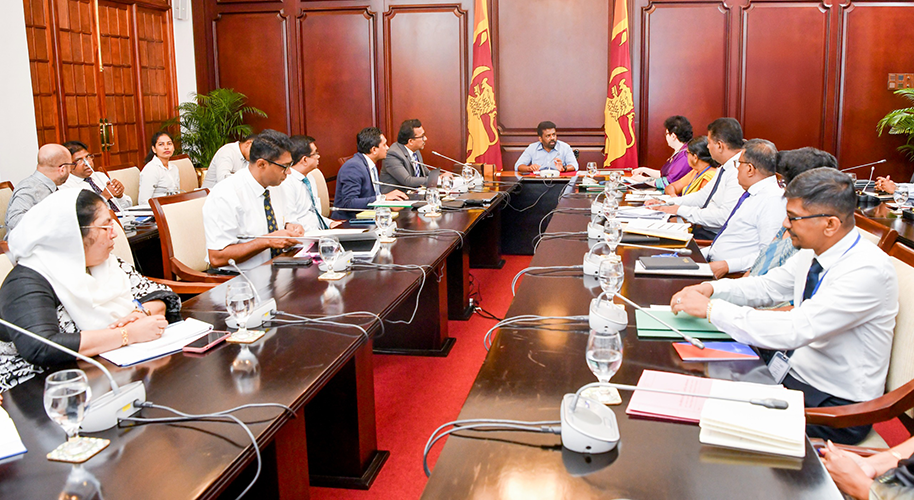
A meeting between President Anura Kumara Disanayake and officials of the Ministry of Industry and Entrepreneurship Development was held today (14) at the Presidential Secretariat.
Discussions focused on enhancing the efficiency, integration and development of the manufacturing sector to strengthen the national economy, as well as addressing the challenges associated with these efforts.
Key topics included government-led initial investments and proper regulation to empower small and medium-scale entrepreneurs, the establishment of local small-scale industries within investment zones and challenges related to business loans faced by small and medium-scale enterprises.
The President directed officials to expedite the release of lands allocated to the Ministry of Industry that have not been released so far.
Further discussions were held on maintaining and regulating import restrictions to strengthen local industries, prioritizing local suppliers in construction industry procurement and resolving issues in the gem and jewellery sector to ensure its full contribution to the national economy.
The President also instructed officials to swiftly implement tax exemptions for tourists to boost the gem and jewelry industry.
Minister of Industry and Entrepreneurship Development Sunil Handunnetti, Deputy Minister of Industry and Entrepreneurship Development Chathuranga Abeysinghe, Secretary to the President Dr. Nandika Sanath Kumanayake, Secretary to the Ministry of Industry and Entrepreneurship Development Thilaka Jayasundara and several other ministry officials attended the meeting.
[PMD]
News
Massive TN fishing fleet poaching in SL waters: Only India’s Central Govt. can halt it – Minister Chandrasekar


By Shamindra Ferdinando
Fisheries, Aquatic and Ocean Resources Minister Ramalingam Chandrasekar yesterday (13) emphasised that only the Central Government of India could prevent the Tamil Nadu fishing fleet from poaching in Sri Lankan waters.
The Minister said that the Central Government of India in consultation with Tamil Nadu should without further delay deploy the Indian Navy and Coast Guard to prevent large-scale organised crossing of the Indo-Lanka maritime boundary.
The JVPer said so when The Island asked him what he intended to do to curb poaching and the destructive fishing practice known as bottom trawling practised by the Tamil Nadu fishing fleet in our waters. “Our Navy and Coast Guard regularly conduct operations in the northern waters to deter the TN fishing fleet. But only India got the wherewithal to stop this menace,” Chandrasekar said.
Responding to another query, the lawmaker stressed that the NPP government would not hesitate to take a firm stand on the issue. “We believe that India should prevent TN fishing fleet from crossing the maritime boundary,” Minister Chandrasekar said, adding that during his interactions with relevant Indian authorities and diplomatic staff, including High Commissioner Santosh Jha, he had taken up the issue.
The Minister said that he had explained the difficulties experienced by the northern fishing community due to the Indian fishers stealing their catch, when Charles Callanan, Director, UNOPS South Asia paid a courtesy call on him recently. They may not intervene or comment on this matter but there was no harm in briefing them of the actual situation on the northern seas, the Minister said.
The people of the northern and eastern regions, too, overwhelmingly voted for the NPP, the lawmaker said, adding that therefore the problems faced by the northern and eastern fishers should be addressed.
Minister Chandrasekar said that President Anura Kumara Dissanayake had, during his three-day official visit to New Delhi in January, raised the issue at the highest level.
Asked whether he was aware of the protests that had been directed at Tamil National Alliance (TNA) leader S. Sritharan, MP, over his recent visit to see Tamil Nadu fishermen held at the Jaffna prison, Minister Chandrasekar said an NPP lawmaker too visited them. “We never sought media coverage for our visit to Jaffna prison,” Minister Chandrasekar said, adding that the government was determined to push for tangible solutions for recurring issues.
Acknowledging that various interested parties both here and in India sought political mileage at the expense of poaching by the Tamil Nadu fishing fleet, Minister Chandrasekar said that Sri Lanka had no option but to continue naval operations to deter encroachments.
Quoting northern fishers, Minister Chandrasekar alleged that at the rate Tamil Nadu fishing fleet stole Sri Lanka’s fisheries resources nothing would remain in 15 to 20 years’ time. The minister appreciated the efforts made by the navy to protect the interests of Sri Lankan fishermen.
Tamil Nadu poaching can be an issue at the forthcoming Local Government polls. There had been several incidents involving the navy and Tamil Nadu fishing vessels during the past couple of years. One incident claimed the life of a Special Boat Squadron man while two Indian fishers were shot and wounded in another. The second incident prompted India to summon Sri Lanka’s Acting HC in New Delhi to the Foreign Office where a warning was issued over the incident.
Minister Chandrasekar said that India should take meaningful measures to stop illegal fishing, thereby avoiding unnecessary incidents. The minister acknowledged that in spite of quite a number of arrests over the years, the Tamil Nadu fishing fleet seemed bent on continuing with the lucrative practice.


2024 Grade 5 Scholarship Examination cut-off marks released

British man killed by president’s convoy in Kenya hit-and-run

President focuses on streamlining, integrating and developing the manufacturing sector for greater efficiency


-

 News7 days ago
Private tuition, etc., for O/L students suspended until the end of exam
-

 Editorial6 days ago
Ranil roasted in London
-
 Latest News6 days ago
S. Thomas’ beat Royal by five wickets in the 146th Battle of the Blues
-
 News7 days ago
Teachers’ union calls for action against late-night WhatsApp homework
-
 Features6 days ago
The JVP insurrection of 1971 as I saw it as GA Ampara
-

 Opinion5 days ago
Insulting SL armed forces
-
 Features6 days ago
Mr. JR Jayewardene’s passport
-

 Editorial7 days ago
Police looking for their own head