
Features
Ukraine: The last warning!

by Kumar David
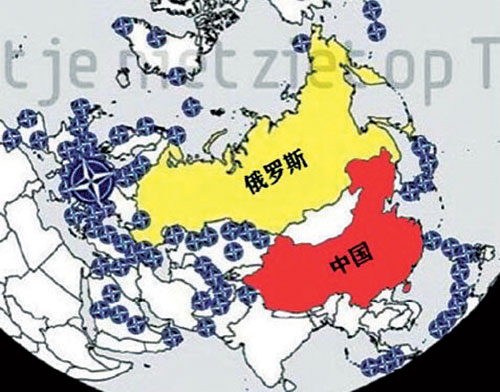
Ukraine joining NATO or stationing nuclear weapons is intolerable. It is a threat to Russia’s security but much, much more serious it is a stage in the realignment of global power relations by neo-imperialism and finance-capital and a step towards future wars. Otherwise it is not possible to understand why NATO does not give Russia a formal guarantee that Ukraine will never be allowed to join. It’s not that Biden, or NATO or finance-capital want wars; it’s that stuff just happens when conducive circumstances materialise. I have provided a map of how Russia and China are strangled by a multitude of American and NATO military bases.
Having made this crucial concern explicit I add that the invasion that Putin launched on 24 February was premature, unpopular, excessive and the outcome is doubtful. Diplomatic and tactical options had not been exhausted. The 190,000 troops he sent are inadequate for the onerous task of taking and holding Ukraine for any length of time. Frustrated by slow progress and dogged Ukrainian resistance, flummoxed by a tornado of sanctions and illegal acquisition of Russian bank assets, and flustered by a blanket ban on Russian TV and broadcasts throughout the West whose citizens are only aware of half the truth, Western media now alleges that he has unleashed the full force of aerial bombardment and artillery. Yes, this is half the story.
For a long game Putin needed a larger force, deeper pockets, preparation of the Russian people and strong global alliances. He did none of this and is now pretty much isolated. He is said to be a master strategist but this time he has blundered. He promised the world that he would not invade and then did just that and blew his credibility. Russian economic and financial arrangements are being scorched by the West’s economic might. Imperialism’s hope is to bring Russia to heel and eventually forge a grand alliance against the alternative superpower, China. Ukraine and Putin are small change in this grand game of global domination. The West’s objective is to crush a Russia that is not under its control and to this end even a transition of leadership in Russia is possible in the months or year ahead.
It is true that the US, NATO, capitalist Europe and the government in Kiev have for months, if not years brushed aside Russia’s unquestionably justified security concerns. In one of the best analysis I have seen a certain Vladimir Pozner, who I have not heard of before, argues that the West created Putin to be what he is today:
Russia has offered Kiev conditions for stopping the offensive; an undertaking never to join NATO and a promise to never station nuclear weapons in Ukraine; similar to what the Americans did to Cuba in 1962. Kiev should accept the conditions though it will anger America and NATO. In truth, I wonder is it Putin who is being naïve? Has he not learnt from repeated false promises since 1991? But he has no alternative now; he wants sanctions which are biting deep lifted. The West is to blame for not making it clear from the beginning to Ukraine that it would never be allowed to join NATO. Why did it not do so? Because it needed a handle to screw the Russians; but the sorcerer’s apprentice has now broken out of control.
Global strategic and more important economic relationships have entered a period of profound change. The China-Russia economic equation will be transformed in the next decade into an aiya-malli (China-Russia respectively) relationship. The tens of billions China is pouring into the Second Silk Road can be more profitably and reliably invested nearer home. The high points will be energy, Chinese industries in Russia (why waste good money in god-forsaken Africa, Pakistan and Lanka?), high-tech and military high-tech to blunt the edge of American leadership, and most important, enabling a new global financial system that will bypass dollar-dominance. Yes, it’s a decade long process but it will start now. Furthermore, events in these weeks are a dress-rehearsal for when China physically acquires Taiwan; there is nothing Beijing sees more clearly than that.
But Putin should have persisted in diplomatic efforts unless Kiev made a practical move to NATO membership. A decades old clause in the Ukrainian Constitution does not amount to an imminent move. Yes, if Ukraine’s accession to membership was imminent it is tantamount to a declaration of war but that was not the case. However, what is more sinister and dangerous is that the US and NATO have lied time again promising not to expand NATO up to the Russian border and broken that pledge every time inching ever closer. While condemning Putin’s heavy-handed humanitarian, military and diplomatic blunders, Russia is justified in refusing to let anyone cross the aforesaid red-line. But I think Putin could have stopped NATO from enlisting Ukraine without going to such extremes.
The Red Cross estimates that 2.5 million Ukrainian refugees have fled the country. Damage to buildings is extensive (the two sides blame each other), civilian deaths add up to several hundred and thousands of soldiers on both sides have perished. Large anti-Putin demonstrations take place all over Europe each day and sizable spontaneous ones in many Russian cities. The tussle between NATO and financial powers that set its agenda on one side, and the you-know-who other side, seems endless. Please permit me unpoetic bowdlerisation:
Greed and power, ranging for payoff,
With the devil by their side have come hot from hell,
Cry ‘Havoc!’ and let slip the dogs of war
While carrion men will soon groan for burial.
Next let me do a thought experiment to give my Lankan readers a grasp of what’s similar and what’s not in our own story. The ethnonym Ukrainian is recent, just 20th Century (post-1917); previously, since the 14 hundreds the people called themselves Ruthenian. Afterwards they called themselves Little Russians (Malorossy) especially after Catherine the Great annexed the eastern portion – the two provinces now recognised by Russia as independent countries and the Crimean Peninsula in the 1770s. The larger portion in the west was overrun by different kingdoms till 1917 when all Ukrainians were recognised as a “nation” and the territory incorporated as a republic of the USSR. Compared to the old-Sinhalese, and Chola and Pandya periods of Sri Lanka it was a more recent, complicated and messy story. Nevertheless, the country does have two linguistic groups, about 80% Ukrainian speakers and about 20% Russian speakers.
The cultural relationship, apart from being more recent (one millennium in Ukraine as opposed to a little over two in our case) it is also thornier. Kiev, historically, was the religious, cultural and dynastic epicentre of Russian society since about 900AD. That is, it was Russia’s Anuradhapura but located in the “Tamil part” of the country. Catherine “took it back” nearly two millennia after Dutugemunu took back Anuradhapura. The Russian speaking portion, the Donbas region in which the two independent new states (Donetsk and Luhansk) are located are in the east and border Russia. An interesting thought experiment is, what if the Palk Strait was land, what if the Jaffna Peninsula was joined to India by land as it was for most of the 80,000 years prior to 10,000 BC? In my estimate the history of Lanka, Eelam and the IPKF (a Putinesque invasion) would have been immensely different. It’s not productive for me to speculate but readers can picture all sorts of outcomes in that scenario.
Nevertheless, I do not believe that India has any wish to incorporate our Lanka into the Union. It would have to be mad to wish to acquire this nation of loonies; neither Delhi nor Madras are that insane. India’s motives are related to geopolitical strategy; it does not want China or any great power to secure military facilities on its southern flank. In this the approach is akin to Russian strategy in Ukraine. Those who suggest that Putin is motivated to resurrect the Soviet Union, or a Russian Empire encompassing Russia, Belarus, Georgia and Ukraine must imagine that Putin is stark raving mad and has no grasp of the difference between the possible and impossible. Putin has blundered (see my “Putin’s self-inflicted fiasco”, Colombo Telegraph March 2) but he is not looney. “Ukraine will not be allowed to join NATO; no nuclear weapons can be stationed there; it will have to remain a neutral buffer state”; that’s it. This bottom-line I support. What about a nuclear war? Well the way Putin sees it a nuclear stand-off is already here. Russia’s options are certainty of nuclear war down the line as the West expands its strategic, imperialistic-finance-capitalist options, or a hard bargain now.
In this context then the conditions India has set out for a billion-dollar loan if Basil’s oft deferred visit to Delhi is to materialise are tougher. The demands include maritime security agreements to strengthen India’s strategic interest around Trincomalee, surveillance aircraft for the Air Force, a ship repair dock in Trinco, posting an officer at an intelligence centre, the reopening Palaly airport for commercial operations and cultural projects in the Jaffna peninsula.
In respect of post-Soviet Russia, the question can be asked “Is Putin a communist?” The answer is a resounding NO. Putin’s faith is known and never in doubt; he is a is a devotee of the Russian Orthodox Church. He has helped and channelled huge funds to the Orthodox Church, the rebuilding of churches and to the spread of its tentacles. You may think this good or bad – are the saffron-obsessions of all our presidents and PMs since independence, good or bad? I think bad (ditto Putin), you may think otherwise. That’s not the point; the point is that he is not a communist in theory, ideology or practise; OK fine, that’s his right. Incidentally he is also an anti-Leninist and says the “thesis of the right of nations to self-determination” is harmful and responsible for the fragmentation of the USSR in 1991. Ukraine is confronted by an Orthodox Christian; we have a Hindutva fanatic on our doorstep.
Living next door to a big power is knotty. Infamous instances where war was/is certain if a line is crossed are:
The United States, the Monroe Doctrine and Cuba 1962.
China, the 9-dash line and refusal to permit any foreign forces to be stationed in Taiwan.
Russia and Ukrainian membership of NATO.
India and the point-blank stipulation of no Chinese military bases in Lanka.
The information blackout imposed by both sides turns the Western and Russian public into ignoramuses. Russian TV and broadcasts are banned throughout the EU. YouTube, Google, Meta and all the others prohibit Russian content. Western intelligence has successfully jammed RTV (the Russian channel) from many parts of Asia. The vapid BBC and mouthpiece-Economist are Western tools reminiscent of the Bush-Blair days where no counterpoint was heard. Likewise, Russia has introduced draconian laws including hash prison terms for anyone who opposes Putin’s way of talking or thinking. It is important for the citizens of the world to know all this and not swallow the daily doses of misinformation and false “analysis”. Humanity at large, not just Lanka’s hungry, electricity and fuel deprived masses, is passing through one of the worst of all possible times.
[Wednesday, 9 March 2022, noon GMT]


The launch of Sri Lanka’s first locally manufactured self-dialysis solution bags by Kelun Lifesciences has coincided with the World Kidney Day.
The company said the new supply bags, designed for home-based self-dialysis treatment, would benefit thousands of Sri Lankans suffering from chronic kidney disease by allowing them to undergo treatment in the comfort of their homes.
The launch represents a significant development in the country’s healthcare sector as the dialysis solutions are produced at Sri Lanka’s only sterile injectable manufacturing facility to receive the prestigious EU Good Manufacturing Practice (EU GMP) certification.
Company officials said the certification places Sri Lanka among a small group of nations capable of producing sterile pharmaceutical products under the strict regulatory standards required by the European Union.
“This milestone elevates Sri Lanka into the same elite tier as established pharmaceutical manufacturing nations such as Germany and Switzerland,” the company said, noting that the EU certification also enables the export of locally produced sterile medicines to highly regulated global markets.
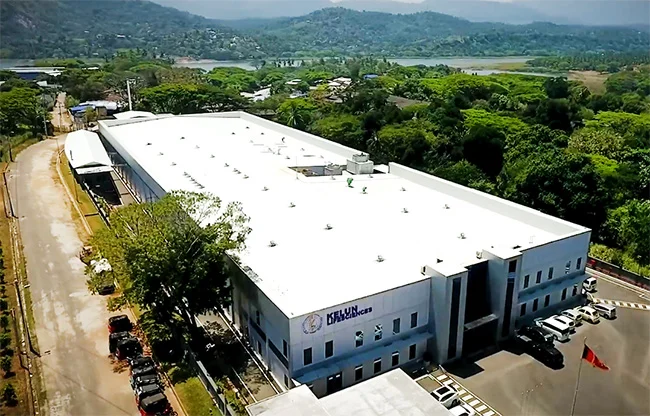 The newly introduced self-dialysis bags support a treatment method known as Continuous Ambulatory Peritoneal Dialysis (CAPD), which allows patients to perform dialysis themselves without frequent hospital visits.
Health sector specialists say the technology can significantly ease the burden faced by patients with chronic kidney disease, many of whom must travel long distances for treatment several times a week.
“With this technology, patients can carry out dialysis in their own homes. It gives them greater independence and restores valuable time to their lives,” company officials said.
Kelun Lifesciences noted that the local production of dialysis solutions would also enhance the country’s health security by reducing reliance on imported medical fluids.
The company said replacing imported dialysis fluids with locally manufactured alternatives would help retain millions of dollars in foreign exchange annually while strengthening Sri Lanka’s pharmaceutical manufacturing capacity.
Officials added that the EU-certified facility would also open new avenues for export earnings, enabling Sri Lanka to compete in high-value pharmaceutical markets.
The initiative coincides with the global theme of World Kidney Day 2026, which emphasises the need to “care for people and protect the planet.”
Kelun Lifesciences said producing dialysis solutions locally would also reduce the environmental impact associated with long-distance shipping of medical supplies.
Industry analysts say the development represents a step forward in Sri Lanka’s efforts to transform itself from a consumer of pharmaceutical imports into a producer of high-quality medical supplies for both domestic use and export.
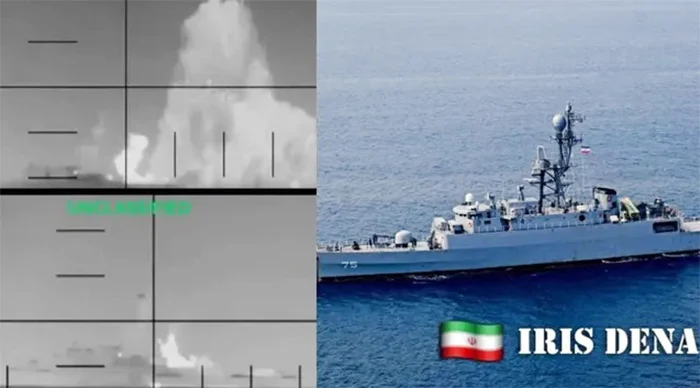
 The US Navy’s torpedo attack on the Iranian frigate, IRIS Dena, on 4th March 2026, just outside Sri Lanka’s territorial waters, killed over 80 Iranian sailors. The Sri Lanka Navy rescued over 30 sailors and provided medical assistance for them in Galle while also recovering the floating corpses of the victims. Thereafter, a second Iranian naval vessel, the IRIS Bushehr, which also requested permission to dock, was permitted into Trincomalee by the Sri Lanka Navy, after separating its crew from the ship and bringing them to Colombo. A third ship, the IRIS Lavan, an amphibious landing vessel, requested to dock in the Southern Indian port of Cochin, with 183 crew, on the same day the Dena was attacked, and has been there since.
There are many aspects of these three incidents that have not been dealt with by the mainstream media, with any degree of seriousness, and warrants deeper analysis.
While the US and Iran are at war, the destruction of the frigate happened within Sri Lanka’s Exclusive Economic Zone, but outside its territorial waters within which other countries, too, have rights of navigation. That is, this was far away from the main theatre of war in West Asia. But with this unprovoked attack in the Indian Ocean, the war and its consequences have come to Sri Lanka and India’s home-turf. The Dena was taking part in the MILAN 2026 naval exercise, organised by the Indian Navy, from 15th – 25th February, 2026, in which the US was also scheduled to take part, but, interestingly, withdrew from at the eleventh hour. One of the requirements of this exercise was for participating vessels to not carry ammunition. The Dena would have ordinarily been armed with various missiles and guns, including anti-ship missiles. Since the US was also supposed to take part in the exercise, this crucial information would also have been part of the US’s knowledge.
In this sense, it was an unprovoked attack against a ship that the US Navy knew well could not have defended itself. In real terms, this is no different from the US-Israeli alliance’s bombing of the girls’ school, ‘Shajareh Tayyebeh,’ in the town of Minab, in southern Iran, on 28th February, killing 165 people who were mostly children. Again, unprovoked and even worse, defenseless. In more recent times, President Trump has blamed this attack on the Iranians themselves, and as usual, without evidence.
The US attack changes the rules of the game. This establishes that any unarmed ship – military or otherwise – is fair game to any state which has the wherewithal to attack and get away with it. The US’s usual bravado, hero-centric narratives and talk of being fair in military contexts has been typified by countless Hollywood war movies, from Rambo to Sniper. However, US Secretary of Defence Pete Hegseth has clearly indicated the present reality and precedent when he noted the US would now ignore “stupid rules of engagement” and “[punch] them while they’re down.” Hegseth and the US war machine have now given Iran and anybody else who wishes to engage with the US, the same set of rules of engagement governed under the Law of the Jungle.
The sinking of the Iranian frigate, Colombo’s rescue of the victims and providing protection to the Bushehr and its crew, and India offering refuge to the IRIS Lavan and its crew but remaining silent about it until after the news on the Sri Lankan action broke out, open many questions for reflection.
All three ships had been invited by the Indian Navy to take part in an international exercise involving over 70 countries. The crew of the Dena had even paraded in the presence of the Indian President not too long before their untimely end. Having invited them to the exercise and given the hostile environment the unarmed Iranian vessels would have to face in the prevailing conditions of war, why did the Indian Navy or the country’s government not invite the Iranian ships to anchor in the relative safety of one of its harbors or even in Visakhapatnam itself where the exercise took place? This would have been a matter of political courtesy. On the other hand, did the Iranians even request such help from India except for the Lavan in the same way they asked the Sri Lankans? At the time of writing, we do not have clear answers to these crucial questions which have not been, by and large, raided in any serious way.
It is ironic that the attacks took place in a ‘zone of peace’. The resolution declaring the ‘Indian Ocean as a Zone of Peace’ was initially proposed by then Prime Minister of Ceylon Sirimavo Bandaranaike at the 1964 Non-Aligned Conference and was later adopted by the UN General Assembly as Resolution 2832 (XXVI) on 16th December 1971. Although the declaration was never taken seriously by the usual bandwagon of chronically belligerent states, particularly the US and the likes of China, France, Russia, UK, etc., violence as significant as the sinking of the Dena with its death toll and environmental consequences to the countries in the region, particularly to Sri Lanka, has not happened since the declaration.
The incident also took place within an area recent Indian foreign policy regards as its ‘neighbourhood’ under its ‘Neighbourhood First’ strategy, officially introduced in 2014. It is aimed at strengthening India’s ties with Afghanistan, Bangladesh, Bhutan, the Maldives, Myanmar, Nepal, Pakistan, and Sri Lanka guided by five basic principles which include Respect, Dialogue, Peace, Prosperity and Culture. Is it not surprising that India, with its unquestionable leadership in the region, could not prevent something this destructive in its own neighbourhood, or even offer help or protection after the naval exercise, to the beleaguered Iranians with whose country India has traditionally had a strong and long association? It is in this context that one can understand former Indian Foreign Minister Kanwal Sibal’s observation on X that “the US has ignored India’s sensitivities as the ship was in these waters because of India’s invitation.” It is disrespectful towards India, to say the least, when the country’s government has, in recent times, made herculean efforts to be included in the country club to which the US, Israel and other such nations belong.
Things look much worse against the backdrop of India’s deafening silence. For all its rhetoric, India comes off as small, insignificant and afraid in this situation which does not help if it still wishes to be taken seriously as an undisputed leader in the Global South. On the other hand, if the Indian government has completed its move in the direction of the Global North (obviously not geographically but politically) and wishes to be included within the rich, the powerful and the belligerent in the prevailing world order, then this positioning is correct. Perhaps, taken in India’s national interest, this is fair enough.
Unfortunately, however, the big boys in the ‘west’ do not still seem to consider India as an equal despite all it has to offer economically and all its efforts to be included in the big boys’ club. After all, Trump’s demand that India stop buying petroleum products from Russia, despite its cost-effectiveness, and only from US-declared sources, was accepted by India, without much resistance. Now, the US has declared that India has a window of 30 days to buy Russian oil, given the developing situation in the Strait of Hormuz because of the US-Israeli war. Unfortunately, this is not the way equals treat each other.
In this context, the following observation in the 8th March editorial of The Morning becomes pertinent and throws light on the instability and opaqueness of the region and its taken-for-granted positions of leadership in the global scheme of things: “India has, in the past, demonstrated a willingness to intervene diplomatically when foreign naval vessels, particularly those belonging to China, attempted to enter Sri Lankan ports. On several occasions, New Delhi has openly objected to Chinese research ships docking in Sri Lanka, arguing that such visits could have security implications for India.” This is not simply a reality but now standard diplomatic practice for India when dealing with Sri Lanka. As The Morning editorial further pointed out, “given that precedent, many observers are now asking a different question: why was there such silence when an American submarine was operating in close proximity to Sri Lanka and ultimately launched an attack that has transformed the region into a perceived conflict zone?
If India possesses the strategic awareness and diplomatic leverage to monitor the movements of Chinese vessels near Sri Lanka, surely it must also have been aware of the growing tensions involving the Iranian ship.”
It is into this situation that Sri Lanka has been reluctantly drawn in. Before the destruction of the Dena, the Sri Lankan government had been in contact with the frigate and Iranian officials in Colombo for 11 hours to work out how the Iranian ship could be given refuge in the country’s waters. Sri Lanka’s political Opposition in Parliament has blamed the government for the seemingly inordinate time taken to make this decision. It is during this time that the Dena was destroyed, causing mass casualties. While it would have been good if Sri Lanka acted earlier and saved more lives, things are not that simple. Sri Lanka found itself in a very difficult situation and without much local experience, or precedence, on how to deal with such conditions. After all, with a Navy, that is the smallest in the region, next to the Maldives, the country’s political leaders might have been rightly concerned that a country as belligerent as the US, with its naval assets in the ocean nearby, including the facilities in Diego Garcia merely 1776 km away might bomb Sri Lankan facilities, too.
After all, it is the belligerent and the powerful that call the shots in the existing world order, as they have done for centuries. If so, there is no way the country’s combined military could defend itself. And as has been made painfully apparent in recent years, there are no friends when push comes to shove. So, the time taken is understandable as a matter of caution, particularly when considering that Sri Lanka does not have standard operational procedures to deal with maritime emergencies of this kind. Besides, the Iranians were not invited to the area by the Sri Lankans but by Indians. The hosts by then had gone completely silent.
Dealing with the situation of the second ship, the Bushehr has also not been easy. As the Sri Lankan President noted in his press conference on 5th March, the docking request for the Bushehr was “described as a visit to enhance cooperation.” Further as he noted, “as everyone knows, a cooperation visit does not take place in such a manner; it requires extensive formal procedures. Therefore, we were studying those procedures.” Obviously, the Iranians were attempting to minimise the military nature of their ships and gain access to Sri Lankan ports on a pretext such as technical difficulties rather than directly making it clear that they needed protection in a situation of war. But this pretext is to fulfill a technical legal requirement. It is very likely that the Iranians were trying to use the practices of customary international law and 1907 Hague Convention (XIII) based upon the principle of force majeure (unavoidable accident or superior force), providing for humanitarian exceptions to the strict prohibition against using the waters of neutral countries.
It is to the credit of the Sri Lankan government that it acted decisively, soon after the Dena was destroyed, by rapidly dispatching its Navy to conduct rescue and recovery operations and also by separating the crew of 208 from the Bushehr and dispatching them to two different harbours. By doing so, Sri Lanka, perhaps unknowingly, has come up with operational procedures that can be used in situations like this in the future. That is, ensuring that the crew and the ship were no longer militarily engaged and under direct Sri Lankan control rather than the Iranians and, therefore, hopefully not a target of yet another US attack. While the Dena rescue was ongoing, the Indian Navy had issued a list of actions it had taken, including naming the types of vessels and aircraft it had dispatched to aid in the search but never mentioning the US attack. If the intention was to show that they were not sitting idly by, this was too little and too late. The Lankan Navy, despite its size, is perfectly capable of running a rescue operation of this kind in its own backyard after years of experience throughout the civil war. Besides, there is no indication that the Sri Lankan Navy had asked for outside help.
Intriguingly, all this while there was no news from the Indian Navy or its government of the Lavan requesting to dock in Cochin as early as 28th February or that it had in fact reached that harbour on 5th March and its crew accommodated in Indian naval facilities which was the right thing to do. All this information literally trickled out only after the destruction of the Dena, the rescue of its survivors and safeguarding of the Bushehr and its crew by the Sri Lankans had hit international headlines with considerable positivity. It almost seems as if the Indian Navy and its government were waiting to see the potential consequences of the Sri Lankan action, prior to making their own action known, despite already having done what was right.
The Sri Lankan President was also at pains to reiterate the neutrality of the country for obvious reasons. After all, if the current war situation is to be considered even superficially, the clearest point it makes is that the world’s most powerful countries are led by mad men with no sense of ethics or empathy. As he noted, “our position has been to safeguard our neutrality while demonstrating our humanitarian values.” He further noted, “amidst all this, as a government, we have intervened in a manner that safeguards the reputation and dignity of our country, protects human lives and demonstrates our commitment to international conventions. That intervention is currently ongoing … We do not act in a biased manner towards any state, nor do we submit to any state … we firmly believe that this is the most courageous and humanitarian course of action that a state can take.” The government also has been cautious to be guided by customary international law, the 1907 Hague Convention (XIII) as well as the United Nations Convention on the Law of the Sea as subsequent declarations have indicated. After a long time, Sri Lankan action with global consequences sounds both statesmanlike and very Buddhist.
Here, I agree with the President without reservation. This is the only way Sri Lanka could have acted in this situation in a world of relative inaction and a regional context marked by uncomfortable silence.
This is a good illustration of independence and statesmanship by a small state even under very difficult conditions. Hopefully, the government will continue on this path in other instances, too, that is, not to “submit to any state” despite pressure and provocation. It must become a necessary part of Sri Lanka’s international and national policy framework governing all actions.
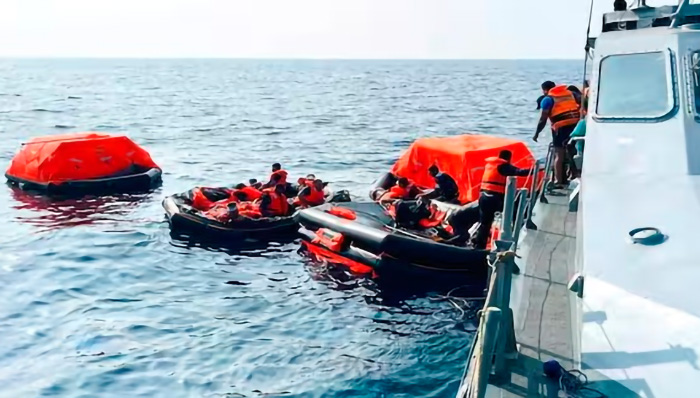
There has been a rare consensus of opinion in the country that the government’s humanitarian response to the sinking of Iran’s naval ship IRIS Dena was the correct one. The support has spanned the party political spectrum and different sections of society. Social media commentary, statements by political parties and discussion in mainstream media have all largely taken the position that Sri Lanka acted in accordance with humanitarian principles and international law. In a period when public debate in Sri Lanka is often sharply divided, the sense of agreement on this issue is noteworthy and reflects positively on the ethos and culture of a society that cares for those in distress. A similar phenomenon was to be witnessed in the rallying of people of all ethnicities and backgrounds to help those affected by the Ditwah Cyclone in December last year.
The events that led to this situation unfolded with dramatic speed. In the early hours before sunrise the Dina made a distress call. The ship was one of three Iranian naval vessels that had taken part in a naval gathering organised by India in which more than 70 countries had participated, including Sri Lanka. Naval gatherings of this nature are intended to foster professional exchange, confidence building and goodwill between navies. They are also governed by strict protocols regarding armaments and conduct.
When the exhibition ended open war between the United States and Iran had not yet broken out. The three Iranian ships that participated in the exhibition left the Indian port and headed into international waters on their journey back home. Under the protocol governing such gatherings ships may not be equipped with offensive armaments. This left them particularly vulnerable once the regional situation changed dramatically, though the US Indo-Pacific Command insists the ship was armed. The sudden outbreak of war between the United States and Iran would have alerted the Iranian ships that they were sailing into danger. According to reports, they sought safe harbour and requested docking in Sri Lanka’s ports but before the Sri Lankan government could respond the Dena was fatally hit by a torpedo.
International Law
The sinking of the Dena occurred just outside Sri Lanka’s territorial waters. Whatever decision the Sri Lankan government made at this time was bound to be fraught with consequence. The war that is currently being fought in the Middle East is a no-holds-barred one in which more than 15 countries have come under attack. Now the sinking of the Dena so close to Sri Lanka’s maritime boundary has meant that the war has come to the very shores of the country. In times of war emotions run high on all sides and perceptions of friend and enemy can easily become distorted. Parties involved in the conflict tend to gravitate to the position that “those who are not with us are against us.” Such a mindset leaves little room for neutrality or humanitarian discretion.
In such situations countries that are not directly involved in the conflict may wish to remain outside it by avoiding engagement. Foreign Minister Vijitha Herath informed the international media that Sri Lanka’s response to the present crisis was rooted in humanitarian principles, international law and the United Nations. The Convention on the Law of the Sea (UNCLOS) which was adopted 1982 provides the legal framework governing maritime conduct and obliges states to render assistance to persons in distress at sea. In terms of UNCLOS, countries are required to render help to anyone facing danger in maritime waters regardless of nationality or the circumstances that led to the emergency. Sri Lanka’s response to the distress call therefore reflects both humanitarianism and adherence to international law.
Within a short period of receiving the distress message from the stricken Iranian warship the Sri Lankan government sent its navy to the rescue. They rescued more than thirty Iranian sailors who had survived the attack and were struggling in the water. The rescue operation also brought to Sri Lanka the bodies of those who had perished when their ship sank. The scale of the humanitarian challenge is significant. Sri Lanka now has custody of more than eighty bodies of sailors who lost their lives in the sinking of the Dena. In addition, a second Iranian naval ship IRINS Bushehr with more than two hundred sailors has come under Sri Lanka’s protection. The government therefore finds itself responsible for survivors but also for the dignified treatment of the bodies of the dead Iranian sailors.
Sri Lanka’s decision to render aid based on humanitarian principles, not political allegiance, reinforces the importance of a rules-based international order for all countries. Reliance on international law is particularly important for small countries like Sri Lanka that lack the power to defend themselves against larger actors. For such countries a rules-based international order provides at least a measure of protection by ensuring that all states operate within a framework of agreed norms. Sri Lanka itself has played a notable role in promoting such norms. In 1971 the United Nations General Assembly adopted a resolution declaring the Indian Ocean a Zone of Peace. The initiative for this proposal came from Sri Lanka, which argued that the Indian Ocean should be protected from great power rivalry and militarisation.
Moral Beacon
Unfortunately, the current global climate suggests that the rules-based order is barely operative. Conflicts in different parts of the world have increasingly shown disregard for the norms and institutions that were created in the aftermath of the Second World War to regulate international behaviour. In such circumstances it becomes even more important for smaller countries to demonstrate their commitment to international law and to convert the bigger countries to adopt more humane and universal thinking. The humanitarian response to the Iranian sailors therefore needs to be seen in this wider context. By acting swiftly to rescue those in distress and by affirming that its actions are guided by international law, Sri Lanka has enhanced its reputation as a small country that values peace, humane values, cooperation and the rule of law. It would be a relief to the Sri Lankan government that earlier communications that the US government was urging Sri Lanka not to repatriate the Iranian sailors has been modified to the US publicly acknowledging the applicability of international law to what Sri Lanka does.
The country’s own experience of internal conflict has shaped public consciousness in important ways. Sri Lanka endured a violent internal war that lasted nearly three decades. During that period questions relating to the treatment of combatants, the protection of civilians, missing persons and accountability became central issues. As a result, Sri Lankans today are familiar with the provisions of international law that deal with war crimes, the treatment of wounded or disabled combatants and the fate of those who go missing in conflict. The country continues to host an international presence in the form of UN agencies and the ICRC that work with the government on humanitarian and post conflict issues. The government needs to apply the same principled commitment of humanitarianism and the rule of law to the unresolved issues from Sri Lanka’s own civil war, including accountability and reconciliation.
By affirming humanitarian principles and acting accordingly towards the Iranian sailors and their ship Sri Lanka has become a moral beacon for peace and goodwill in a world that often appears to be moving in the opposite direction. At a time when geopolitical rivalries are intensifying and humanitarian norms are frequently ignored, such actions carry symbolic significance. The credibility of Sri Lanka’s moral stance abroad will be further enhanced by its ability to uphold similar principles at home. Sri Lanka continues to grapple with unresolved issues arising from its own internal conflict including questions of accountability, justice, reparations and reconciliation. It has a duty not only to its own citizens, but also to suffering humanity everywhere. Addressing its own internal issues sincerely will strengthen Sri Lanka’s moral standing in the international community and help it to be a force for a new and better world.
BY Jehan Perera

EU-approved sterile pharma facility launched

Prime Minister Holds Bilateral Meetings with ADB Leadership and Participates in education policy dialogue in Manila

Nahid Rana and Tanzid Hasan complete Pakistan’s demolition in opening ODI

Prime Minister highlights the importance of recognising Women’s Unpaid Care Work

Australia grants asylum to 2 more members of Iranian women’s football team

Showers are likely in the Northern, Eastern, Sabaragamuwa, Southern and Uva provinces and in Kandy and Nuwara-Eliya districts

‘Dates have the highest sugar content to fight Coronavirus’

Sunday Island 27 December – Headlines

#SundayIsland 17th December – Headlines

Sunday Island – 28th March

Sunday Island Headlines – 21 March

Sunday Island – 21st February – Headlines
-

 News6 days ago
University of Wolverhampton confirms Ranil was officially invited
-

 News7 days ago
Legal experts decry move to demolish STC dining hall
-

 News5 days ago
Peradeniya Uni issues alert over leopards in its premises
-

 News6 days ago
Female lawyer given 12 years RI for preparing forged deeds for Borella land
-

 News3 days ago
Repatriation of Iranian naval personnel Sri Lanka’s call: Washington
-

 News6 days ago
Library crisis hits Pera university
-

 News5 days ago
Wife raises alarm over Sallay’s detention under PTA
-

 News6 days ago
‘IRIS Dena was Indian Navy guest, hit without warning’, Iran warns US of bitter regret