
News
Two private member’s Bills presented to amend two tax laws to bring about parliament oversight

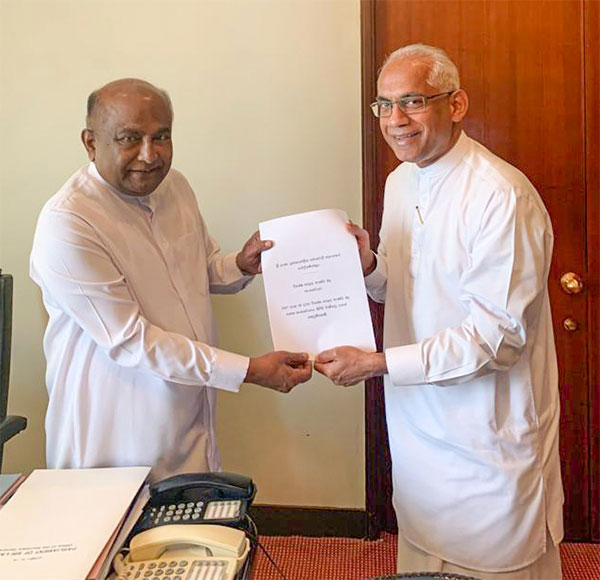
SJB MP Eran Wickramaratne yesterday (08) tabled two private member’s Bills to amend both the Value Added Tax Act No. 14 of 2002 (as amended) and the Special Commodity Levy Act No. 48 of 2007.
The following is the text of a statement issued by the former State Finance Minister: “These two amendments seek to facilitate parliamentary control over public finance as constitutionality required, and prevent the executive (Minister) from abusing statutory powers, including by (corruptly) granting benefits to a chosen few.
As the people of Sri Lanka are calling for more accountability and transparency with regard to public finances in the country, I have brought these two amendments to ensure parliamentary control on any changes to Value Added Tax (VAT) and to the Special Commodities Levy.
Sri Lanka’s parliament is constitutionally supposed to have full control over public finances (article 148).
However, there is currently tax legislation that actually violates this imperative provision, and instead gives discretion to the minister on: (i) tax exemptions, (ii) tax base, and (iii) tax rate. This type of discretion is seen in two key tax acts, the Value Added Tax Act No. 14 of 2002 (as amended) and the Special Commodity Levy Act No. 48 of 2007.
In both pieces of legislation, the minister has complete discretion to change taxation and simply announce it through a gazette notification. The decision to change taxation comes into effect immediately on the Minister’s signature and will only later be approved by Parliament. Even if it is not approved, whatever actions by the minister (e.g. reducing VAT or SCL) through the Order cannot be reversed by parliament but only discontinued. This leaves an extraordinary amount of power in the minister’s hands and leaves room for the tax system to be abused in favour of vested interests and potential corrupt activities.
The well-known sugar scam from 2020 is an example of the impacts of leaving the discretionary power with the minister. Prior to October 2020, sugar taxes were LKR 50 per kilo of sugar, and were drastically reduced to 25cents per kg. This is a reduction of 99.5% taxes on imported sugar. The gap between the cost to the importer and the market price has increased substantially after the tax reduction. According to the National Audit Office of Sri Lanka, between October 2020 and February 2021 we have cumulatively lost LKR 16 billion in potential tax revenue. PublicFinance.lk has noted that the benefit of the tax reduction was not passed on to the consumer and importantly that Sri Lanka has lost approximately LKR 59 billion in cumulative revenue from October 2020 until December 2022 by cutting the SCL on sugar imports.
The discretionary power of the minister to make ad hoc changes to taxation can also have serious impact on the country’s economy. At a time when the country is facing a severe economic crisis, and when there are calls from the people to have more transparency and accountability of our public finances, it is imperative that parliament retains full control over public finance as mandated by Article 148 of the Constitution.
Therefore, I have submitted these two amendments to amend the VAT and SCL to promote fiscal accountability and ensure that decisions on taxation are transparent and are discussed in the public domain.
The government in 2022 tried to bring a new tax called the Special Goods and Services Tax (GST) Bill, which gave the minister similar powers to that which presently exists in the VAT and SCL framework. However, the Supreme Court in very strong terms held the Bill to be unconstitutional and even violated the sovereignty of the People. The Court held: Thus, by empowering the Minister in the manner provided in clauses 2 and 3, the Parliament distinctively and manifestly loses control over public finance and unconstitutionally alienates such power to the Minister. In the circumstances, this Court holds that clauses 2, 3 and 4 individually and collectively amount to an infringement of Article 148 of the Constitution read with Article 76, and by virtue of such infringement violates Article 4 read with Article 3 of the Constitution.
The proposed amendments will bring the relevant portion of the VAT and SCL laws in conformity with the constitutional framework, as recognised by the Supreme Court in the Special GST Bill Determination.”








The National Water Supply and Drainage Board (NWSDB) on Friday said the largest groundwater source discovered in Sri Lanka so far had been identified during tube-well drilling near the Pitabeddara Police Station.
Indrajith Gamage, geologist in charge of the Southern Province, said the source recorded a continuous flow of about 10,000 litres (10 cubic metres) per minute, marking the first instance in the country where a groundwater source of that magnitude had been found.
He noted that the previous largest groundwater source was discovered in the Madhu area, which recorded a flow of about 7,000 litres per minute.
According to the NWSDB, the tube well was drilled following geological studies of rock layers and the identification of underground water through fractures in rock strata using specialised technical instruments.
The Board said steps would be taken to distribute water from the newly discovered source to residents facing shortages in Pitabeddara, Morawaka and surrounding areas.

The Ceylon Chamber of Commerce has formally handed over its historical records to the National Archives Department, entrusting over a century of the nation’s commercial history to the country’s official custodians of heritage.
The archive, spanning from the CCC’s founding in 1839 to 1973, includes correspondence, meeting minutes, reports, ledgers, and publications that chronicle the development of trade, enterprise, and industry in Sri Lanka. Together, the records provide a rare and detailed account of the island’s economic evolution and the role of its business community in shaping national progress.

The Ministry of Defence said on Friday (13) that arrangements had been made to repatriate to Iran the bodies of 84 sailors who died aboard the IRIS Dena, which sank in the southern seas off Sri Lanka.
A special aircraft carrying the bodies departed from Mattala Rajapaksa International Airport on Friday, the Ministry said, adding that the repatriation was carried out in coordination with the Embassy of Iran in Sri Lanka.
The remains had been kept in two mobile cold-storage units at the Galle National Hospital before being transported to Mattala by lorry following a court order. Forty-five bodies were moved in the morning, while the remaining 39 were transported later in the day.
Earlier this month, the Iranian naval vessel suffered an incident about 40 nautical miles off Port of Galle while carrying around 180 personnel. Thirty-five rescued sailors were admitted to the Karapitiya Teaching Hospital, while 84 bodies were subsequently recovered.
Following the incident, Pete Hegseth confirmed that the Iranian vessel had been sunk in international waters by a torpedo fired from a submarine of the United States Navy.
Showers will occur at several places in the Western, Sabaragamuwa, Central, North-western and Uva provinces and in Galle, Matara, Mannar and Anuradhapura districts after 2.00 pm.

Lanka discovers largest groundwater source

Lanka’s commercial legacy preserved in National Archives

Bodies of 84 Iranian sailors flown home

Kirsten brings pedigree, but Sri Lanka must fix the system

Barrels vs bombs

‘Dates have the highest sugar content to fight Coronavirus’

Sunday Island 27 December – Headlines

#SundayIsland 17th December – Headlines

Sunday Island – 28th March

Sunday Island Headlines – 21 March

Sunday Island – 21st February – Headlines
-

 News6 days ago
Repatriation of Iranian naval personnel Sri Lanka’s call: Washington
-
 Features6 days ago
Winds of Change:Geopolitics at the crossroads of South and Southeast Asia
-

 News5 days ago
Prof. Dunusinghe warns Lanka at serious risk due to ME war
-

 Sports4 days ago
Royal start favourites in historic Battle of the Blues
-

 Sports3 days ago
The 147th Royal–Thomian and 175 Years of the School by the Sea
-

 News3 days ago
Historic address by BASL President at the Supreme Court of India
-

 News4 days ago
CEBEU warns of operational disruptions amid uncertainty over CEB restructuring
-

 Business4 days ago
BOI launches ‘Invest in Sri Lanka’ forum